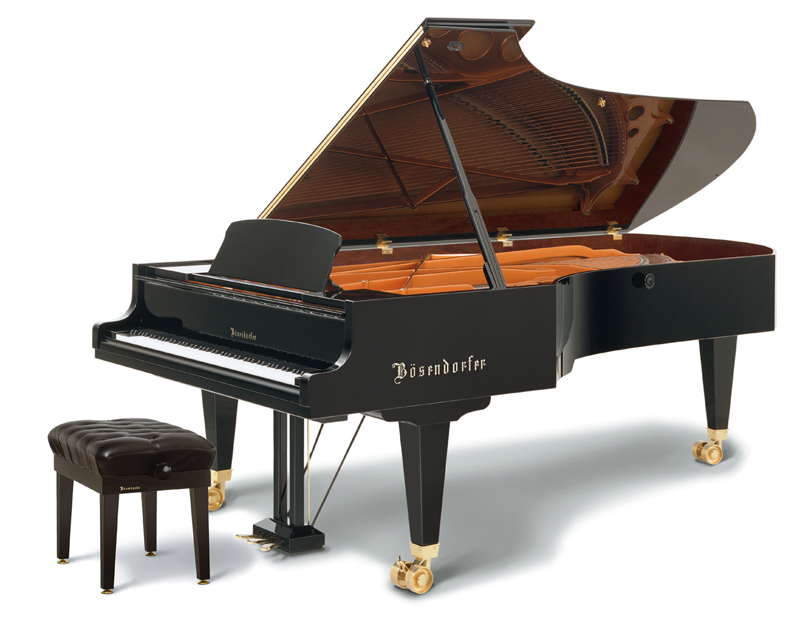
 A little late to the story, but this was news that came up just before I resumed blogging at the end of last year. Yamaha acquired the prestigious Austrian piano manufacturer Boesendorfer (Bösendorfer). It had come down to a contest with Brodmann — Austrian in name only, a Chinese company at heart (a 100% China-made piano manufacturer) — and in the end Yamaha was chosen.
———————————————————–
Yamaha Acquires World-Renowned Piano Company Bösendorfer
20 December 2007, 23:46A contract was signed on the 20th for the sale of all shares in Bösendorfer, the world-renowned Austrian luxury piano manufacturer, to Yamaha (Hamamatsu). The announcement was made by the local bank that held the shares. The sale price has not been disclosed, but according to local reports it stands at 14 million euros (approximately 2.3 billion yen). Yamaha intends to deepen its presence in the luxury piano market through the acquisition of this prestigious brand.
Bösendorfer was founded in 1828. Counted alongside America’s Steinway and Germany’s Bechstein as one of the world’s three great piano makers, it was cherished by composers including Liszt. Annual production stands at just over 300 instruments. The average price per piano is 60,000 euros (approximately 10 million yen), yet the brand enjoys enduring popularity in Japan as well.
The company passed into American hands for a time, but was bought back in 2002 by an Austrian banking group and is currently under the umbrella of the major US investment fund Cerberus Capital Management. In recent years sales volumes have declined, accumulated losses have risen to nearly 8 million euros (approximately 1.3 billion yen), and the company has continued to face financial difficulties.
The acquisition came down to a contest with Brodmann, a local piano manufacturer established approximately three years ago by former Bösendorfer sales executives who had struck out on their own, but Yamaha presented favourable terms, including a commitment to maintain the Austrian factory and preserve the brand.
In an interview with Nikkei on the 21st, Yamaha President Mitsuru Umemura outlined his plans for the Bösendorfer acquisition, saying he hoped “to achieve a single-year profit within four years and recover the accumulated losses over ten years or more.” He identified the American market as particularly promising and spoke of the company’s future strategy: “We aim to combine Bösendorfer pianos with Yamaha’s player piano technology, targeting a launch in two years.”
———————————————————–
In Japan, the word “acquisition” carries negative connotations, and the fact that it was Yamaha — for better or worse — has prompted a certain anxiety, even outright hostility, from voices both at home and abroad. A Yomiuri Shimbun article dated 17 January noted that Austrian conductor Nikolaus Harnoncourt and Vienna-based pianist (born in Czechia) Rudolf Buchbinder had each come out against the Yamaha acquisition, but speaking as pastel_piano, I would like to take a deliberately positive view of things here.


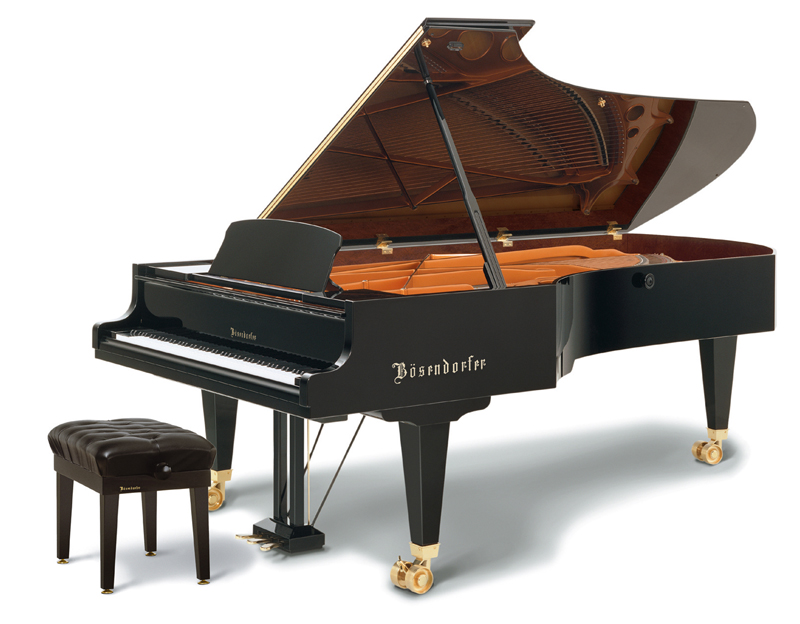
First of all, it is far better than being acquired by Brodmann, a Chinese manufacturer with commercial ambitions written all over it. Had the decision gone their way, it would only have been a matter of time before cheaply mass-produced Chinese pianos bearing the Bösendorfer name in name alone swept the world — and I mean that quite literally. In the matter of the share transfer, I would imagine that even setting aside the acquisition price, it was judged that Yamaha — being Japanese — understands and respects the soul of Vienna, the tradition and identity of Bösendorfer, more than Brodmann with its Chinese backing. That must have counted for something.
Among Japanese pianists who favour Bösendorfer, the one I love most is Yukino Fujiwara. Her interpretations are outstanding, and her Chopin études in particular are extraordinary in terms of sound as well.
Then there is the fact that Yamaha has committed to maintaining local production arrangements and employment as before, and has stated clearly its intention to preserve the sound of Vienna and its traditional culture. Now that Bösendorfer has come under Yamaha’s ownership, it would be most unwelcome if they were to start interfering in the actual craft of piano making — but I rather think the sensible people inside Yamaha would not do such a thing. To be frank, the accumulated deficit cannot be resolved by simply continuing with traditional manufacturing methods, and equally, there is no room to push the per-unit price any higher than it already is (it is already quite breathtakingly high as it stands). That said, to alter the traditional manufacturing process even slightly would mean, in almost every case, a fatal decline in quality, and doing so would draw hostile looks from musicians and music lovers the world over and leave a permanent stain on the Yamaha brand itself. I sincerely hope that no misguided Japanese person who fails to grasp this basic point becomes involved in the project.


 ポチップ
ポチップ
Among the world-class pianists particularly well known for playing Bösendorfer in classical music, the one I feel closest to personally is András Schiff. His more recent ECM recordings in particular are a reference point, sound quality included. And from an earlier era, Wilhelm Backhaus. His complete Beethoven piano sonatas have been a cherished listen since my student days. Others worth mentioning are the Austrians Paul Badura-Skoda, Jörg Demus, and Friedrich Gulda. Though with Gulda, who is of course well known, the tone feels more like Gulda himself than natural Bösendorfer, if I am honest. In jazz, Oscar Peterson is known as a Bösendorfer player.
Possibility 1. The way I see it, Yamaha has essentially paid 2.5 billion yen for Bösendorfer as a brand with advertising value, and will probably be willing to turn a blind eye to some degree to the structural manufacturing losses that come with maintaining that brand. Between a small piano maker producing 300 instruments a year entirely by hand with 180 employees, and Yamaha — the world’s largest musical instrument manufacturer (and a comprehensive electronics company besides), producing 100,000 pianos a year with 5,000 employees (or 20,000 on a consolidated basis) — the difference in scale is simply too great for Bösendorfer’s individual profit or loss to amount to more than a rounding error for Yamaha. Even if they aim for profitability, I would expect them to pursue it not by changing the pianos themselves but by adding sales options beyond the instrument alone, revamping sales methods, or working towards profitability through a tie-up with Yamaha’s worldwide sales network. There has already been talk of fitting Bösendorfer with Yamaha’s player piano function as a first step — but this presumably means adapting Yamaha’s existing player mechanism to work with Bösendorfer, rather than changing the piano itself in any fundamental way, so if you dislike the action you can simply remove it, and there should be relatively few negative implications.
 ポチップ
ポチップ
Possibility 2. Bösendorfer pianos may come to be placed in Yamaha music schools and showrooms across Japan and throughout Europe and America. At the very least, some of the larger flagship showrooms may end up displaying a Bösendorfer small grand piano or the luxurious upright “Model 130CL” — which boasts the finest mechanism in the world — as the showpiece instrument. Since Yamaha schools have until now dealt exclusively in Yamaha pianos, most pupils have known only the tone and touch of Yamaha or Kawai; so even the simple fact of children having opportunities to hear and try a Bösendorfer at recitals and the like would already represent a significant step forward.
Possibility 3. Some of Bösendorfer’s closely guarded piano-making know-how may find its way to Yamaha, and the sound quality of Yamaha grand pianos produced in future may improve as a result. I imagine Yamaha has already been taking apart Bösendorfers and Steinways to borrow ideas and running computer analyses for some time now, so perhaps it will not make as much difference as one might think — but even so, given the dexterity of the Japanese, there is a chance that through training exchanges and other forms of interchange they will identify elements applicable to Yamaha’s own instruments, and that this will ultimately lead to improvements in the tonal quality and manufacturing standards of Yamaha pianos.
Possibility 4. Much as Kawai manufactures the lower-priced Boston Piano as a second brand using American Steinway’s technology and designs, Yamaha could launch an affordable second brand designed by Bösendorfer and produced in Japan. Boston has its share of supporters and detractors, but when it first came out I was thrilled — as a poor man’s Steinway, I thought, this would at last liberate struggling students from having to use Yamaha. Whether a second Bösendorfer-designed brand would succeed in the same way remains uncertain, depending on component quality, the degree of Yamaha’s involvement, and how much Bösendorfer know-how can actually be applied to a new piano design within limited costs — but at the very least it would surely be preferable to mass production in China.
Possibility 5. Yamaha’s Clavinova has long led the field in electronic instruments, and digital pianos in particular — with multi-velocity-layer sampling technology that no other manufacturer can match, complex DSP driven by Yamaha’s own semiconductors, and amplifier and  speaker manufacturing expertise honed through Hi-Fi and studio equipment. Yet for all that, the sampling source for the Clavinova has always been limited to Yamaha’s own flagship, the Yamaha CFIIIS. Personally, I was always quietly dissatisfied — the CFIII(S) is fine enough as Piano 1, but how much better it would be if Piano 2 were sampled from a Steinway. Now that Bösendorfer has come under Yamaha’s umbrella, imagine what a selling point it would be if the Bösendorfer Imperial were to be added as a sampling source for the top-range Clavinova models. If that were ever to happen, as someone who has a deep love for playing on a digital piano, I would be absolutely beside myself with joy — and yes, I would definitely buy that Clavinova. ※Postscript: It happened.
CLP-675/CLP-775. The Clavinova I use at home features sampling sources from both the Yamaha CFX and the Bösendorfer Imperial.

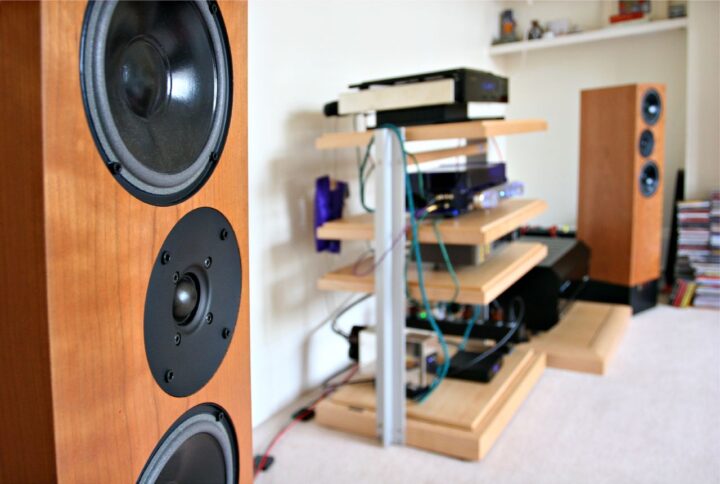
Possibility 6. In 2004 — in what can only be described as a moment of madness — Bösendorfer applied its woodworking and manufacturing expertise to enter the Hi-Fi market, releasing three tall-boy speaker models for the high-end segment, the “Boesendorfer VC-1/VC-2/VC-7”, using what the company called a horn resonator principle. That is still fairly fresh in the memory. ※Postscript: The high-end speakers that debuted under the Bösendorfer brand were subsequently taken over from 2005 onwards by Brodmann Acoustics and renamed Brodmann Vienna.
ポチップ
Hi-Fi is no less unprofitable an industry than piano making, so I find it hard to believe that venture did Bösendorfer any great good — but if they were going to do it at all, they might as well have partnered with Yamaha to produce lower-priced, more compact speakers, or perhaps amplifiers and SACD players under the Bösendorfer brand, and just as TEAC’s high-end line is ESOTERIC, perhaps Yamaha’s high-end audio could accommodate a Bösendorfer series… Of course, the sound direction would ideally be left to the Austrians.
 ポチップ
ポチップ
Well, that has been a good deal of personal speculation on my part, but on balance I am taking a positive view of things — it is better than mourning the bankruptcy of a piano manufacturer that is as good as a world cultural treasure. Setting aside the last possibility concerning Hi-Fi, I do think several of these scenarios will come to pass in time. I shall continue to watch developments with keen interest, hoping that Yamaha’s acquisition will work out well for the future of both brands.
Auto Translated by CS4.6