

 ポチップ
ポチップ
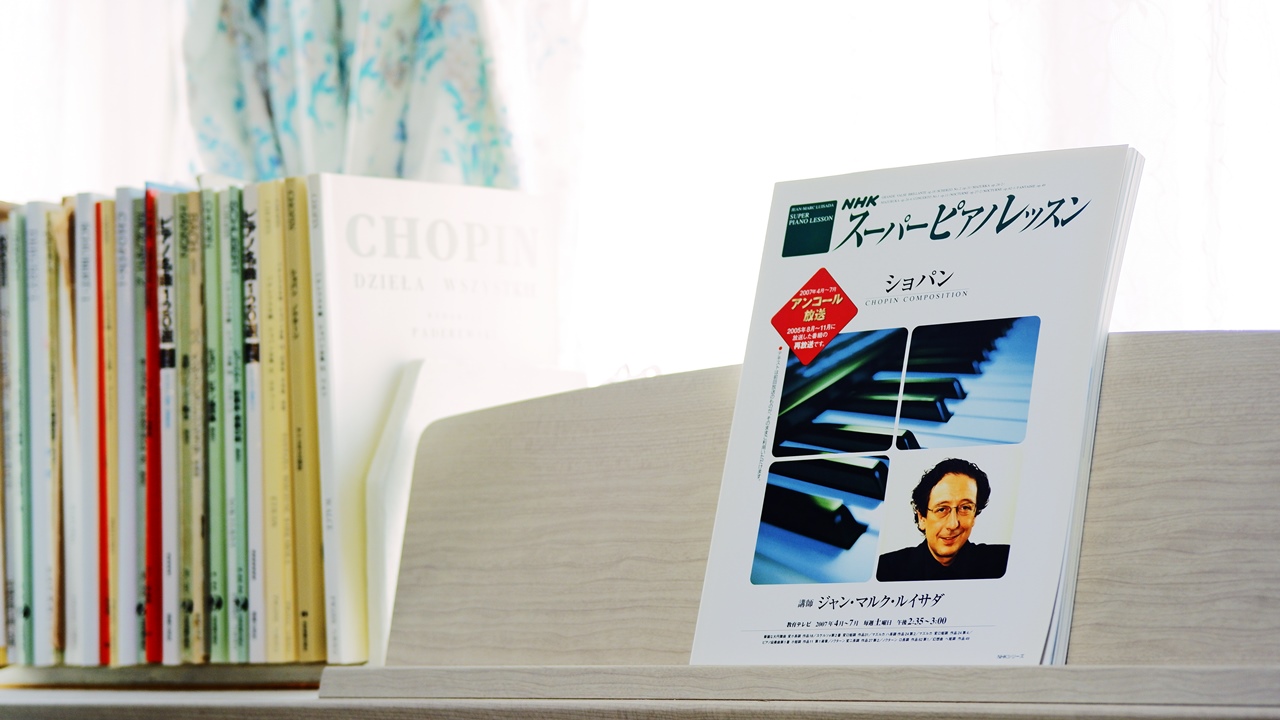
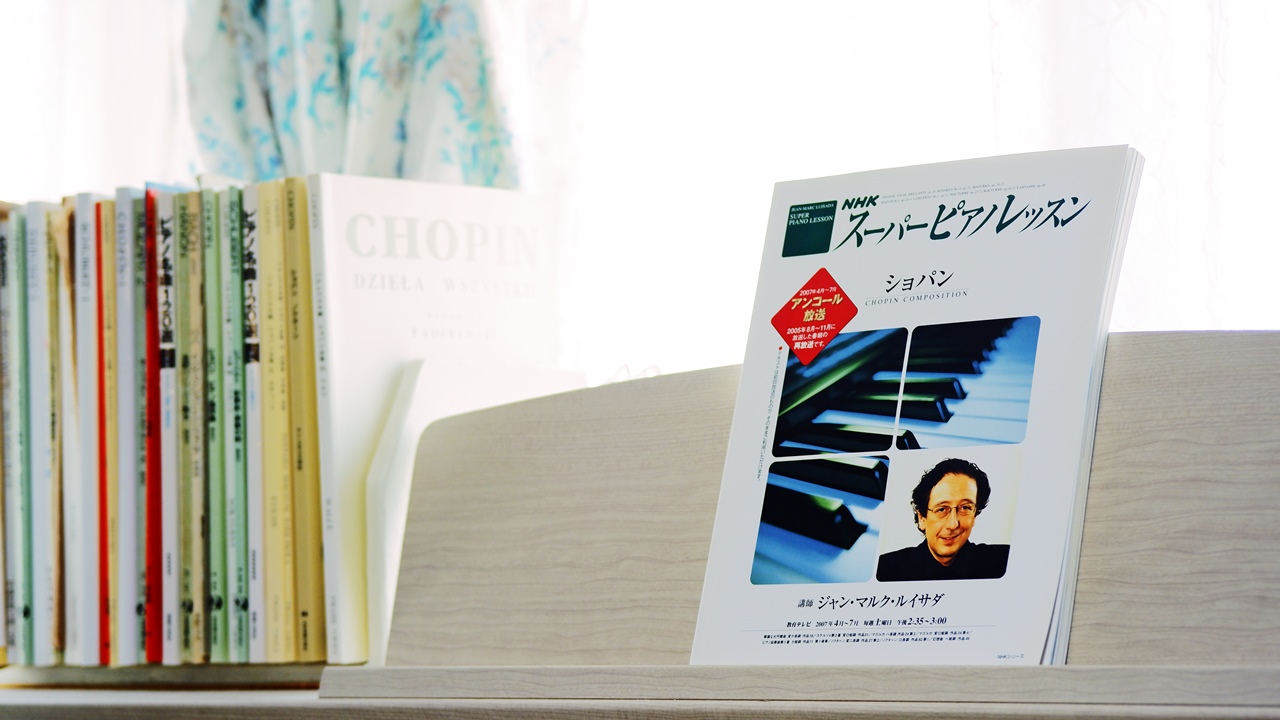
Luisada is now a very well-known and popular Chopin player, partly owing to his role as instructor on NHK Educational Television’s Super Piano Lessons a couple of years ago. One might think: Luisada — at this point? But since there are probably people who don’t know him well, I’ll set down my impressions of the Japan recital that was broadcast recently on NHK Hi-Vision and BS2. He placed fifth at the 11th International Chopin Piano Competition in Warsaw in 1985, and won the Critics’ Prize. Stanislav Bunin, who won that Chopin Competition, apparently once said that the only other talent he recognised was Luisada — that Luisada really deserved second place or something to that effect, or at least I seem to recall something along those lines (…a hazy memory from the past).
 ポチップ
ポチップ
This recital recording was made last November at Hitomi Memorial Hall, Showa Women’s University.
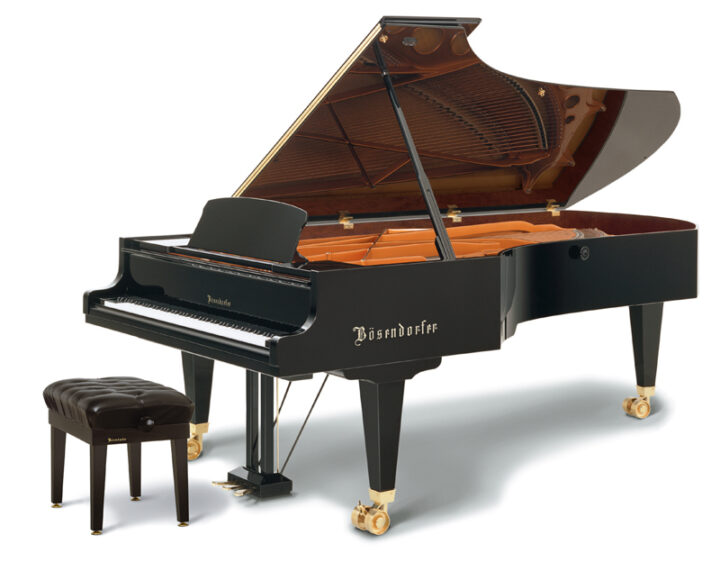
During this Japan visit he’s playing on a Yamaha CFIIIS, I see. Hmm (curious). Perhaps because Yamaha has been a sponsor since the Super Piano Lessons days? But never mind that — his playing is, as ever, thoroughly unique and eccentric.
I was expecting him to play Beethoven’s Piano Sonata No. 8, the “Pathétique,” but he launched straight into the middle of a Haydn piano sonata — (this opening performance was splendidly good) — and then, without a moment’s pause, as though continuing the same thought, into the first movement of the Pathétique. Elsewhere too, he seems to be the type who never allows any break between movements where applause would be unwelcome. His interpretation of the Pathétique is rather odd in various ways, but then, coming from someone like me who is not particularly fond of stiff, formal Beethoven playing, my reaction was rather “but that’s exactly what makes it good,” so while devout believers may faint or lose their minds, the real issue is the Chopin.
The interpretive thinking is remarkably elaborate — the meaning behind each touch, the differentiation of tone colour between fingers and pedal, all full of interesting ideas. The variety of touch is rich, and he plays in one unusual way after another, so there is never a dull moment watching him; yet technically speaking, there are far too many wrong notes. Mistakes upon mistakes, fingers that won’t move properly, chords that don’t line up, hammering away at fortes and muddying everything — one could spend a good hour asking how a teacher can go wrong quite so often. And then in Chopin’s Piano Sonata No. 3, he slips a note partway through the first movement and wanders into incoherence for a moment, only for a rather mysterious melody to emerge in the second movement — one can only wonder whether the score inside his head is a special transmission-from-beyond edition, personally delivered to his bedside by one of Chopin’s own pupils.
 ポチップ
ポチップ
He pushes the piano bench back as far as it will go, bends his arms at an odd angle as he faces the keyboard, and sweats profusely throughout — one moment producing phrases full of Chopinesque delicacy and nuance, and the next suddenly hammering the keys with exaggerated, deliberate shifts of dynamics. Watching him, one wants to say — rather than feeling pained — that surely 49% of that energy is not being converted into sound; and faced with this supremely individual and thoroughly irrational performance, I find myself unable to tell whether he wants to trip the listener up or jolt them awake, which probably means I still have a great deal to learn.
That said… the quiet passages are truly beautiful.
Setting aside the technical shortcomings for the moment, he is a remarkably rare presence in this day and age — someone in whom extraordinary musical talent and an extravagant stage manner (which does rather seem to court the audience, one cannot help feeling) are sublimated and fused into something unified. In a good sense, of course. If it were all surface performance, he would simply be a clown, but in Luisada’s case, despite possessing genuine musical sensibility and real substance, he insists on playing up to the audience on stage and performing these strange, sentimental flourishes — which is either surreal or endearing, and perhaps he is simply the type who is too good-natured, too eager to give, and ends up being led along by the audience. What a charming man he is. Perhaps, in order to encounter his genuine musicality unadorned — the spontaneous flash of intuition — what is needed is somewhere other than a large stage, somewhere more intimate and private. Or perhaps, one muses, listening to his  CDs, where the wrong notes have been edited out, might allow one to lose oneself in the music without being distracted by the visual oddities — or so I found myself musing.
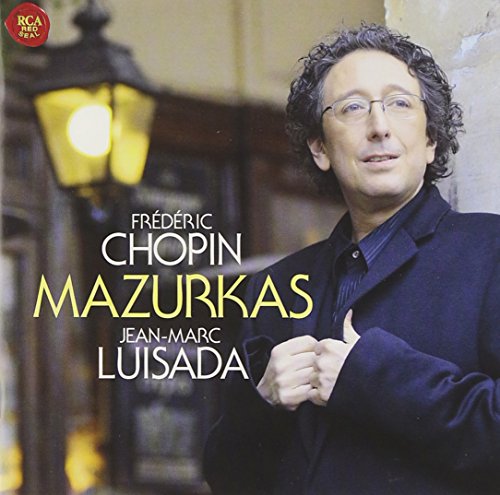
A collection of Mazurkas marking the 200th anniversary of Chopin’s birth — recorded at Karuizawa Oga Hall, a venue with personal significance for me
 ポチップ
ポチップ
Even so, the fact that a pianist like Luisada — with his sometimes score-unfaithful and highly individual interpretations, and his uneven (wildly variable in form) technique — is permitted to exist in this day and age is truly remarkable. Coming from me, who is a far worse pianist than he is, I feel that this is how a pianist ought to be — or even how one should be. But in the latter half of the twentieth century, the classical music world came to place technical accuracy first and foremost: the literal sequence of notes printed on the page and the logical construction of the music. The poetic, spiritual, and expressive reading between the lines — what the composer was truly expressing — was made secondary. The free, improvisatory spirit of nineteenth-century Romanticism, in which composers themselves were often technically imperfect and played their own works with spontaneous liberty, was condemned as a corrupt and degenerate tradition; and in its place, the distorted notion that playing logically faithful to the score constitutes service to the composer took hold in musical education with an almost religious authority. This is what passes for “orthodox” musical interpretation in the modern era.
Many young performers have fallen into a cult of technical supremacy; individuality has been lost from classical music, and expression has become uniformly rigid. Within that climate — driven by the many “technique” competitions that define and encourage the accepted mould, with musical artistry relegated to second place — piano playing has become something akin to a sporting contest using an instrument. That pianists like him continue to exist, even in small numbers, is genuinely precious; and conversely, the fact that audiences in twenty-first-century society are able to enjoy and appreciate, straightforwardly and without mere condescension and criticism, a pianist like him offering what is truly classical Chopin — this feels, looking back even a short time, like quite an extraordinary change. On the subject of these questions of musical interpretation, I would like to set down here the words Luisada himself spoke at the close of Super Piano Lessons.
 ポチップ
ポチップ
“This is what I think regarding today’s pianists. I feel reassured about the pianists of the twenty-first century who are coming. My own generation — the seventies and eighties — was preoccupied with a kind of intellectual aesthetic, and the atmosphere was rigid, measured against the interpretations of the great pianists of that era. But today there is a return to the playing of the golden age of the piano, and I find that heartening. Chopin apparently told his pupils not to practise more than three hours a day. I agree entirely. Of course, in today’s world — where technique demands more — one must practise a little longer. The world is busier and more stressful than in Chopin’s time. But I think pianists and violinists would do well to limit their practice to four or five hours a day at most. Use the remaining time to cultivate your broader education. Young people in the past were far more broadly educated. Theatre, literature, cinema — one should take an interest in every domain. That breadth of culture connects to fine performance. The nineteen-twenties and thirties were the golden age of piano and violin. Seek out the wonderful recordings of that era. For example… the great Russian pianist Genrikh Neygauz (Heinrich Neuhaus), Vladimir Sofronitsky, and Grigory Ginzburg are also excellent. These are the Chopin players I personally love.”
Names in parentheses follow the NHK subtitle spellings. Genrikh Neygauz was the grandfather of Stanislav Bunin.
Also recorded at Karuizawa Oga Hall — the distinctive acoustic of that venue captured in full SACD quality.
 ポチップ
ポチップ

Auto Translated by CS4.6

List of comments (2)
先日は失礼しました。
4月14日に杉並公会堂で、SD05と新作スピーカーのお披露目コンサートをやります。ぜひ、ぜひ。
PS
ピアノ弾かれるんですよね。ちょっとお願い事がありまして、メールいただけませんでしょうか。
メール投下しました~♪