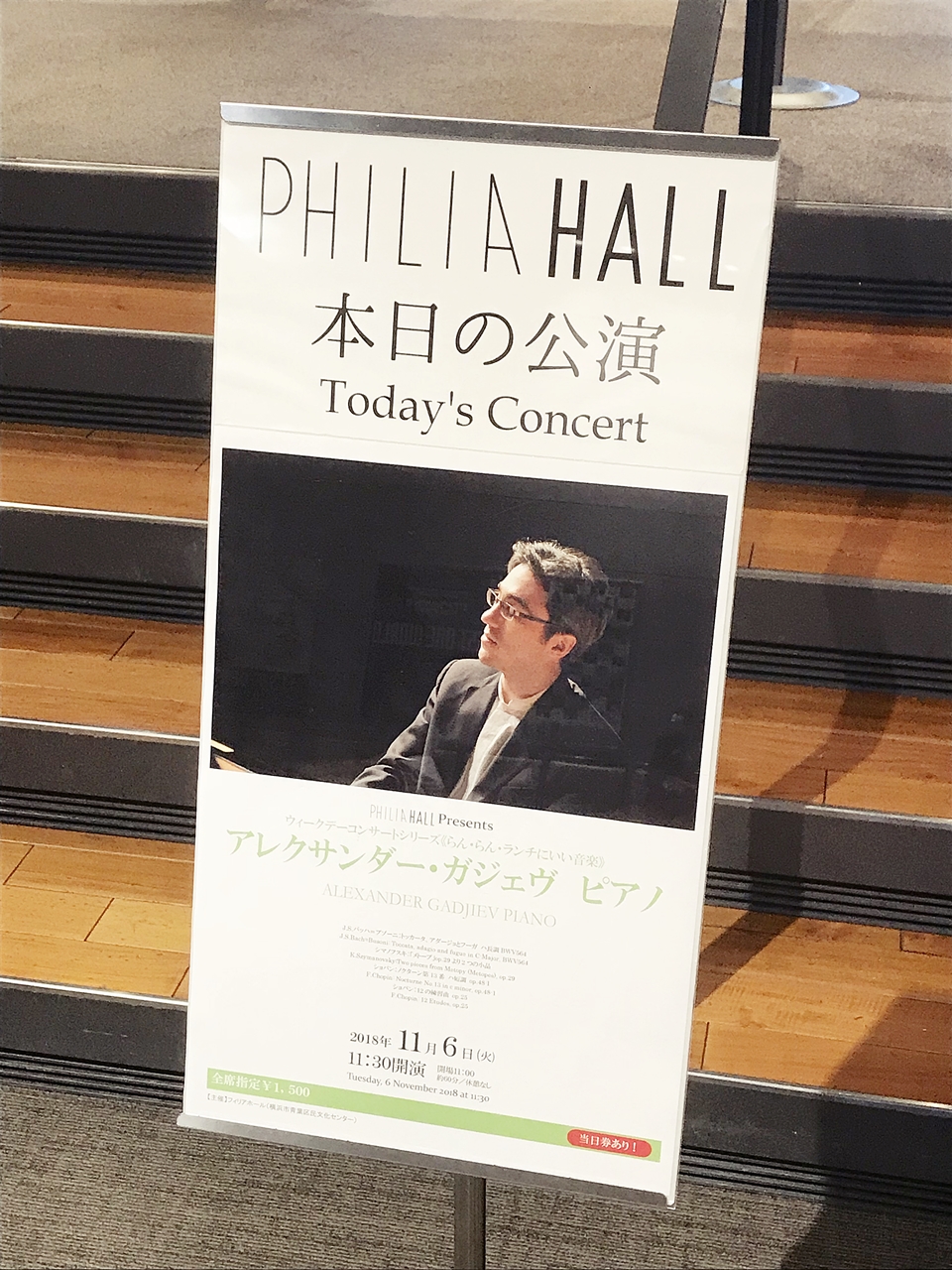
Alexander Gadjiev is a pianist who came to prominence by winning the 9th Hamamatsu International Piano Competition in 2015. Born in Italy in 1994, he is only 24 years old, yet his somewhat handsome appearance — silver hair and glasses — gives him a very grown-up, professorial air. The silver hair in particular makes him look considerably older than he is at first glance (though look carefully and you can tell he’s young). Come to think of it, given a name like his, I had initially assumed he was Russian, but it turns out he is Italian (of Slovenian descent).
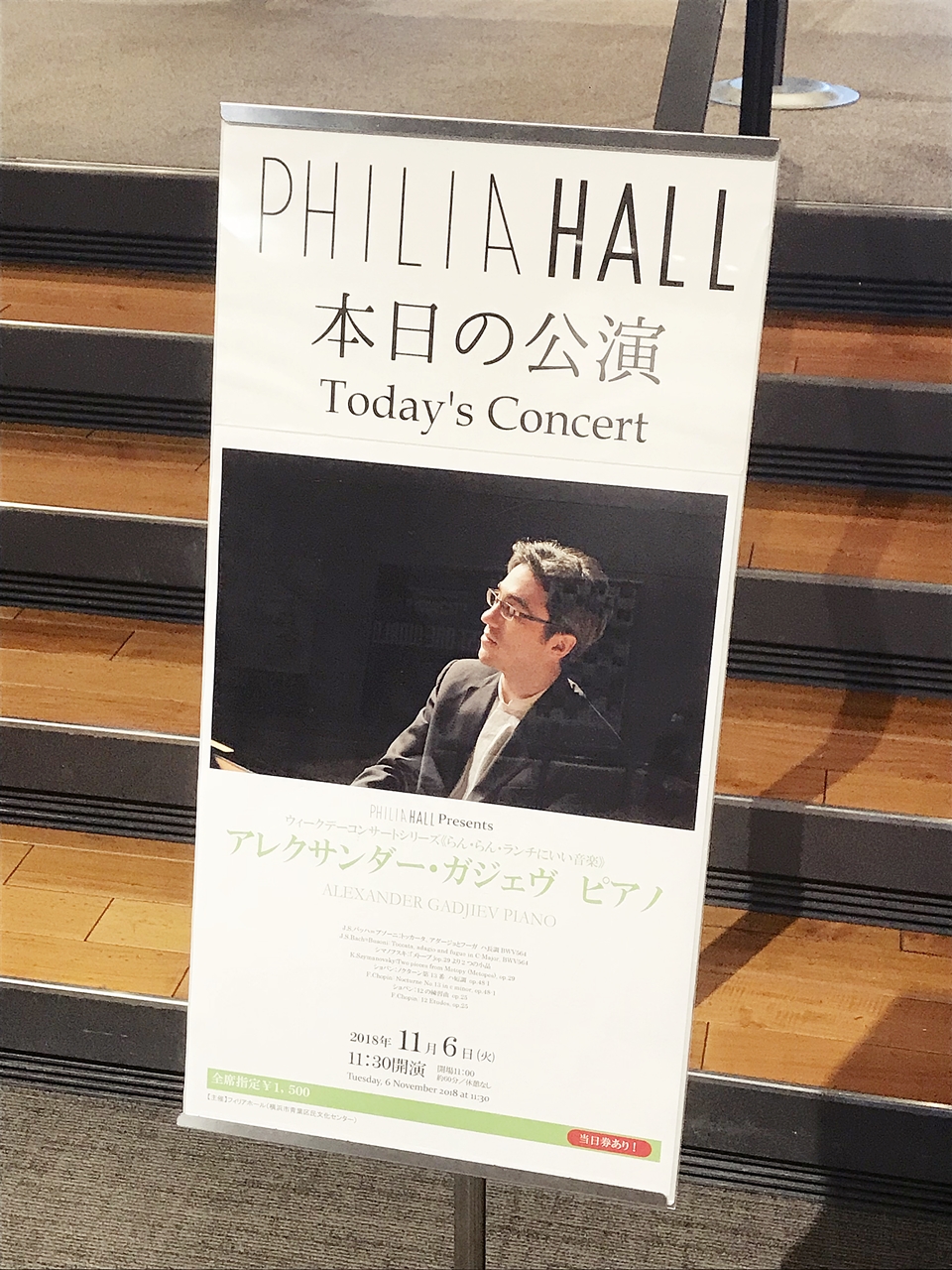
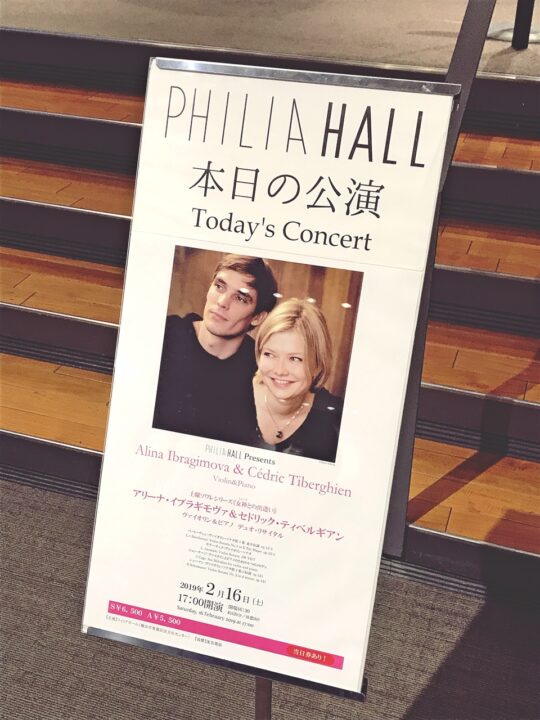
Today’s programme at Philia Hall in Yokohama opened with the Bach–Busoni arrangement of the Toccata, Adagio and Fugue, BWV 564, followed by two pieces from Szymanowski’s Métopes: The Island of the Sirens and Calypso. I had known the Busoni-arranged Toccata, Adagio and Fugue through Evgeny Kissin‘s recording, and this was quite a different interpretation — bright in tone with a fine sense of rhythm, yet not the sort of playing that insists on sharp contrasts at every turn; rather a soft, naturally flowing performance making generous use of the pedal. The build-up in the Fugue was overwhelming, though the tempo and manner of playing looked technically formidable. The Szymanowski Métopes were richly colourful — a shame I didn’t know the pieces well enough beforehand. The five Scriabin Preludes Op. 16 that had originally been scheduled were replaced by the well-known Chopin Nocturne No. 13, and the Nocturne too was a well-considered performance, with dynamics and contrasts working from restrained beginnings towards the latter half.
The highlight was Chopin’s Twelve Études Op. 25 — the fingers simply flew, on and on without end. Beginning with the Aeolian Harp, as loose and soft as one could wish, every single piece was at an extraordinarily high technical level, and yet the interpretive detail throughout was equally well thought through. And then there was the deeply introverted expressive quality of No. 7, and a beauty overflowing with romanticism that drew one in entirely. The Butterfly étude was light and soft to the last; the Winter Wind carried a driven, propulsive energy while never turning rough — cool, refined dynamism and conviction; and the Ocean étude was magnificent in the way its tone and dynamics moved from conscious restraint towards release. Not merely technically brilliant, but supported by a firm rhythmic sense, musically expressive throughout, and the interpretation from the most delicate pianissimo to a powerful fortissimo was worked through with intellectual care down to the last detail — it was a fresh and endlessly engaging Op. 25 that held my attention to the very end.
Across the whole programme, every piece shared the same quality — a relaxed, loosened tone, painted out like a refined and luminous watercolour. Taken on its own terms, this might put him in the category of a pianist like Marc-André Hamelin — fingers so loosened up that one might wonder whether the core of the music is being reached, whether perhaps the fingers run just a little too freely. But with Gadjiev, the difference is that alongside his inward expressiveness, there is a natural, innate rhythmic sense that seizes the heart of the sound, and it is this that brings moments of genuine substance to the performance at just the right points — which is why it does not remain merely a smooth, softly outlined flow of notes, and that is where I find his particular appeal.


 ポチップ
ポチップ
At present, Alexander Gadjiev has released only one solo album, coupling Liszt’s Petrarch Sonnets with Schumann’s Kreisleriana. A young pianist of this calibre occupies a somewhat uncertain position in today’s world, competition results and all; and yet his technical level is already one that simply cannot be imitated, and I must confess I was quite taken aback to find that the Chopin études played by the current competition-circuit generation of young pianists had reached quite this extraordinary a standard.
 ポチップ
ポチップ
Speaking of the Hamamatsu International Piano Competition — there is of course Riku Onda’s novel The Bees and the Thunder, which won the Naoki Prize last year. The novel is apparently based on research from the 4th through to the 7th competitions, so it covers a generation slightly before Alexander Gadjiev, but anyone who loves the piano really ought to read it.
 ポチップ
ポチップ
The encore, incidentally, was No. 11 from Debussy’s Douze Études, “pour les arpèges composés.” I didn’t buy the CD at the venue as it was on the pricey side (I’m the sort of person who feels too self-conscious to queue for a signing session…). Listening to the sample tracks, I had honestly found the Kreisleriana rather too cleanly sophisticated for my taste and hadn’t quite connected with it — but listening again after getting home, the intention became clear and I found myself thinking: ah, yes. So here I am, adding it to my basket rather belatedly. If a recording of his Chopin études ever comes out with good sound, I would very much like to get hold of it.
 ポチップ
ポチップ


Auto Translated by CS4.6