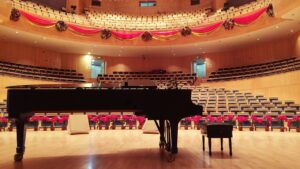
Flyers for a concert by Alexandra Soumm at the nearby Philia Hall had been arriving since last year, and I had a vague feeling — based largely on how she looked — that I’d quite like to go. Then, when the concert was nearly upon us and I checked the booking situation again, there were plenty of seats still available. As it happened, I’d been feeling rather better over the past few days, so I booked a seat three days before the performance, just slipping in in time.
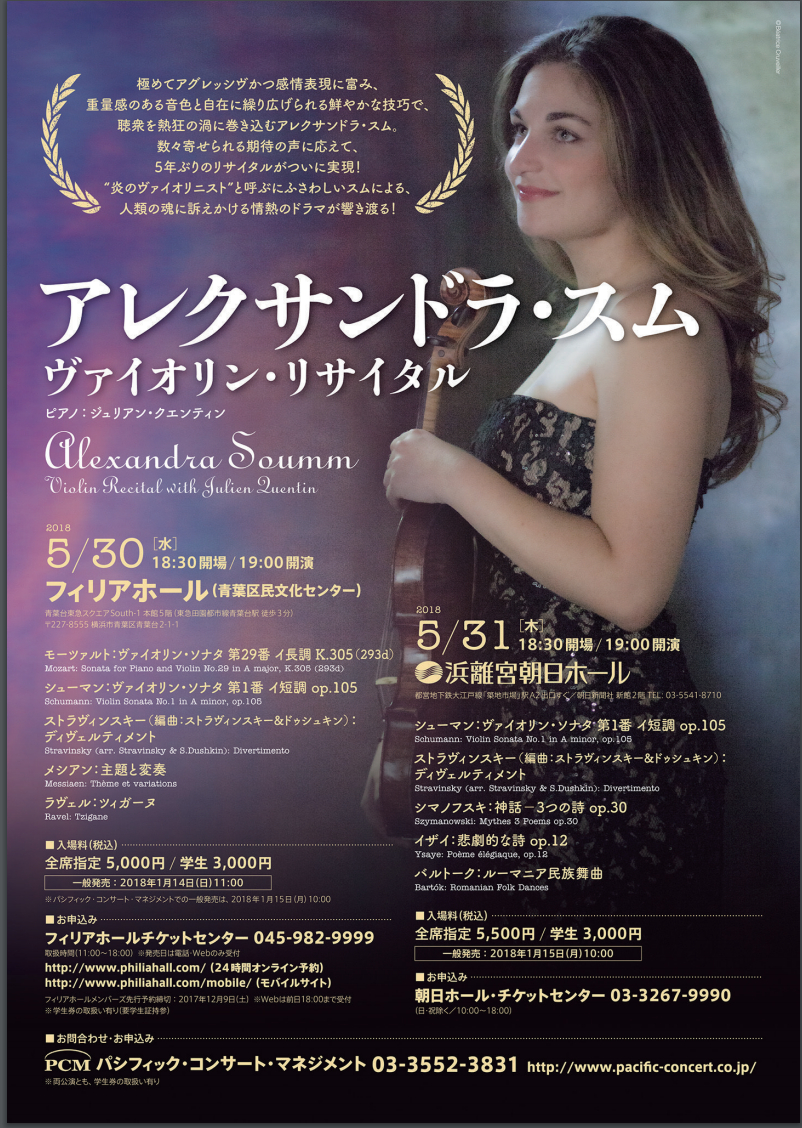
As it turned out, the day of the concert — 30 May — was unfortunately rainy. Alexandra Soumm is a young violinist I didn’t know very well, but looking her up, I found she was born in Moscow in 1989, making her a former Russian, aged twenty-nine. Born during the turbulent years of the Soviet collapse, she moved to France at the age of two when her parents, who were members of the Yuri Bashmet Chamber Orchestra, relocated there together with the ensemble. Her violin training was not in the Russian mainstream tradition; she studied mainly in Vienna and Paris. In person, her aura is less Russian than distinctly French, and she was, I must say, considerably more striking in the flesh than in photographs.


 ポチップ
ポチップ
I don’t yet own any of Alexandra Soumm’s CDs, but it seems she has so far released recordings of the Grieg violin sonatas and the Bruch and Paganini Violin Concerto No. 1. I checked the Grieg disc on Spotify and it sounded quite good, so I promptly ordered it from a marketplace seller on UK Amazon (¥470 plus postage). Then, browsing HMV&BOOKS online, I found the Bruch/Paganini concerto disc for a remarkable ¥800, so I snapped that up as well. Incidentally, both were also on sale at the hall on the day of the concert for a signing session — import editions at ¥2,800 each. I’ll add a note here once they arrive.
 ポチップ
ポチップ
The programme was, on the whole, rather connoisseur-oriented. The first half opened with Mozart’s Violin Sonata No. 29 in A major, K.305. Mozart’s violin sonatas are full of wonderful pieces, but this particular sonata has always made a rather faint impression on me — in short, the second movement in variation form in particular hasn’t really lodged itself in my memory, and that’s despite there being a piano solo passage in it. So my initial reaction was something along the lines of: of all things to play, it has to be this one. Next came Schumann’s Violin Sonata No. 1 — now that’s a piece I’m fond of. The first half still had something of an opening-half feel about it, but it was a remarkably serious and well-grounded performance all the same.
The second half began with Stravinsky’s Divertimento. Originally derived from the ballet The Fairy’s Kiss, Stravinsky arranged it — in addition to the orchestral suite version — for violin with the help of the violinist Samuel Dushkin. The work weaves in several well-known Tchaikovsky miniatures, including the Humoresque, moving back and forth between early modern and late Romantic melodies in a rather charming way. Despite having done careful preparatory listening over the preceding three days — working through Benjamin Beilman’s album Spectrum and a recording of Vadim Repin from an old NHK BS Classic Club broadcast — when the piece ended, I was so swept away by its power that I momentarily drifted off, and my applause got off to a late start.
 ポチップ
ポチップ
Next came Messiaen’s Thème et variations. Including the piano part, it’s a piece of very considerable performative effect. I hadn’t managed to locate a recording of it in my CD collection and so had done no preparation whatsoever. It seemed the rest of the audience were in a similar position — very few people in the hall appeared to be quite certain when the piece had ended (which rather says it all). The final work was Ravel’s famous Tzigane. From the very first note, there was a succession of sharp, taut sounds filled with an intensity that made one instinctively recoil. She may be young, but this was a Tzigane of extraordinary technical accomplishment — one felt a quite remarkable level of mastery throughout.
Personally, the highlight of the evening was the first encore: Kōsaku Yamada’s “Aka Tombo” (Red Dragonfly). Pianist Julien Quentin said, just before they played, in Japanese: “We love Japan very much” — so the moment people recognised what the piece was, the applause broke out even though they had already started playing. And yet the performance itself was truly of exceptional quality; a “Aka Tombo” this moving and this technically refined is something one very rarely gets to hear. I imagine they will almost certainly perform it again at Hamarikyu the following day, and I do rather envy those who will get to hear it in that acoustic. The second encore was Kreisler’s Schön Rosmarin — a relaxed, casual rendition that felt very much like an encore in the looser, bonus-piece sense of the word.
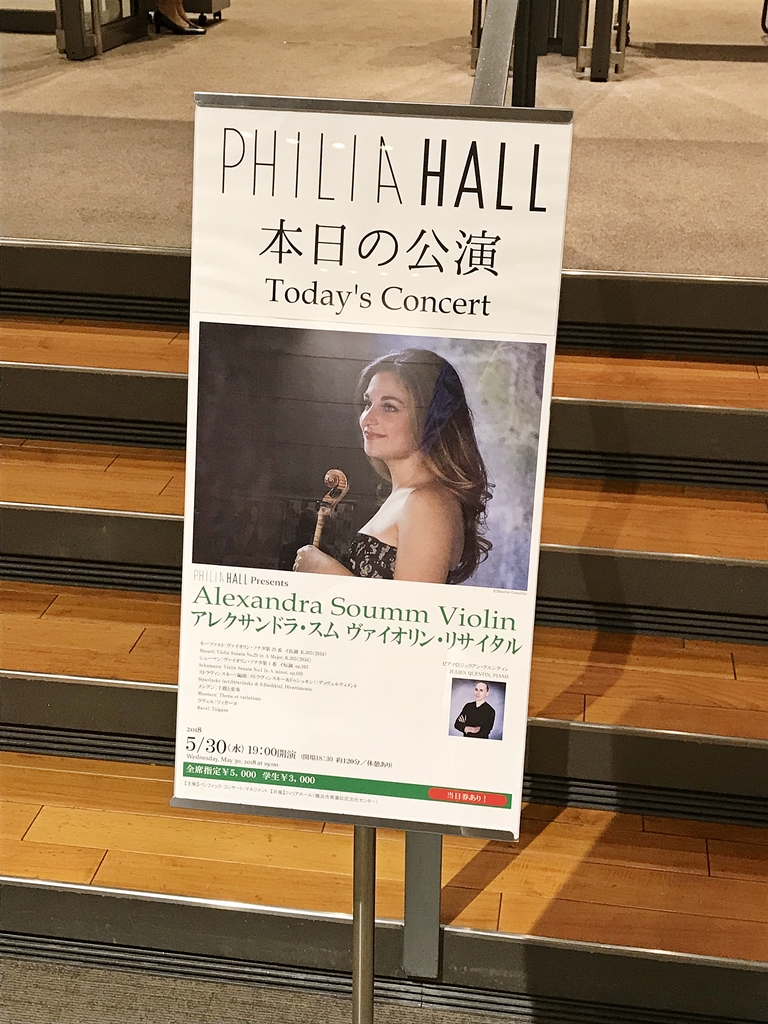
My overall impression of Alexandra Soumm on the night: built on a foundation of strong, precise technique and an accurate sense of intonation, she possesses an expressive range of great breadth and dynamism — from pianissimo to fortissimo — combined with a remarkable stability, and I came away feeling she is already a violinist of quite considerable potential. Whatever one might say about her age, the playing was unquestionably first-rate. If I were to press the point: the combination of Philia Hall’s acoustics, the particular timbre of her instrument, and the weather that day made the tone quality feel a little uncertain to my ears; and when I ask myself whether there was something in the overall programme — beyond “Aka Tombo” — that moved me deeply, what stays with me more is the technical solidity and excellence rather than any single moment of revelation. That, I suspect, may vary from day to day. But there was a palpable sense that when she truly finds her stride, she has the talent to deliver playing of dynamic, sweep-the-audience-off-their-feet intensity. The instrument she was using, incidentally, is said to be the “ex-Kavakos” Giovanni Battista Guadagnini of 1785.
The French pianist Julien Quentin — whose shaved head seems to be something of a trademark — was also astonishingly accomplished. His fingers move with quite remarkable agility, and his technique is frankly at a level that feels somewhat wasted in an accompanist role; and yet, viewed purely as a soloist, his personality is perhaps not so strongly individual — which may be precisely what makes him so effective in chamber and accompaniment settings.
On the day, there were more empty seats than I had expected — it felt as though fewer than half of the 500 seats were filled. Given that her profile in Japan is not yet particularly high, that is perhaps understandable, but with playing of such a high level, it does seem a shame. The following day’s concert is at Hamarikyu Asahi Hall, whose acoustics are even better than Philia Hall’s, so those going there have just a little cause to feel pleased with themselves.


Auto Translated by CS4.6
List of comments (2)
はじめまして。
今日、浜離宮朝日ホールでスム/クエンティンのリサイタルを聴きました。
ファリア・ホールの時と異なり、シューマン以外全て近現代の曲というプログラムでしたが、スムさんと近現代の曲との相性の良さを感じました。
私も、拙ブログに近々スムさんのリサイタルの記事を書こうと思っています。
アルトゥールさんこちらこそはじめまして。
記事が出来上がりましたらまた御連絡くださいませ。
お差し支えなければこちらの記事にリンクをさせたくださいd(^_-)