【QUAD L-ite2 British Small Speaker Review】
Prologue|Part 1|Part 2|Single-Wire|Bi-Wire|Reservations|Jumpers
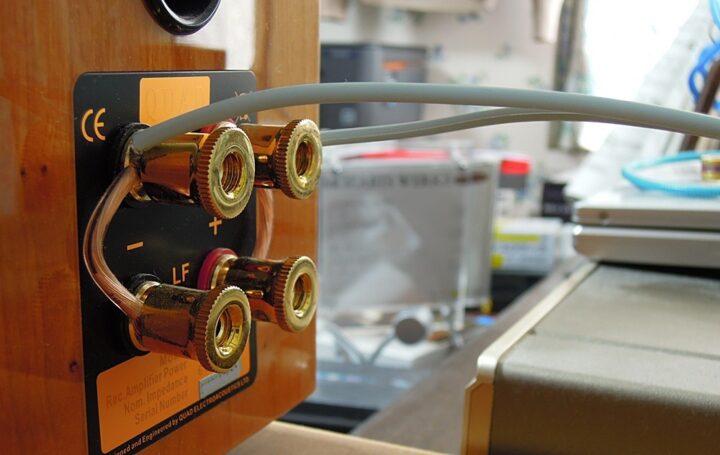
Despite its small size, the QUAD L-ite2 is generously equipped with the same proper bi-wiring speaker terminals found on the higher models. A speaker with bi-wiring terminals is, implicitly, the manufacturer recommending bi-wiring — that’s the message, folks. As mentioned in the previous review, for the initial impressions I connected the Supra entry-level speaker cable CLASSIC 2.5H in single-wire to the woofer terminals — and with sound quality as a secondary concern, using banana plugs at that. For the tweeter, I left the large metal shorting bar — the included jumper plate — in place as supplied.
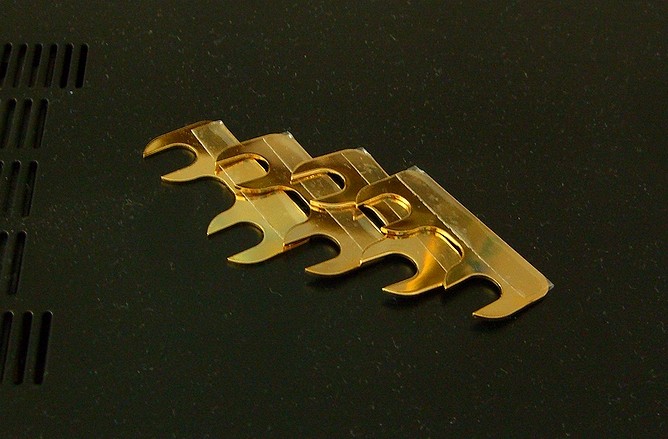
Do Not Use the Supplied Jumper Plates
In my experience, when you use these freebie-style metal jumper plates — presumably brass with gold plating — as supplied, the tweeter takes on a metallic, distorted quality. This is therefore clearly not a good way to connect things. Frankly, there is no need to strain your budget on a single expensive speaker cable; for a bi-wirable speaker, the better approach is to use two pairs of speaker cable, or a bi-wire speaker cable with four conductors inside.
Come to think of it, there are so many different names for “jumpers”, aren’t there… jumper pin, shorting bar, jumper plate, short plate, short jumper, jumper strip, metal jumper, metallic jumper — none of it seems to be standardised. What on earth is one supposed to call them when writing about this sort of thing…
Incidentally, in a case like this one — where the dissatisfaction with the woofer and the dissatisfaction with the tweeter point in different directions — rather than using the same cable for both runs or a dedicated bi-wire cable, there is an irregular approach that can actually work remarkably well: deliberately connecting two entirely different speaker cables, one to the woofer and one to the tweeter, can neatly resolve the different complaints you have about the bass and the treble. Of course, if you get the combination wrong the midrange coherence goes to pieces, and you end up with a bass and treble that sound wildly mismatched, so care is required. That said, the L-ite2 already has quite distinct tonal characters between the Kevlar cone woofer and the silk dome tweeter, and using the same cable top and bottom doesn’t really fix that at its root — so deliberately choosing different cables for high and low might actually be the right answer here.
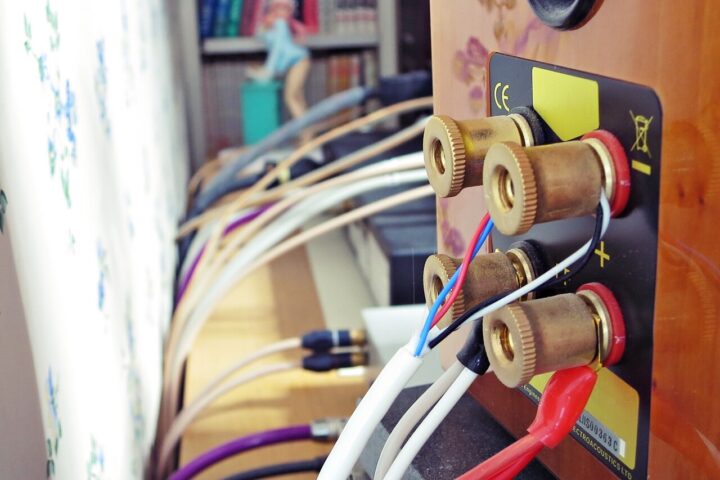
That said, in order to properly gauge the sonic potential of a bi-wirable speaker, the sensible starting point is to get two identical pairs of speaker cable that are as flat and neutral as possible, remove the metal shorting plates, and simply listen to music for a while in that state. This is a necessary ritual — a kind of calibration — so that your ears can learn the speaker’s default tonal balance before you start upgrading anything.
The trouble is, I somehow don’t have two pairs of the same speaker cable… well, I do, but the ones I have would need to be cut to length. Or, the only ones I have already cut are the SPACE & TIME PRISM OMNI 8N. The OMNI has a narrow bandwidth, a monotone, warm and rather laid-back sound (though with a reasonably firm bass), and its tendency to dominate — or rather, restrict — the frequency range is rather too obvious, making it thoroughly unsuitable for a neutral reference comparison like this. And frankly I can’t imagine it would suit the sound of the QUAD L-ite at all… hmm.
Standard Single-Wiring — Testing Both the Tweeter Terminal and the Woofer Terminal
As a first step before trying bi-wiring, I moved the SUPRA Classic 2.5H from the woofer terminals to the tweeter terminals and listened. You might wonder what difference that could possibly make, but when the cable is plugged into the woofer terminals, the signal reaching the tweeter is coloured by back-EMF distortion from the woofer, and then passes entirely through the metal jumper plate — a recipe for heavy treble distortion. Moving to the tweeter terminals doesn’t eliminate the back-EMF, but it at least greatly reduces the jumper plate’s negative influence on the high frequencies. In exchange, the bass now passes through the shorting bar, which means it will distort considerably instead.
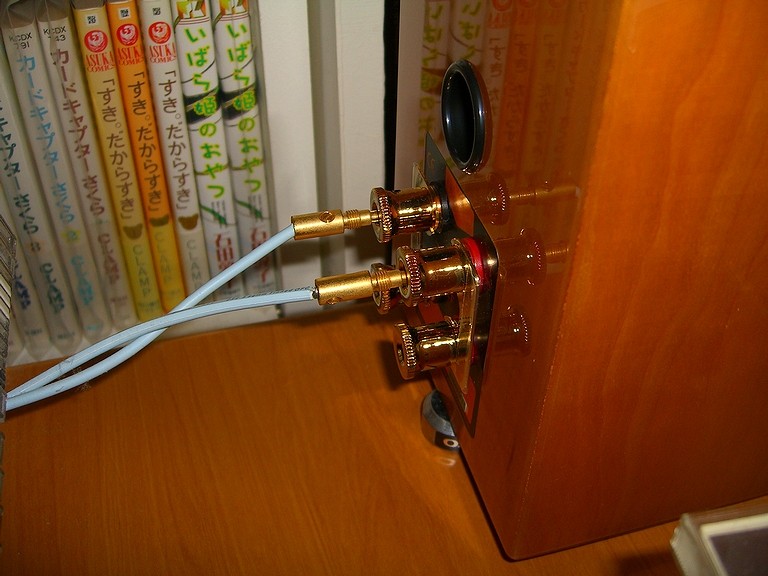
So I swapped the connection from bottom to top, expecting only a slight shift in the tonal balance towards the treble… and then — what on earth? The sound was dramatically better than moments before. Which made me wonder what on earth I had been listening to for the past few days. The change was drastic enough that I felt I needed to completely revise the first impressions I wrote in Part 3.
Conventionally, when single-wiring a bi-wirable speaker that uses jumpers, connecting to the woofer terminals is considered the standard approach — the accepted wisdom in Hi-Fi, so to speak. My previous bi-wirable speaker, the Acustik-lab SYSTEM1.2, was clearly like that, and when I read overseas impressions of the L-ite2, there were reviews saying the tonal balance was better with the cable plugged into the lower terminals — so I had rather uncritically taken that on board without thinking too deeply about it. With the QUAD L-Series tweeter harshness issue, it seemed obvious enough that connecting on the tweeter side would make the highs even more piercing and worse — so I didn’t question it.
And yet. With the L-ite, connecting to the tweeter terminals actually results in less perceived treble distortion. Thinking about it more carefully: if jumper plate quality is one of the major factors behind the sense of distortion, then plugging in on the upper side rather than the lower side should be less of a problem, logically enough. On top of that, connecting at the tweeter terminals gives three times the clarity, soundstage width, and richness of decay compared to connecting at the woofer side. The overall balance does lean slightly bright because of the increased sense of air and space, but the bass quantity itself doesn’t change substantially. What is going on here? So the QUAD L-ite2 can produce this level of clarity just by changing how it’s connected. Just this one thing turned it into a modern-sounding, high-resolution Hi-Fi speaker. And there I was thinking it was strictly a warm, slightly murky British retro-sound specialist…
When single-wiring with the supplied metal jumper plates, connect to the tweeter terminals. It really is that simple — but the difference is, without exaggeration, as large as swapping the speaker itself. It might even be bigger than the difference between the standard L-ite and the L-ite2 under identical connection conditions. That said, since the treble reverb now opens up with an Audio Pro Image 11-like clarity, the point of pairing it with the CREEK integrated amplifier and CD player — whose whole appeal is a gentle, laid-back retro sound — is rather undermined. In conclusion, I quite like how the treble behaves with single-wire connection to the tweeter terminals. However, I would not say the distortion has disappeared entirely — that would be a no. It is considerably more presentable than connecting to the woofer side, but there remains a slight edge that causes listening fatigue over time.
Single-Wire “Cross-Connection”
Next, just for the sake of trying, I had a go at the “cross-connection” method recommended by Audio Ippinkan — positive (red) to the high-frequency terminal and negative (black) to the low-frequency terminal. A connection method that seems likely to raise eyebrows. The result… well, to cut straight to the conclusion: it didn’t work. Dismissed in thirty seconds flat. The sound sits roughly in between the woofer-side and tweeter-side single connections, but the best qualities of each are neutralised, leaving something rather vague and indistinct.


 ポチップ
ポチップ
The cross-connection may actually be the worst choice for the QUAD L-ite2. Audio Ippinkan put forward the rather oblique argument that single-wire cross-connection is preferable to bi-wiring — but reading it carefully, their recommendation is based on using aftermarket high-quality jumper cables or AIRBOW jumper cables, not the supplied jumper plates. So if you can’t use quality jumper cables, this is probably the sort of advice best not taken at face value. That said, there are reviews from other people using entirely different speakers where the cross-connection gave the best results — so it’s worth not being too dogmatic about it, and simply finding the best connection method for your own particular setup.
For those who, for whatever reason involving cable compatibility, have no choice but to use jumper cables, yet cannot justify the cost of commercially available ones and don’t fancy making their own — searching Yahoo Auctions for jumper cables will turn up handmade examples crafted by hobbyists (using regular speaker cable) at fairly reasonable prices. It is entirely at your own risk, of course, but before splashing out on something expensive it might be worth experiencing the effect of proper jumper cables this way — just to get a feel for whether they actually make a difference and whether using them at all is worthwhile. (Continues in QUAD L-ite2 Part 5 — Trying Bi-Wire Connection)
【QUAD L-ite2 British Small Speaker Review】
Prologue|Part 1|Part 2|Single-Wire|Bi-Wire|Reservations|Jumpers


Auto Translated by CS4.6