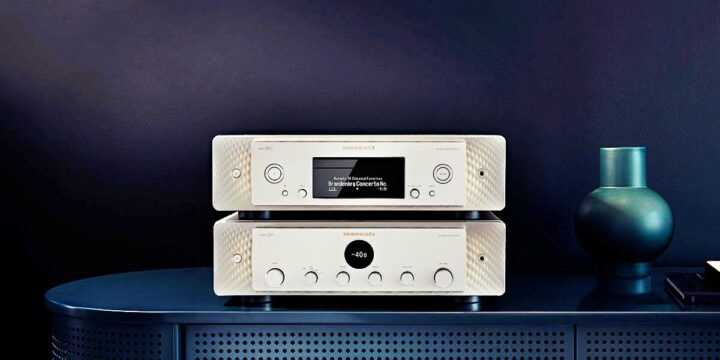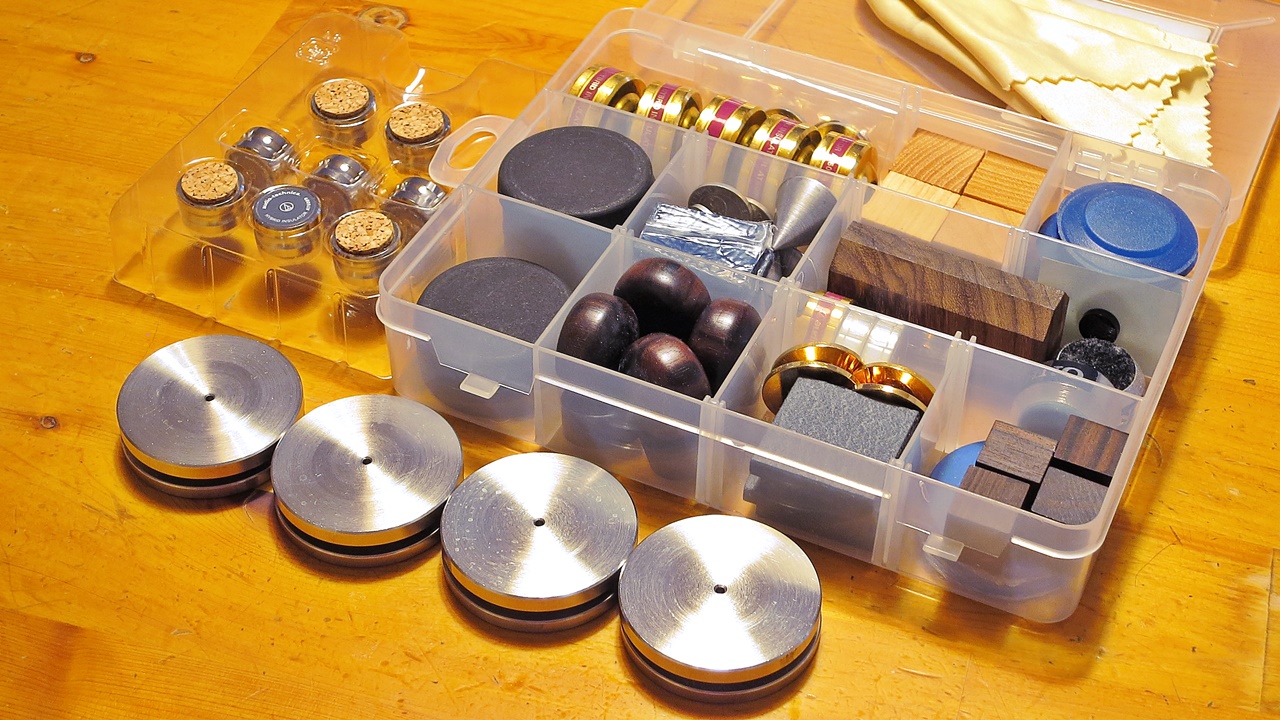
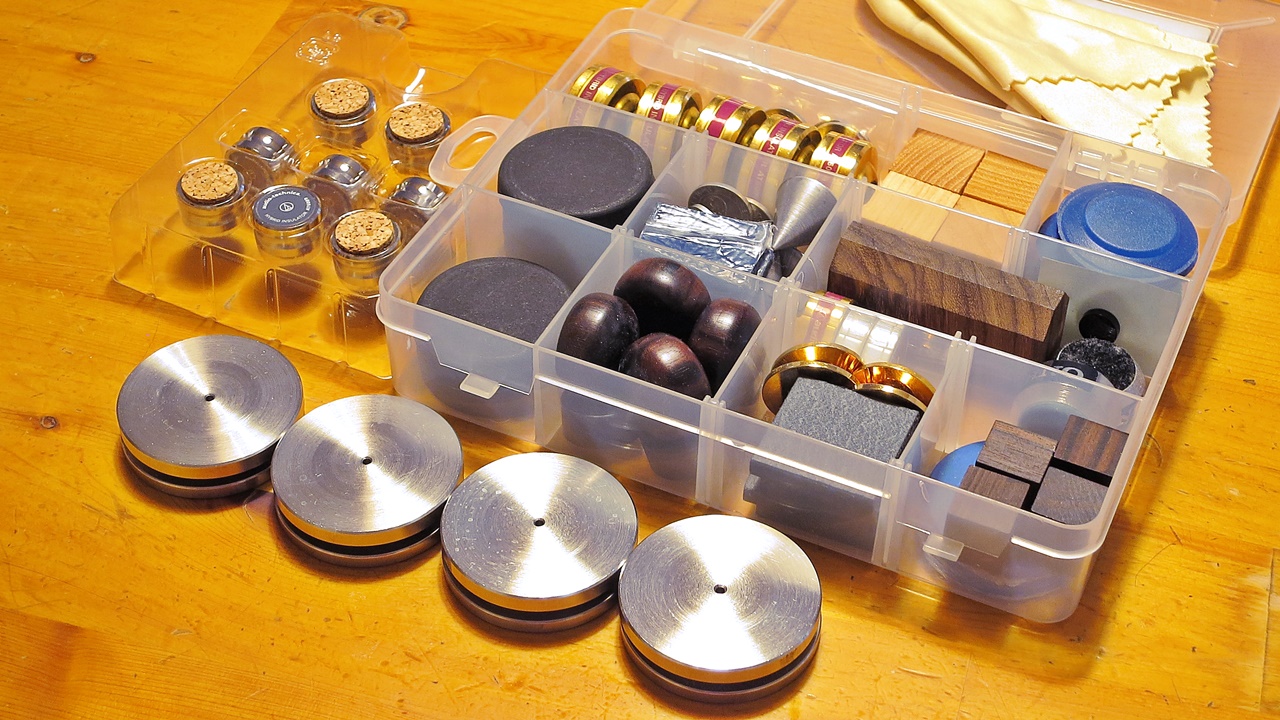
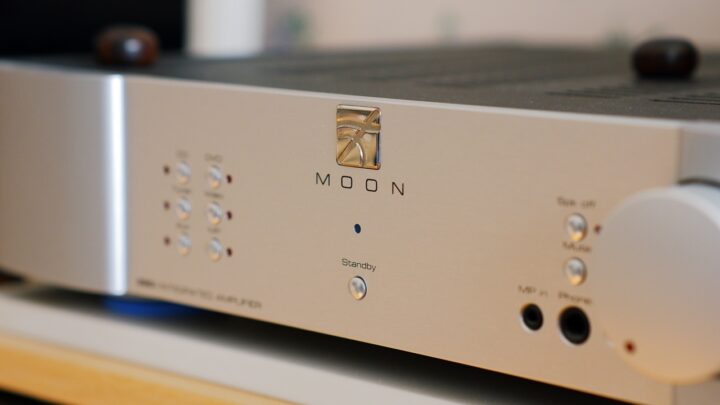
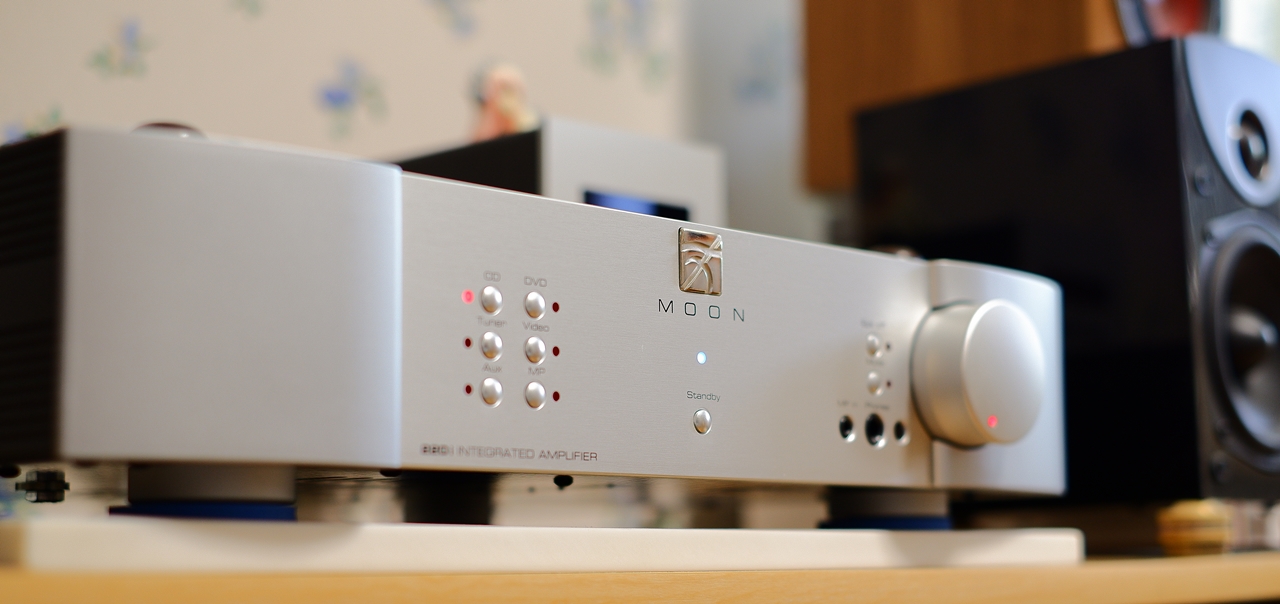
This time, with the aim of drawing out the full performance of the Simaudio Moon Neo 220i — newly adopted for Sub-system A in the study — I have undertaken an audition of the Hi-Fi insulators I have on hand.
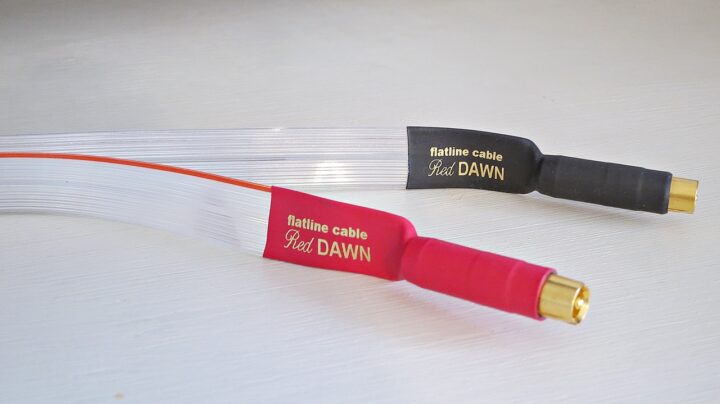
The audio rack — or rather, the simple chest of drawers — on which the equipment and speakers of Sub-system A sit has a top panel made of cheap particleboard. It has warped over the years and I intend to replace the whole thing with a single slab of laminated timber before long, but for the time being I have laid an audio board — specifically the white Corian board (350×450mm, 12mm thick) from Ippinkan AIRBOW, described further below — only under the section where the integrated amplifier sits. Incidentally, at audio shows in North America, one quite often sees Simaudio Moon products demonstrated with NORDOST’s triangular cone spike insulators, the Sort Kones, alongside the company’s audio cables.

 ポチップ
ポチップ
AIRBOW Corian Board 12mm Thick
Corian board is what is known as artificial marble — originally a building material made by mixing inorganic matter into a polyester-based resin. To the ear it feels closer to stone than to resin, with a hard, matte quality to its sound character. That said, it is not the type that rings with a booming resonance the way natural granite does. The AIRBOW Corian board is, to its credit, a step above simply placing equipment directly on the low-density particleboard of a cheap storage unit, and an integrated amplifier placed straight on it will produce a sound that is at least adequate. However, since this is ultimately a building material pressed into audio service, it does fall somewhat short — or rather, sounds somewhat short — compared to high-quality audio-dedicated boards constructed with special damping materials or laminated structures, or high-density laminated timber boards made from well-resonant wood.
I have kept using the AIRBOW Corian board all this time, partly because it is inexpensive relative to its performance, and partly because a white board suits the interior décor.


With a high-quality audio board, the sound can actually be better without insulators (or rather, better when you don’t use them) — but when placing equipment on an artificial Corian board, I do think it is preferable to introduce some kind of insulator into the chain. In practice, both the Simaudio Moon Neo 220i and the ONKYO A-1VL I had been using before it produced sound that was neither particularly good nor bad when placed directly on the Corian board, and I always found myself feeling the need to lift things further with insulators.
And so, this time I decided to audition 17 insulators from my collection that seemed likely to be a good match for the Moon Neo 220i. As a point of note, the Simaudio Moon Neo 220i has a structure in which the aluminium base plate itself doubles as the heatsink for the power transistors, which means that, compared to typical amplifiers with their own separate comb-shaped heatsinks, it is a design more susceptible to sonic influence from insulators. In this test, insulators taller than the stock feet were compared using a three-point support arrangement — two at the front, one at the rear. Thinner types were simply slipped under the stock feet in a four-point configuration. Please bear in mind that these are evaluations of the Corian board’s own character combined with each insulator, and results — both compatibility and outcome — may change considerably depending on the character of the equipment being used and the material of the under-board or audio rack.
For the record, none of the items here were provided by manufacturers or any other parties — every one of these insulators was gathered at my own expense, little by little. This is not one of those armchair articles you so often see on major ranking sites (the kind of comparative review cobbled together without any actual hands-on experience, full of nonsense write-ups driven purely by advertising).
★ Scores are out of 5 points. The sound quality of direct placement on the Corian board — rated ★★☆ 2.5 points — serves as the notional midpoint for this relative evaluation. The evaluation is entirely the subjective opinion of the author of “Hakoniwa-teki AUDIO STYLE” alone, and scores would naturally differ under different installation conditions or with different equipment. These scores do not reflect the absolute quality of any individual product — they are, strictly speaking, ratings valid only under the specific test conditions used here, nothing more and nothing less.
 【PR】簡単に音質向上「インシュレーター」の世界 -サウンドハウス
Direct placement (amplifier’s stock insulators) ★★☆ 2.5 points
Four-point support using only the insulators originally fitted to the Simaudio Moon Neo 220i. I have never turned the unit upside down, so I cannot say for certain what material they are made of, but they feel like resin-type insulators. Approximately Φ4.5mm, and visually somewhere around 7–8mm in height. The underside appears to be a double-layer construction, with some kind of non-slip material — something resembling hard urethane foam (my assumption) — bonded to the bottom.
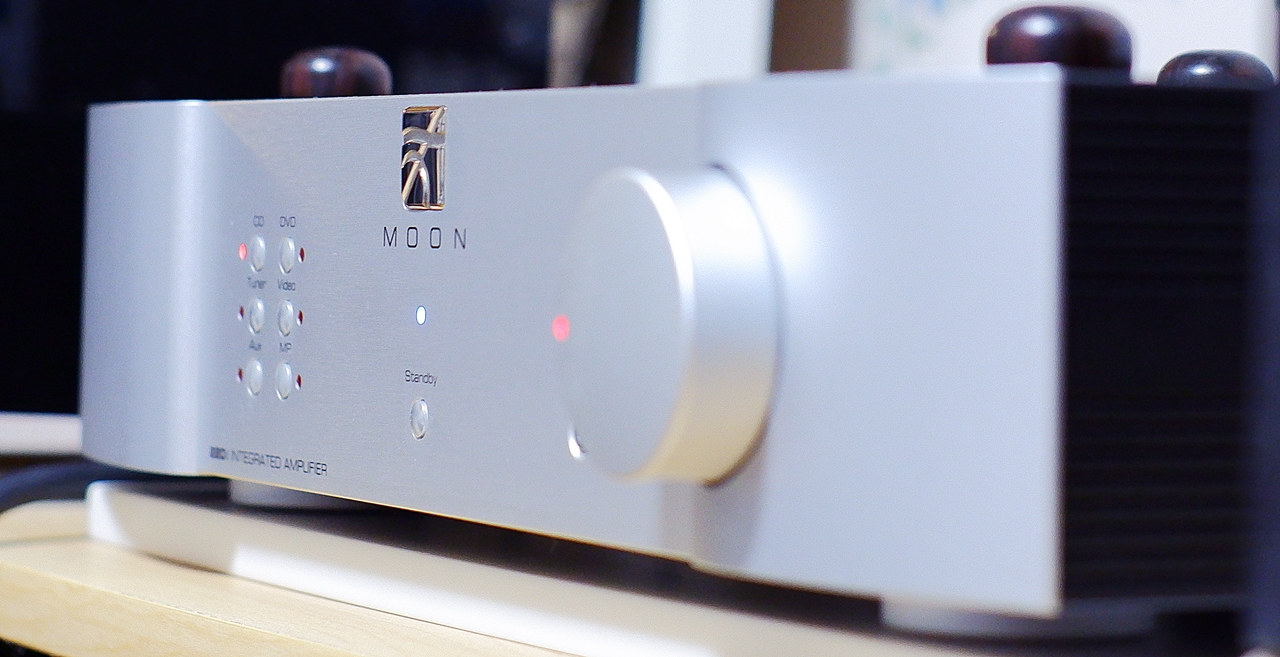
Along with a distinctively wide soundstage and sense of stability, there is a curious looseness — almost as though the chassis rigidity has dropped — and a slight roughness or graininess is noticeable, which is a drawback. The tendency towards high-frequency edginess also comes through most strongly here, compared to configurations using aftermarket insulators described later. Cost constraints may well be a factor, but the stock insulators represent the sound closest to what Simaudio intended, and given that the amplifier’s overall tuning was done with these included insulators in mind, switching to aftermarket insulators does not necessarily improve the sound quality — and that is an important point. This applies in many cases to other audio components as well, so if something feels off after fitting aftermarket insulators, I would recommend removing them and listening again.
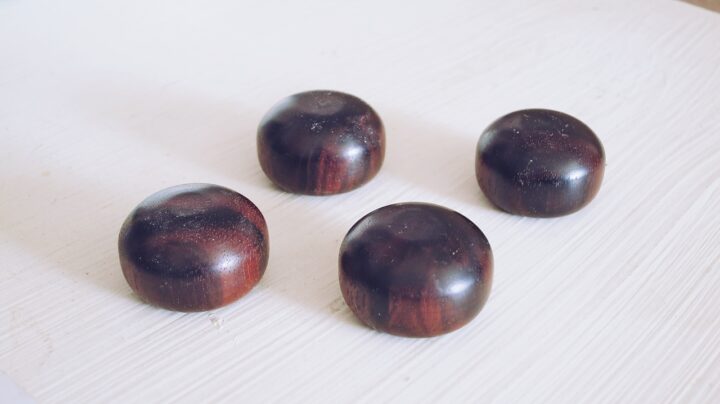
AIRBOW WOOD-BOY ★★★ 3 points
The first thing I tried was the AIRBOW WOOD-BOY from Ippinkan. The amount of high-frequency information increases, and the already excellent imaging of the Moon Neo 220i becomes noticeably sharper and more delicate. Bass moves in a lighter direction — and since this amplifier tends to push low frequencies rather heavily with ordinary speakers, I thought perhaps the balance might even out a bit. That said, when paired with the audiopro Image12 — a sealed ultra-compact bookshelf speaker — the inherent low-frequency output of the speaker is already quite limited to begin with, and the bass ended up feeling lighter than expected.
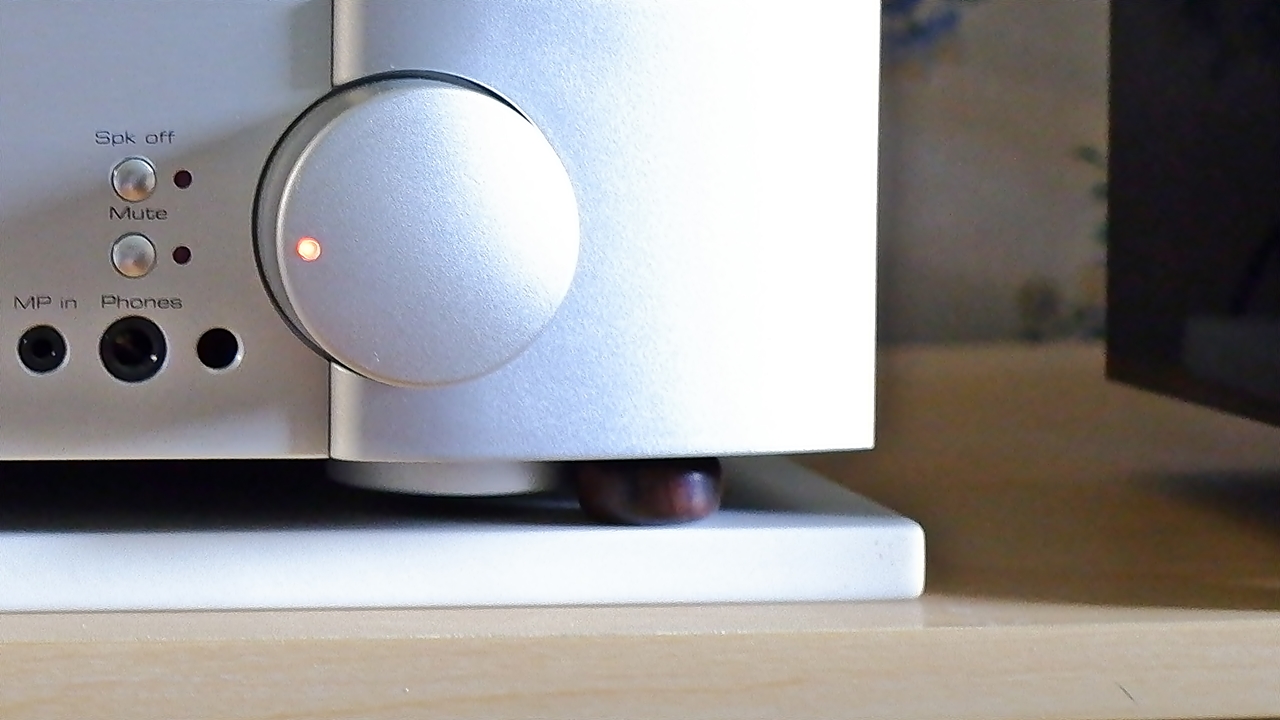
On top of that, the overall soundstage takes on a vague, gently blurred quality — rather like shooting with a fast lens wide open and letting the background go soft. The attack of individual sounds becomes uniformly over-smoothed across the board, and one cannot help feeling that the true sonic capabilities of both amplifier and speakers are being somewhat undermined. In the end I decided against using it as an insulator — but African blackwood is a wonderfully resonant material, and simply placing a few pieces on top of the amplifier’s lid adds a certain delicacy to the sound and, quietly, improves things quite noticeably.
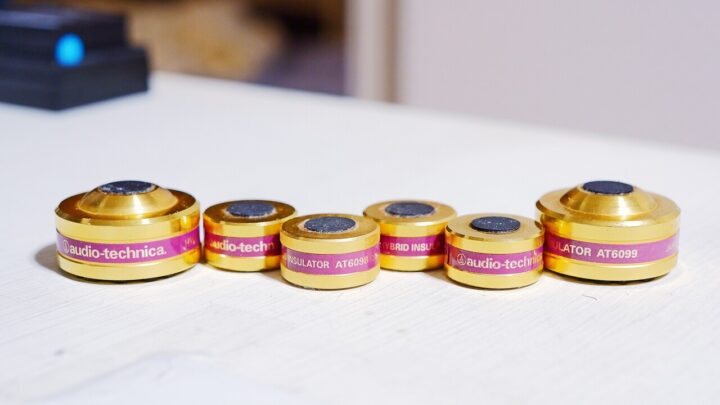
audio-technica AT6098 ★★ 2 points
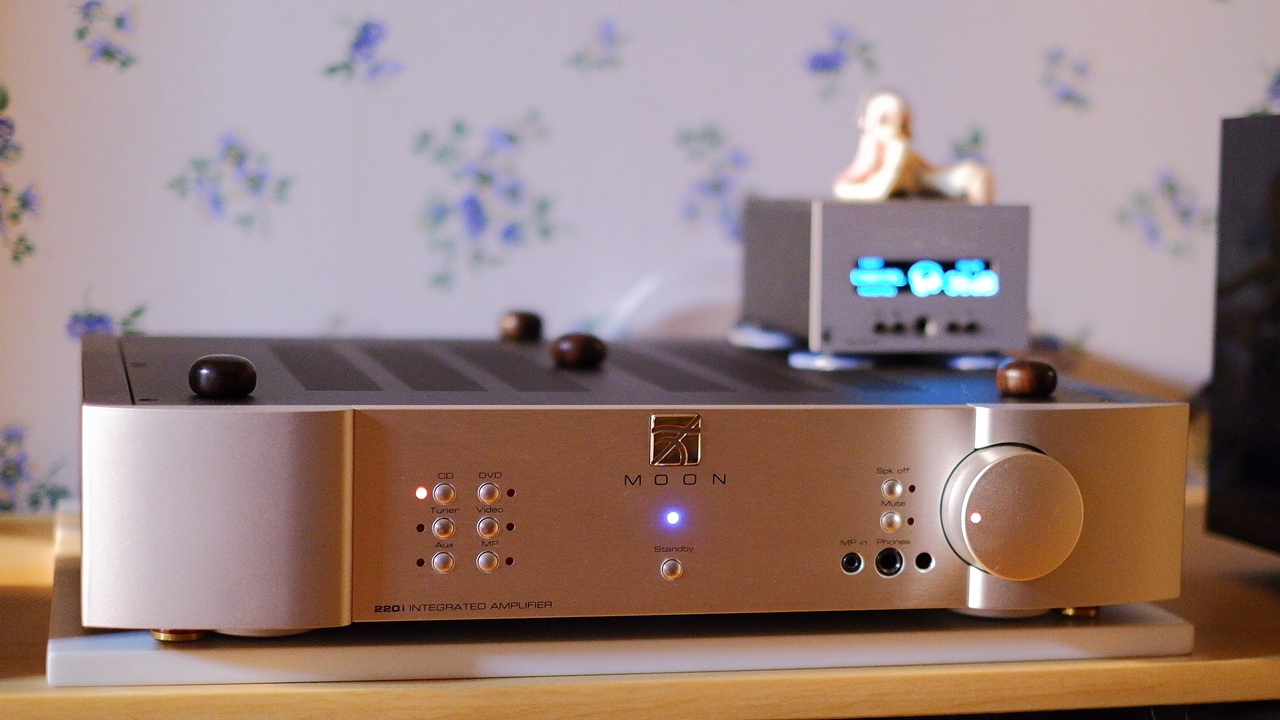
The next thing I tried was the audio-technica AT6098, which was discontinued just recently — set up in a three-point configuration, two feet at the front and one at the rear. As it happens, the combination I had used for years between the AIRBOW Corian board and the ONKYO A-1VL was precisely the AT6098 in this three-point arrangement. The brightness one expects from a brass material, combined with a smooth, almost viscous quality and a sense of density in the midrange, and on top of that the harsh, clanging pressure in the upper-midrange is quite well suppressed — so the overall impression on the ears is pleasant. At first it sounded better-matched with the Moon Neo 220i than I had expected, and I thought, oh — same as the ONKYO A-1VL, this might actually work! But after a full day had passed, the Hanenite had settled in, and the sound became somehow dead and uninteresting, lacking in resonance. And so, regrettably, it was set aside.
Audio Replas OPT-1 HR ★☆ 1.5 points
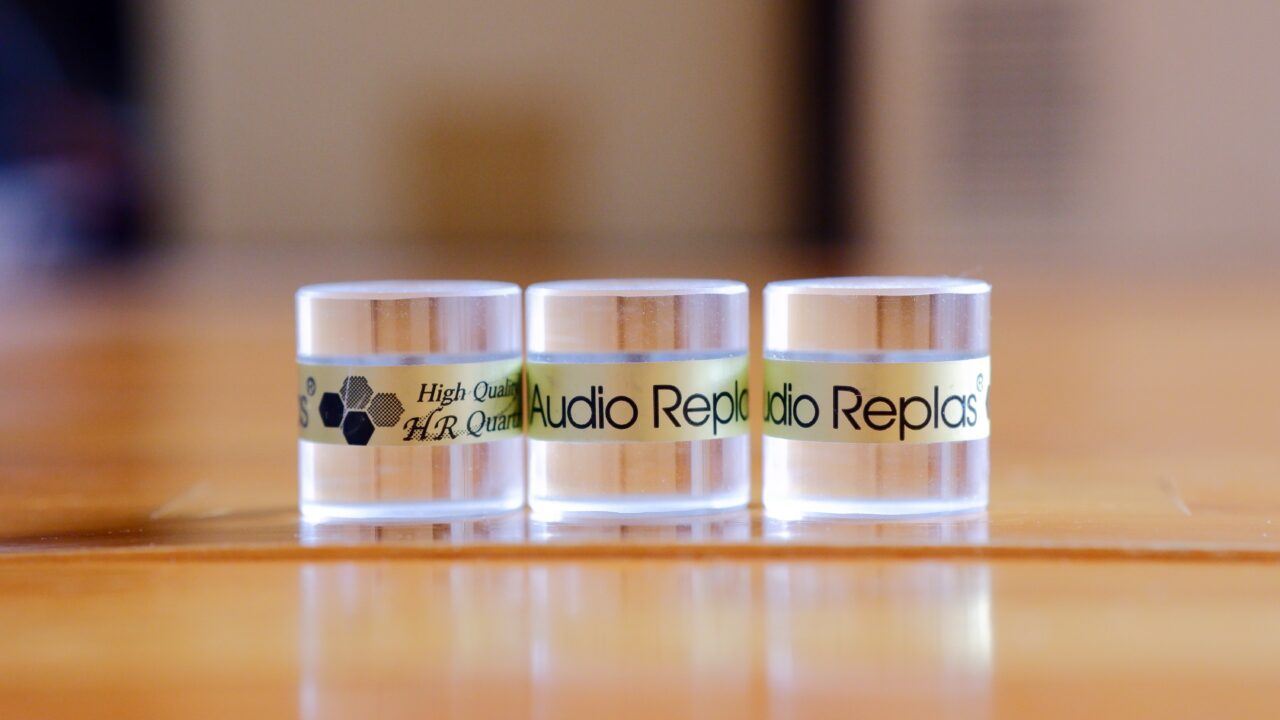
The Audio Replas OPT-1 HR is a high-end insulator that I am particularly fond of, having used it under the CREEK Evolution CD, the MARANTZ CD-R630, the CI AUDIO VDA-VAC1, and various others. The material is synthetic quartz, and in my own thinking it is something of a trump card when it comes to insulators placed beneath CD players and DACs. Similar-looking insulators are available at lower prices through auction sites and the like, and I have tried comparing them, but the sonic character was quite different from the Audio Replas range, and honestly there was no comparison to be made. Even within what is broadly called synthetic quartz, the sound differs depending on the manufacturer — though I should say, this is only on the basis of one particular product I happened to try.
ポチップ
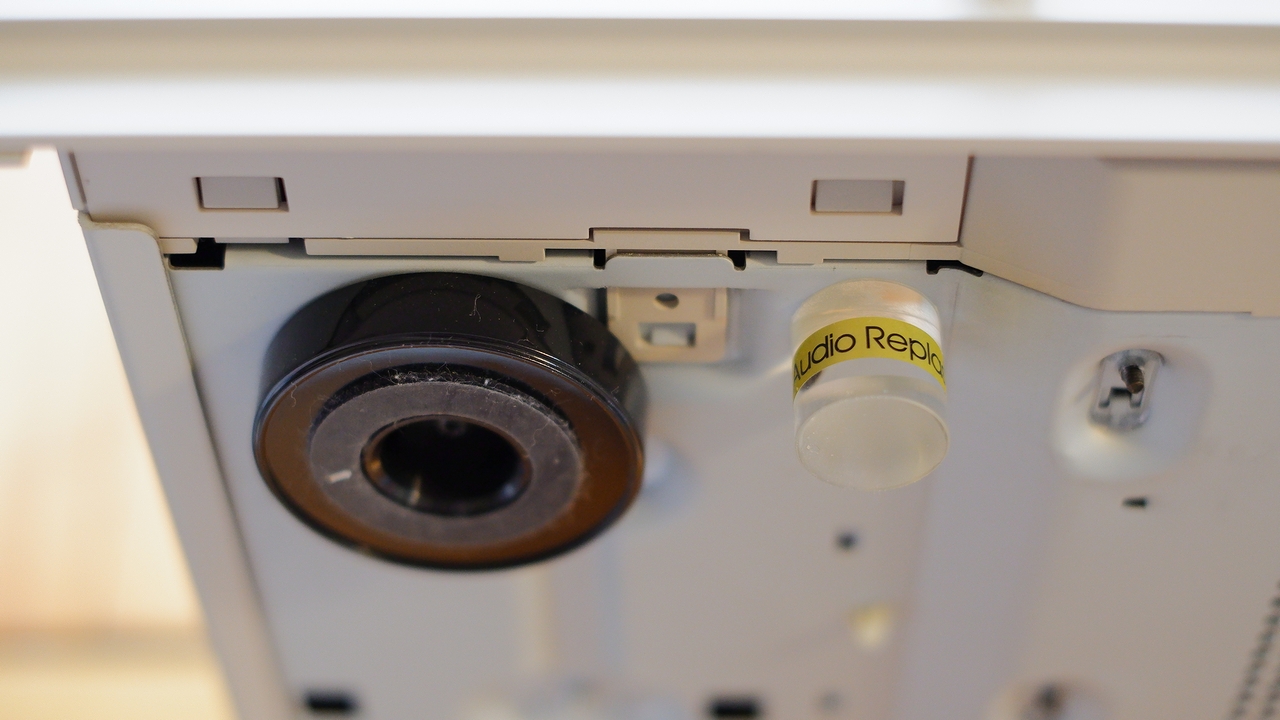
True to Audio Replas’s crystal material, a refined transparency and delicacy in the high frequencies stand out — yet when placed in the Moon Neo 220i, the sound image comes across as somewhat thick for some reason, with a hard, bony texture I have never encountered with this product in combination with other equipment. When using the OPT-1 HR with other devices, the sound is generally richer and the soundstage wider, but this time it kept condensing inward, and the spatial breadth just wasn’t there… Perhaps it simply isn’t a good match. I didn’t feel the pressure in the upper-midrange was particularly severe, but when I heard the television immediately afterwards, something about it struck me as off — so I decided not to go ahead with it. Buying yet more at this point would be far too painful on the wallet, so in a way, perhaps that was for the best.
audio-technica AT6099 ★★★★ 4 points
The audiopro Image12 speakers have long been sitting on a three-point support of audio-technica AT6099, so I won’t pretend there wasn’t a moment of hesitation about using the AT6099 under the amplifier as well — but this is a test, so all possibilities need to be checked.
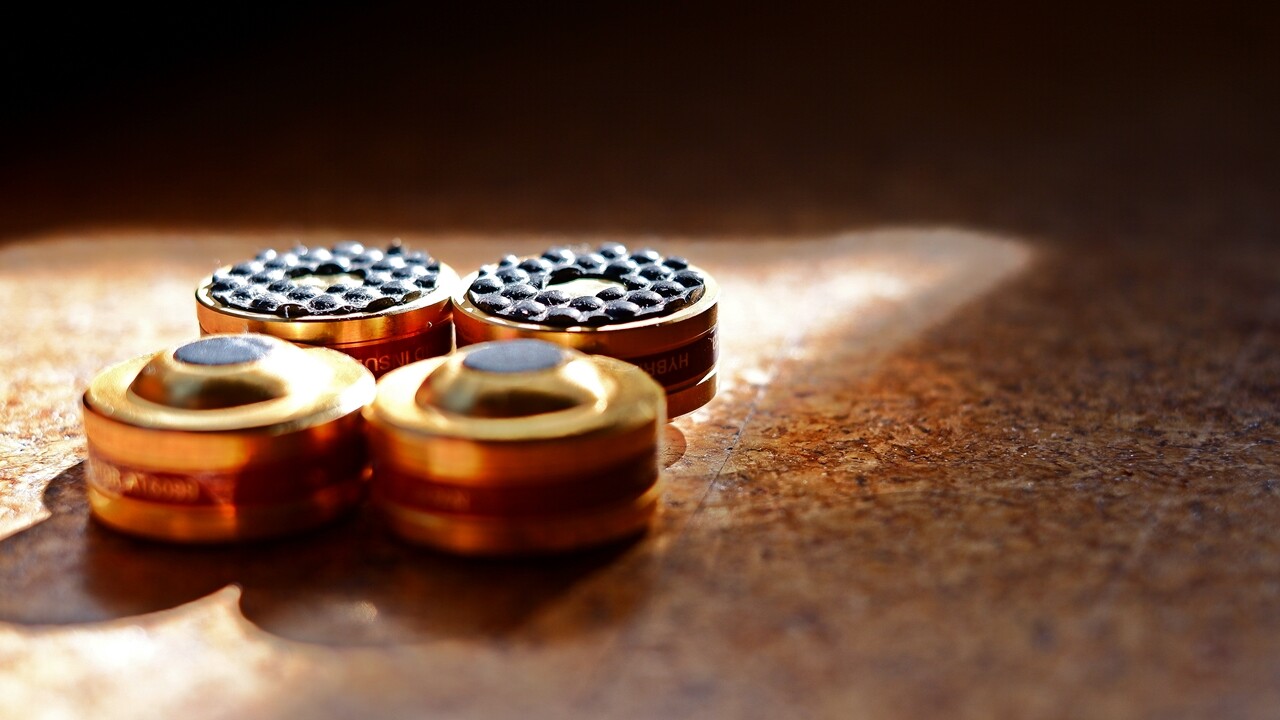
First of all, it is far easier on the ears than the OPT-1, and the sense of pressure in the high frequencies is barely noticeable. The softness of the Sorbothane is the dominant impression. Each AT6099 has considerable mass, and yet the slick, distinctive tonal character of the brass material is, surprisingly, less conspicuous than on the smaller AT6098. The presentation is bright, dynamic, and charming, though finer details feel somewhat tidied away. With greater movement and dynamic range in the sound, the soundstage also opens up. Imaging tends toward pinpoint rather than blooming as much as one might expect, but the outlines are smooth. I suspect the impression will change after leaving it in place for a few days, but this is how things stand right at the point of installation.
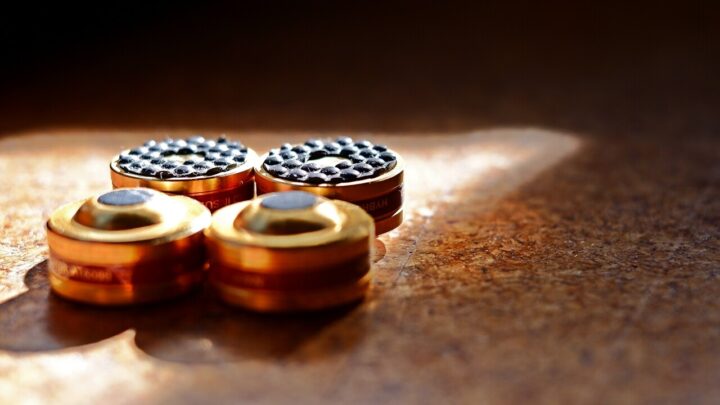
That said, the sound character it produces is the polar opposite of the Moon Neo 220i’s solid austerity and depth of shadow — cheerful, and easy to listen to, yes, but there is also a nagging sense of waste in using it with this particular amplifier. It handles music perfectly well and without obvious shortcomings. But when it comes to drawing out the system’s potential in a way that truly serves the equipment — it feels a little underpowered for that task.
 ポチップ
ポチップ
A few days later… The AT6099 had felt slightly off at first, but after letting it settle in for a few days, it turned out to work rather better than expected — and unlike the AT6098, it reached a tonal balance that made me think: well, perhaps keeping the AT6099 indefinitely isn’t such a bad idea after all. It adds a touch of the softness and dynamic musicality that the Moon Neo 220i is ever so slightly lacking, while offering naturalness, smoothness, and a welcome freedom from upper-frequency pressure. On the other hand, there are moments where the strictly rendered depth and precision — the very qualities that define the Moon Neo 220i — become somewhat blurred, and I cannot quite shake the impression that this is, in the end, an isolator one reaches for as a compromise, a way of settling for a balance that is merely acceptable.
Zigsow DC-mini ★★ 2 points
The DC-mini is a nylon isolator released some years ago by Zigsow, a Japanese audio accessories brand that has since quietly disappeared. The tip is spike-shaped with a gentle angle, making point contact. Set up in a three-point configuration with the contact points facing downward.
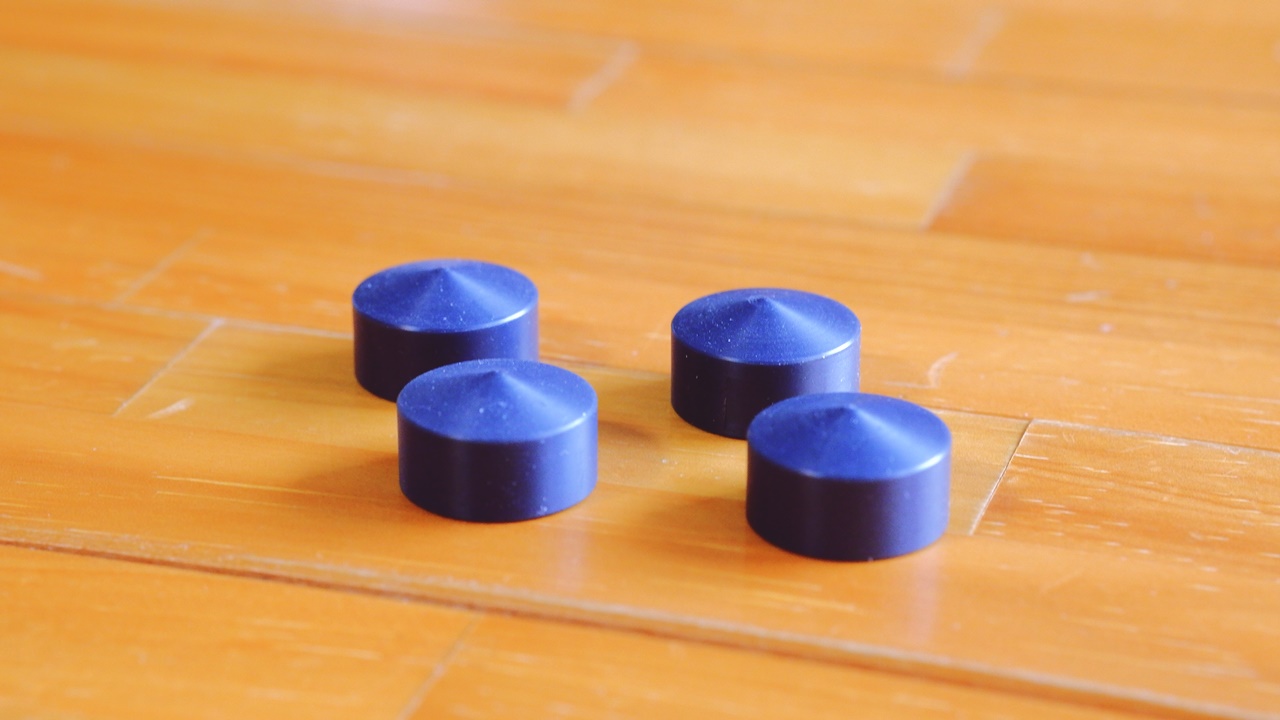
I had never used the Zigsow DC-mini before, as it tends to push the tonal balance towards the upper registers and introduces a peculiar kind of smearing in the midrange that is characteristic of hard nylon — but I thought I’d give it a try all the same. The balance is indeed slightly top-heavy and flat, but the imaging is sharp and pinpoint. The most notable advantage, and quite a surprising one, is that there is absolutely no sense of pressure in the upper frequencies. Indirect sound components are tidied up somewhat. It is more listenable than expected and not unpleasant, but there is a slight draining of vitality, and the musical expression feels rather contained — modest in scale, along with the soundstage itself. The top-heavy balance also tends to undermine the weighty low-frequency presence that the Simaudio Moon Neo 220i possesses, which is another drawback. The tonal character, too, is somewhat monotone and lacking in variety.
audio-technica AT6089CK ★★★ 3 points
Among the audio-technica budget isolators that were all discontinued at once, the AT6089CK is personally my favourite. It feels perhaps a little too entry-level to be paired with the Simaudio Moon Neo 220i, but I’ll give this one a try as well.
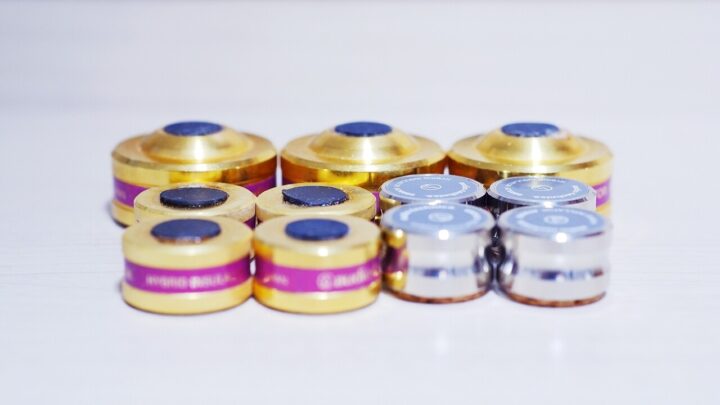
True to form for the AT6089CK, the sound is bright, smooth, and richly resonant, free of any roughness — and tonally, yes, it suits my taste. The soundstage does tend to become somewhat shallower in depth. The issue is that (better than with the stock isolators, but) the nervousness that the Moon Neo 220i already carries in the upper registers begins to show itself, leaving the impression that this is not quite sufficient as a remedy for the sense of pressure in the upper midrange and treble. The low-frequency weight, too, feels neither here nor there — neither a strength nor a weakness. The overall impression is less one of drawing out the amplifier’s capabilities to the full, and more one of settling things into a competent, well-balanced sort of tidiness.
 ポチップ
ポチップ
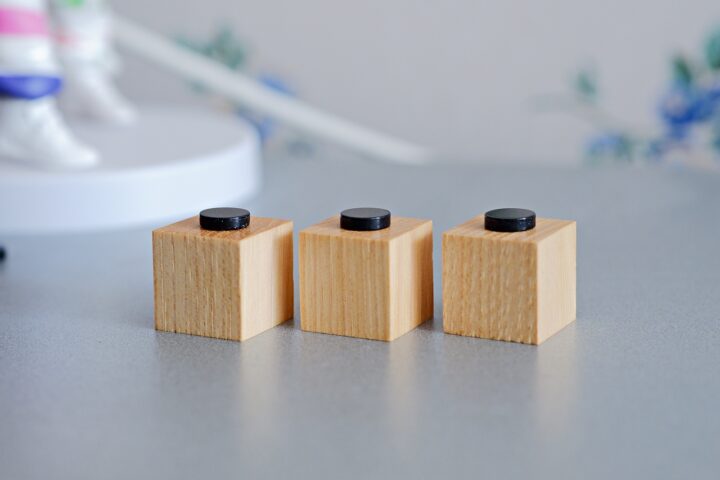
Acoustic Revive Hickory Cube HQ-4 + QR-8 ★★★★ 3.5 points
This is covered on a separate page.
Acoustic Revive RKI-5005 ★★★★ 4/5
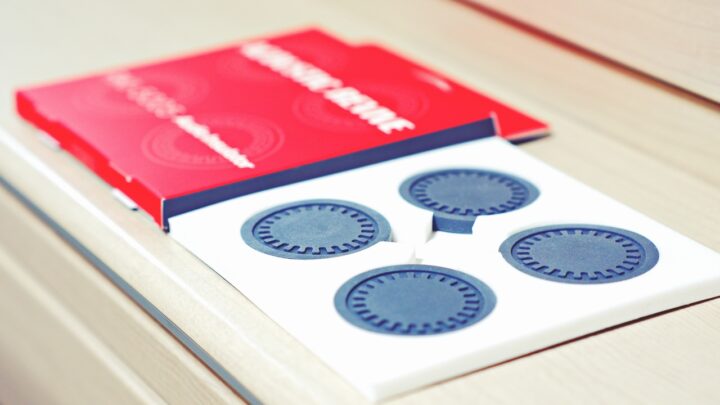
Φ50mm. Four-point support placed beneath the stock feet. Bright and well-defined, with excellent resolution; a sound image that has appropriate presence and density without being harsh. Musical expression is positive. Particularly appealing is a slight tension that runs through the mid-range into the upper-mid region. The upper-mids are sharp yet rarely fatiguing. Low-frequency quality is (in this system) perfectly ordinary — neutral. Partly because I personally favour a brighter tonal character, this brightness and the refreshing quality in the upper registers are tendencies you simply cannot get from J1 project, whose overall tone runs on the darker side. Similarly, the somewhat dark tonal quality that Simaudio inherently possesses is swept away all at once with the RKI-5005, as if sunlight had suddenly broken through. There is a slight tidying-up and restraint of the indirect sound, and one has to consider what to do about the very slight softening of attack that comes from the silicone texture — but despite being a single-material design, the tuning sensibility is excellent, and I think this is an insulator with a fine overall balance.
J1 project P7708-J4P ★★☆ 2.5/5
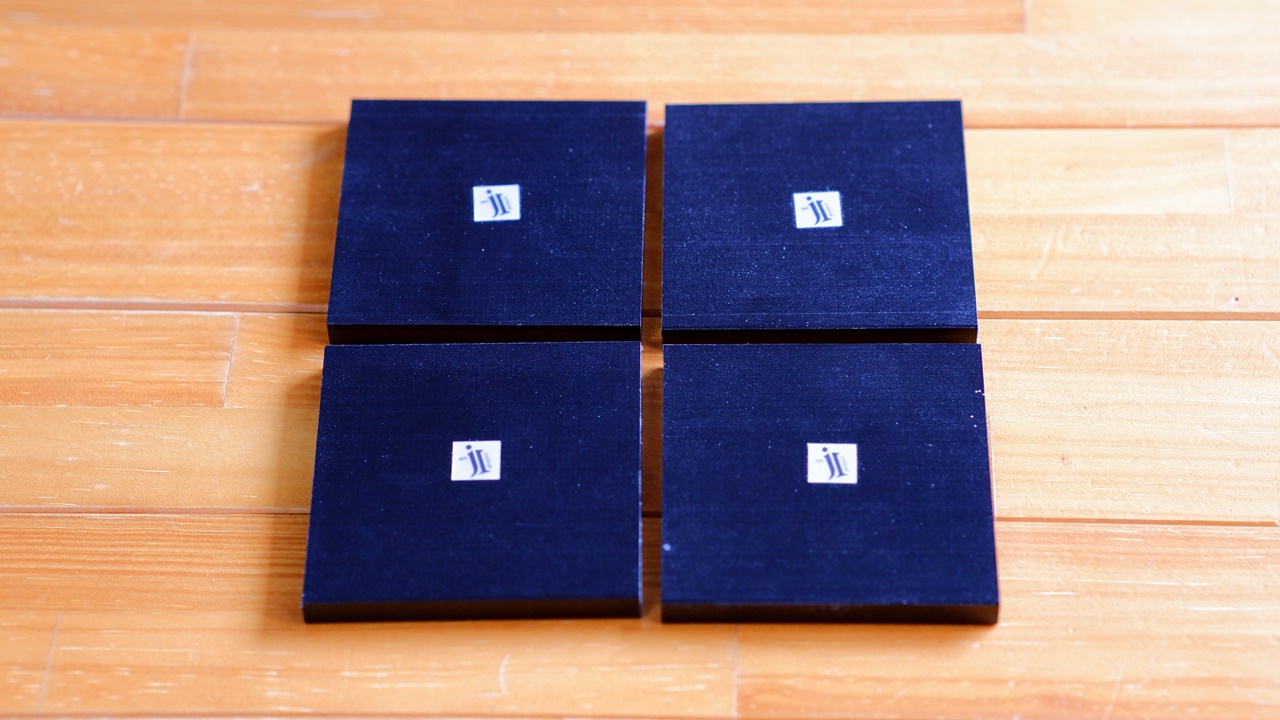
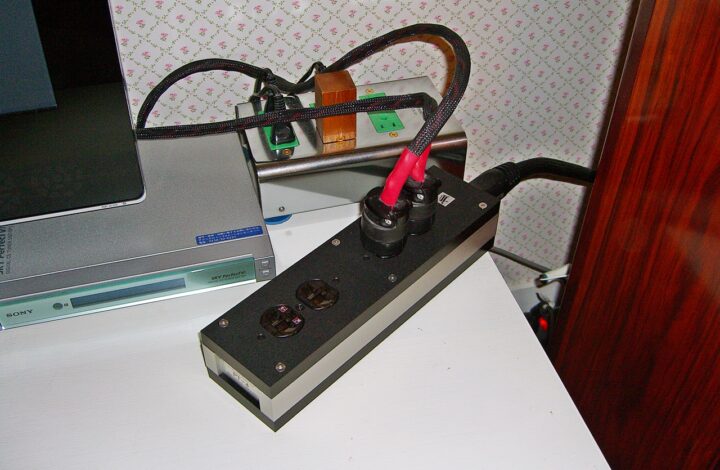
This is the top-of-the-range model (excluding spike types) among J1 project’s insulators made from their high-tech polymer composite material, ICP Composite. The J1 project PT-4 power strip that I use regularly employs a construction in which this same material is sandwiched between aluminium blocks above and below. There have also been audio boards and audio racks using the same material in a larger format in the past. Testing was carried out in a four-point support configuration making use of the stock feet as they are.
The high vibration-absorbing capability of the J1 project P7708-J4P is, looked at from the other side, a case of the effect being too strong and the product therefore difficult to place — and sure enough, that tendency is quite pronounced with the Moon Neo 220i as well. The background sinks noticeably deeper, and the character is one of rich bass, a natural mid-range with a moderate sense of body, excellent S/N ratio, and a quiet overall sound — though in the upper frequencies there is a tendency for the number of audible details to be pruned back. Transient attack is mild. Because energy is absorbed to a degree, the effect can work well with amplifiers that lean towards being overdriven, but when the system balance is already on the passive side, the musical flow ends up being suppressed and things go dead. Getting that balance right is difficult — (and in that respect, the PT-4 really is very well designed). For some reason the stock feet’s weaknesses tend to be slightly emphasised, so in terms of compensating for those, the compatibility feels a little lacking here.
J1 project P50D-J ★★★★☆ 4.5/5
Like the P7708-J, this uses the high-tech polymer composite material ICP Composite, but this one gives a harder impression, closer in feel to the material used for the ICP spikes and spike receivers. The texture has a somewhat plastic quality, though it is characterised by a hardness reminiscent of a go stone, and when you strike two of them together with a flicking motion they produce a pleasant sound. Φ50mm. Four-point support making use of the Moon Neo 220i’s stock feet as they are. Incidentally, I am also using the smaller P35D-J, made from the same material, placed beneath the integrated amplifier EMF Sequel2 in Sub-system C.
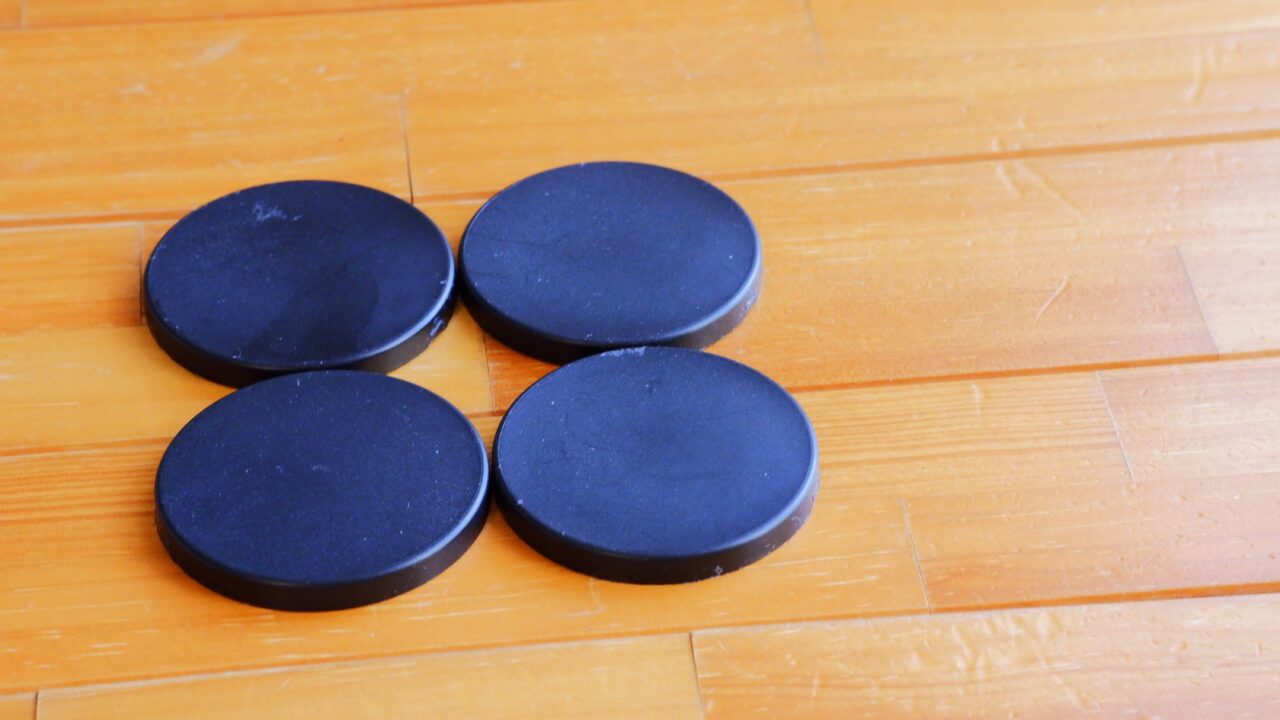
In contrast to the P7708-J, the P50D-J has a decidedly tight character with a richness of resonance, where the treble region does not go dead but is brought into focus with a moderate sense of closeness. The soundstage has considerable depth, and the sound is honest and straightforward, free from any sense of constraint or theatrical artifice. There is an elegant, deep resonance — like peering into an abyss toward the pianissimo end. This treble character is delicate and appealing in terms of tonal colour, though it is a shame that the ringing quality leaves a little of the upper-midrange pressure that the Moon Neo 220i possesses. On this point, the A50R-J has the edge. The midrange is somewhat monotone, though it is bright and lively. Towards the bass, resolution is high and the response is flat. There is also a pleasing sense of attack speed, and the compatibility with the Moon Neo 220i’s stock feet is far better than with the P7708-J — an honestly rather surprising result, as I had not expected them to suit each other at all.
 ポチップ
ポチップ
That said, as an insulator it does carry a fair amount of added colouration, and there are moments where a plasticky resonance — for better or worse — peeks through, so whether one can accept that aspect is really the key question with this type. Also, being a single hard material, it understandably does not work in the direction of cancelling out the roughness that the stock feet introduce into the sound. On the whole, the tonal compatibility is quite good, though it falls just one step short of the combination of the Moon Neo 220i with the A50R-J/4P.
ポチップ
J1 project A50R-J ★★★★★ 5 points
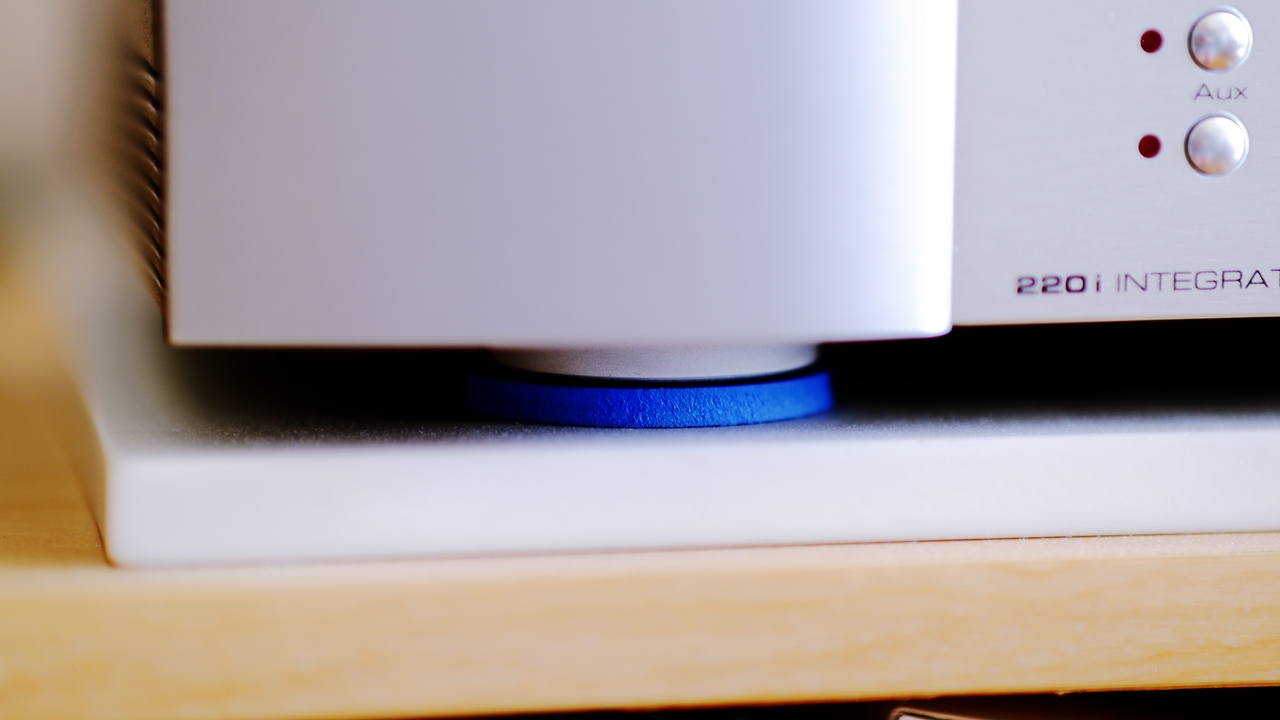
A blue soft-type material called IDS Composite Material A. It is softer than the P50D-J, yet has a crisp feel and is not so soft as to deform under the weight of equipment. This one also produces a pleasing sound when you strike two pieces together. Compared to the P7708-J, the tonal character is brighter, with a sharp sense of speed on the attack. There is a gentle, moderate lustre and firmness to it, with a smooth tonal quality. Compared to the P50D-J mentioned later, there is less emphasis in the treble region, the frequency response is flatter, and the soundstage scale is somewhat larger. There is a tendency for resonance and the density of notes to be somewhat tidied up in exchange for a sense of S/N, but the problematic upper-midrange pressure is almost completely resolved — a splendid effect in this regard. It is a good-quality insulator that moderately removes an audiophile sense of distortion across the entire frequency range. The material’s character is not entirely absent, but because the natural tonal colour of instruments is not strangely masked by the insulator’s character, the overall impression is very favourable. Among the J1 project insulators introduced here, it falls slightly behind the RKI-5005, P7708-J, and P50D-J in terms of strength of character — but by that same token, the colouration-related drawbacks are fewer, and it quietly strikes me as the most balanced insulator of the lot, and the easiest to use in a variety of situations.
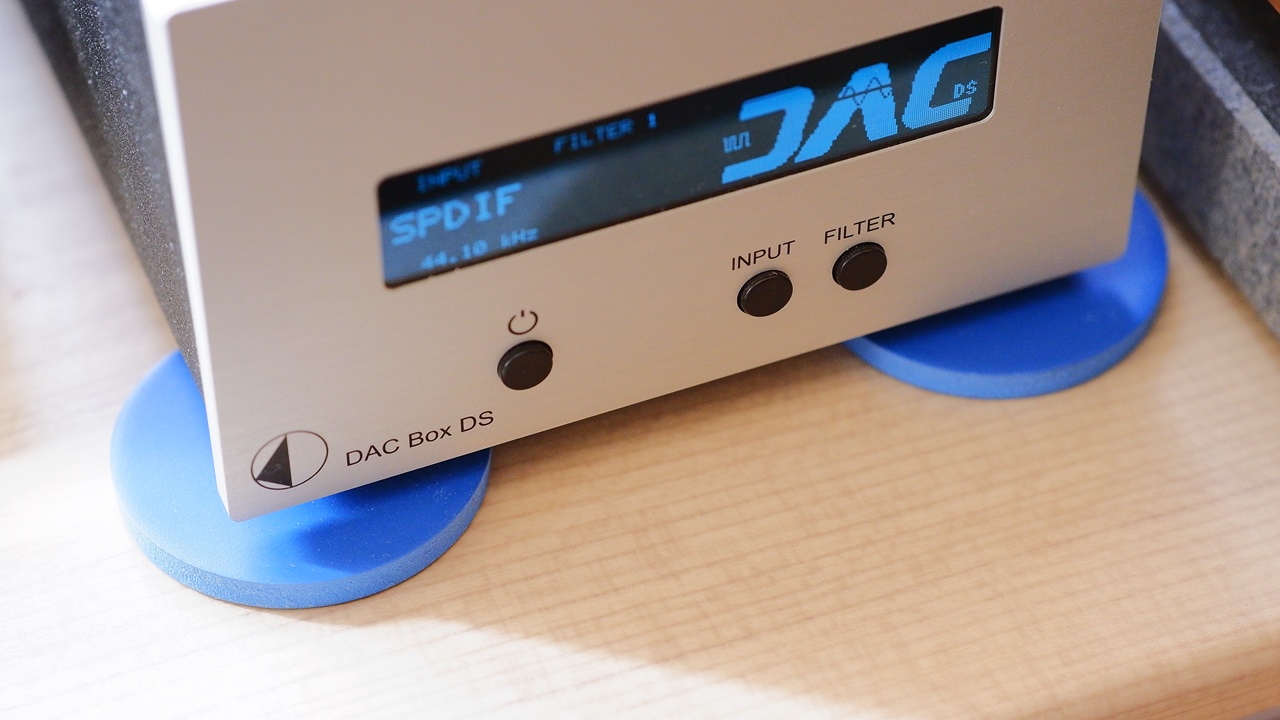
Smaller sizes in the same material are available — the “A25R-J”, “A-35R-J”, and “A-40R” — and in this test I am using the A-40R under the Pro-Ject Head Box DS (the DAC sitting on top of the Moon Neo 220i) and under the Pro-Ject DAC Box DS in a separate system. The sonic character is identical to the A50R-J, though with the A-40R the soundstage is a size smaller. Also, while both the A50R-J and A-40R purchased in the latter half of the 2010s are Japanese-made and use exactly the same material, the older J1 Project units from the American-manufacture era — more than twenty years ago — are slightly thinner, the IDS Composite Material A feels subtly different, and the sound differs slightly as a result. The American-era units offer a more varied tonal palette, though their effectiveness as insulators is a little weaker. The Japanese-made units tend to show a stronger damping effect, but the character of the material comes through a little more strongly. If both the amplifier and the DAC are fitted with Japanese-made IDS Composite, the insulator’s personality asserts itself too strongly through a kind of synergistic effect — but pairing the Japanese-made version under the amplifier and the American-made version under the DAC turned out to be just the right balance.
 ポチップ
ポチップ
With a strongly characterful material, increasing the mass tends to make the drawbacks more prominent in proportion — but since this is not a particularly coloured type to begin with, I think the A50R-J, with roughly twice the volume, allows the sonic benefits of the IDS Composite to come through more clearly.
ポチップ
Inakustik H-Gel EX-ABSORBER Clear Gel Pads (Soft) ★★★☆ 3.5 points
The one I was actually most keen to try this time was the Inakustik H-Gel EX-ABSORBER. When I was using the Simaudio Moon Neo 220i in the main system, the best match I found was the higher-grade RF-ABSORBER (black gel / hard type) — but as my existing RF-ABSORBERs are currently placed under the AUDIOLAB 8300A and ONKYO C-S5VL in the main system, I purchased this one separately.
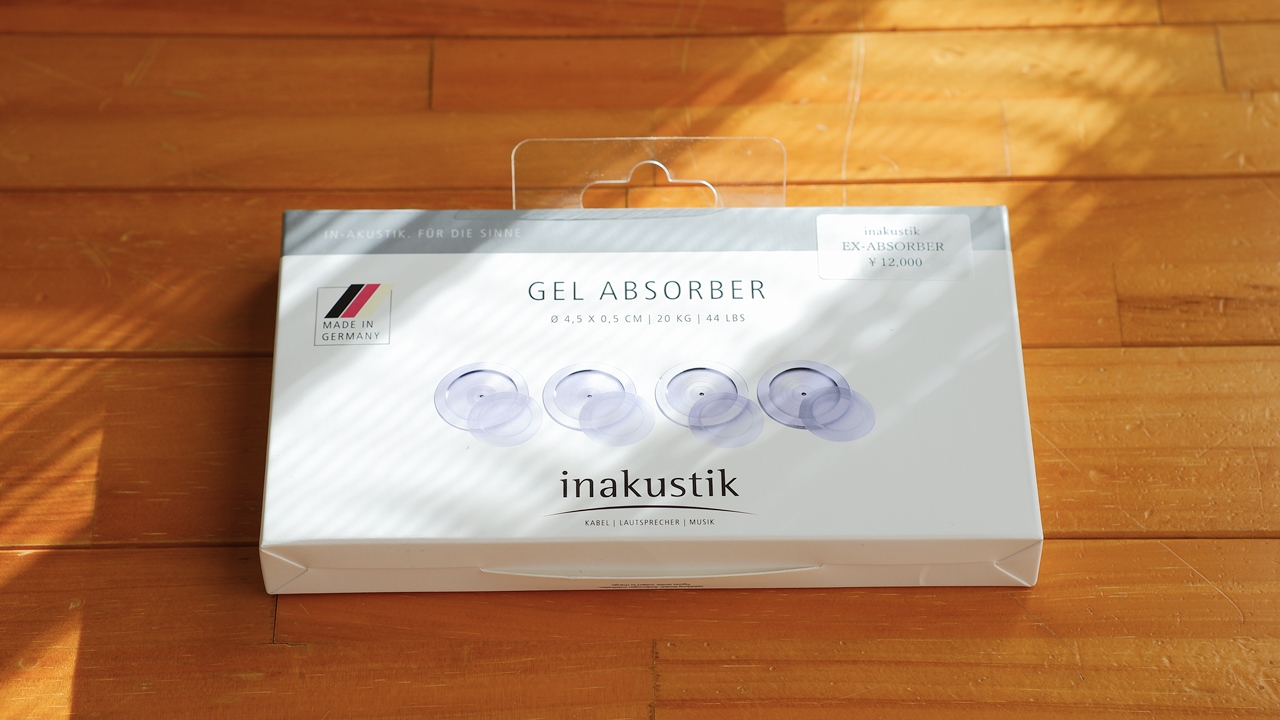
First, using the clear gel pads that come included with the EX-ABSORBER by default. I placed them in a four-point configuration directly under the stock feet. At Φ45mm, they are exactly the same diameter as the stock feet. The included clear gel is the softest type among the range of bundled gels, and feels roughly the same hardness as the green gel from the RF-ABSORBER. I have tried both the clear and the green types on various pieces of equipment over the years, and placing these under a component gives a noticeably soft tonal character. Particularly straight after setting up, the softness is dominant. The harshness and sense of congestion in the upper midrange are largely dispelled — though I would not say the result fully draws out the performance of an amplifier whose natural character is solid and tightly controlled. Even so, the insulator’s influence is considerable, and it does a fine job of cancelling out the drawbacks I noticed with the stock feet, which is a point in its favour.
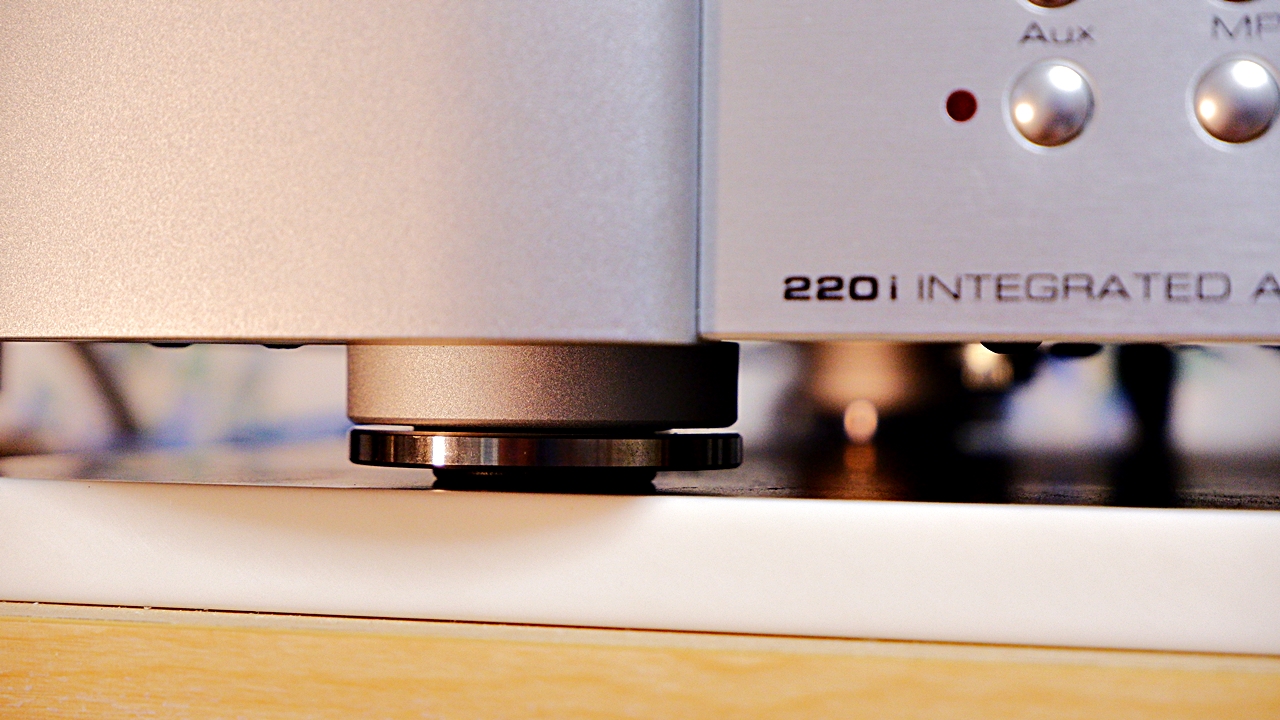
What I find particularly promising — and unlike other insulators — is that the flow of the music becomes remarkably easy to follow, to the point where, if I may put it a little dramatically, it can feel almost like a different performance; there is a sense of the music’s character seeping into one’s mind. The frequency response is not flat — the midrange pushes forward in a kamaboko curve — but the soundstage opens up broadly and deeply in all directions, height, width, and depth alike, with a stage size that I have not been able to achieve with other insulators. The influence is especially pronounced in the lower frequencies, and a soft, resonant quality dominates the overall presentation; yet in the upper frequencies there is also a sense of speed and crispness of attack that comes from the stainless steel element. In terms of sonic character, I would describe it as something like a 7:3 ratio of gel to stainless steel.

After 24 hours. The softness has reduced to some degree, and along with that, extension in both the high and low frequencies begins to emerge. As the insulators use a soft material — like BlackRavioli and the like — the change in sound quality from the initial stages of setting up through the first few days is quite considerable, and in my experience it takes around two to three weeks of settling in before things stabilise completely.
Inakustik H-Gel EX-ABSORBER × Gel Pads — Blue ×2 / Clear ×2 ★★★ 3 points
Starting from the default configuration of four clear gel pads, I swapped the two pads on the left side of the amplifier — where the heavy transformer sits — for the blue gel pads included with the RF-ABSORBER. This mixed-hardness combination is the same arrangement I use under the AUDIOLAB 8300A in my main system with the RF-ABSORBER.
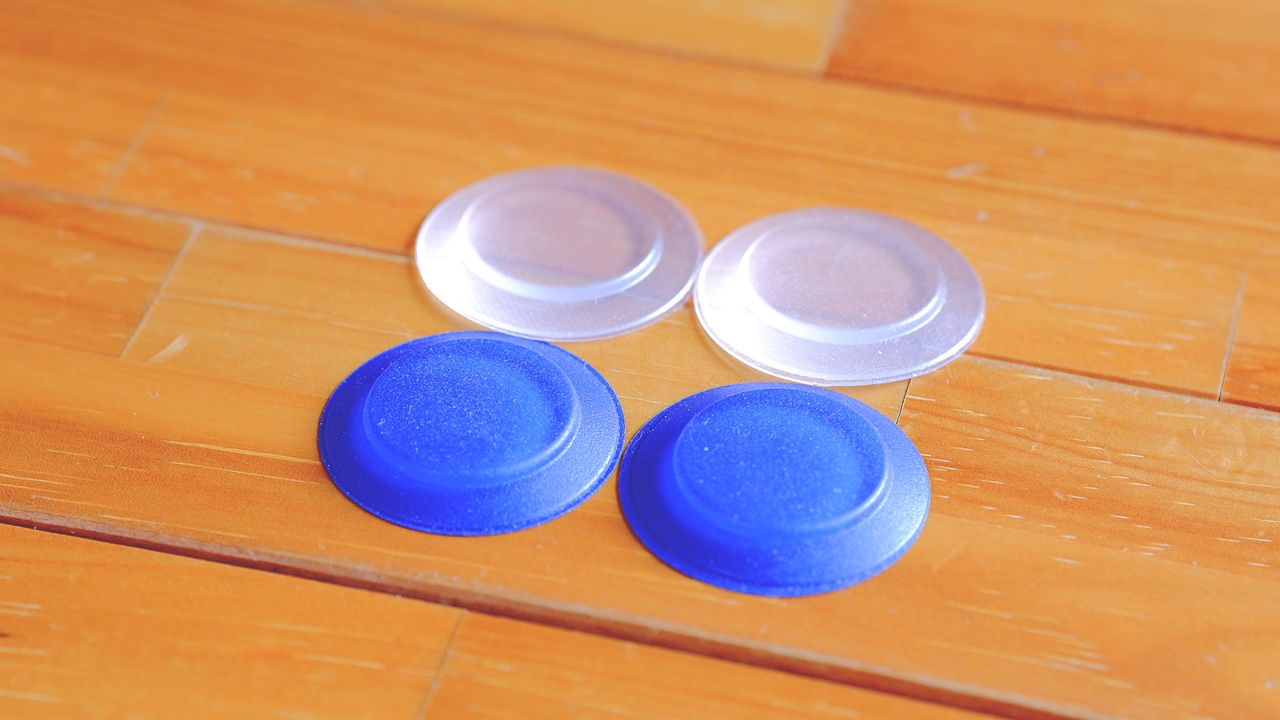
There is still quite a good deal of softness remaining, yet the frequency range opens up both top and bottom, sound pressure rises, and the presentation becomes more energetic. There is a greater sense of life-size presence and added impact coming forward — though the slightly bloated imaging that comes with it is perhaps a point of concern. The resolution of resonances such as the growl of piano strings improves, and overall sound quality is better than with the clear pads, but the balance in the initial stages of settling is still not quite there. I thought I would leave it for a few days to see how it settled, but there was something about the sound that felt physiologically unpleasant, and it was fairly quickly rejected.
Inakustik H-Gel EX-ABSORBER × Blue Gel Pads (Medium) ★★★★★ 5 points
Next, I try changing all four pads to blue gel (medium). High-frequency resolution improves further, while the energetic forward-pushing quality is resolved and the presentation returns to a deeper, more rearward expansion. There is a greater sense of note density and a richer overall impression. The balance is slightly mid-forward, but in terms of soundstage scale, front-to-back depth, and energy balance, four blue pads across the board is preferable to either four clear or the mixed combination.
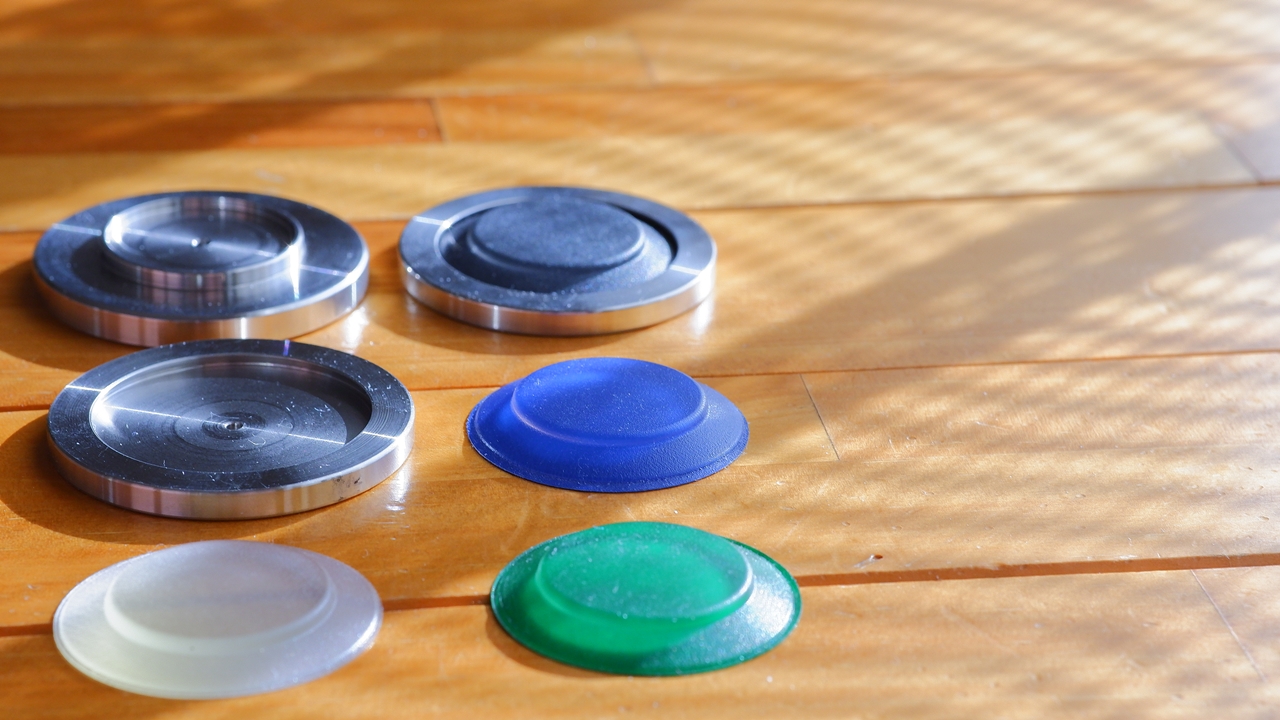
However, the high frequencies take on a more metallic character as the stainless steel’s own character comes through more prominently, and one gets the feeling that the nervousness the Moon Neo 220i exhibits in the upper registers is not being cancelled out sufficiently. Even so, in the initial stages of settling, the mid-to-low frequency region is still noticeably soft in character. That said, this is to be expected with the EX-ABSORBER, so the question is what the final result will be once things have settled over a few days.
Switching back from EX-ABSORBER × Blue Gel Pads to P50D-J
Having failed to shake off that sense of unease with the EX-ABSORBER Blue 4, I switched back to the J1 project P50D-J once more to confirm my impressions. Against the EX-ABSORBER’s soft character and rich, note-dense presentation, the P50D-J’s composed, flat soundstage with genuine depth feels like the more straightforward tonal match for the Simaudio Moon Neo 220i — a sound that draws out the amplifier’s natural temperament more directly. It’s clean and uncluttered, and if I’m honest, I prefer the P50D-J.
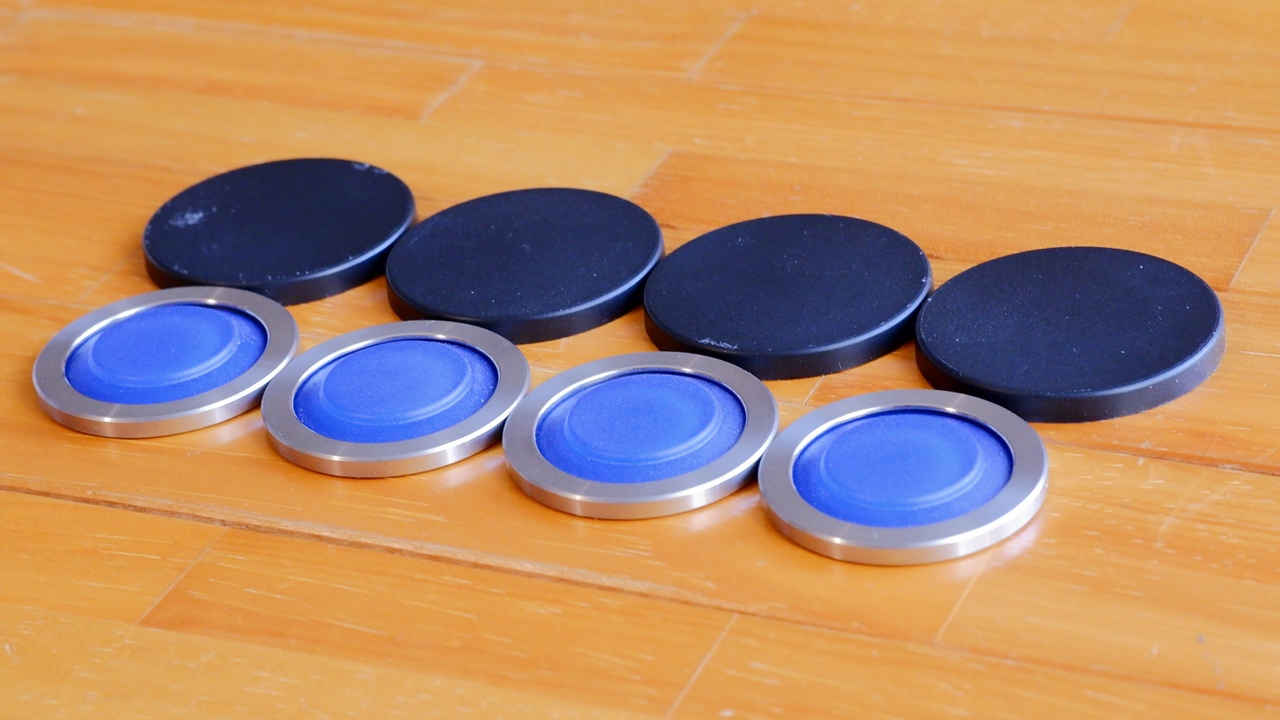
That said, the EX-ABSORBER Blue 4 clearly produces more notes and a larger stage, and in purely audiophile terms it suggests a higher level of potential — so choosing between the two is genuinely difficult. The EX-ABSORBER Blue 4 has the stronger sonic influence as an isolator, and that cuts both ways: both the merits and the drawbacks come through more strongly. In terms of showroom appeal, the EX-ABSORBER Blue 4 is the obvious choice — it sounds conspicuously impressive and easy to sell.
Back to EX-ABSORBER + RF-ABSORBER Included Blue Gel Pad
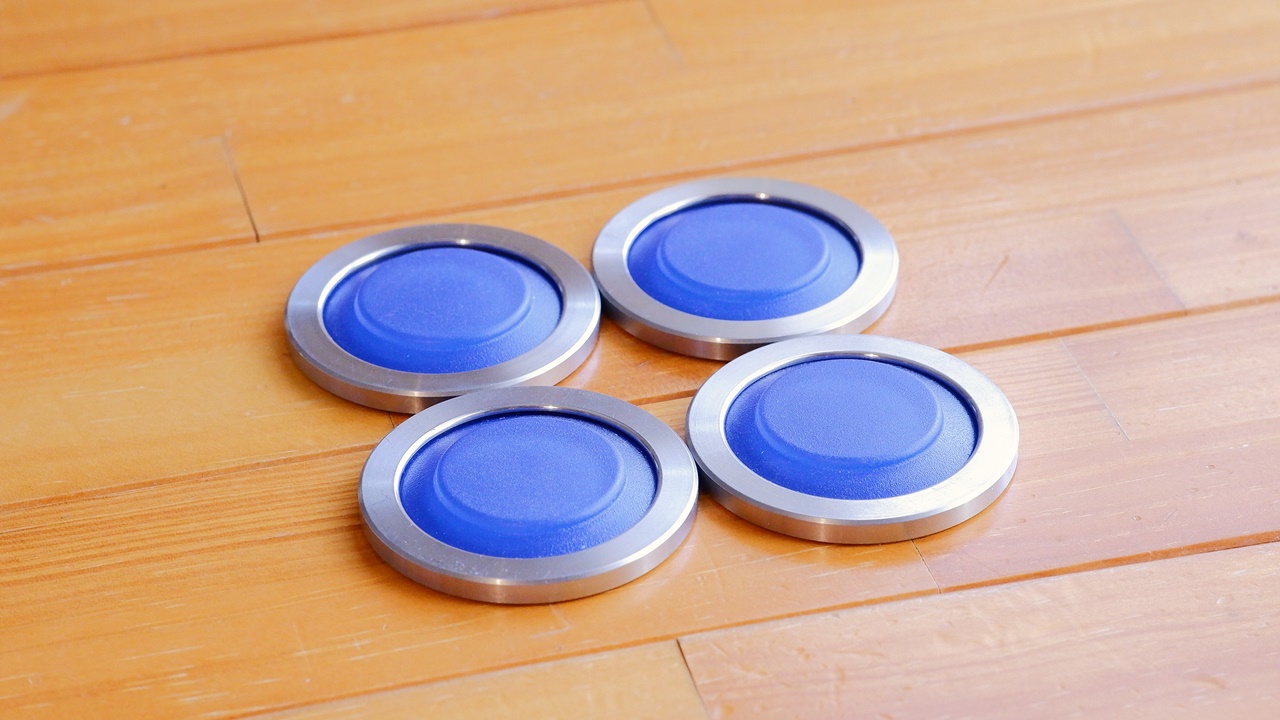
I set everything up more carefully than before, paying closer attention to how the unit stacked against the stock feet and ensuring the stress across the gel sections was distributed evenly. The effect was surprisingly immediate — the softness of the gel that had bothered me first time round was barely noticeable compared to when I initially installed it. After going back and forth several times between the Acoustic Revive RKI-5005, J1 project P50D-J/4P, A50R-J/4P, and EX-ABSORBER Blue 4, I kept arriving at the same conclusion: the largest improvement in sound quality came from the EX-ABSORBER combined with the Blue 4 gel pad. The polished, high-end-style beautiful tone, the wide frequency range, the expressive musical dynamics, and the rich, full-bodied energy all coexist — it’s a rather showy and thoroughly attractive presentation.
Running In the EX-ABSORBER × Blue Gel Pad for Three Weeks
The remaining issue was a nervy, clanging quality in the upper frequencies, but after three to four days that settled down and reached what I would call a practically acceptable level — so the high-frequency hardness was fully resolved. However, as more days passed, the EX-ABSORBER’s characteristic abundance of resonance began to stand out, and the sound gradually started shifting in a direction where the actual notes became masked by that resonance. With this isolator, the sound is at its softest immediately after installation and hardens over time, yet even after three weeks the low end still retains a certain softness. The stage remains large and there is a pleasant sense of shimmer, but overall the sense of pace has dropped compared to when it was first installed, and the character has drifted towards something relaxed and rather languid… Honestly, it reached the point where I found myself thinking: wait, is this really the system being driven by the Moon Neo 220i? — the tonal shift towards something so gentle was that pronounced. Somehow this just isn’t the sound I was after.
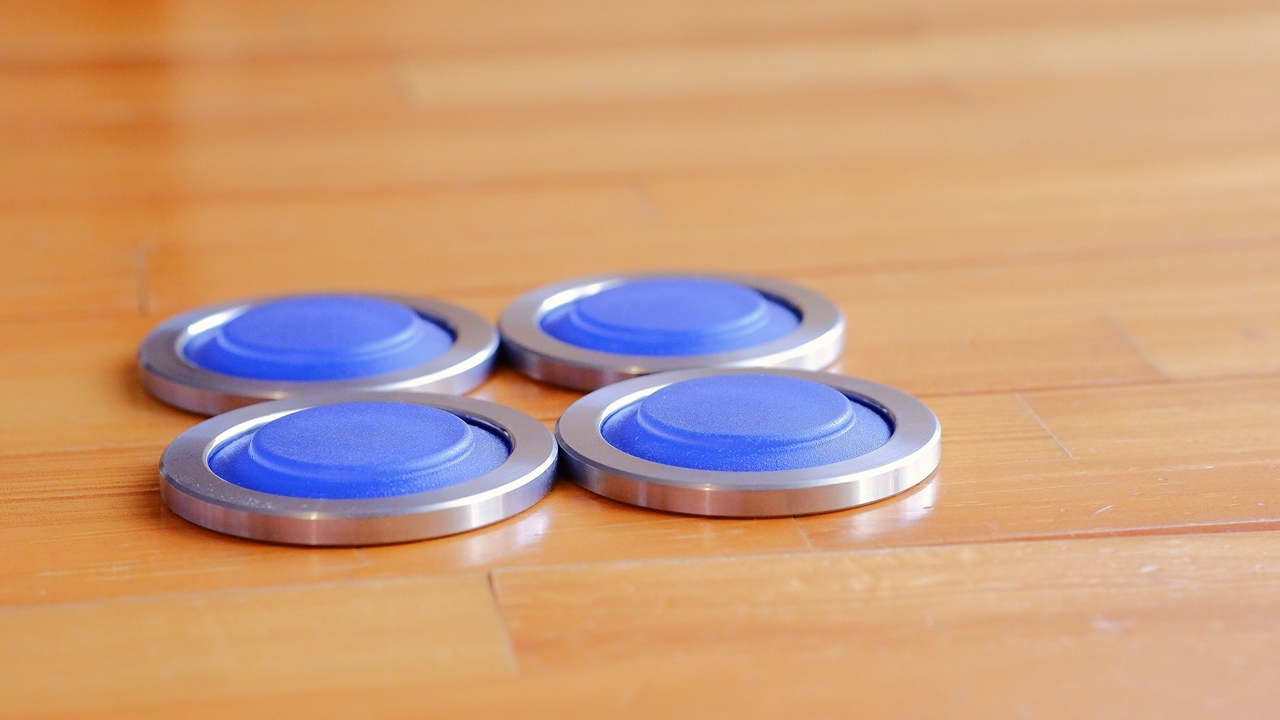
As it happens, when I was previously using the Moon Neo 220i in my main system, I compared various options against the higher-range RF-ABSORBER and settled on the hard-type black gel — and after spending three weeks letting the blue gel settle in, the conclusion is that, once again, the black gel seems to suit the sub-system better as well. However, the eight black gel units I have on hand are already taken up by the SACD player ONKYO C-S5VL and the DAC CI AUDIO VDA-2 in my main system, so there are none spare to rotate into the Moon Neo 220i…
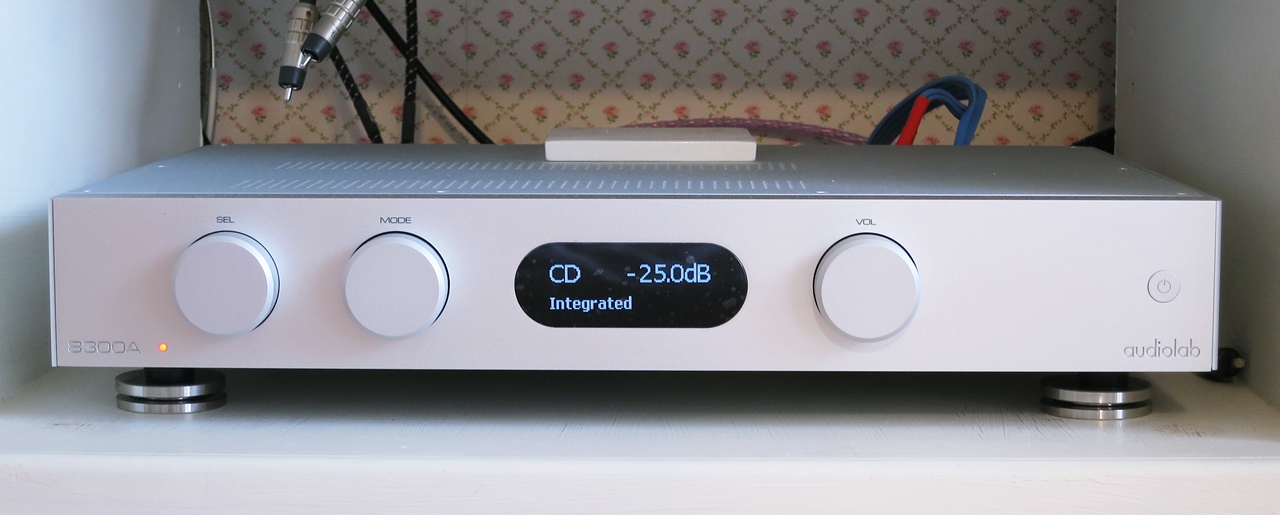
Trying the J1 project A-50R-J again.
The sense of unease I had been feeling with the EX-ABSORBER blue×4 had, if anything, grown stronger as time went on rather than fading, so I came full circle and went back to the J1 project A-50R-J, which had shown the best balance with the fewest drawbacks up to this point. The sense of stage expansion that came with the EX-ABSORBER disappears, but the tonal balance moves closer to flat, and the sonic character that is intrinsic to the Moon Neo 220i — its dry, sharp-edged rendering and sense of pace — returns. On top of that, with the J1 project A-50R-J there is no pressure in the upper frequencies whatsoever. Above all, it is the J1 project A-50R-J that allows the musical expression encoded in the source to come through more directly, without any sense of theatrical colouring. In purely audiophile terms of presentation it falls short of the EX-ABSORBER×blue 4, so the possibility remains that comparing it against EX-ABSORBER×black 4 might yield a different result — but for now, I would like to make the J1 project A-50R-J my final answer for this audition.
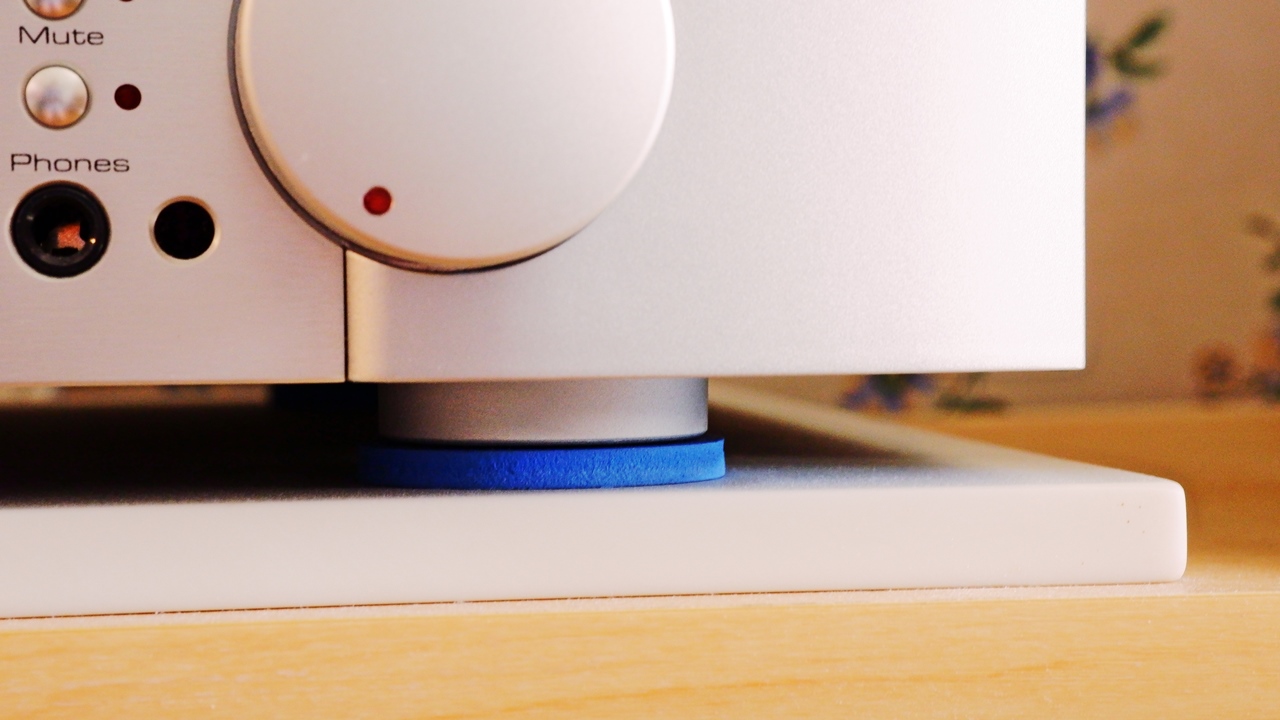
Incidentally, the P50D-J/4 from the same J1 project range is also difficult to set aside — the P50D-J/4P has a slightly pronounced material character, yet its appeal lies in a straightforward, unrestrained resonance; whereas the A50R-J/4P is the type that damps resonance and removes distortion. In terms of adaptability across music and equipment, the A50R-J/4P has the edge, though I do also have a fondness for the sound of the P50D-J/4P. That said, the challenge this time was how to bring the mid-to-upper-range pressure of the Moon Neo 220i under control, so the A50R-J/4P, which is more effective at reducing the sense of distortion, is the one I would like to go with.
~ Summary ~
This time, with the aim of drawing out the full performance of the Moon Neo 220i integrated amplifier in Sub-system A, I tested around 17 different insulators. The EX-ABSORBER, which I had been counting on as the top candidate, ended up in second place — though it probably would be worth retesting it with the black gel pads at some point. That said, it was a real discovery to find that the A50R-J/4P, which had been sitting unused all this time, could deliver a solid insulation effect and good control of high-frequency distortion. And then there was the rediscovery of the potential of the J1 project P50D-J, which was another find worth noting. During the test, the Pro-Ject Head Box DS DAC was sitting on top of the Moon Neo 220i, with J1 project A40R (old US-made type) placed between the lid and the DAC — I tried various things there as well, and I hope to write about that in a separate article at some point.

One important point I would like to pass on to anyone who has read this insulator review and wishes to take something useful from it. In my own case, there are various insulators and accessories I have bought and tried that simply did not match well — but in most instances I have kept them stored away and very rarely let them go. The reason is that when the time comes to set up and tune things with new equipment in the future, I want to have as many options as possible to choose from in terms of combinations.
With insulators and audio accessories of all kinds, the better combinations and compatibility change in endless ways depending on the equipment and how it is paired, as well as the environment — including the room and the power supply. In other words, there are very few insulators or audio accessories that will reliably produce good results in every environment, and equally, a product that fails under every conceivable condition would itself be quite a rare case.
 ポチップ
ポチップ
If I were asked which single insulator among the ones introduced here I personally find most pleasing in tone, it would actually be the Audio Replas OPT-1 HR, made from synthetic quartz. And yet, when evaluated in combination under the conditions of this particular test, it scored the lowest. Hi-Fi enthusiasts tend to look at the result in one particular environment and jump to a definitive judgement about whether a piece of equipment or a product is good or bad — but one of the deeper pleasures of Hi-Fi is that something you had written off can, in a completely different environment, or with the equipment its developer originally had in mind, produce a wonderfully musical sound.
 ポチップ
ポチップ
Myself included, most users are quite likely not drawing out the sound quality that the makers of each piece of equipment or accessory actually had in mind — and if one keeps that in mind and approaches audio with a degree of humility, it becomes possible to avoid the trap of dismissing a particular product outright simply because it does not sound good subjectively in the moment. By always maintaining an objective perspective that can hold judgement in reserve, one’s relationship with the equipment and accessories one has already acquired changes, and I think it becomes possible to develop the kind of flexibility that allows one not to miss the hints that lead towards better sound.

Auto Translated by CS4.6