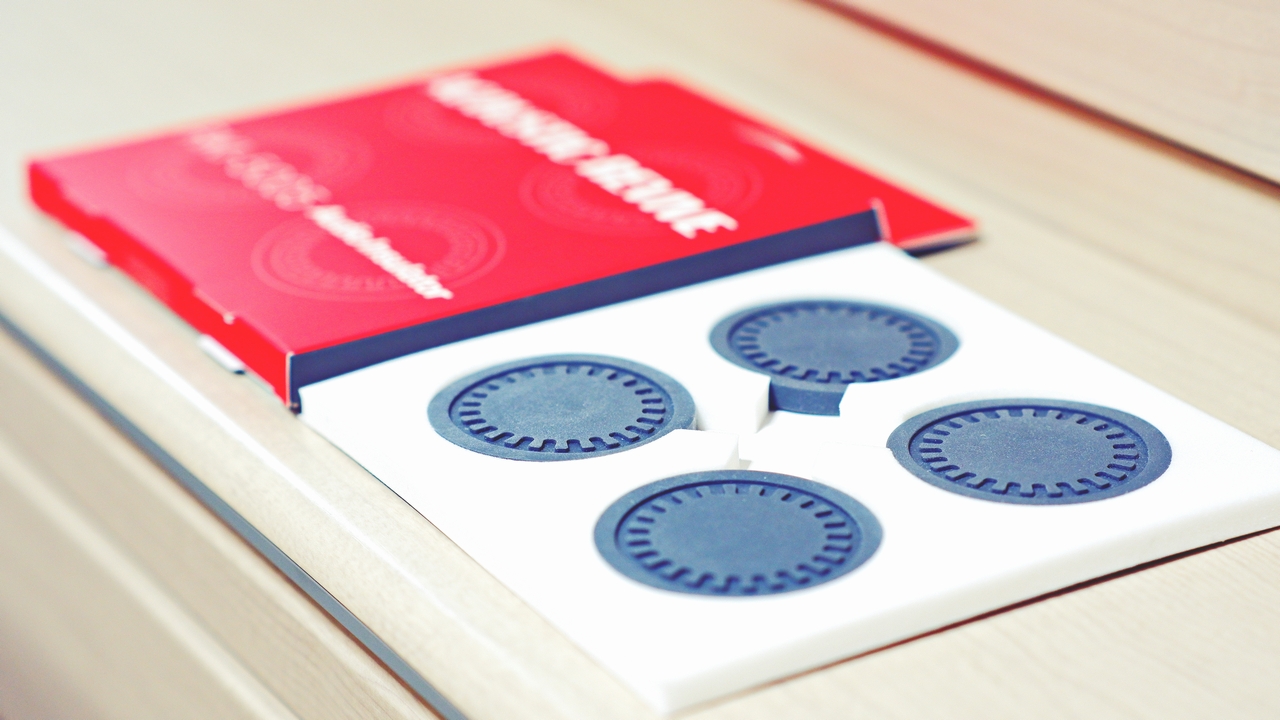
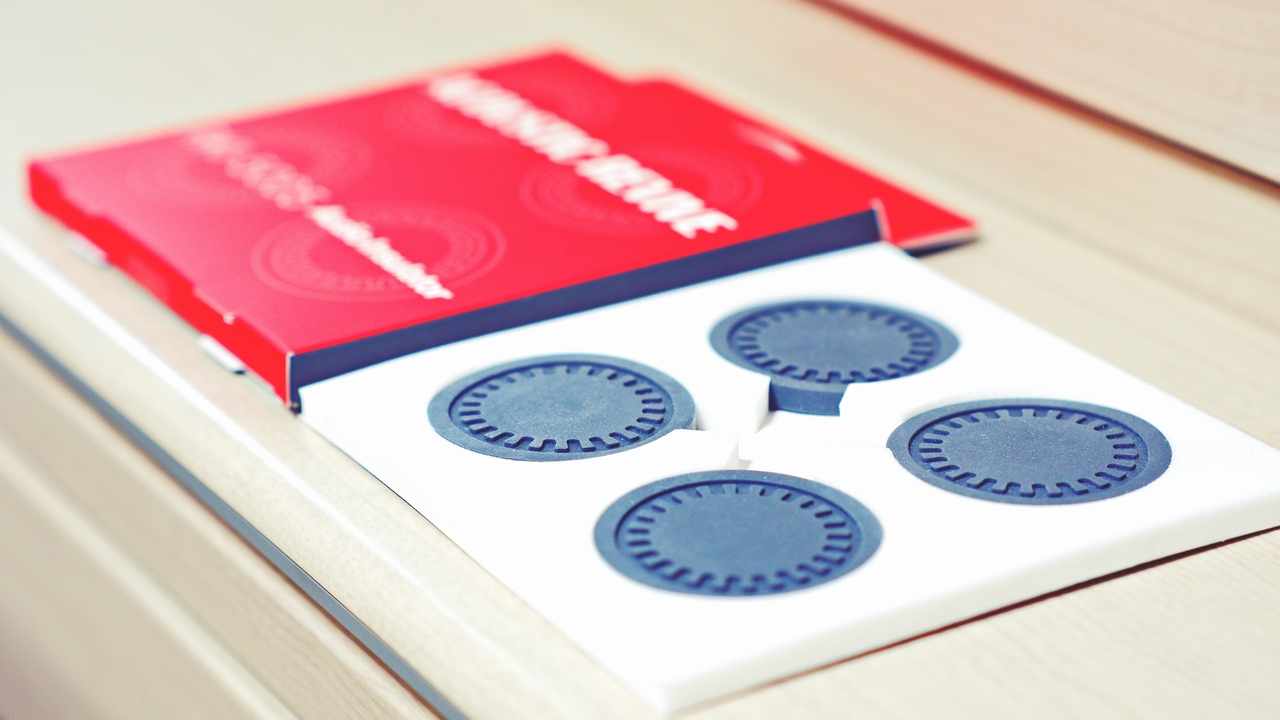
This time — unusually for me at AUDIO STYLE — I reserved a unit in-store and picked it up right on release day: a review of the new Acoustic Revive RKI-5005 Hi-Fi insulators. I bought them at my local specialist Hi-Fi shop, Audio Shop Square. The shape is very easy to work with, and the price is — well, peculiarly high, yet oddly tempting for the Hi-Fi enthusiast mindset — so I have a feeling these could be a runaway hit. Incidentally, the RKI-5005 apparently uses the same material as the already-released and hugely popular turntable sheet RTS-30, re-tuned and repurposed for use as an insulator.
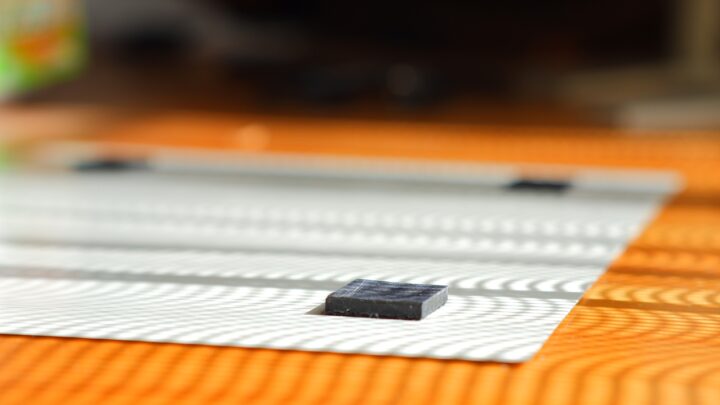
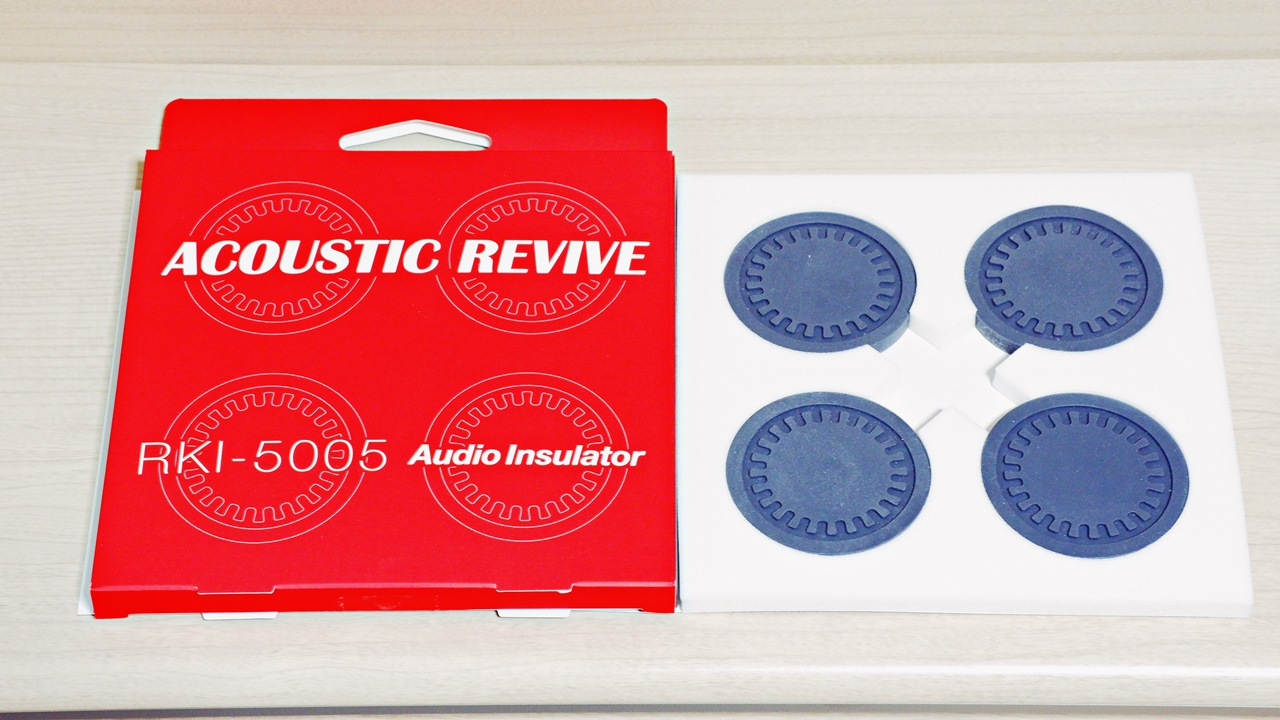
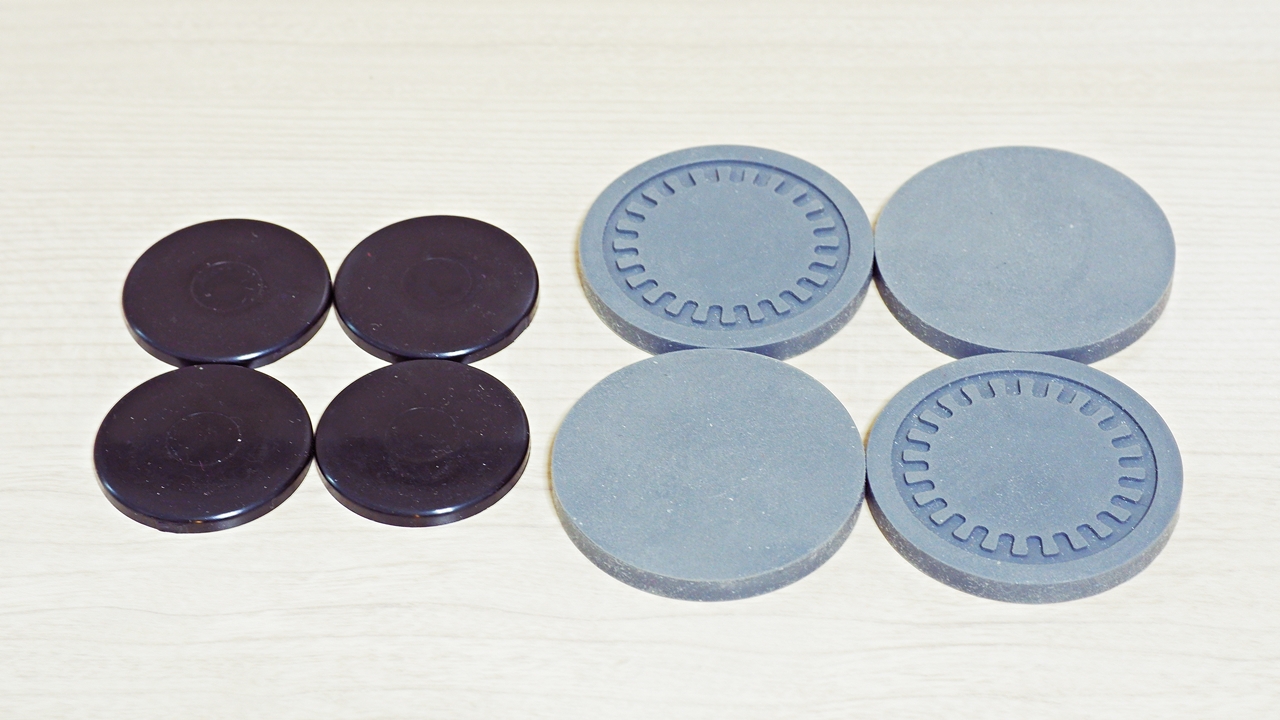
The Acoustic Revive RKI-5005 measures 5 cm in diameter and 5 mm in thickness — a very practical size for an insulator. The feel is that of a firm rubber pad, and the colour is grey. Honestly, the appearance does not convey the sense of luxury one might expect at this price. Opening the package, there is a faintly pleasant smell. The underside is completely flat, and you use it with the textured side facing up. It is described as a firm silicone-based material, though it bends with a slight give, so if you leave equipment sitting on it for an extended period, foot impressions may remain. It has a fair amount of elasticity — drop one and it bounces lightly. It is not the smooth type, so dust tends to cling to it, which is a minor drawback; on the other hand, the surface does not slip, so it should also serve reasonably well as an anti-slip pad for earthquake-proofing purposes and the like.
About the Special Material in the Acoustic Revive RKI-5005
The silicone-based material is described as “impregnated with natural minerals including Kiyouseki and tourmaline”, and — very much in the tradition of Acoustic Revive’s cheerfully occult approach — it promotes negative ion effects. Beyond its use as an insulator, it can apparently also be placed on top of equipment or attached to it, with the aim of eliminating static electricity and generating negative ions. Tourmaline and Kiyouseki are said to produce negative ions more actively when pressure is applied, so even when used as an insulator, the pressure exerted by the equipment is supposed to fill the area around your Hi-Fi system with negative ions. Which would mean, I suppose, that heavier equipment might actually be more effective… Well, it is all rather baffling, to be sure.
Dust clings easily, but alcohol, detergent, and chemical cleaners are all prohibited for wiping it down. The recommended method is to wipe with a soft, non-fluffy cloth dampened with water, then allow to dry. When things are really bad, a quick rinse under water followed by immediate drying should do the trick.
RKI-5005 Sound Quality Review ♪
The overall sound tendency is full-bodied and taut, with a bright, smooth tonal quality in the mid to upper-mid range. Acoustic Revive products tend strongly towards wide-range presentation, which I was actually a little worried about, but there is no harshness or distortion-like quality in the upper frequencies whatsoever. If anything, true to its silicone character, it moves in the direction of removing a sense of distortion. The mid to low range gains a certain stickiness and density, with a slightly enhanced push, and energy and focus increase. The influence of the silicone material is not entirely absent — there is a very slight softening, and the impression that the sharpest edges of transients are very gently rounded off — but for a rubber-type insulator prone to dulling the sound, the side effects are fewer than expected, and the sense of speed on transients is reasonably well preserved.


 ポチップ
ポチップ
The soundstage becomes larger and more realistic in scale, but the amount of fine spatial detail is somewhat tidied away; it is the type that draws your ear towards smoothness rather than granularity. In return, the musical flow — the clarity of melodic lines — is good, and musicality is nudged in a somewhat more buoyant direction. There is a particular character in the way sound is held together, with a sense of stickiness and damping that gives it a distinctive personality; how well that meshes with your system’s own presentation will likely be the key factor. If it does not mesh, the result might end up feeling a little noncommittal — neither here nor there.
The RKI-5005 has a moderate damping quality, and the tendency for musical energy and focus to increase feels natural — so much so that once you have grown accustomed to its sound and then remove it, things can feel as though the volume has dropped slightly and the sound has become thin. That said, the openness of the soundstage and the extension upwards into the high frequencies are actually better without it, so if there is one small drawback to mention, it would be that trade-off. That said, rather than immediately after fitting, leaving it in place for a while — anywhere from a few hours to a few days — allows fine detail that was initially masked by the silicone material’s own smell to emerge, transient response also improves, and it is the type of insulator that simply sounds better once it has settled in.
Overall, there is not much in the way of a sharply distinctive character — rather, it reads as a well-schooled, competent piece of work, tuned in the very Acoustic Revive manner to suppress as much as possible the shortcomings typically associated with silicone-rubber insulators. The effect is honest and mild — for better or worse. Conversely, in terms of how much character it imparts relative to what one might expect at this price, I personally find it a little underwhelming, and I honestly think the value for money is somewhat lacking. For speakers, you would need two sets to go around… Had the recommended retail price for a set of four been half what it is — say, around three thousand yen in actual street pricing — I would have been singing its praises unreservedly.
Testing with the CREEK Sub-System
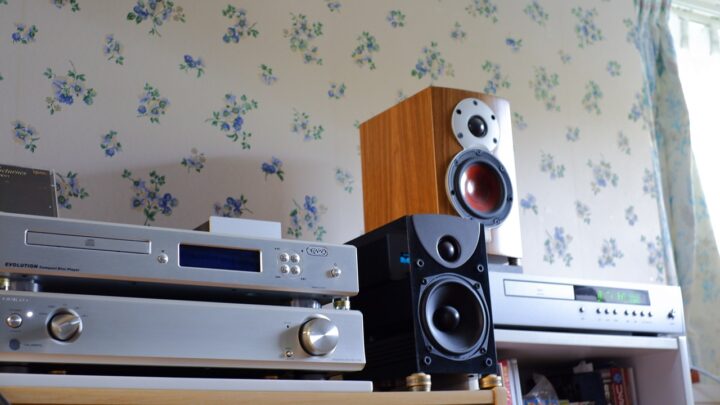
On the steel top panel of the CREEK CLASSIC CD, the integrated amplifier CREEK Sequel2 normally sits on J1 Project ICP damping spacers P35D-J/4P between its hard rubber feet and the surface below. I try leaving the P35D-J/4P spacers in place and adding the Acoustic Revive RKI-5005 underneath them. Hmm… the sound has gone dead. The harshness in the highs does disappear, but the sound moves in a slightly boxed-in direction. The richness through the mid to low range becomes attractive, but there is also a sense of constriction in the soundstage’s spread… Each insulator had its own balance, so layering them arbitrarily just did not work.
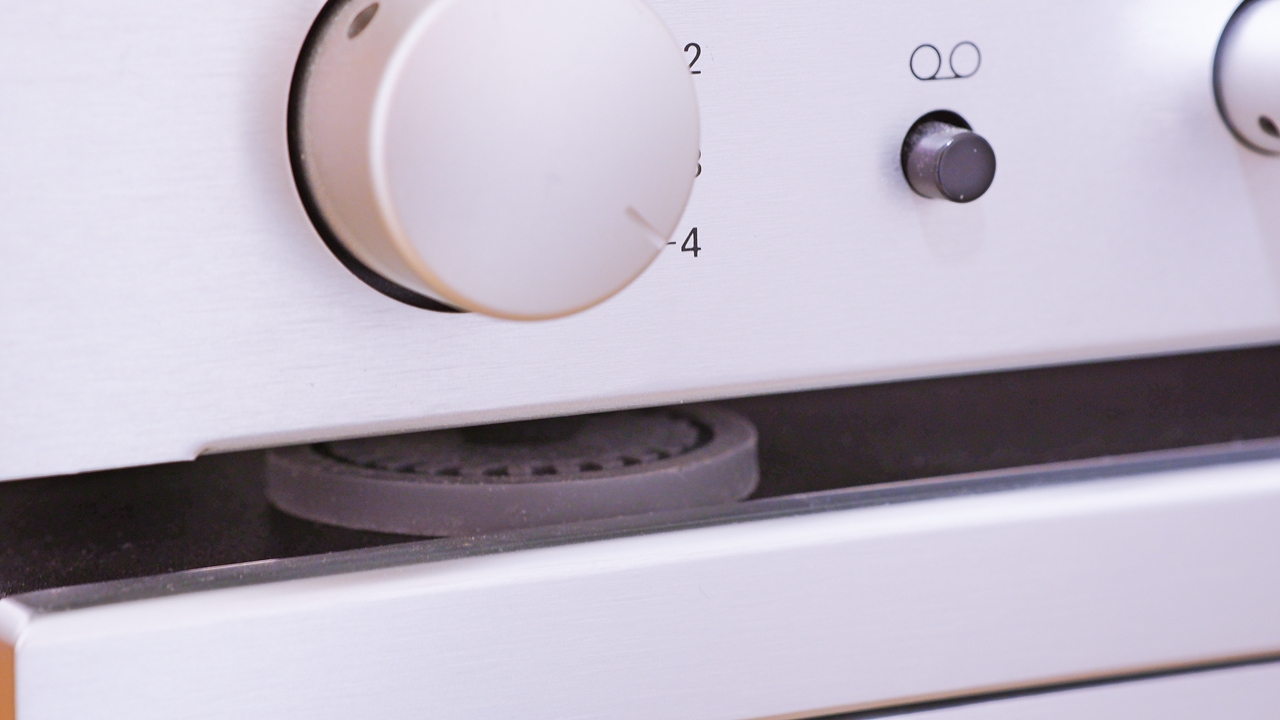
Trying the RKI-5005 on its own, things are considerably more sensible compared to the stacked combination — but while the weight and thickness of the mid to low range and the presence of the sound image increase, the high-frequency response, already on the reserved side, is suppressed further, leaving an overall impression that feels somehow inconclusive. Once my ears have adjusted to the RKI-5005 and I remove it, I do briefly feel a thinness in the sound — but since this system already has ample energy, going without the RKI-5005 actually gives better clarity in the fine detail and a more open, easier-to-listen-to soundstage. Returning the J1 Project damping spacers P35D-J/4P that were there originally, they may not match the RKI-5005 for bass drive and weight, but they add a distinctively charming, beautiful resonance that compensates for the amplifier’s weakness (a somewhat dead tonal quality in the high frequencies) — so in the end, everything goes back where it was, and the RKI-5005 does not make the cut for the Sequel2.
 ポチップ
ポチップ
Trying it with the Pro-Ject DAC Box DS D/A Converter
I try placing the Acoustic Revive RKI-5005 under the compact DAC — the Pro-Ject DAC Box DS — used in the DALI MENUET sub-system. Beneath it is the top panel of a Clavinova (probably MDF faced with some South-East Asian timber), and the DAC has the small round rubber feet common on compact audio equipment of this size, so this also becomes a silicone-on-silicone pairing.
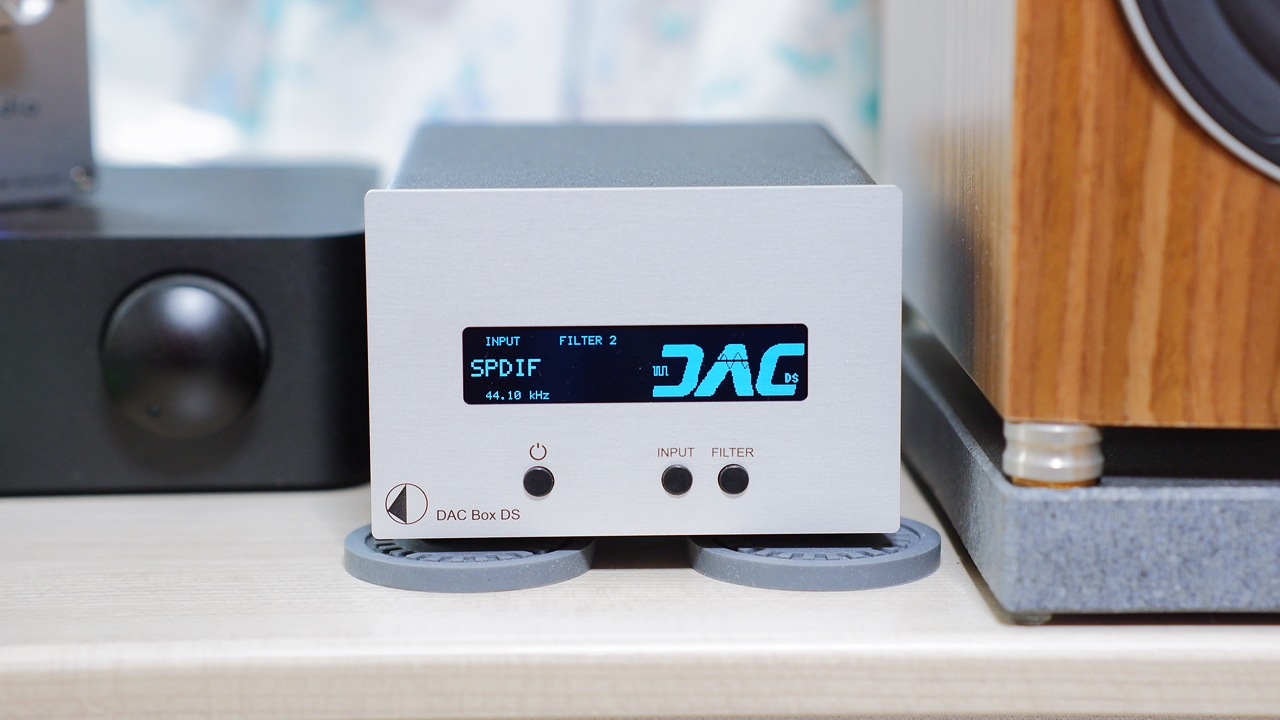
I was curious whether the effect would carry through on a small, lightweight unit weighing under one kilogram — and fitting them does produce a generally fuller, more vibrant, bright and lively tendency. The imaging is less of the pinpoint, solid variety, and more of a smooth, well-fleshed, tangible kind. The soundstage drops very slightly in perceived height. This pairing gives a satisfying sense of substance and leaves a fairly positive impression. Removing the RKI-5005, the sound pressure drops and the soundstage recedes and rises, though depth and vertical spread may actually be better without it.
Trying it Under the Miuaudio MKTP-2 Valve Digital Amplifier
I move the Acoustic Revive RKI-5005 from under the Pro-Ject DAC Box DS and transfer it to the even smaller micro valve digital amplifier Miuaudio MKTP-2, connected downstream via a Nordost Blue Heaven. The amplifier’s feet are small cushion-rubber pads, 5 mm in diameter and 2 mm thick, in transparent silicone. The surface below is the top panel of a ROTEL RDA-06, in solid aluminium with high rigidity.
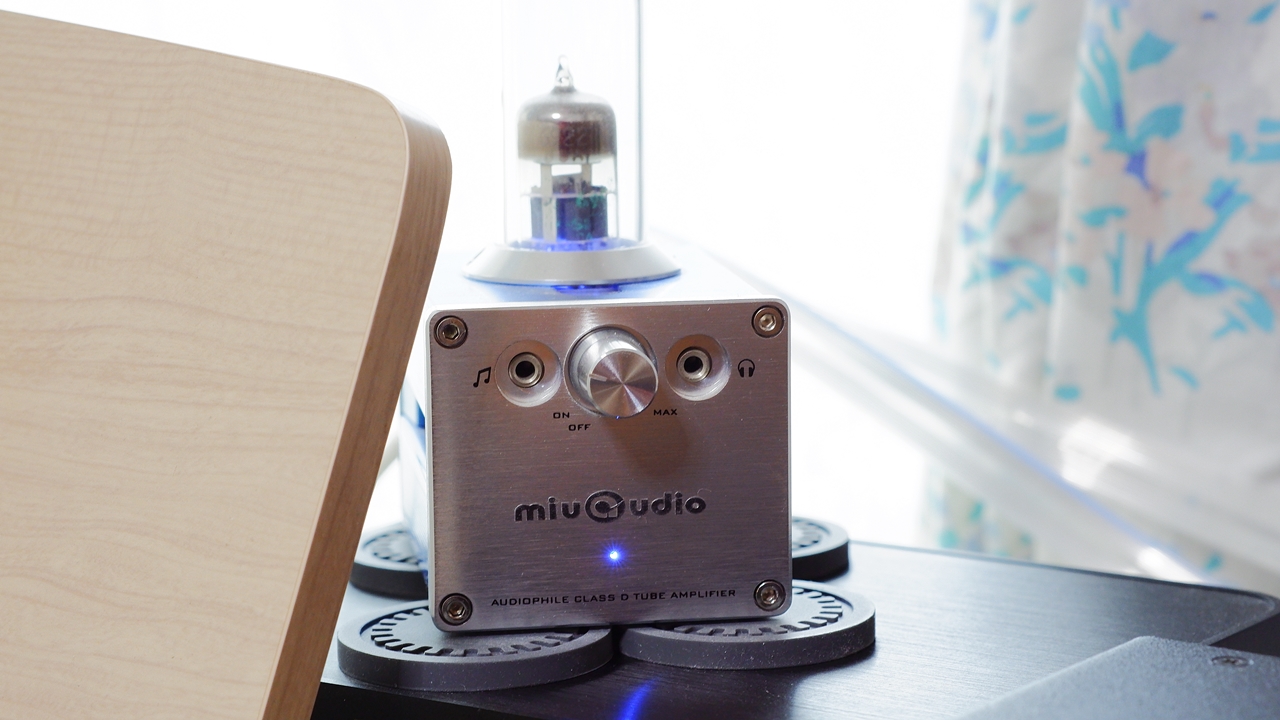
Along with an increase in musical energy, the lustrous quality of the upper-mid range is appealing. The added tautness and brightness are the same here as elsewhere. The sense of fullness in the low end was more pronounced on the DAC side, from the impression I had. The amplifier has a tendency for the soundstage to become overly diffuse — partly due to the PHILIPS 6922 valve in use — and the RKI-5005 provides a degree of damping in that direction. The previously scattered resonances seem to wrap themselves around the sound image, adding a rich thickness. Rich and smooth, though the granularity of the spatial information does diminish somewhat.
I only purchased one set of RKI-5005 this time, so I cannot say what would happen if both the Miuaudio MKTP-2 and the Pro-Ject DAC Box DS had them fitted simultaneously. Even so, one set already feels sufficient — or rather, fitting both might simply strengthen the silicone character of the RKI-5005, and while the damping would increase, the openness of the presentation would be traded away, which could become a concern. If fitting only one, which position is better… hmm, a difficult choice. In terms of compensating for weaknesses, perhaps the amplifier? ※ Of course, which is better will vary depending on each individual’s system. Also, for use under equipment that runs quite hot, I am a little curious about heat resistance and long-term thermal durability — though being silicone, it is probably fine in normal terms.
~ Summary ~
In an unusual turn for AUDIO STYLE — a site whose reviews typically arrive years after a product’s release, thoroughly behind the times — this is an emergency review right at launch ♪, so the testing ends here for now. I have not had the Acoustic Revive RKI-5005 long enough yet, and there will likely be more to notice as time goes on. My initial impression is more favourable than expected, and it is an insulator that suggests various possibilities; and in fact, the primary intended use I had in mind when purchasing it is elsewhere entirely. Results from further tests in different configurations will be added to this page as and when they happen.
ポチップ
To summarise the character of the Acoustic Revive RKI-5005: within the musical frequency band, the overall quality is bright, taut, and positively full-bodied, with a tendency towards softness. In that respect, it seems particularly well suited to taming systems where the resolution is too high, the sound is too hard, and the highs are harsh. Conversely, it may not be a good match for systems whose high frequencies are already on the dead side. It excels at three-dimensional placement and realistic imaging within the soundstage, but the spread of the ambient and indirect sound components is somewhat restrained, and the musical frequency range tends to push slightly forward. It is not quite what one might call a “kamaboko sound” — a pronounced mid-range hump — but nor is it flat, as one might put it. If you are already an admirer of the Acoustic Revive RTS-30 turntable sheet — which has been so warmly received — and appreciate its sonic character, adding the RKI-5005 will very likely make you even happier.
 ポチップ
ポチップ
The sluggishness in transient response and a certain sense of constriction — typical of silicone-rubber materials — both appear to have been addressed with considerable care. They are not entirely absent, even so, and how to make the most of those traits will likely be the key to getting the best from the RKI-5005. In terms of direction, it suits entry-level Hi-Fi systems that lack control and energy — the sort that can sound somewhat thin and underpowered — by adding damping and generating organic energy. The price is admittedly on the high side, but if you find yourself feeling that your sound lacks body and richness, I think it is worth a try.
 Category:Acoustic Revive (アコースティックリバイブ)Category:その他オーディオアクセサリー


Auto Translated by CS4.6