【Banana Plugs and Spade Lugs Unnecessary in Hi-Fi?】
Part 1|Part 2|The sound of plating|AT6301|Banana Plug Sound Comparison
In this article, I will look at the pros and cons of using spade terminals and banana plugs.
Q: When connecting speaker cables to my speakers, which manufacturer’s banana plugs would you recommend?
A: There is no particular recommendation I can offer…
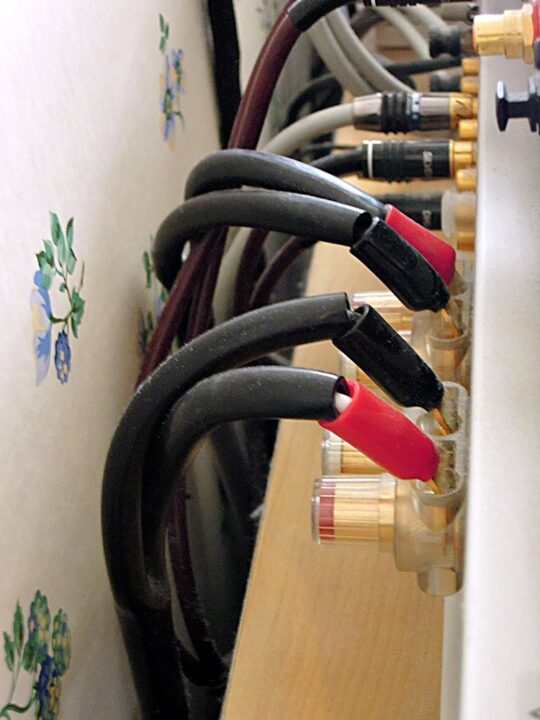
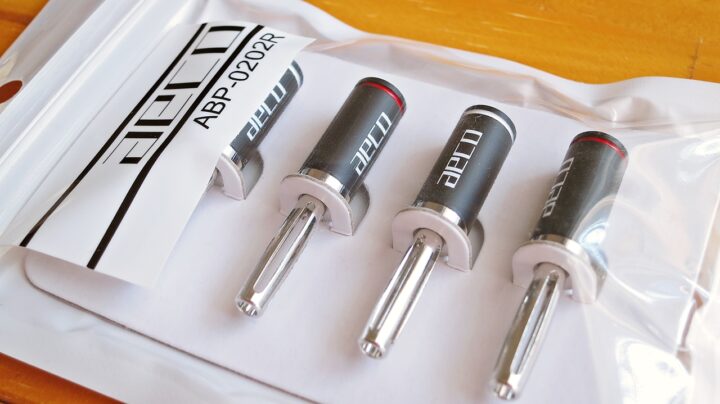
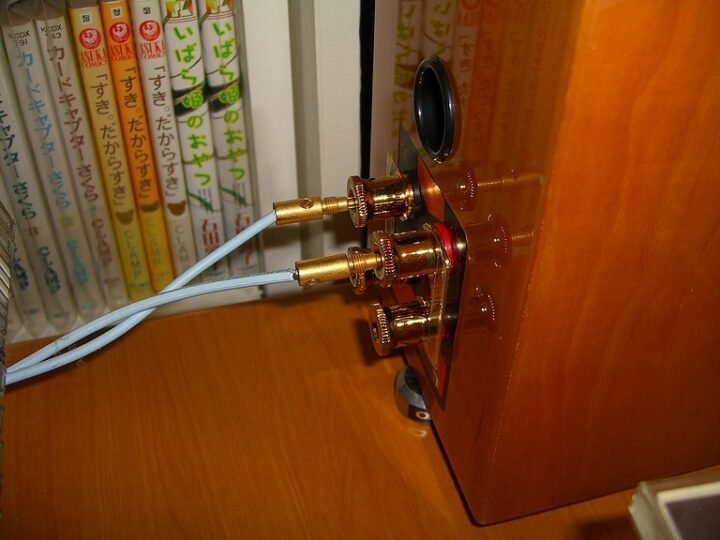
Banana plugs are, by their nature, something to be used provisionally — in situations where you find yourself constantly plugging and unplugging speaker cables on a daily basis, such as in a shop or at the home of a keen Hi-Fi enthusiast, and where direct connection each time simply becomes too much of a bother. From a sound quality standpoint, it is better to avoid them wherever possible. If we rank the methods of connecting speaker cables from best to worst in terms of sound quality, from left to right…
Direct connection > Spade terminals > Banana plugs
In theory, this is how it works. The best option sonically is the most ordinary method of all — connecting the speaker cable directly to the speaker terminals and amplifier terminals with nothing in between. When using a standard speaker cable with typical connection terminals, this should introduce the least distortion and yield the most ideal, straightforward sound quality for all components and cables alike.
 Next, there are situations where the thickness of the speaker cable simply will not fit into the equipment’s terminals. Many speaker cables designed for audio use have thick conductors, and there are also cases where certain amplifiers — particularly those made overseas — cannot be connected at all without banana plugs, or where the spacing between terminals on very compact amplifiers is so narrow that connecting via banana plugs with insulating sleeves is actually preferable from a safety standpoint.
 Sound quality comparison of 4 types of banana plugs [from 100 to over 10,000 yen]Audio-Technica AT6301 : Good value banana plugs
Also, when using a simple jumper cable made by simply cutting a piece of your preferred speaker cable to length, the terminal holes may end up blocked by the jumper cable, making it impossible to insert the speaker cable.
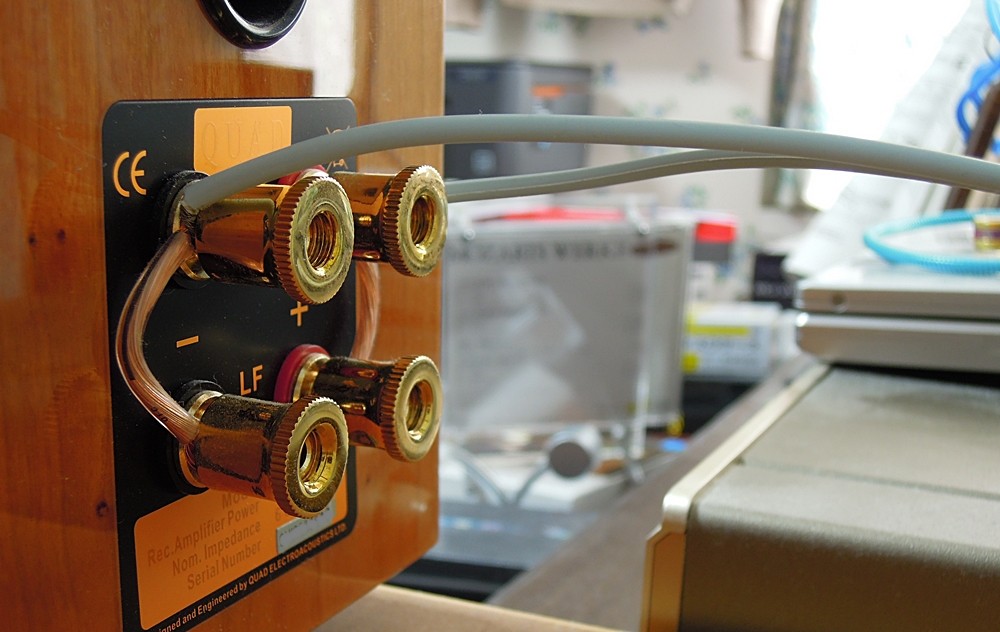
In cases like this, I trim the conductor strands of the speaker cable with scissors until they are thin enough to fit into the terminal, reducing the exposed section, and then twist them together. Even if the number of strands is reduced by roughly half, the effect on sound quality is almost negligible compared to using banana plugs or spade connectors. That said, making them too thin risks the conductor snapping under the clamping pressure of the terminal screw, so it is best not to go too far.
The next method is one introduced by Mr Kanaimaru of SONY, in which solder is flowed into the conductor ends. I have never actually tried this myself. Done well, using a minimal amount of high-quality solder, I think it could result in less sonic impact than using spade connectors or banana plugs, while at the same time making the speaker cable ends easy to insert and remove. When fine stranded wire is connected directly to a speaker terminal, the sound tends to become slightly rough or blurred — perhaps due to the speaker’s vibrations being transmitted through the conductors — but using solder could avoid micro-level irregularities at the contact points, and in some cases the result might be a smoother, rather pleasing sound. Of course, one must be prepared for the character of the solder material itself — tin, silver, and so on — to colour the sound to some degree, so finding a balance that accounts for that is all part of it. Writing this, it occurs to me… perhaps I should give it a try with Oyaide’s SS-47 acoustically dedicated alloy solder, which has a good reputation for sound quality, or the German WBT silver-bearing solder WBT-0820…


With speaker cable sold by the metre, the question of when you actually need to strip back the oxidised or corroded conductor ends comes down to this: in principle, every time you reconnect. Of course, if you only stripped the cable yesterday or the day before, there is no need to strip it again just because you have reconnected it — but whenever you occasionally rearrange your wiring, or give the area around your Hi-Fi a thorough clean and remove the cables in the process, stripping the speaker cable ends afresh as a matter of course is the basic principle of serious hi-fi listening. Also, please do not twist the conductors with sweaty or greasy fingers. When handling cables, at the very least wash your hands first, or if you are particular about it, wear gloves.
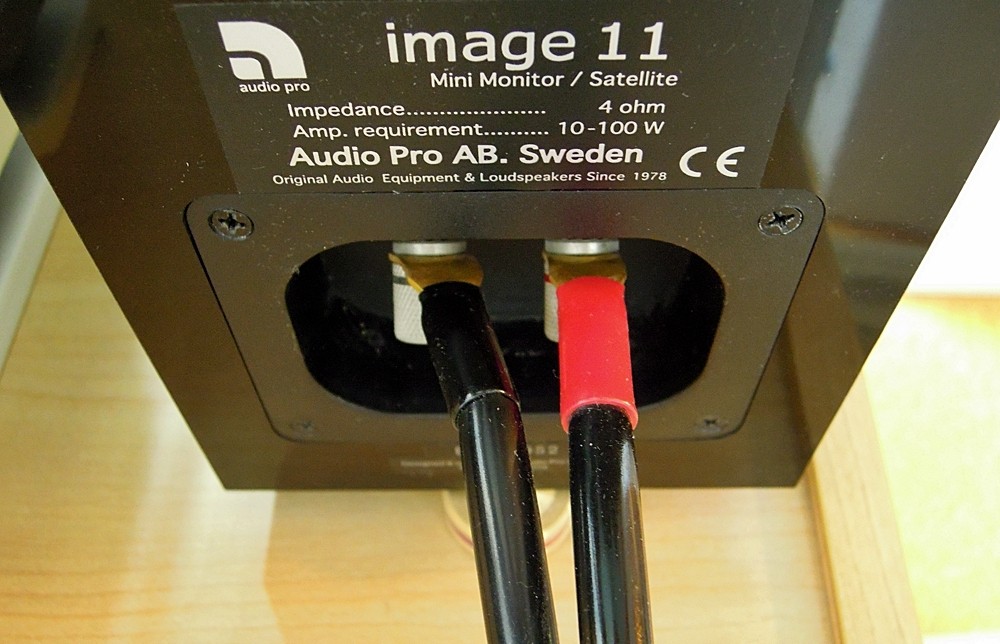
When some form of termination is needed on a speaker cable, spade plugs (Y-lug connectors) are generally preferable to banana plugs. Finished, pre-terminated high-end cables quite often come with spades as standard, and in recent years some manufacturers have adopted spades made from carefully selected materials — high-purity copper with gold plating, rhodium plating, and the like. The thinking is twofold: to avoid deterioration of the cable’s terminations over time, and rather than have users disassemble things and make dubious connections of their own, to design and bring the cable to market as a finished product with the character of the connectors factored in from the outset.

The great thing about high-quality spade connectors is that once crimped, the cable remains a finished piece with contacts that will not degrade no matter how many years pass. With bare-ended cables sold by the metre, you do periodically need to cut back the oxidised conductor ends and re-strip the insulation, which is a nuisance and inevitably means the cable gets a little shorter each time — whereas a quality cable purchased ready-terminated with spades can simply be left as it is for ten years without a second thought. All that is really needed is the occasional polish of the connectors with something like Caig DeoxIT or Panduit 29D.
There are all manner of inexpensive spade connectors out there — brass or aluminium with a thin flash of gold plating — but beyond making wiring easier and ensuring a reliable contact, you cannot really expect much from them in terms of sound quality. I was once lured in by the price and bought a packet of some cheap crimped gold-plated spades, only to find the sound was rather off, and in the end I had to cut them off again and start over. I really should have stuck with Oyaide, FURUTECH, or Audio-Technica from the start. Unless the material is pure copper — ideally OFC or PCOCC — with a substantial plating of rhodium or gold, you are probably better off not bothering at all.

 ポチップ
ポチップ
FURUTECH FP-209. Pure copper + gold or rhodium plating. Compatible wire gauge: up to 10AWG / 5.5SQ. Treated with FURUTECH’s α (Alpha) Process (cryogenic treatment at −196°C combined with a special electromagnetic field treatment — is this essentially cryo treatment?). Listed as being for power cables, but the FP-209 has an 8mm width with a 4.3mm opening, so it might work where the binding posts on a speaker or amplifier are on the smaller side? Could be good value if you need smaller spades, such as for car audio use. Winner of the Audio Accessory magazine Meikirshō Award in 2013.
Among high-quality spade connectors there are both screw-type and crimp-type, and all else being equal — same material — the simpler crimp type, which cannot be reused, tends to have the sonic advantage. Crimp connectors do require a tool — a crimping tool — whereas screw-type connectors, like banana plugs, have the advantage of being reusable any number of times; though the more complex structure may introduce additional variables on the sound quality side of things. That said, when you are dealing with expensive connectors, it does take a certain amount of courage to go with a crimp type that cannot be reused.

When you find a particular cut-length speaker cable you really like — one you can see yourself using for years to come — the electrically ideal approach is of course to connect it directly without any termination at all. But there are cases where the cable itself is expensive, or the jacket is so complex and difficult to strip cleanly that re-stripping and trimming it down feels rather daunting.
In such situations, I think the approach that makes the most sense over the long run — both as a tool for listening to music and as something that looks good in the home — is to simply accept whatever colouration the spade connectors add, deliberately choose an audio-grade spade that feels like it nudges the sound in a direction you personally find pleasing, crimp or screw it on, and then finish everything off neatly with heat-shrink tubing to keep deterioration at bay for as long as possible. A tidy, lasting, and — if I may say — rather beautiful way to make the connection. Would you not agree?
[PR] Compare prices on high-quality spade Terminals
>>Rakuten
>>Amazon.co.jp
>> Yahoo! Shopping
>>Soundhouse
In the second part, I take a fresh look at the question of banana plugs.
【Banana Plugs and Spade Lugs Unnecessary in Hi-Fi?】
Part 1|Part 2|The sound of plating|AT6301|Banana Plug Sound Comparison