【Audio USB Cable Comparison】
1|2|OYAIDE |4|WireWorld Chroma|ELECOM|SUPRA
These days, if you search for “audio USB cable,” you’ll find multiple large ad-revenue-driven ranking and comparison sites — M●i●t, M●●bi, R●nk● and the like — sitting right at the top of the results, and I’m genuinely stunned. These are sites where it’s obvious the writers have little real knowledge of Hi-Fi, use terminology incorrectly, and by the feel of them have absolutely no experience actually comparing USB cables.
AUDIO STYLE is a dedicated, no-compromise, out-of-the-way Hi-Fi blog — 90% music and audio, a little bit of home electronics and PC gadgets, and almost nothing else. We do carry advertising, but we don’t let it influence what we write, and unlike those fraudulent ranking sites full of air reviews, everything here is written from the honest perspective of a genuine enthusiast. This is a veteran Hi-Fi enthusiast of 30 years writing with unashamed personal bias, covering only products “actually tested by the author himself” in thorough, hands-on reviews. With that said — today’s topic, after quite a gap, is audio USB cables. Let’s get into it.

 ポチップ
ポチップ
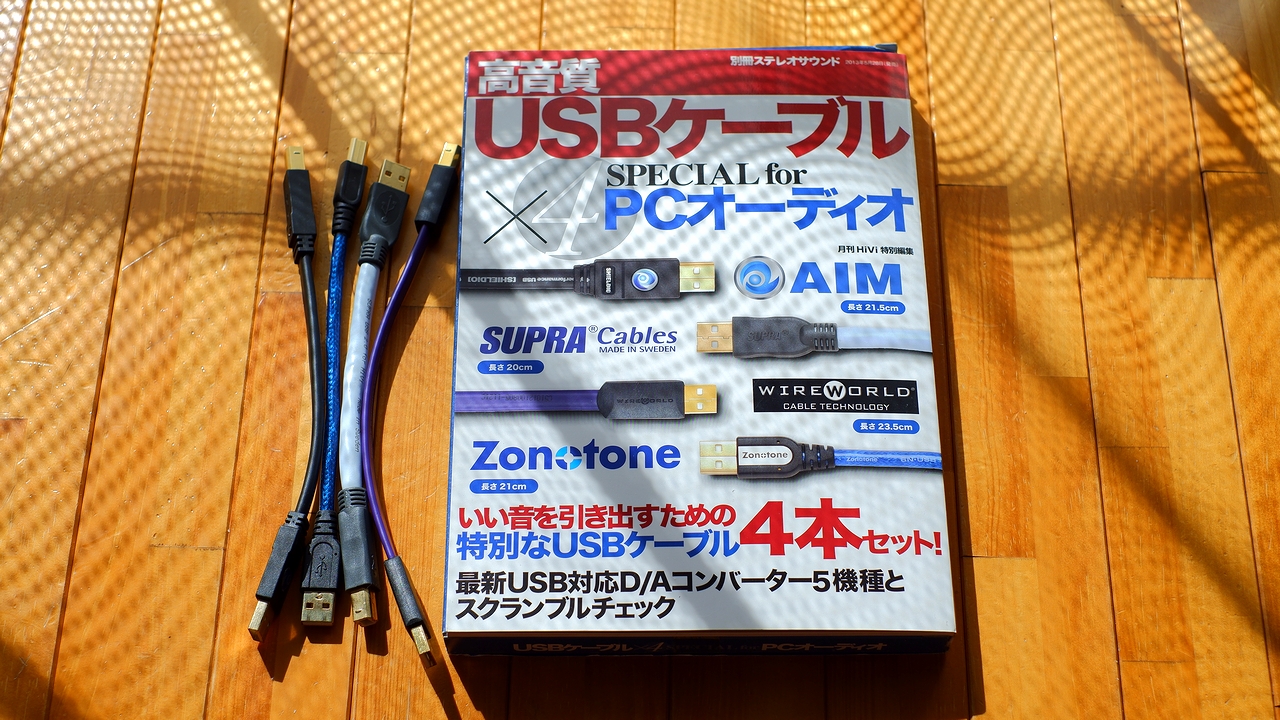
This is my first USB cable listening comparison entry in a good while. The cables covered this time are the AIM SHIELDIO UAC, the SUPRA USB 2.0, and the Wireworld Ultraviolet Series 7 — all in 20–21 cm lengths. Those who know will know: these are the cables from the Stereo magazine special supplement, “High-Quality USB Cable SPECIAL for PC Audio.” Added afterwards were the Wireworld Chroma Series 7 1m and the SUPRA USB 2.0 0.7m. This entry is actually one I was halfway through writing four years ago, when that Stereo magazine USB cable supplement mook was making waves. For various reasons I never published it at the time — but I’ve decided to re-examine everything, add some rewrites, and finally put it out there.
Test Environment for Audio USB Cable Sound Quality Comparison
The system used for comparison is my usual desktop PC audio setup. The current configuration is as follows.
· PC transport ASUS VivoMini VC65-G108Z (non-dedicated music PC)
· Storage SAMSUNG 870QVO SSD (internal sub-drive)
· USB cable SUPRA USB 2.0
· D/D converter: Trends Audio UD-10.1 USB
· S/PDIF coaxial digital cable QED Reference Digital Coaxial Audio Cable 70cm
· S/PDIF optical digital cable (four years ago) AUDIOTRAK GlassBlack2+ 50cm
· D/A converter: Firestone Audio Spitfire 24BIT DAC
· Digital amplifier: Trends Audio Class-T Amplifier TA-10.1
· Speaker cable NORDOST Wyrewizard Spellbinder
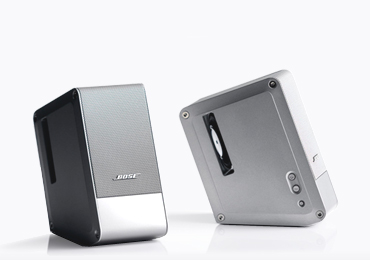
· Speakers ELAC CINEMA 2SAT
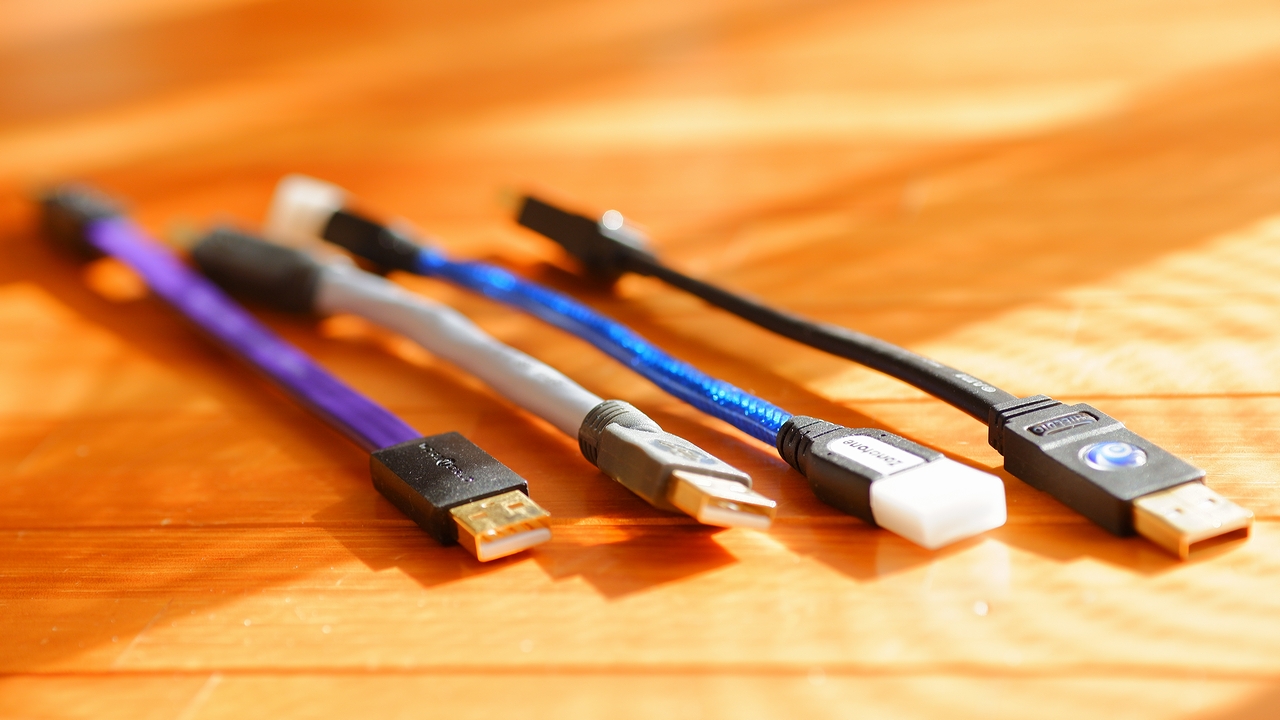
I’ll give the conclusions up front: the one I consider the most objectively well-balanced is the AIM SHIELDIO UAC, with the Wireworld Ultraviolet in second place. For jazz, the most satisfying is the Zonotone 6N USB 2.0. The SUPRA has a delicate, refined, beautiful sound that suits classical music well. I’ve reviewed it separately before, but for musical expressiveness the top pick is the Wireworld Chroma Series 7 — it’s effective at lifting the expressive quality of the relatively modest desktop PC audio setup I use here. That said, being Wireworld’s entry-level model, the sound quality itself isn’t something I can praise unreservedly… It has since been replaced by the SUPRA USB 2.0 0.7m. The reviewer is the same person throughout, but I’ve deliberately presented the four-years-ago test and the current test as separate entries. Right then — on to the detailed reviews.
AIM SHIELDIO UAC
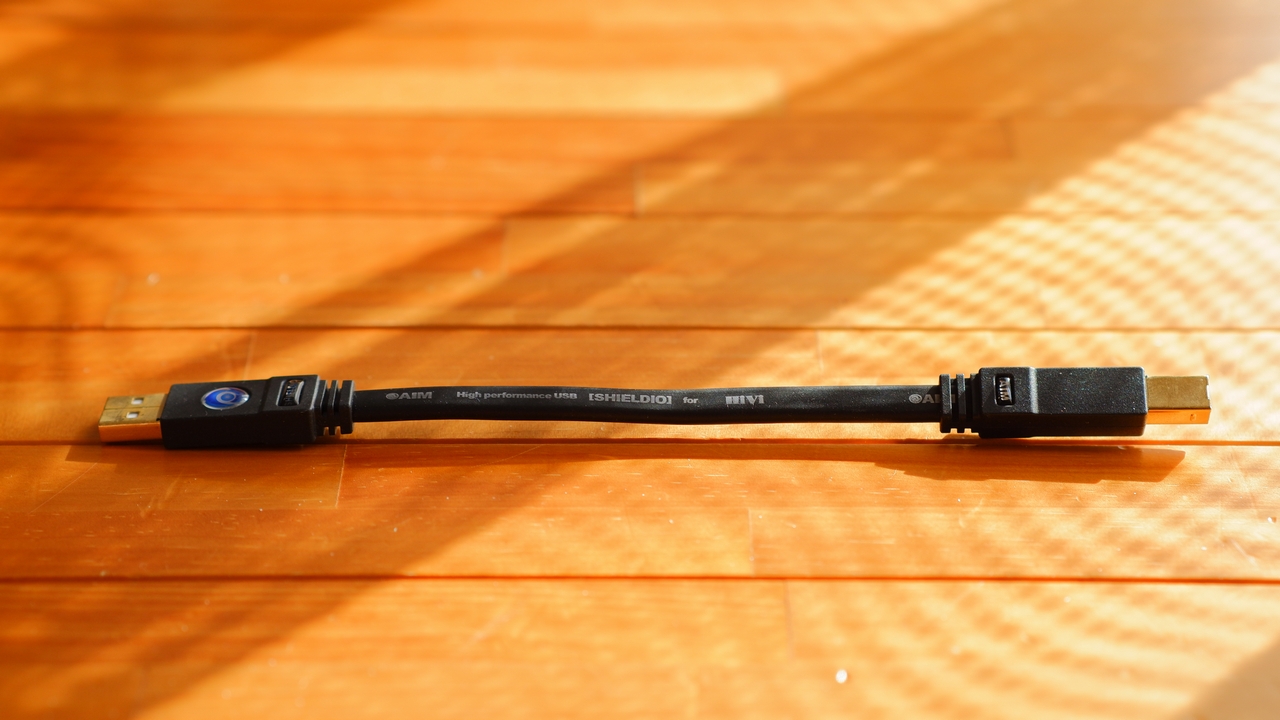
AIM SHIELDIO UAC. The conductors are OFC + silver-plated copper twisted pairs, two sets, in a separate flat construction. The shield is aluminium foil + copper braid. Insulation is polyolefin. A Japanese-made product from a domestic manufacturer well known for high-end HDMI cables for video use. Compared to other USB cables, the rearward expansion of the soundstage is notably larger, the range is wide, and there’s a rich sense of body. Dynamic range feels broad as well. The tonal character is unmistakably silver-plate in flavour. Musical expressiveness, however, is middling. What bothers me is that it struggles with depth of feeling and the finer nuances of emotional expression in musical terms. In purely sonic terms the AIM SHIELDIO UAC is the strongest in this lineup, but its heavy silver-wire character and a certain lack of focus in the melodic line — a tendency to render music in a matter-of-fact, unremarkable way — are its weaknesses. It’s less that musical expressiveness is absent, and more that there’s little embellishment in how it serves things up; it simply describes what’s there, quite ordinarily.

 ポチップ
ポチップ
AIM SHIELDIO UAC — 2021 Re-review
Deliberately noting the drawbacks: there are few that stand out, and this cable offers the most coherent, well-balanced sound of the lot. Like the SUPRA — or even more so — it has a bright, beautiful tonal quality characteristic of silver-plating, yet compared to the SUPRA there’s less of a sense of distortion, and soundstage depth is good. Nor does the treble feel pulled upward (as it does with the SUPRA). The right-hand piano register has a moderate sense of moisture, with a gentle elasticity in the air around it that is easy on the ear and rather charming. Overall there’s no sense of harshness; it plays in a bright, open manner, and objectively speaking the AIM SHIELDIO UAC stands out for a well-balanced quality that one could recommend to virtually anyone. Every corner of the soundstage is evenly lit, so shadow and shade are not its strong suit. The fact that it can dispel the monochrome feeling that tends to afflict PC audio is, personally, a significant point in its favour.
Zonotone 6N USB 2.0
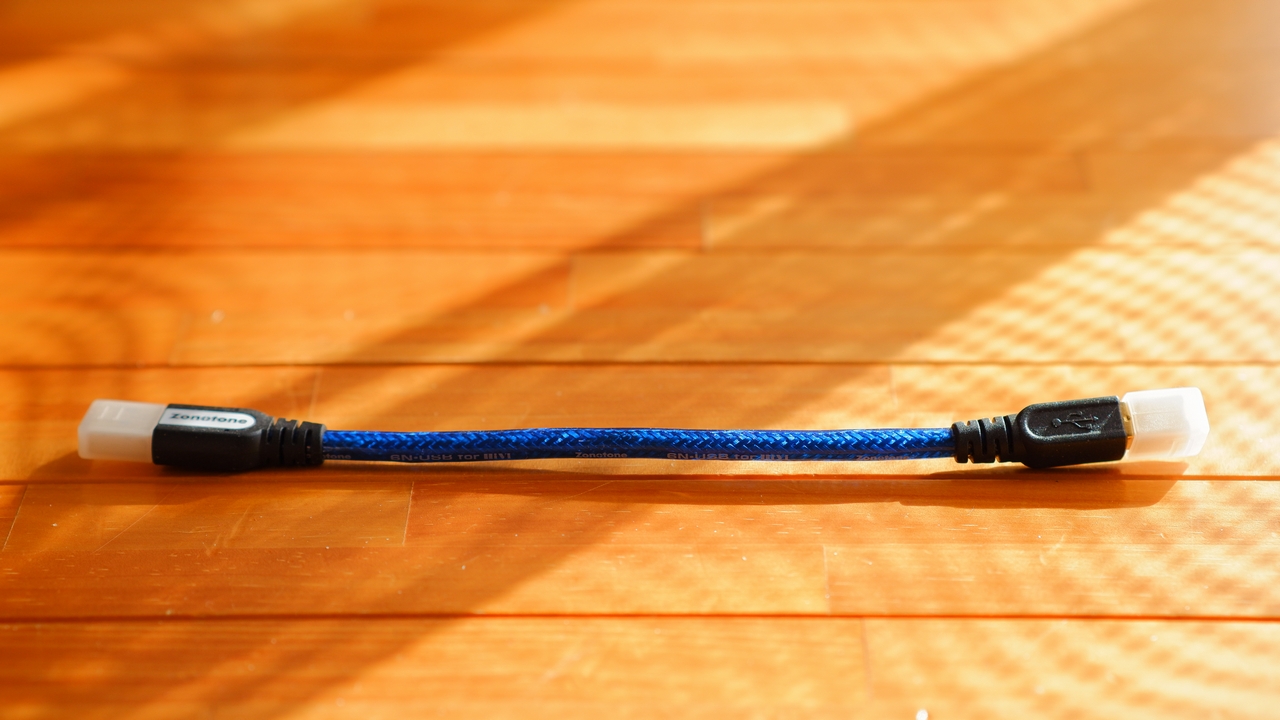
Conductors: 6N copper + pure silver-coated Higher-OFC hybrid, 4-core construction. Shield: silver-plated OFC braid. Insulation: cross-linked PE + drain wire + aluminium PET tape. Zonotone is one of Japan’s leading audio cable manufacturers. The Zonotone 6N USB has a crisp, forward, quite bright upper midrange. The frequency range leans towards the mid to upper-mid, and isn’t particularly wide. Slightly dry, with a tendency towards dead reverb. The soundstage is on the narrow side. S/N ratio isn’t great. There are sonic question marks, and yet the imaging is pleasurable, the rhythm is light-footed, and it has a knack for capturing the flow of the music. Quite distinctive, in its own way. I suspect it would work well in a system that tends towards a drowsy sound.
 ポチップ
ポチップ
Zonotone 6N USB 2.0 — 2021 Re-review
One listen and it’s unmistakably Zonotone. That distinctive granular texture and slightly dry tonal character, catching the most appealing qualities of each instrument — and when a jazz source comes on, there’s a sudden surge of tonal realism that is genuinely attractive. Compared to the other USB cables in this comparison, the soundstage is smaller in scale, images are positioned more intimately and presented in a contained, close-in way, with energy concentrated in the mid to upper-mid range and a compressed feel at both frequency extremes. The silver-wire flavour, interestingly, is less pronounced than with the other three. Of the four Stereo supplement cables, this one has the strongest character in the best sense. Even so, if I were to specifically seek out a Zonotone, I feel I’d want that character to come through even more strongly — and if buying today, I think you’d be better served going for the successor model, the USB-Grandio.
SUPRA USB 2.0 / 0.2m
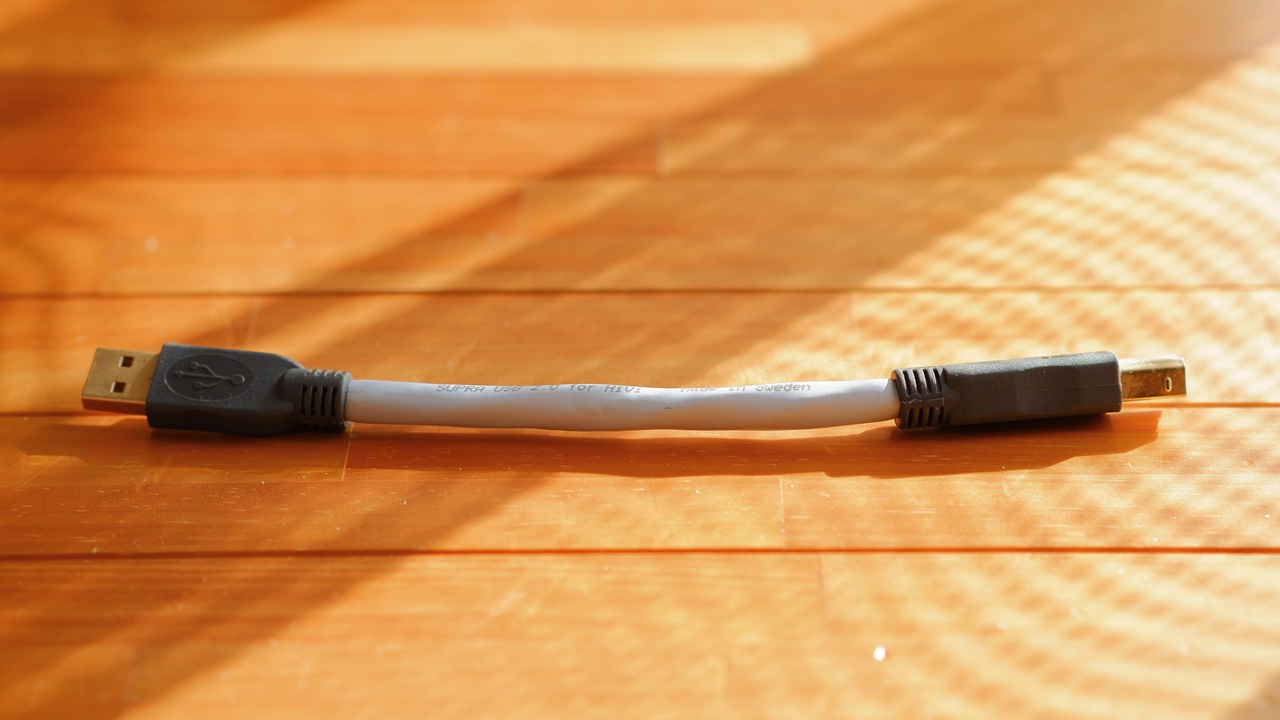
Made in Sweden. SUPRA is the premium consumer audio and video brand from Jenving, one of Europe’s leading industrial cable manufacturers. Conductors: tin-plated 5N OFC multi-core twisted pair construction. Shield: PE foam + aluminium foil. Insulation: cotton-filled air layer + PVC jacket. The sound is delicate and refined. The frequency range is flat — or to put it less charitably, flat in a two-dimensional way. Resolution is high. The imaging lines are fine-drawn, with a shimmer or slight crispness in the upper midrange. Well-controlled and restrained; suited to early music and classical in general.
SUPRA USB 2.0 / 0.2m — 2021 Re-review
SUPRA’s distinctive delicacy and refinement draw the ear immediately. S/N is excellent, there’s a fine sense of clarity, and the tonal temperature runs cool. Compared to the other cables, the soundstage sits higher and leans slightly towards the upper registers. Notes have good cut-through and the outlines of images are emphasised. A notable characteristic is a high degree of inward-facing, minor-key musical expressiveness. Ambient reflections are plentiful, with a cool, Nordic quality to the air.
 ポチップ
ポチップ
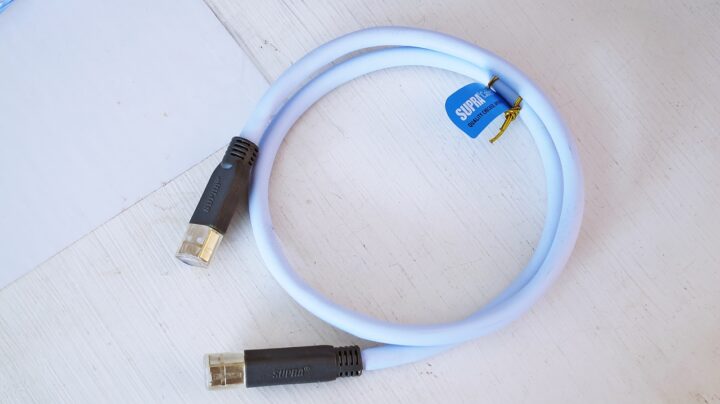
SUPRA USB 2.0 / 0.7m
The USB cable I’ve been using for the past year or so is the SUPRA. The 0.2m from the Stereo supplement was the one that best suited my taste, so I purchased the 0.7m length needed for my normal setup. In the longer version, however, a glossy, shiny quality becomes more pronounced, and in exchange there’s a slight retreat in freshness — resolution and information density. (It’s actually 0.75m in practice.) The result: the minor-key musicality and detail that I find so appealing in the 0.2m version are to some extent buried, and comparing them directly, the longer cable does feel marginally inferior in sound quality. The information density and freshness diminish, yet the brightness and edginess in the upper midrange remain. I’ve reviewed it in detail below.
Wireworld UltraViolet Series 7
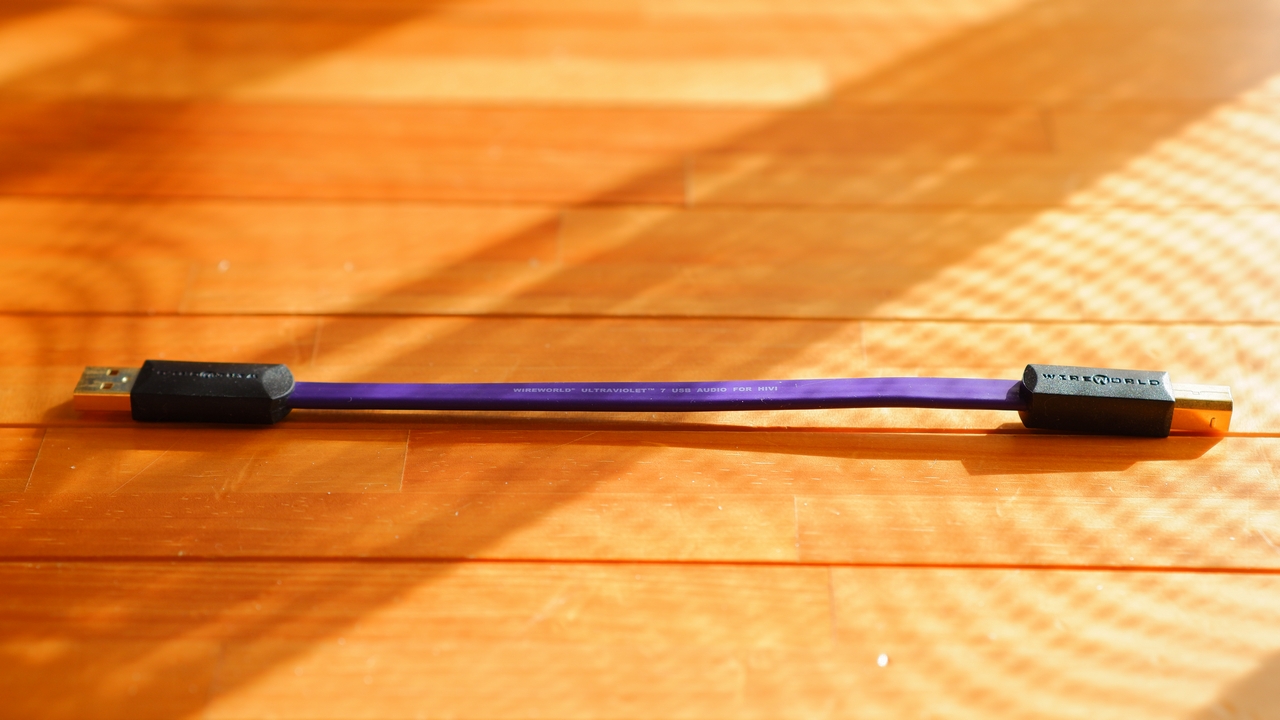
Made in the USA. Conductors: silver-plated 4N OFC, Symmetricon design, power lines separate. Insulation: Composilex 2. This sounds like the Wireworld Ultraviolet Chroma with a silver-plate character added on top. Compared to the Chroma — whose treble texture is rather disappointing — this one opens up, becomes brighter and larger in scale, with even more generous bloom in the resonances. On the other hand, the extension and resolution in the treble don’t really improve, which gives it an oddly buttery, heavy character, and the musicality that should be a strength ends up swamped by the colouration. For that reason, I might actually prefer the Chroma, which despite everything at least makes the low end feel more resolving and is more immediately readable musically. When you compare Ultraviolet and Chroma side by side, the Chroma’s bass sinks deeper, pulling the overall imaging lower. The midrange to upper-mid — the violin register, the soprano register — is outlined more clearly and brightly, with better cut-through. The treble above that is rather dead, though…
 ポチップ
ポチップ
Wireworld UltraViolet Series 7 — 2021 Re-review
Structurally, in terms of the Symmetricon design, I think this is essentially the Chroma with silver plating applied — but the warm-yet-lacking-in-cleanliness quality I sense in the Chroma is substantially dispelled here, and while a fair degree of musical vivacity is retained, a smooth, refined, high-quality lustre appears all at once. In short, quality in the treble direction has improved significantly. The fact that I didn’t feel sufficient treble extension four years ago was probably because I was listening to a brand-new cable straight out of the box, with no burn-in. In exchange, the hot eroticism of the Chroma has diminished by about 50% (※ though even so, it remains more musically expressive than the others). Not to the same degree as the Chroma, but compared to the other USB cables here there are still some areas where the imaging detail feels somewhat rough-hewn, and I’d like a touch more spatial transparency in how note density is managed — so it leaves a slightly tantalising impression. That said, this is after all Wireworld’s second-from-bottom USB cable, so that has to be kept in mind. I didn’t think all that much of it in the four-years-ago test, but this time around the Wireworld Ultraviolet sounds considerably good. The successor Series 8 has a revised construction with Composilex 3 insulation, and (USB cables move on so quickly) from a quality standpoint it would simply make more sense to go straight for the new Series 8.
Wireworld Chroma Series 7
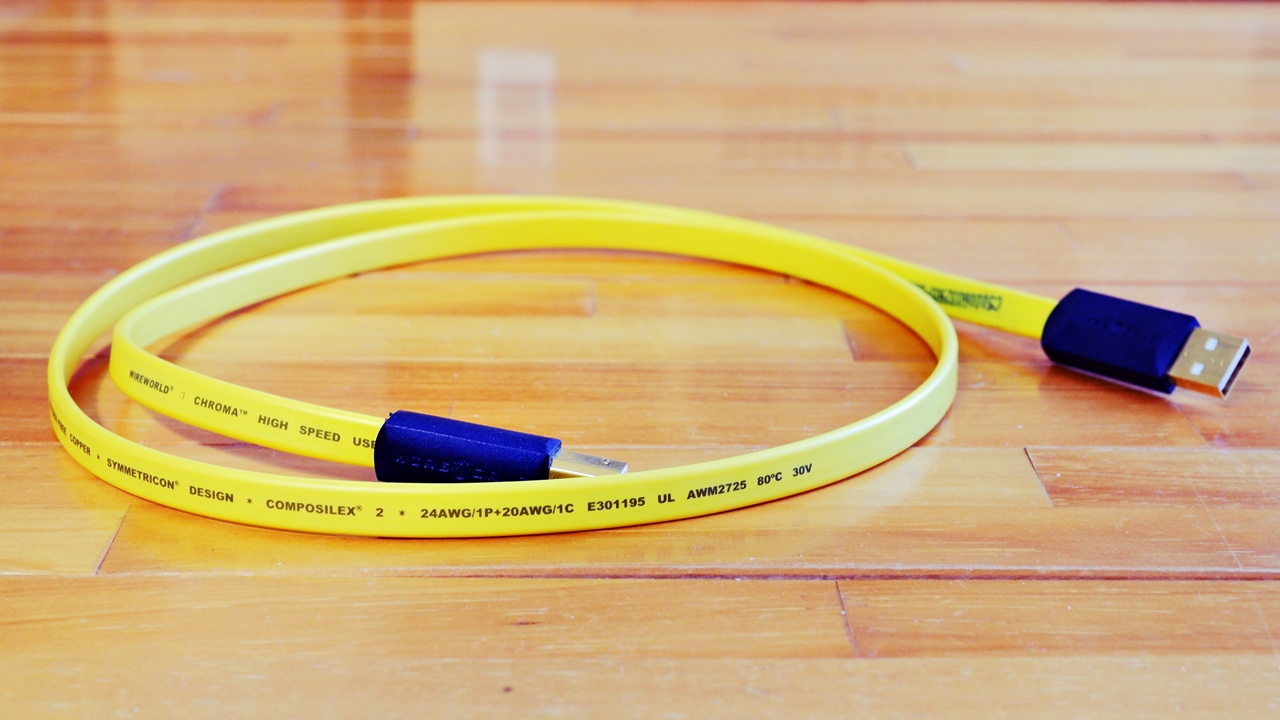
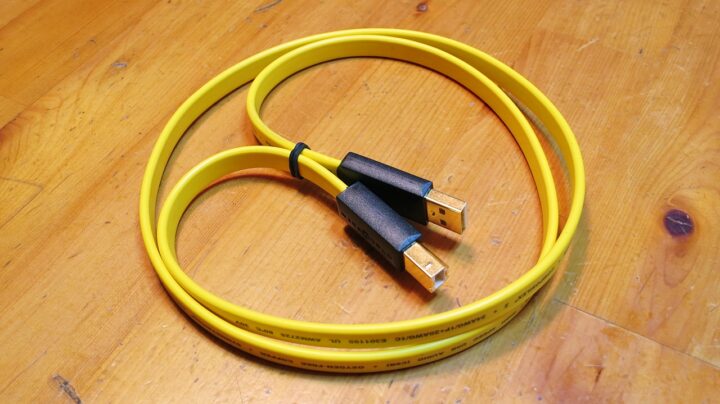
Wireworld Chroma Series 7 — 2021 Re-review
Made in the USA. Well. Of these cables, this one has the lowest transparency and the worst sound quality by objective measure. Some listeners might call it outright terrible. It leaves behind any audiophile quality in the upper registers and leans heavily into energy in the mid to bass range. But — what is it? It’s warm and graceless and has no cleanliness to speak of, and yet it makes a hot, lively, enjoyable sound. Unlike silver-coated cables, there’s a strong brick-red colouration that is a flaw, but the expressiveness itself is the liveliest of the lot. Very suited to Western pop, or more specifically country music — a lo-fi sound that is, for better or worse, thoroughly American.
 ポチップ
ポチップ
— Summary —
There’s a degree of variation in the sound quality assessments, partly because the finer details of the system configuration — the S/PDIF digital cable between DDC and DAC, the power supply arrangement, and so on — have changed somewhat since four years ago. But broadly speaking, my impressions are much the same. I should add: these reviews reflect highly localised results on my own desktop PC setup, and the assessments will change depending on the system — even if I myself were doing the listening. This isn’t me trying to be particularly fair-minded; it genuinely varies by system, so by all means take it as some degree of reference, but please don’t swallow it wholesale.
Also, if I’m honest, I’m starting to feel a certain fatigue with the SUPRA’s sound… That’s partly why, this time around, the AIM SHIELDIO UAC and the Ultraviolet struck me as unexpectedly good. The brightness of the AIM is very effective at dispelling the monochrome quality that tends to bother me in PC audio, and the Ultraviolet is, as you’d expect, considerably more balanced than the Chroma. That said, if I were actually going to spend money on a Wireworld USB cable, I’d probably go for the Platinum Starlight, which sits further up the range… In which case, I really should have snapped one up last year when the old Series 7 stock was being cleared at half price or less as the Series 8 models came in… ※ Wireworld products tend to go at heavily discounted prices when old stock is cleared during their full-range model changes, which happen roughly every few years.
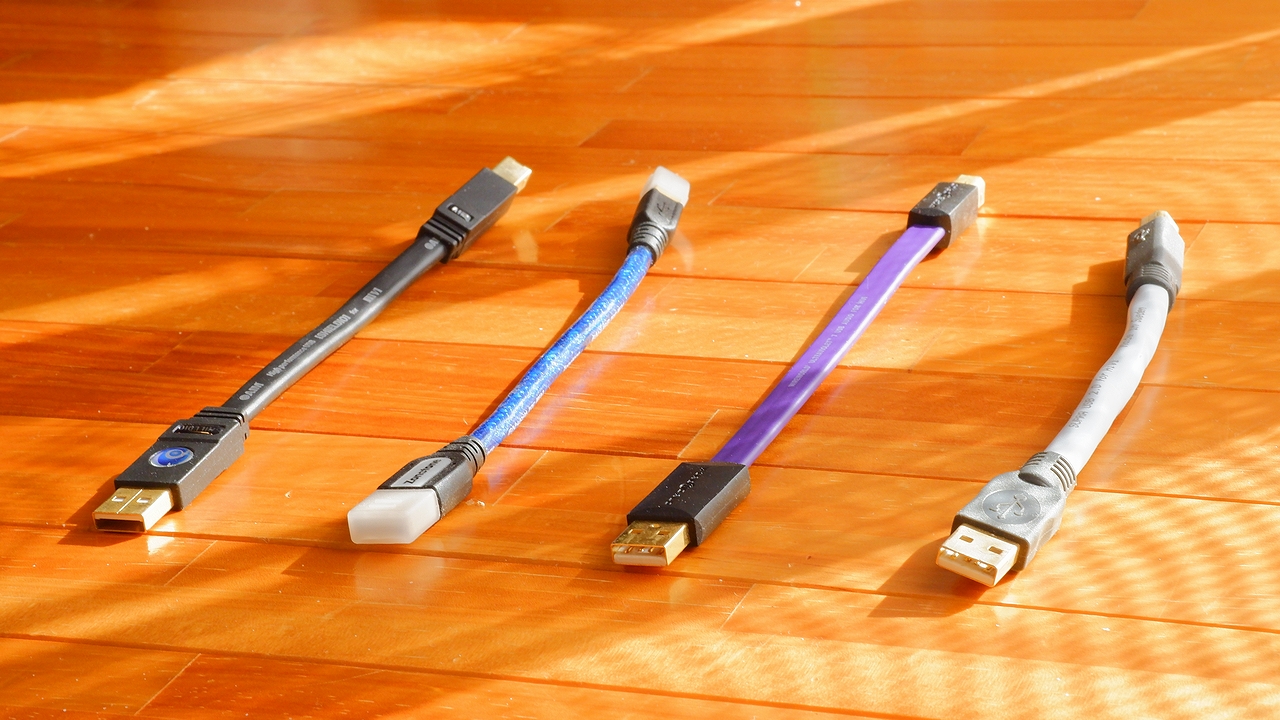
Come to think of it, USB cables are said to change considerably with length — and indeed, even a difference of a few tens of centimetres proved to have a meaningful impact. Comparing the same SUPRA cable in different lengths, and looking at the freshness gap that shows up between the Ultraviolet and the Chroma, I found myself inadvertently confronted with the negative effects of length… When it comes to USB cables, it’s preferable to aim for the shortest practical run. In my own desktop PC audio setup, I think the ideal would be a 20 cm USB cable running to the DDC, and then a longer 1.5 m S/PDIF digital cable from there to the DAC — even using the same cables, that arrangement would almost certainly be an improvement. ※ The reason I don’t do this is simply that I don’t have a 1.5 m high-quality digital RCA or optical cable spare.
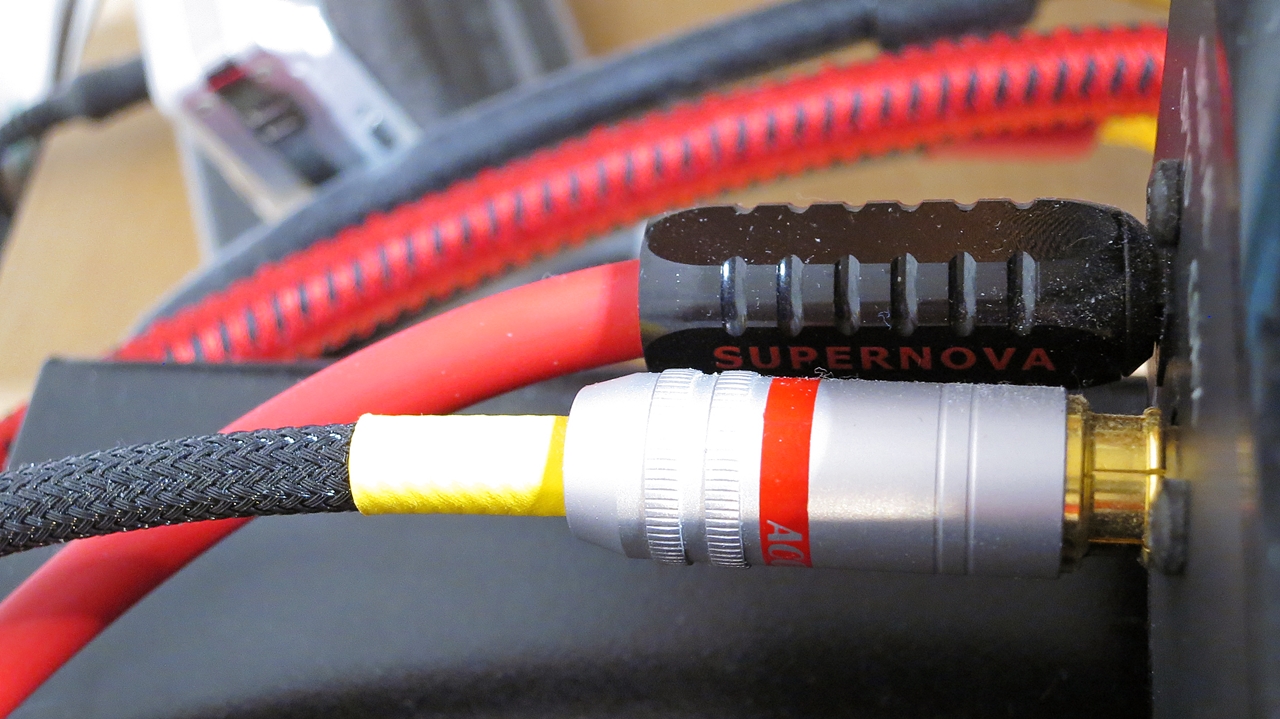
And then there’s this — again, specific to my own system — but having swapped things around extensively in a PC → USB cable → DDC → S/PDIF → DAC chain, my honest impression is that the differences introduced by the S/PDIF digital cable (optical/coaxial) are far, far greater than those introduced by the USB cable. The dramatic, impossible-to-ignore changes on the S/PDIF side make the USB cable differences feel contained within a fairly narrow range — six of one, half a dozen of the other — and I get a lingering sense of comparing something at a rather low level, where only the tonal character shifts slightly and there’s no feeling that overall quality is about to improve in any dramatic way.
 ポチップ
ポチップ
In my case, the S/PDIF side benefits from hand-me-downs from my main Hi-Fi system — reasonably good-quality digital cables — whereas the USB side has only entry-level cables, which may be part of it… But somehow, I feel like this difference goes beyond that kind of explanation. It may be that in my desktop PC audio setup, passing through the DDC somehow neutralises the negative influence of the USB cable to a considerable degree. For USB specifically, I suspect that unless you go to a separately-supplied power line arrangement — as some Hi-Fi-grade USB cables do — the problem isn’t really solved at its root.
The Problem with Audio USB Cable Ranking Sites — as Mentioned at the Start
Having read through them, I found more than enough to take issue with — so to help audio beginners avoid being misled, here are some corrections:
※ “Hi-Res compatible” → Pure bluster. To put it plainly, it has absolutely nothing to do with sound quality or build quality.
※ Choose a cable length that is easy to manage → Shorter is better, within the constraints of your setup. Stiffness and poor flexibility are a result of pursuing sound quality; they’re not a flaw.
※ Gold-plated connectors → Virtually every audio-grade cable has gold or rhodium-plated connectors. In practice this point is irrelevant.
※ Constant harping on about noise reduction → Every cable on the market does something about noise. Singling it out as a selling point for each product is meaningless.
※ 100% braid coverage → What on earth is that? Utterly baffling.
※ OFC value → A mysterious incantation I’ve never encountered before. Are they trying to say 6N or 7N?
※ OFC at 99.5% or 99.99% purity cannot be considered high-purity by today’s standards — it is relatively low-purity. For what it’s worth, obsessive focus on copper purity in the Hi-Fi world was something that happened about 20 years ago.
Given all of the above, any genuine enthusiast reading these sites would see through them in an instant — the work of a half-informed self-styled expert who doesn’t really know what they’re talking about. These large ranking sites are aimed at people who don’t know the Hi-Fi world well — casual readers and beginners — and what they do is line up whichever products are selling best through affiliate advertising, copy the specs loosely from the catalogue, and pad out the rest with vague commentary. Most of them have no hands-on comparison experience at all — what are commonly called “air reviews.” If a site shows genuine passion for audio and offers something genuinely useful, I’ve always been happy to link to it here on AUDIO STYLE — regardless of whether it carries advertising or is a competing blog. But I really do wish sites like these, driven purely by profit, would disappear.
 Category: Mastering Desktop PC AudioCategory: Audio USB Cables
【Audio USB Cable Comparison】
1|2|OYAIDE |4|WireWorld Chroma|ELECOM|SUPRA
Auto Translated by CS4.6