AUDIOTRAK GlassBlack2plus – ATC-GB24 Optical Digital Cable: Construction
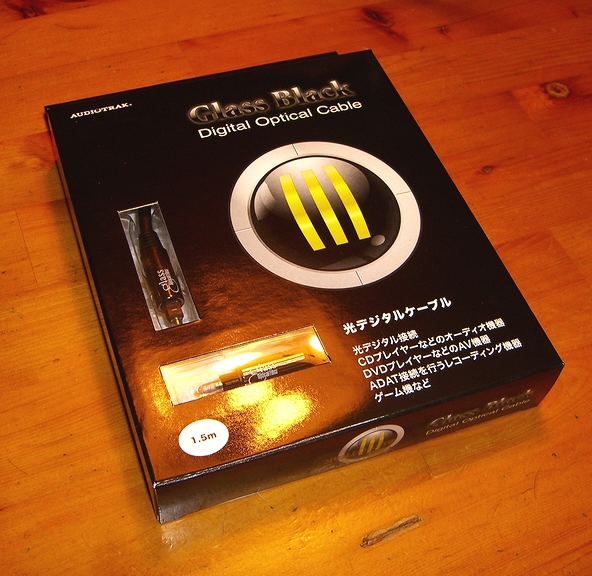
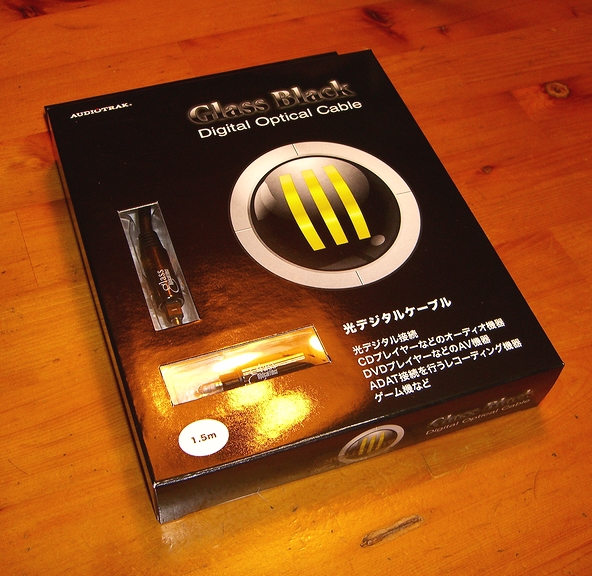
Now, the guest of honour for today’s test: the optical digital cable I have newly added to the “AUDIO STYLE” system — the AUDIOTRAK GLASS Black ATC-GB24. The biggest difference from the inexpensive TOSLINK cables mentioned earlier is that, while this cable uses glass fibre rather than plastic fibre (acrylic fibre) for its core, it has been kept within a price range that budget Hi-Fi enthusiasts can actually reach.
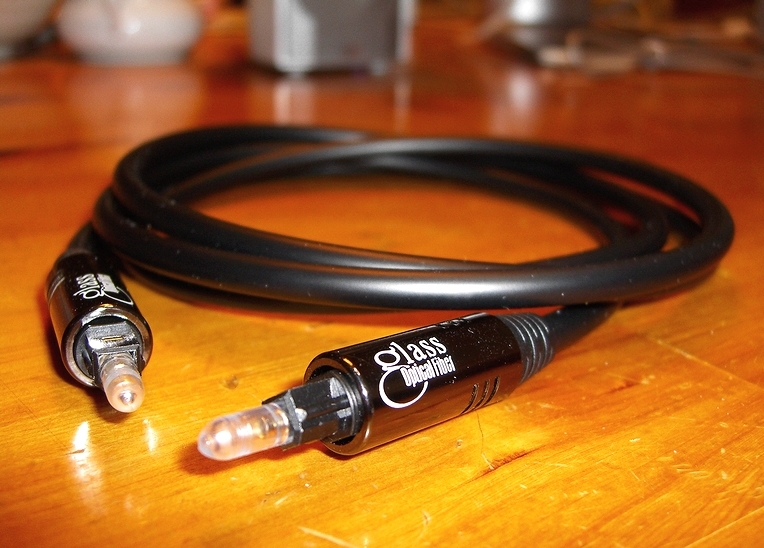
The core consists of 280 strands of ultra-fine glass fibre, each 53 microns in diameter — and picking it up, I was surprised at how soft it feels, on a par with plastic-core optical cables. Being soft, however, does not mean it can be handled carelessly — forcing it into sharp bends risks creating numerous small fractures inside the cable, which left me feeling rather worried just holding it. The manufacturer does state a minimum bend radius of 65.0 mm (diameter). Given how limply it droops under its own weight, maintaining a bend radius of R65 mm or more in actual use is going to be tricky… Anyway, I carefully connected it to the PIONEER SuguReco DVR-DT100, making sure to avoid any bends of less than 6–7 cm at the back of the unit or around rack edges…
Glass Black ATC-GB24: Sound Quality Review


 ポチップ
ポチップ
The first difference I noticed compared with the audio-technica AT-OPX1 I wrote about earlier is in how the soundstage spreads. Whereas the AT-OPX1 opens up a wide soundstage that extends upward and rearward, the ATC-GB24 presents its sound in the space between the two speakers. Its imaging sits lower than most optical digital cables. Put another way, the soundstage may feel slightly narrower than the AT-OPX1. In particular, there is none of the floaty, exaggerated high-frequency extension that TOSLINK cables tend to have — dialogue and vocals are placed properly lower, snapping neatly into place at the centre point between the two tweeters.
And within a soundstage that is not especially wide — yet not narrow either — there is a sense of particulate information density, like diamond dust, that I have not encountered with other optical digital cables. Another characteristic is the fast transient attack, with a sharp, high-speed leading edge. That said, you might expect the high frequencies to stand out prominently, but they do not — the overall character is accurate, monitor-like, and earnestly neutral. On top of that, the peculiar lukewarm sense of echo and colouration that TOSLINK cables tend to add (a delay inherent to optical cables, perhaps?) is notably reduced. It gives the impression of having stripped away the excessive tinting that digital cables often add.

The transient attack is fast, but with AAC-compressed television content played via the PIONEER DVR-DT100, there are moments where the midrange definition and openness of dialogue and vocals feels somewhat lacking — a slightly nasal, congested quality. (Note added later: after continuing to use it for several months, this problem mysteriously resolved itself.) This is probably because… the quality of the compressed audio output from SKY PerfecTV! and the DVD recorder itself is not great, and unlike the audio-technica AT-OPX1 — which pleasantly softens such things — the GlassBlack delivers the jitter and noise as information, as-is. Also, for an optical digital cable, the low-frequency extension is reasonably good and resolution is high — though that is with the caveat that we are still talking about a TOSLINK cable. When the low-end of the GlassBlack ATC-GB24 is compared against a coaxial digital cable with a well-regarded bass response and weight, it does come across as somewhat lean.
To be honest, at this point I was beginning to wonder whether buying it had been a mistake. My main reason for bringing the AUDIOTRAK GlassBlack ATC-GB24 into the system was to connect AV equipment lacking a coaxial digital output to a standalone D/A converter. But with the PIONEER DVR-DT100 specifically, while the added information retrieval was welcome, the vocal openness — the thing that matters most — was not quite right. The presentation was earnest to a fault, lacking in charm and not particularly engaging. Going back to the audio-technica AT-OPX1, the soundstage opened up, a modest sense of life returned, and television became fun to listen to again — yet in terms of objective sound quality, it was nowhere near the AUDIOTRAK Glass Black ATC-GB24… and that left me in a bit of a dilemma.
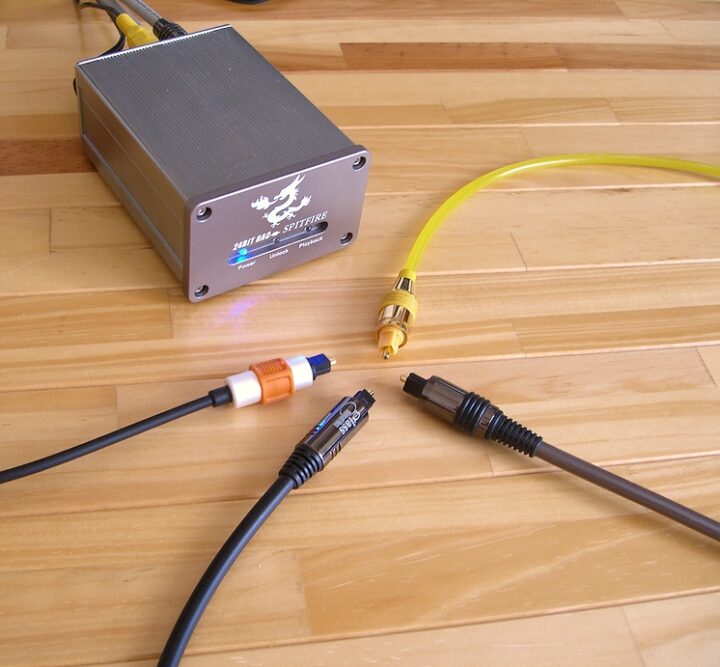
But then, better sound quality means nothing if you can’t enjoy the music — and that is simply true. For the time being, I switched the SuguReco’s optical digital connection back from the GlassBlack ATC-GB24 to the audio-technica AT-OPX1, and this time tried connecting the GlassBlack between the main system’s CD player, the CEC TL5100Z, and the same standalone D/A converter as before, the Firestone Spitfire 24bit DAC (page under construction). In this combination, with the inexpensive optical digital cables mentioned earlier, none of them — whichever I tried — could hold a candle even to the yellow composite video cable (75Ω coaxial video cable) that used to come bundled with old video equipment. I was half resigned to this being the limit of optical digital output — TOSLINK’s ceiling, so to speak — but when I connected the GlassBlack ATC-GB24, well, to my considerable surprise, it quite straightforwardly sounded far better than the yellow cable.
 ポチップ
ポチップ
The GlassBlack’s character is cool-toned, with a chilly temperature, a hard, disciplined, earnestly matter-of-fact musical presentation, a high-speed leading edge and crisp definition that handles instrumental separation reasonably well, and a good sense of S/N. The subtle powdery quality in the mid-to-high frequencies that had been nagging me with the Firestone Spitfire 24bit DAC (page under construction) — possibly inherent to higher-order oversampling — receded, replaced by the GlassBlack’s own character: a cold, clean, dry frizzante-like sensation going down (don’t ask). It is not what I would call an optical digital cable with exceptional “musicality” in the way I usually mean that phrase, but it is straightforwardly good-sounding. Monitor-like, crisp, and precise. Piano in particular has a pleasing transparency and clarity of outline — rather a captivating tone.
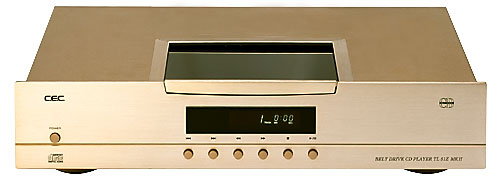
The CEC TL5100Z, like other CEC belt-drive transport models bearing the hand of Carlos Candeias, has a warm, smooth, analogue-tinged sound with body in the mid-to-low frequencies. The Firestone Spitfire 24bit DAC (page under construction) connected to it is modest and neutral in character. The belt-drive’s sound tends warmly, smoothly, and with a certain looseness — and by routing through the AUDIOTRAK GlassBlack ATC-GB24, an appropriate degree of tautness, firmness, and transient speed is restored, pulling the temperature back toward neutral. Musicality and vitality come from the CD transport side; the glass fibre cable adds a monitor-like sense of high-resolution clarity, injecting it into a DAC section whose virtue is faithful, if somewhat plain, reproduction — each of the different characters married together, and the balance, remarkably, works out beautifully.
 ポチップ
ポチップ
~ Summary ~
Note added later: the monitor-like earnestness and dry, austere impression I noticed when I first introduced the cable gradually softened as burn-in progressed. The fine, delicate frizzante quality remained, but alongside the density of information, a transparency and a pleasing moisture to the resonance emerged, and at some point it had shifted into a natural, easy way of sounding. I would not normally expect burn-in to apply to an optical digital cable, but with this ultra-fine multi-strand glass fibre construction, I suspect that over the course of repeatedly inserting and removing the plugs, microscopic cracks have formed inside — and that, paradoxically, the sound has become more appealing and supple as a result.
The switching tests between optical digital cables were more taxing than I expected… TOSLINK has a quality — for better or worse — of being somewhat colour-drained compared with coaxial digital: its character is thin. With plastic-core cables in particular, quality tends to stay within a certain ceiling, and it is hard to perceive the kind of immediately identifiable character you get with coaxial digital or analogue RCA cables. With AV use, watching video content every day, it is more the gradual accumulation of small differences — the atmosphere and nuance of dialogue, something quietly nagging away at you over time…

Come to think of it, I seem to have lost the protective caps for the optical digital cable terminals somewhere during all this swapping — the count has been quietly dwindling, and before I knew it they had fallen victim to the vacuum cleaner. I keep wondering if you can buy replacement caps somewhere. Also, the square TOSLINK plug is fiddly to seat correctly at the best of times, and with a round plug you cannot tell by touch which way up it goes — making blind insertion quite stressful. It is a shame that only the audio-technica AT-OPX1 does anything sensible about this. Though I should note that audio-technica’s higher-end models using quartz cores — the AT6D40, AT-EDP1000, AT-SDP2000 (page under construction) and so on — do use round plugs as well…
Finally — the “Netsuken OPTICAL GATE” I used to use as my reference optical digital cable: I have a feeling it sounded even better than the ATC-GB24… though that may simply be a romanticised memory. It suffered a spontaneous cable break, and I rather wish it would come back to life somehow… (sigh)
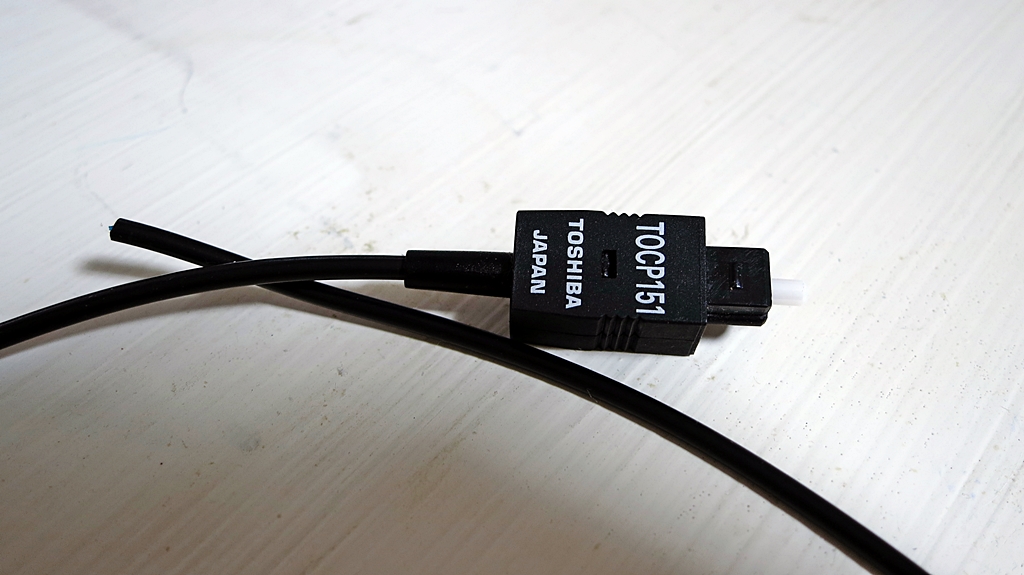
It had stopped transmitting light, so on a whim I cut it in half — and one side did light up again. However, even with the glowing end inserted into the optical terminal, the DAC unfortunately refused to recognise it. Glowing alone is apparently not enough… I wonder whether there is some kind of optical lens element required at the plug end? (If it ever miraculously comes back to life, I would like to write up a comparison review.)


Auto Translated by CS4.6
List of comments (4)
光ケーブルの交換、いつもながら手間・暇かけて詳細な分析お疲れ様です。光ケーブルでも音質に変化あるのですね。多分、自分には聞き分けられないと思う気が…。SPケーブルなどの導体、端末処理で電気信号が変わるだろうなあとうっすらイメージはできるけど光デジタルケーブルの場合中をとおる光デジタル信号に変化・質の差が現れるというのが謎で・・。今回の実験を読んで交換してみようかと思いました。
ちなみに、某オクですがポチって…・・しまいました。読み取り不良の場合の修理費用も面倒みてくれるそうで、大変ありがたい出品者様でした(時折、出現するようです。この機器の持病?C1ーvlも最近そうなります。クリーニングしても・・)感謝です。パステルピアノさんの教えてくれたプライマー試聴された方のブログも参考に。同じ北国出身ですし・・。いろんな意味で吉とでるか凶とでるか。いずれにしろ、今回の機器総取り換えで新たな一歩踏み出せます。しばらくは、ケーブル、アクセサリー類などの小物を物色して楽しみます。
>>光ケーブルでも音質に変化あるのですね。
一応、電気/光→ゆるゆるプラグ→ゆるゆるプラグ→光/電気信号と回りくどいことになりますので、その間のジッターや外来ノイズの影響、コア内部の損失や反射など問題が色々あるそうです。まぁこの辺私には良くわかりませんけれども。。。
経験上同軸デジタルの方が高音質を得やすいのは間違いありませんので、同軸が使える状況ならばそちらで良い音がする物を選ばれるのが先だと思います。ただ、同軸デジタルで音が変わる理由も割と意味不明なんです。インピーダンスが合ってないとか、測定するとデジタル波形の出方に製品の個性があるとか、なんかの雑誌でデータ羅列されてましたが、これもツッコミどころとかあるかもですし。
極めつけは、アナログ音声ケーブルを同軸デジタルケーブルとして転用した場合、得られる音質傾向がほぼ同じなんですよね。大抵のアナログRCAピンケーブルはインピーダンスが合わなくてもデジタル同軸側に繋いで音が出ますので、試してみると判ると思います。(オマケ赤白ケーブルの場合、音(映像)が出ないことが結構ありますので、それなりの高級音声ケーブルで試してねw)
>プライマーI31/CD31
見てました。即決されてましたね~。読み取り不良ですが、仕様上の限界でしたら仕方がない部分はあると思います。ベルトドライブトランスポートなども、輸入盤で偏芯の酷いディスクなんかで音飛びしたり止まってしまうことがあり、単価が高い物だったり、BOXで一箱にそういうCDが大量に紛れている場合はCD側の新品交換で対処しています。レコードの輸入代理店からすると良くあることだそうで。アコリバのアースRGC-24は…効果が判らなかったら私に安く譲ってくださいませ。そういえばモグさんRD-3お持ちじゃなかったですか?
初めてコメント差し上げます。貴名を何とお呼びしたら良いのでしょうか。
当方は,東京在住の69歳の男性。古いオーディオ・ファンで,40歳過ぎてからパソコン・ファンに転向しました。ケーブル論争は知っていますが,転向後に起きたことで,対岸の火事と冷眼視を決め込んでいました。
それが,最近 iPod にはまり,ONKYO ND-S1 や Audiotrak(track ではない)社の DR.DAC2 DX まで買い込んで,オーディオ熱がすっかり再発してしまいました。
ND-S1 の付属ケーブルをテストしている段階で,Audiotrak Glass Black 1.5m も買い込んで,比較試聴に参加させました。
今の段階では,ONKYO の付属品の光ケーブルが,貧相な外見に似合わず,一番良い音質でした。ところが,これが何物だかわからず,現在すっかり困惑しています。
それに,光ケーブルには,方向性というものがあるようで,どんな安物でも,入り口と出口を入れ替えると,再生される音場がすっかり変わることに気付きました。正しい方向でないと,「位相」を逆にしたような不安定な感じになります。
ところが,大抵のメーカーは何の指示もくれません。識者も,全然注意してくれません。
貴方は,この辺をどう解決して居られますか。アドバイスをいただければ幸いです。
On September 29, 2009 せつだかんじ,チャングム評論家
ぱすてる・ぴあのさん,
先日は,お返事を丁寧なメールでいただき,恐縮に存じます。有難うございました。
その後も,私は光ケーブルについては,いろいろと苦労を重ねました。その結果得た結論を,私なりに文章にまとめて,自分のHPに発表してみました。
お忙しいところを大変恐縮ですが,おついでの折に,以下の拙HPを御訪問いただき,「オーディオ評論」のページを御一読賜りますれば,幸いに存じます。
http://homepage2.nifty.com/KanjiSetsuda/
オーディオ評論: iPod と iTransport
貴方の御活躍・御健康・御多幸を切に祈りて。
(せつだ かんじ,69歳男性,アマチュア数楽者)