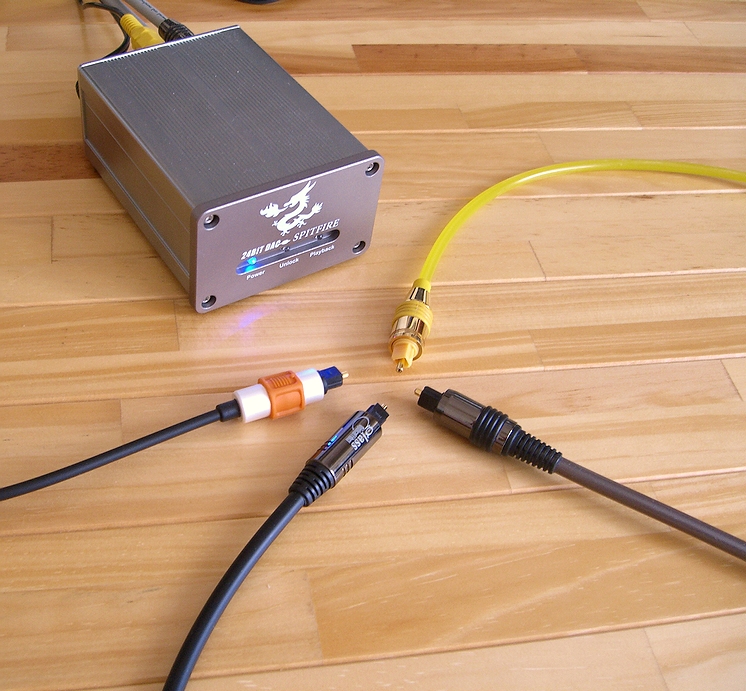
This time I will be comparing the sound quality of the glass-fibre TOS optical digital cable I recently purchased, the AUDIOTRAK GLASS Black ATC-GB24, against several other budget optical digital cables I have to hand.
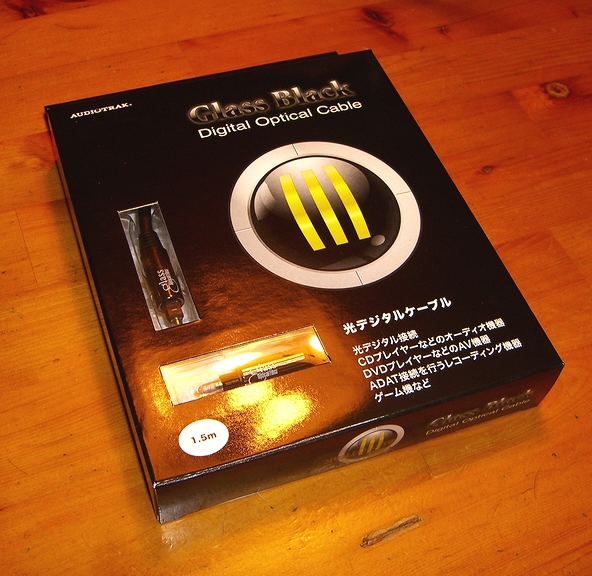
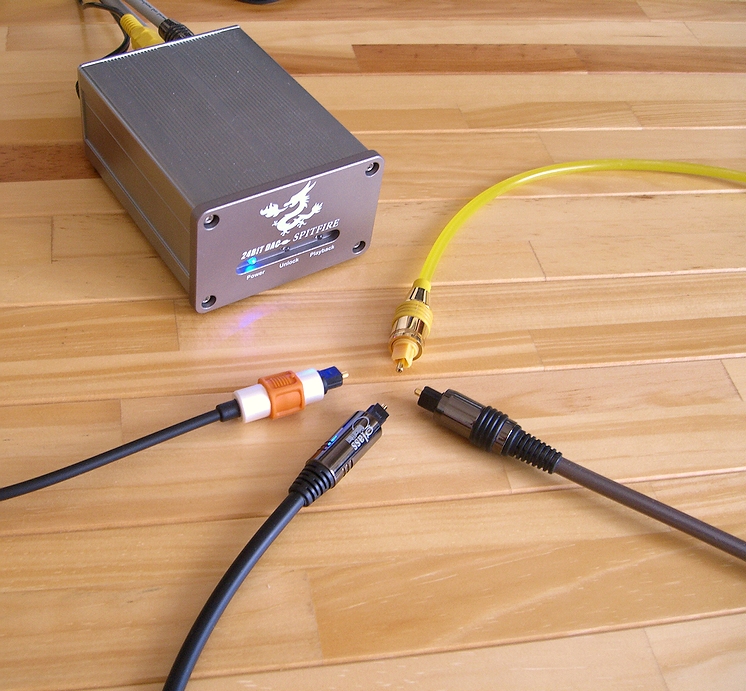
To begin with, TOS optical digital cables are in many respects at a sonic disadvantage compared to coaxial digital cables, and Hi-Fi-oriented products in this format have not been made with much enthusiasm until now. Glass-fibre and quartz-core cables, which exhibit lower jitter, are costly to produce, and have been limited to a handful of models such as the Saec OPC-X1, the American AudioQuest OptiLInk-5, and the audio-technica  AT-SDP2000. Optical digital cables are essentially divided into two camps depending on whether the fibre core is plastic or quartz glass, and the majority of models below the ¥10,000-odd price bracket — including those marketed as premium TOS cables for Hi-Fi use — use PMMA plastic cores. Models employing the sonically superior glass-fibre core have until now been exclusively in the several-tens-of-thousands-of-yen range.

Inexpensive plastic-fibre cores are said to suffer from greater transmission loss than quartz glass, which is considered one of the reasons TOS optical cables so often fall short of coaxial digital cables in terms of sound quality. Throwing a stone into that particular pond is the GLASS Black ATC-GB24, from the maker known for the high-quality DA converter AUDIOTRACK DR.DAC2. The fact that it uses a glass-fibre core at this price point is already appealing in itself, but what does it actually sound like — that was what I was eager to find out when I sat down to test it.
Test equipment (main system)


 ポチップ
ポチップ
audio-technica AT-OPX1
 ポチップ
ポチップ
The audio-technica AT-OPX1, which I ordinarily use with my DVD/HDD recorder PIONEER DVR-DT100 for AV purposes. Length: 1.5 m. Among the five optical digital cables currently in the audio-technica lineup, this is the lowest-priced model. Inside it uses APF — all-plastic fibre. Compared to the other models in the range, it is thinner and extremely supple. Despite its low price, the metal plug housing features an orange square rubber grip, which both damps vibrations transmitted from the equipment and makes the connector easier to remove.
The difference you notice immediately when you first listen to the AT-OPX1 — compared to other optical digital cables — is the breadth of the soundstage, which spreads upward and to the rear on both sides. That something one might call a “soundstage” is even perceptible from a cable at this level is itself surprising, and of the four models tested this time, this one produces the widest soundstage of all. On the other hand, the number of sounds drifting through that broad space feels rather sparse, giving a slightly lonely impression. Whether it is due to the vibration control measures at key points or not, the perceived S/N ratio is good, and for a TOS cable — which ordinarily tends to sound harsh — there is a sense of quiet and of space between sounds. That said, the absolute amount of information feels limited, the tonal colour is a little monotonous, and the characteristic softness and lack of body that optical cables tend to have does dominate, leaving a definite sense of insufficient weight and drive. On the other hand, there is a pleasing moistness and transparency to the tone, and delicate, sensitive expression can be heard.
The centre image sits slightly high, the bass is moderate, and the treble is just a touch brighter than neutral. What is genuinely attractive is the midrange: separation between individual images and note clarity are good, and vocals and spoken dialogue stand out crisply and pleasurably. Musical expression is, perhaps surprisingly, quite high. Of all four cables in this test, this is personally the one I would rank best. The rubber grip gives the impression of lending a gentle, lively springiness to the music. The sense of sparse information that is noticeable throughout might improve to some degree by using a shorter length — 0.5 m or 1.0 m — rather than the 1.5 m I am using. The weight and body are thin, but the good note clarity and wide soundstage are genuine attractions. The sonic roughness of inexpensive AV equipment tends not to be accentuated, and the AT-OPX1 strikes a well-balanced compromise between sound quality and musicality for a TOS cable.

For reference, the higher-tier audio-technica models include: the top-of-the-range Art Link S AT-SDP2000, which uses a quartz core with transmission loss of 0.04 dB/m; the AT-EDP1000, which uses a 50-micron × 280-strand glass fibre with transmission loss of 0.25 dB/m; the AV-oriented AT-DV91D; and the Gold Link Fine AT591D, which uses a plastic core with a titanium sheath. The more recent AT591D is actually cheaper than the long-running AT-DV91D, but with its titanium outer sheath and optical filter sheath cladding and so on, it appears to be more elaborately constructed with Hi-Fi use in mind than the DV91D. ※ The successor to the AT-EDP1000, the AT-EDP1100, has been changed in specification to use PMMA plastic fibre.
 ポチップ
ポチップ
TDK OC-6TT10/OC-6TT20/OC-6TT30
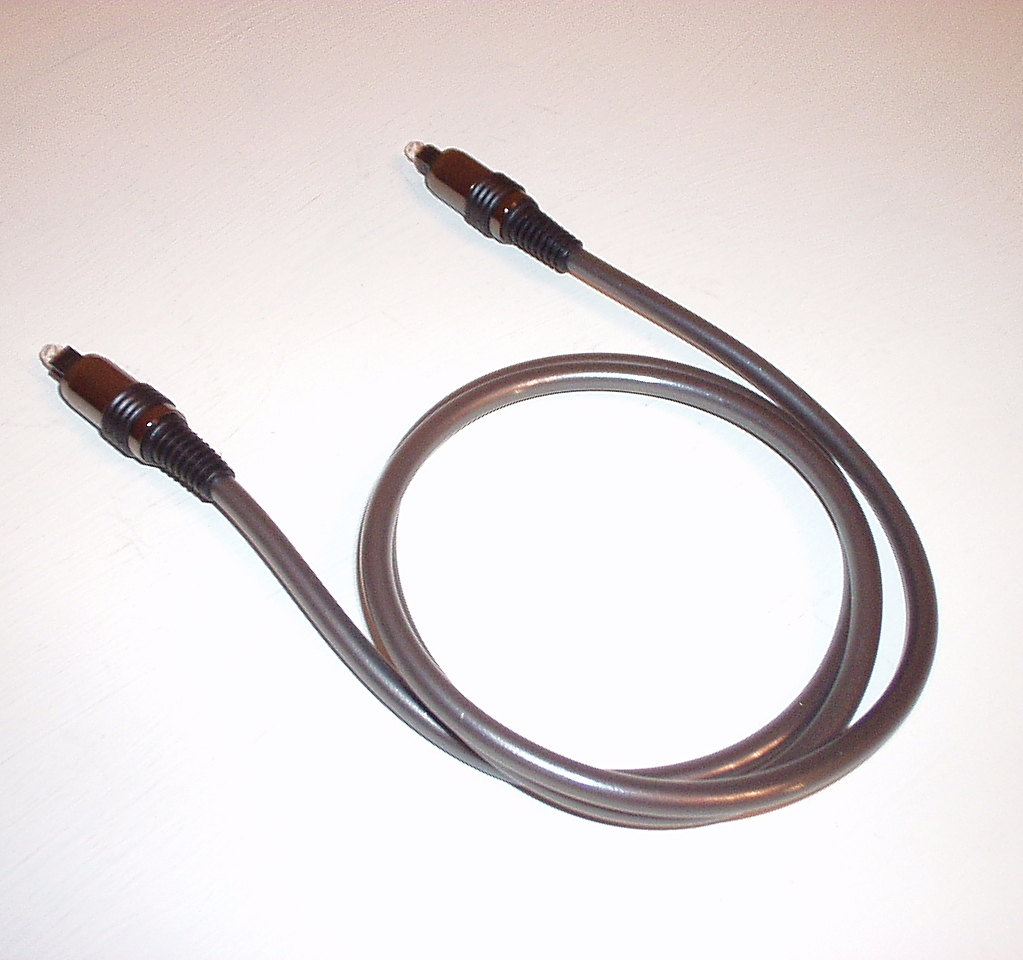
The TDK OC-6TT10/OC-6TT20/OC-6TT30, released by TDK in 2001 and noted in certain corners of the internet as sounding good for the price. Now discontinued. The sound has a somewhat different character from other optical digital cables: voices and vocals have large, soft outlines with a moist, full-bodied tone. The overall balance is midrange-heavy and closed-in, with a narrow range, and the sound tends to sit spread horizontally across the centre. There is little sense of vertical height, though depth is reasonable, and there is possibly more low-frequency presence than one might expect from something this inexpensive — though I am not entirely certain. The real strength of this cable lies in its soft, nuance-rich midrange. Piano nuance is well conveyed, but individual notes tend to bleed into one another, and passage-to-passage separation does not feel particularly good. Also, in sections where other optical digital cables do not particularly draw my attention, this one has a curious tendency to let hall tone come through — or rather, it may be that there is a kind of echo applied to the reverb. The treble hardness and brightness typical of TOS links are present, but the overall tonal colour is on the darker side. Information density is standard for a TOS cable in this class. Whether the OC-6TT10’s value reveals itself or not will depend on how well one can make use of its softness and relative freedom from distortion.
D/A converter Super PRO DAC707-USB bundled cable (JZR JAPAN?)
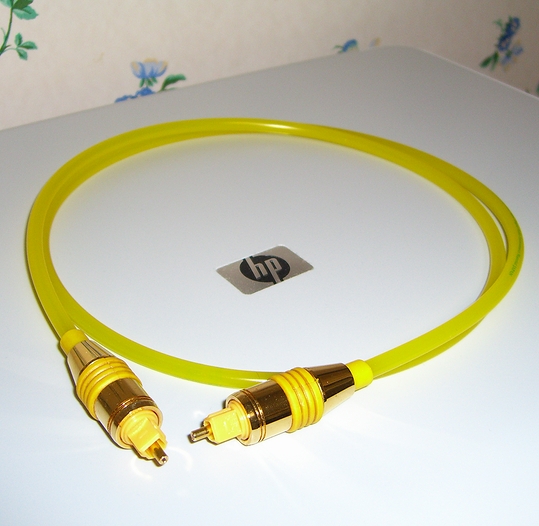
This came bundled with the compact Hong Kong-made DAC, Super PRO DAC707-USB, which I imported personally from the United States last year. (I plan to review the Super PRO DAC707-USB when I feel like it.) First of all, the colour of this cable is extraordinary. It looks like a toy from a penny sweet shop. A translucent, vivid yellow through which you can see the interior. When I searched online, it seems there are people who received a green version bundled with the same model; apparently red and blue versions also exist. One does wonder about the wisdom of using a transparent material — one that freely admits external light — in a TOS link cable whose entire purpose is to transmit optical signals, but what is even more remarkable is the word “JAPAN” printed insistently all over the cable and its connectors. Looking at overseas sites, some retail packaging apparently goes so far as to include the Japanese characters for Japan alongside the word “Akihabara.” Clearly they want to suggest it is a Japanese product — yet nowhere does it say Made in Japan. It appears in abundance on Hong Kong eBay listings, which is rather amusing. And for some reason, when I opened the bag, the cable was coated in what seemed to be machine oil, sticky all over. Cleaning it up with alcohol before use was quite a chore.
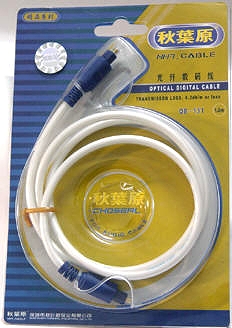 Given all of the above, one would hardly expect much from it sonically — and yet, when connected, the sound quality is surprisingly decent; in fact, genuinely respectable. It has a different quality from the thin, flimsy TOS cables that come bundled as an afterthought with digital audio equipment. In particular, in the sense that it straightforwardly brings out the sonic character of a plastic-core TOS link cable, this is the most “TOS-like”-sounding of the lot. Image transparency is high, the sound has an appropriate firmness, and imaging is good. Listening for extended periods, it can feel slightly bony. The midrange is clear. Dynamic and positive, the treble is bright, though conveying quiet and stillness is not its strong suit. The tonal colour — as with all TOS cables — has a certain one-note quality, like viewing scenery through a sheet of acrylic, and this cable is no exception. Accordingly, tonal differentiation within classical music and orchestral repertoire is equivocal. The soundstage is flat — there is breadth and some height, but little depth — or rather, the sound tends to project forward. That said, it is bright and energetic, and I find myself thinking that for anime soundtracks and J-pop, this kind of presentation is actually rather enjoyable, and I consider myself to have acquired quite a characterful oddity for a bundled accessory.
This has run on rather longer than planned, so the AUDIOTRACK GLASS Black ATC-GB24 will be covered next time….

Auto Translated by CS4.6

List of comments (1)
Très intéressant, cet article. j’aurais aimé des graphiaues de comparaison des pertes des frequences