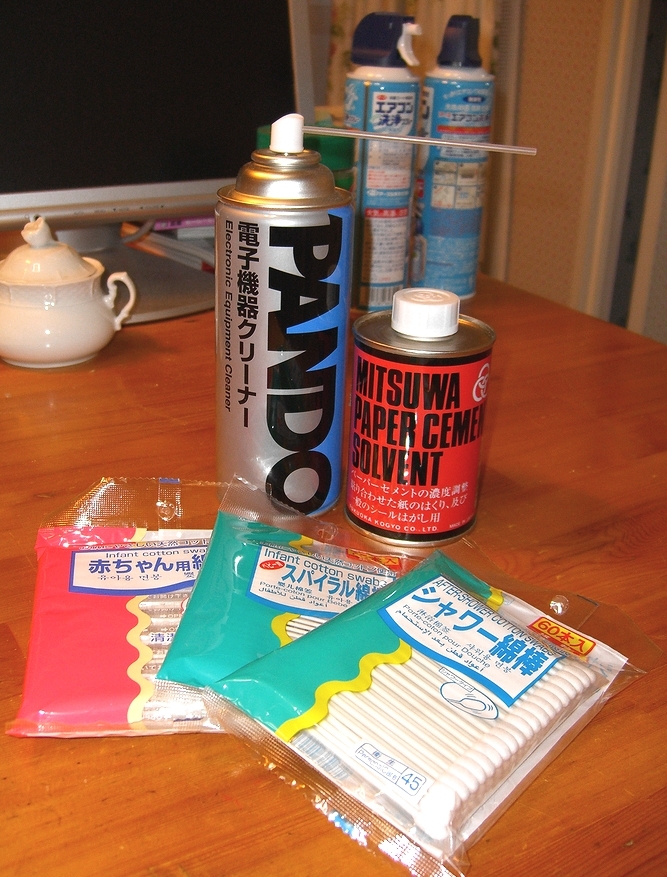
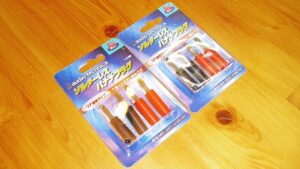
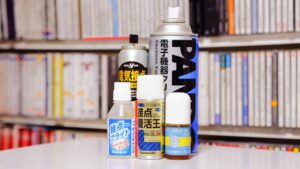
I have written before about using PANDO29D electronic contact cleaner and Mitsuwa’s Paper Cement Solvent for cleaning the metal terminals and other contact points on audio equipment — and the cotton swabs I use alongside them are these. In recent years, almost all cotton swabs sold in ordinary pharmacies and supermarkets in Japan have been treated with chitosan antibacterial processing, but these ones are purchased from the 100-yen shop Daiso, and are among the rare non-antibacterial, plain cotton swabs. Though, really, the level of thoroughness with which absolutely everything gets antibacterial treatment — that’s uniquely Japanese, isn’t it…
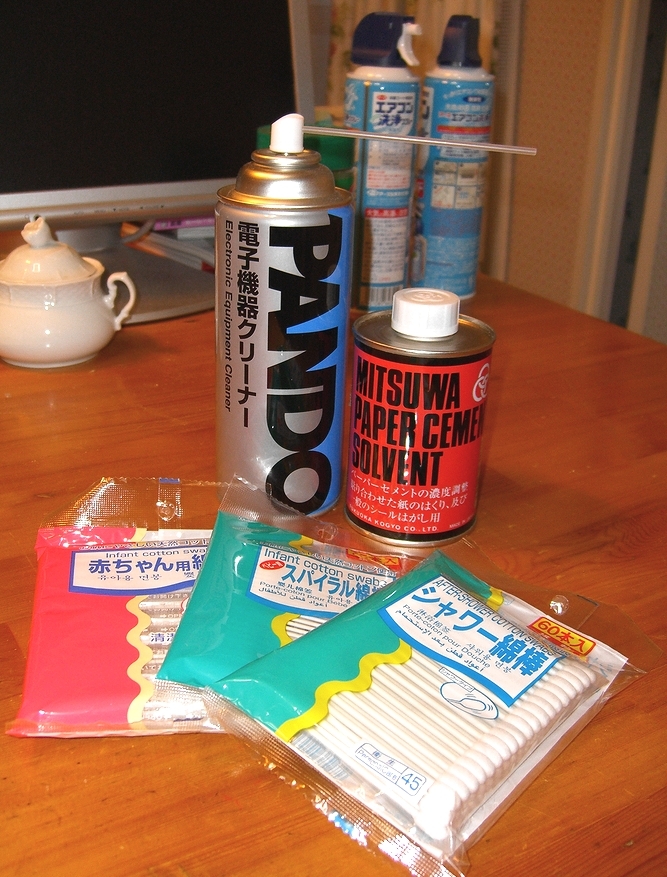
Could the chitosan antibacterial agent contained in the fibres (apparently extracted from the shells of red snow crabs) leach out? Or is it actually entirely harmless? I don’t honestly know either way — it may well be completely unrelated and not a problem at all — but for the time being, what I don’t fully understand is best avoided for peace of mind, so I try to use non-antibacterial cotton swabs on audio equipment wherever possible. In recent years, however, non-antibacterial swabs have been all but driven out of general retail, and can now only really be found in 100-yen shops. Or rather, even in 100-yen shops, more than half the swabs on the shelf have recently become chitosan-antibacterial spec, which makes this particular Daiso series something rather precious. 《Later note, 2015: Non-antibacterial cotton swabs have now been gone from every 100-yen shop for quite some time.》
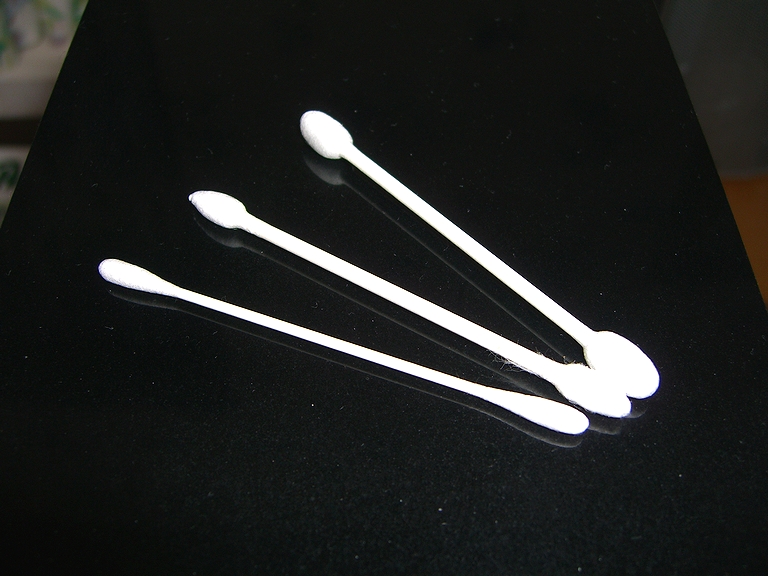
The baby swabs and spiral swabs are just the right size for the inside of RCA terminal sockets and the tips and inner surfaces of pin cables — and also for the interior of female inlet plugs on power cables. Standard-sized swabs work well for the outside of RCA terminals and inside speaker terminals. The large round shower-head swabs are a good fit for the outer surfaces of various terminals, mains plugs, AC inlets on the equipment side, the ends of speaker cables, Y-lugs, and banana plugs.
And something that cannot be overlooked is the pickup lens. Starting with PC optical drives, whenever reading becomes suspect on a CD player, DVD player, Blu-ray recorder, or anything similar, I do not use a rotary lens cleaner — instead, I soak a baby cotton swab in isopropyl alcohol and, “with the utmost care”, clean the pickup lens from directly above with the lightest possible pressure and a gentle circular motion. Even when no dust is visible, years of use inevitably cause moisture, oils, and other contaminants in the air to cling to the lens and cause it to cloud over. Depending on the unit, this alone can reduce disc-skipping, or — whether because servo jitter is suppressed or for some other reason — the perceived sound quality can become noticeably cleaner. 《Depending on the model, this may require removing the top panel or disassembling the drive mechanism, and any physical contact with the lens carries a direct risk of damage, so please proceed entirely at your own risk.》
The weakness is that, being budget 100-yen-shop cotton swabs, the handle snaps rather easily. On one occasion the head of a swab came off inside an RCA socket, and I was in quite a panic trying to retrieve the cotton tip. I managed to get it out in the end using a method shown to me by a friend who is skilled at scale modelling — bending the tip of a thin dressmaker’s pin into an L-shape of about 1 mm with a pair of pliers. In a genuine emergency, this turns out to be a surprisingly practical approach.
For cleaning audio equipment, I now use modelling cotton swabs such as those made by Tamiya.


 ポチップ
ポチップ
Among products developed specifically for audio use, Audio-Technica‘s AC200 was one — lint-free and with a handle that resists snapping. The head is standard-sized, so cleaning the inside of RCA terminals is not possible, but it was originally sold for cleaning tape deck heads and transport mechanisms. At some point it was discontinued. I now use various craft cotton swabs made for modelling and industrial purposes by Tamiya and GSI Creos as substitutes.
 ポチップ
ポチップ
Audio-Technica also used to make a product called the AT604, a cleaning stick designed for RCA terminal cleaning. I used it once, more than fifteen years ago, back when I was still an audio novice. It is made from a fairly firm material, and can clean both the inside and outside of an RCA terminal at the same time, with the other end for cleaning pin cable terminals. Being a dedicated tool, it was genuinely easy to use — but it would turn pitch-black almost immediately, and the unit cost was high. Personally speaking, outrageously high. As a result, I ended up switching to cotton swabs thereafter. Back then, these sorts of swabs and terminal cleaners were even stocked in the AV section of ordinary supermarkets…

Auto Translated by CS4.6

List of comments (5)
キトサンでぐぐってみましたが
http://jstore.jst.go.jp/cgi-bin/patent/advanced/detail.cgi?pat_id=13200
くっつけるのにノウハウがいりはがれやすくてたまらない、みたいですね。
使い捨ての綿棒に行われている品質は推して知るべきかと。
検索多謝です。
PANDOやソルベントの中でキトサン綿棒を浸すと溶液中に溶け出し、端子に擦りつけると溶け出したキトサンで抗菌コート出来ると云うことかっ!
まぁ実際には経時劣化(酸化)する動物性の鮫の肝油をスクワランと称してベースオイルとして使用している接点保護材が色々と出回っているので、それよりは遥かにマシであると思います…(^^;
今回も勉強になりました。接点クリーニングって機器購入以来してないのでしてみます(爆)。ところで先日、以前当ブログで紹介されていたアコースティックリバイブのRD-3を購入しました。一応、オークションなどで購入したCDに使用してますが、微妙な変化かなと。高音がクリアーになってるなとは感じますので、今後も使用しますが。(自分にとっては高価な買い物でしたから使わないと損?場合によっては使用すると音質悪化ですか)こちらのリンク先のアメリカにお住まいの方のホームページでは、アメリカ製の同様な製品に買い替えたらしいですが。今後DVDにも使用可ということもあり、どんな変化をするかこれから実験してみます。ブルーレイにも変化あるのでしょうか?変化するのは音質?画質?悪化しない?などなど興味津々です。ではまた。
クリーニング、ぜひやってみてください♪お金は掛かりませんし、半年に一度でもやると音質が見違えるようになりますよ♪
>RD-3
Jazzaudiofanさんの記事ですね。
http://blog.livedoor.jp/jazzaudiofan/archives/51347315.html
ベディーニ・ウルトラクラリファイアー(Bedini Ultra Clarifier)とRD-3でどちらが良いかとの話ですが、正しい音云々については、オカルトの領域なので強いて云えば両方間違っている音だと考えています。古いCD、レンタル、中古などで高域の鮮度を回復させる用途ではRD-3、ナチュラルなサウンドならベディーニみたいですね。
https://www.audiostyle.net/archives/23980268.html
アコースティックリバイブの消磁器による変化の大きさはシステムに依存します。たとえばうちの場合、クリークのEVO-CDでは何故か大きな違いが出ません。他で音飛びを起こすような傷入りCDでも何故か普通に再生してしまう読み取り性能の高いプレーヤーですので、メカの世代やデジタル段の設計でオカルト効果の出方にも差が出るようです。逆にCECのベルトドライブプレーヤーでは劇的に変化します。CECは元々音調がソフトでボケ気味ですから、RD-1での変化が聴感バランスを良い方向へ傾けてくれる感じです。
こういう製品は、不満を感じた時に初めて試してみるという類の物であり、何でもかんでもやたらめったら消磁処理すればいいという訳ではないと思います。不満のないCDを処理すると失敗することがあります。基本的に何故か音調のバランスが変化するけれど、本質的な意味で良くなっているわけではないというのが私の考えです。
ブルーレイでもSACDでもDVDでも環境次第で変化はあると思います。画質なら再生するプレーヤーによっては精彩感が増すような感じがしますが、私は音の方が画よりも敏感に知覚できる変な人なので断言はしません。プラグとかRCAケーブルでも変化します。しかも聴感上の変化の方向性はCDを処理する場合と一緒ですから、消磁したからとか、デジタルの読み取り精度が上がる!?云々は屁理屈の建前であって、本当はなにか別の所に影響が出ているのではと思ってます。じゃあ何か?と問われてもそれはデムパなので解らんとしか答えられませんです。