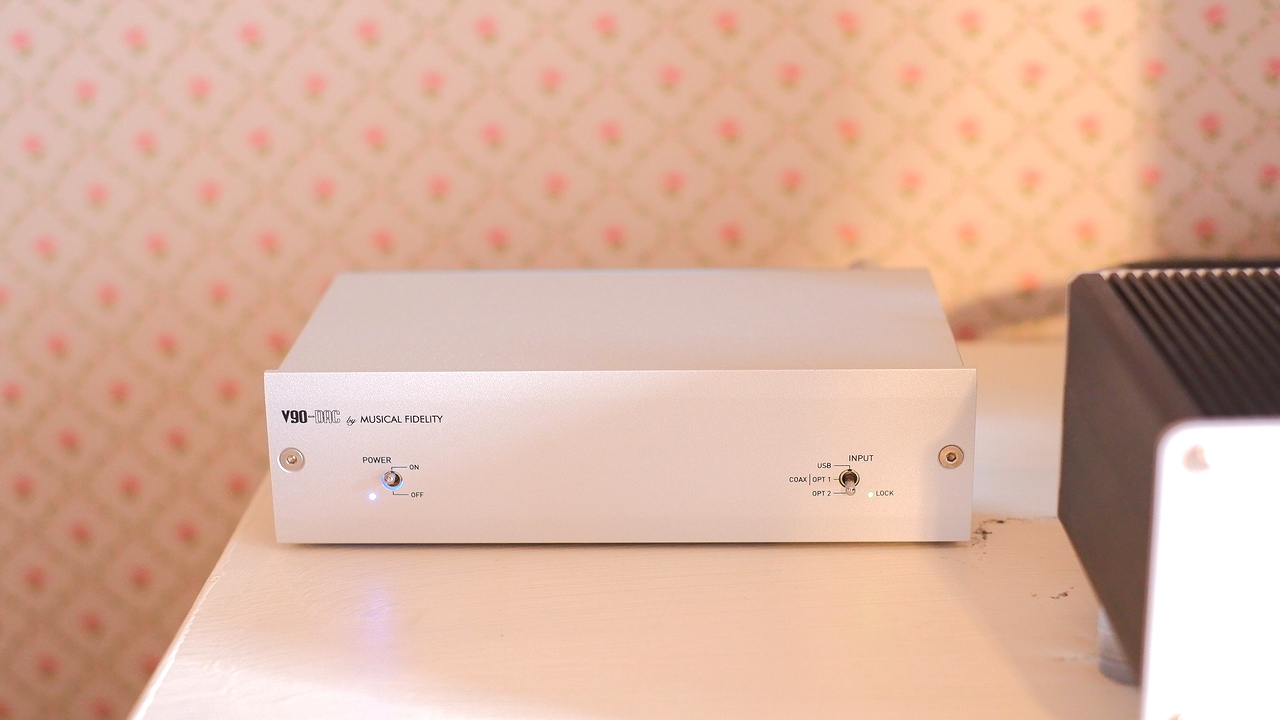
This time I would like to introduce the Musical Fidelity V90 DAC, a small British D/A converter I originally purchased in 2014 for the AV equipment in my main system. As usual, it is one of the palm-sized, inexpensive compact DACs I have been collecting here at AUDIO STYLE — and it is the successor to the well-regarded Musical Fidelity V-DAC and V-DAC II.
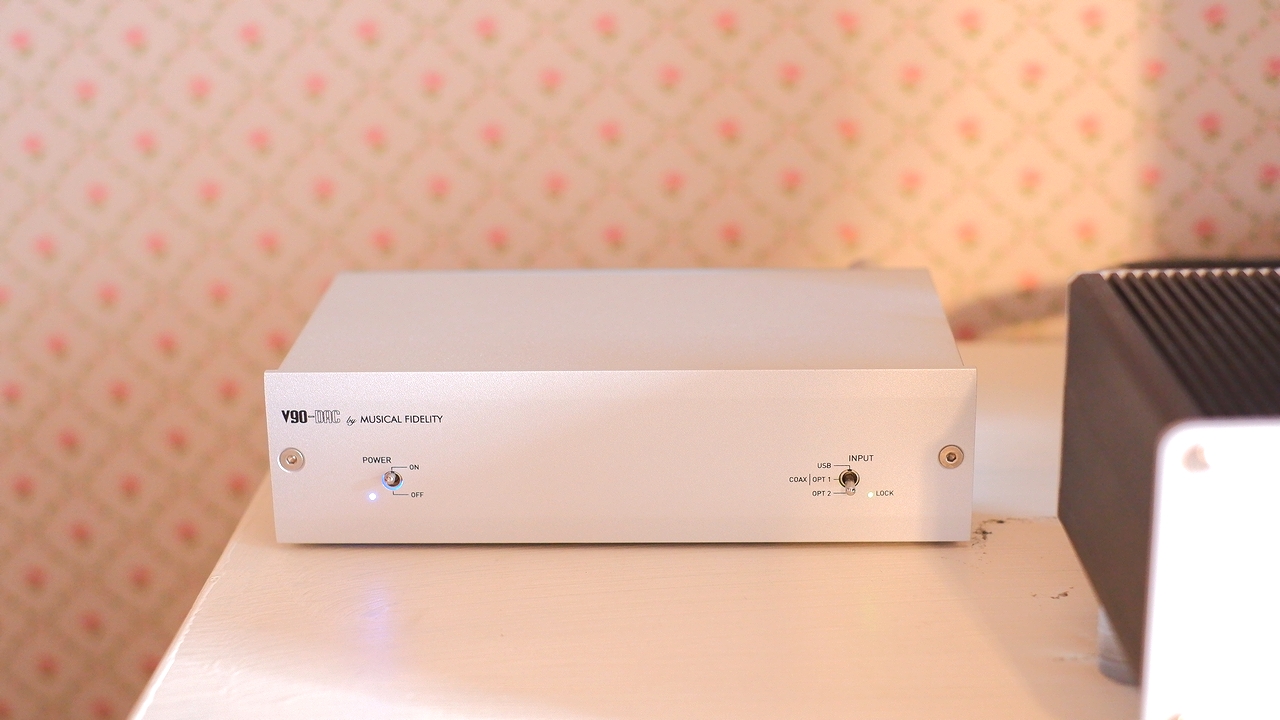
I had considered buying the V-DAC and V-DAC II — the two generations that preceded the Musical Fidelity V90 DAC — on several occasions over the years. However, the input and output terminals were positioned on the short sides of the unit, which looked awkward to use once incorporated into a system; and at home in the UK, they were sold hanging on blister packs in the audio accessories aisle, giving the whole thing a rather cheap, toy-like feel that always stopped me from taking the plunge. With the new V90 Series — the third generation — the design has been rethought: despite its ultra-compact dimensions, the unit now comes in a conventional aluminium enclosure with all terminals gathered on the rear panel, and the packaging has been updated to an ordinary, smartly presented white box.
How I came to buy the V90 DAC
At the time, the Japanese distributor Heinz & Company was effectively dormant, and there was no official domestic import of the new Musical Fidelity V90 Series, so I arranged to import it personally from the UK. The previous V-DAC II and the generation before that, the V-DAC, had been sold domestically, and a fair number of reviews could be found if you looked. For the V90, however, there was only a single blog review from someone who had imported it ahead of me — “Ui-Toma no Blog (Wayback Machine)” — which has since disappeared without a trace, which is a shame.※ The link above goes to the Web Archive.
 ポチップ
ポチップ
That said, the compact V90 Series seems to have sold reasonably well overseas, and English-language reviews are plentiful. The local price was £199 / US$299, which was not especially high, so I ordered it unheard, going by my impressions of existing Musical Fidelity products. In fact I ordered two units at the same time — one for myself and one for an acquaintance — but looking back, the pound was around ¥190 at the time, and all things considered — customs, shipping, everything — I do think I picked a rather expensive moment to buy.
V90 DAC: product overview and DAC circuit design
The V90 Series includes five sibling products sharing the same design. All are available in two finishes: black and silver.
The V90 DAC accepts 16–24-bit PCM digital input with no DSD support. The DAC chip is a 32-bit Burr-Brown PCM1795, with fixed 24-bit 192kHz upsampling. The unit measures 170×47×102mm and weighs 600g. In circuit terms it is a new design, distinct from the previous V-DAC II: the axial-lead aluminium electrolytic and film capacitors that featured prominently in the V-DAC II and the original V-DAC have been dispensed with and replaced by radial-lead types. The DAC chip has also been upgraded from the 24-bit Burr-Brown PCM1796 to the 32-bit Burr-Brown PCM1795. However, it operates as a 24-bit device; no upsampling to 32 bits is performed, which may be a matter of cost or component availability. I deliberately write “Burr-Brown” rather than “TI” or “Texas Instruments” — it is something of a personal habit.
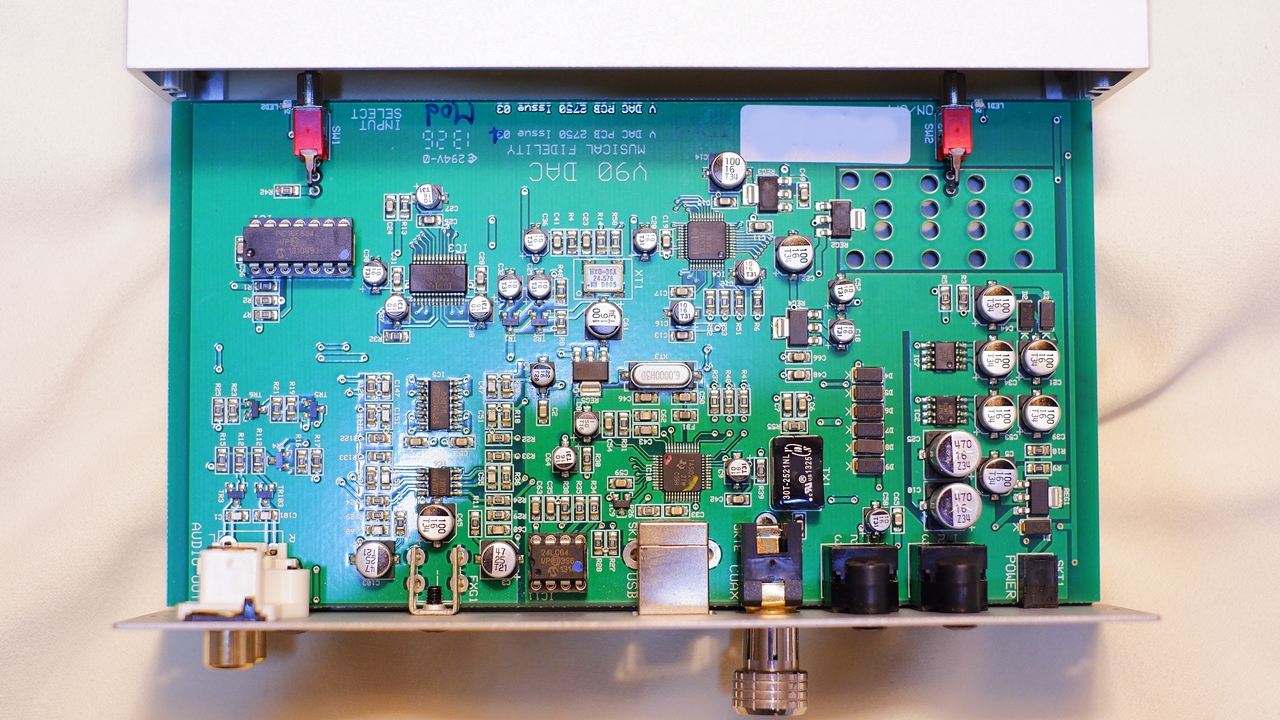
Like other recent Musical Fidelity products (the M Series), it is manufactured in Taiwan. The inside of the V90 DAC looks like this. Handle it and you will notice that the build and assembly quality is genuinely excellent. Musical Fidelity UK was acquired by Austrian company Pro-Ject around three years ago, but judging by the products released since then, there has been no dramatic change in Musical Fidelity’s product development or manufacturing — at least so far. Whether that will continue to be the case is another matter. Incidentally, the current authorised distributor in Japan has transferred to Rocky International.
Three digital inputs — effectively four ※
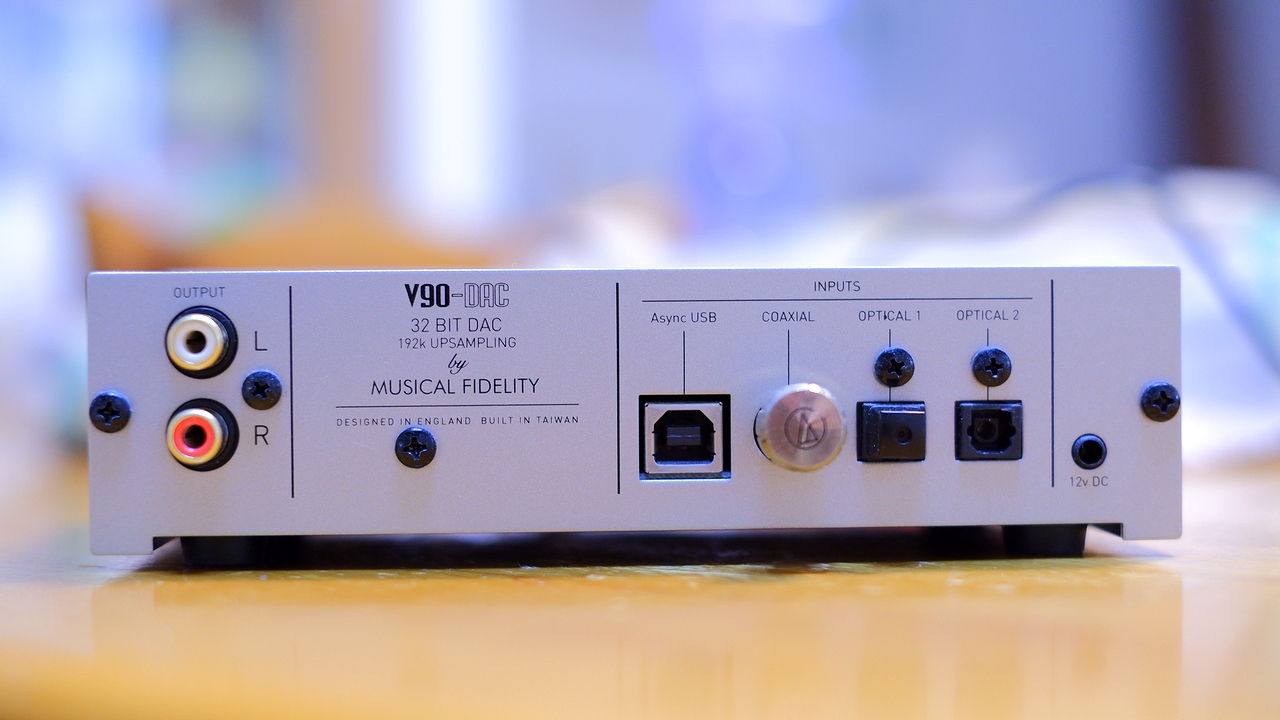
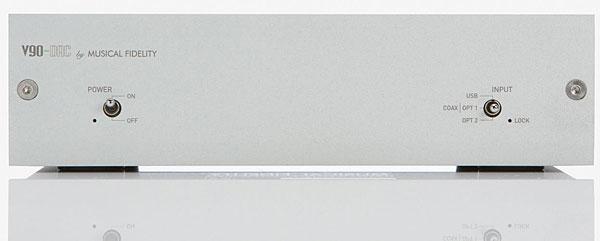
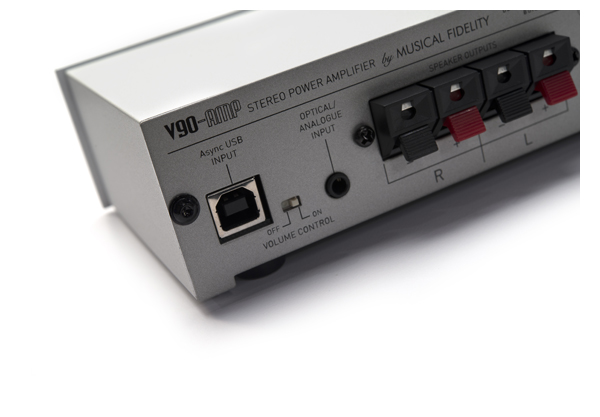
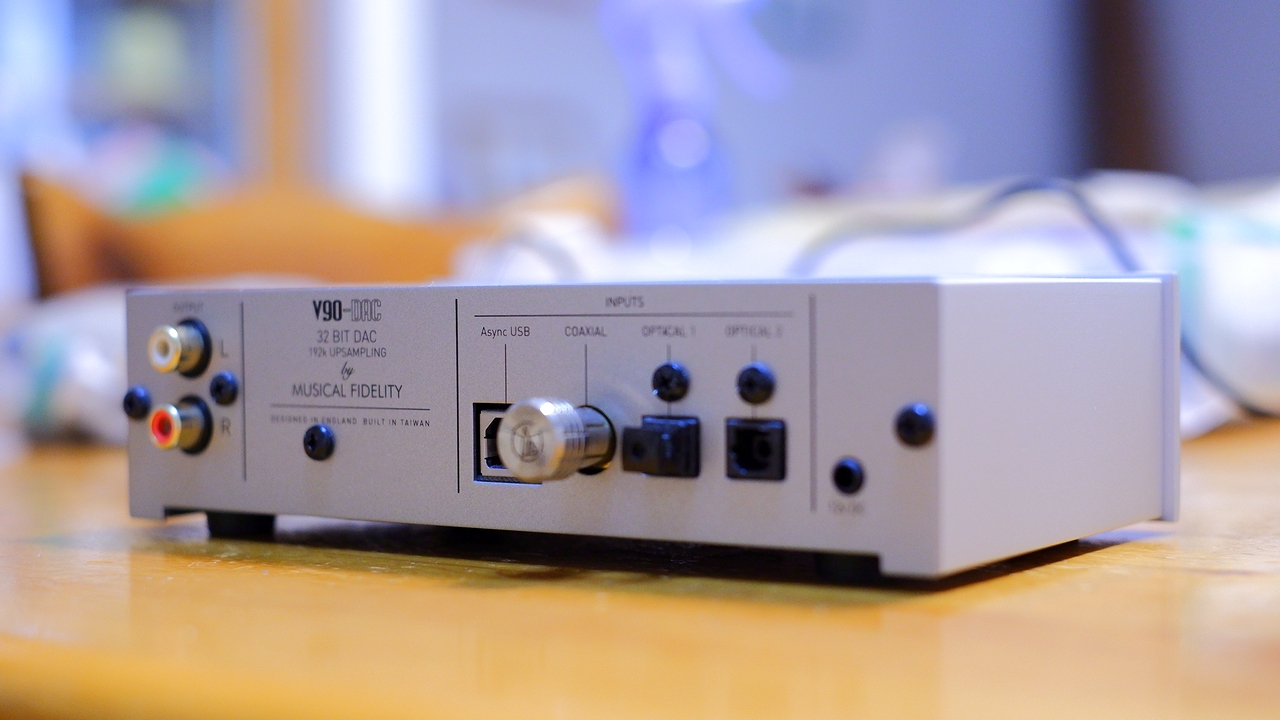
One of the reasons I bought the V90 was that I wanted a DAC with as many digital inputs as possible. The palm-sized compact DACs I had collected up to that point were, partly owing to their low price, invariably limited to one or two digital inputs (S/PDIF coaxial or optical) plus USB. The V90, by contrast, offers two S/PDIF inputs (effectively three: coaxial or coaxial/optical) alongside a USB input. The input selector switches between three positions: coaxial / (coaxial + optical) / USB. The coaxial and TOS-link optical side share automatic switching — when the unit is powered on or the selector is changed, it detects whichever input carries a signal. If both coaxial and optical signals are present simultaneously, coaxial takes automatic priority. If the TOS-link side fails to be recognised due to a conflict, powering the V90 DAC off and on again, or switching off the digital source connected to the coaxial input, will resolve it. Using this method, it is effectively possible to run three S/PDIF digital inputs in addition to USB.
 ポチップ
ポチップ
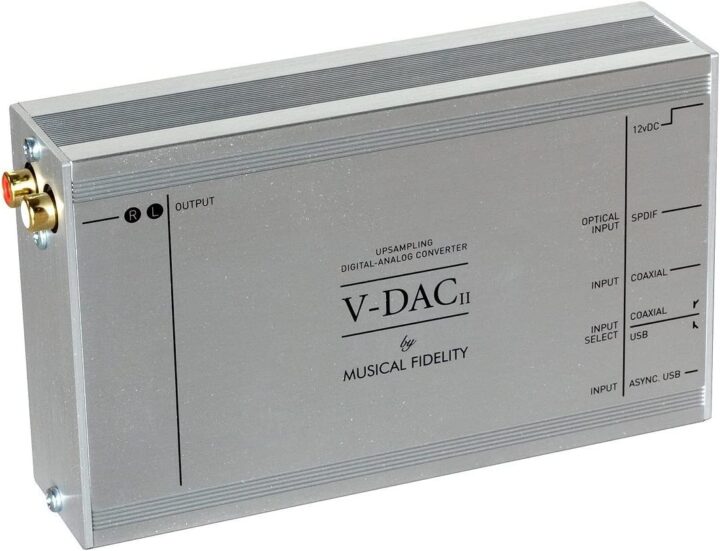
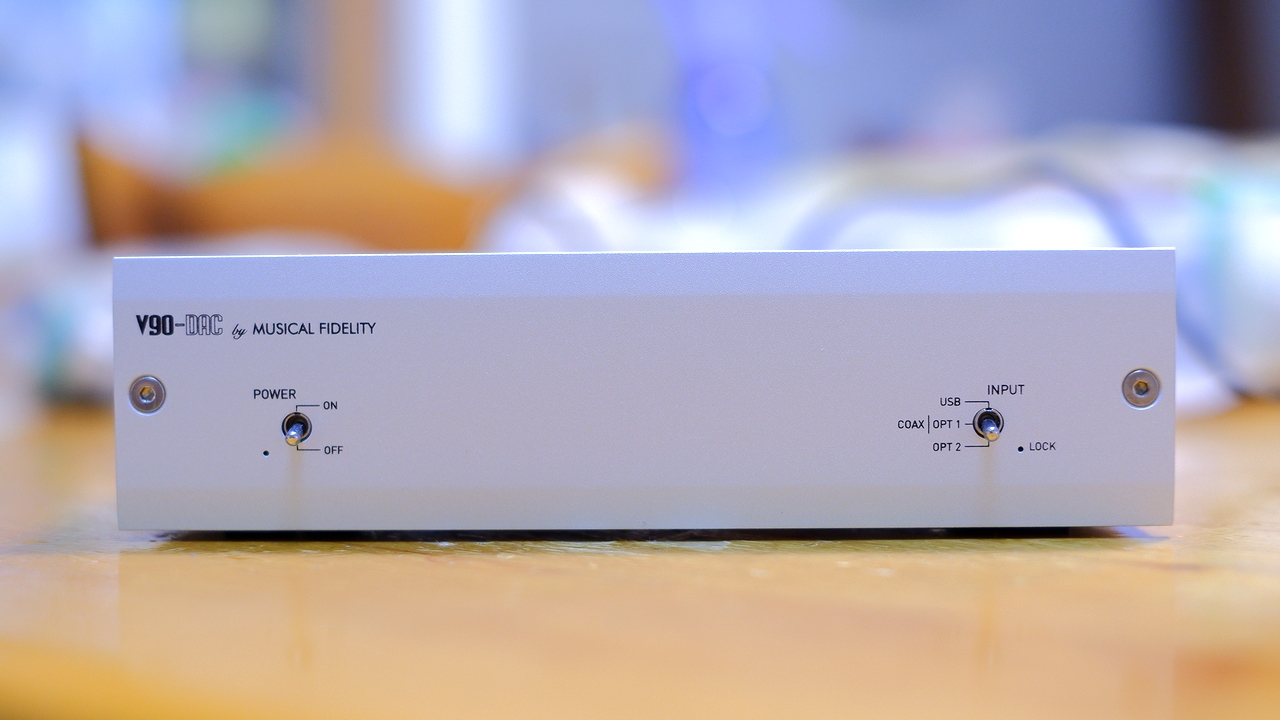
The older V-Series V-DAC and V-DAC II had their input and output terminals arranged in a portable-device fashion, with signal entering from the right short side and leaving from the left — something that caused no problem at all on a headphone amplifier like the V-CAN II, but was not particularly convenient for a desktop DAC in a home Hi-Fi system. The new V90 Series addresses this: a toggle power switch and input selector sit on the front panel, with all inputs and outputs moved to the rear, giving it the layout of a proper component that is far easier to live with.
Musical Fidelity V90 DAC — sound quality review
Now, to the sound itself. I was using the Musical Fidelity Class A integrated amplifier A1 Junior when I was still in my early twenties — long before I ever started writing this site. The Musical Fidelity of that era was all about the hot, energetic character of its Class A amplifiers: dense, rich, and analogue-like in flavour. The V90 DAC, by comparison, shares so little with that image that it is difficult to find any common ground at all — it is an entirely different, thoroughly modern-sounding proposition. The tonal character is slightly low in saturation, neutral, and soundstage-oriented. Images are on the lean side, but the gradations are finely drawn and delicate. The overall impression is very much in keeping with the contemporary British tendency, and it reminds me less of the old Musical Fidelity A1 than it does of AUDIOLAB.
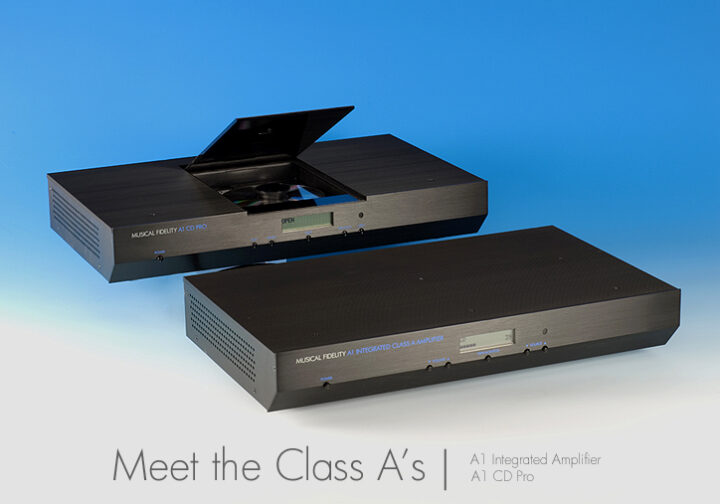
Among full-size Musical Fidelity products, the closest sonic family resemblance I can think of would be the A3 series from the mid-2000s. ※ The current M Series is probably even closer, but I have not heard it. The A3 was, of course, a step up in class, and accordingly offered a richer soundstage with more moisture and sheen; the Musical Fidelity V90 DAC, perhaps partly influenced by the matt, sandblasted finish of its aluminium enclosure, has a somewhat flat, roman-grey quality to its tone — understated rather than lustrous. In this respect the previous V-Series (V-DAC II / V-CAN II), with its smoother, more polished aluminium finish, actually had the edge in terms of perceived quality; and sonically, I could do with just a little more warmth and texture in the presentation.
Straight out of the box, the soundstage had a misty, slightly powdery, dry quality to it, and it took the better part of a year of use before it settled down to the point where that no longer bothered me. In the case of the V90 DAC, I suspect this has a great deal to do with the fact that all the electrolytic capacitors are solid-state types. Solid capacitors offer better measured performance and longer service life, but in my experience they tend to sound less liquid than conventional film capacitors on a perceptual level, and require considerably more burn-in time before any sense of strangeness fades away.
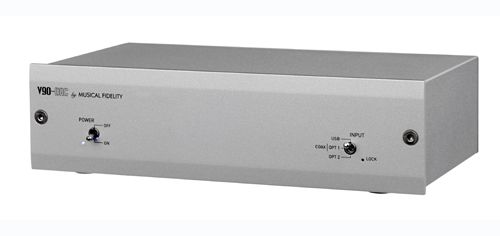
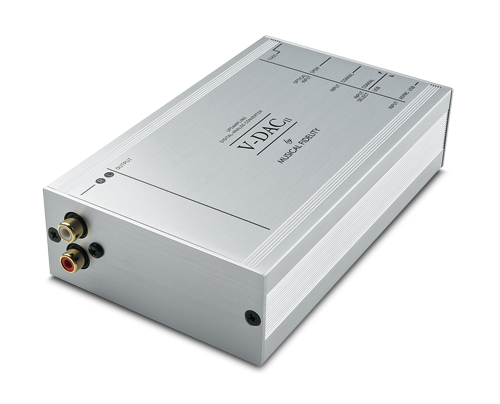
In the What Hi-Fi review, the V90 DAC — like the V-DAC II before it — fell short of five stars, earning four. The For/Against section is fairly pointed in noting that it falls well short of a serious DAC, and I think that is a fair comment. My own impression runs along similar lines: there is a thinness that you often encounter at entry level — a generally soft, slightly loose soundstage; a smooth, detailed, beautifully graded midrange with rich gradations; not much in the way of pace, and a character that is rather calm and passive than lively. It holds together tidily enough without falling apart, but there is no particular sense of vividness, and it leaves you feeling slightly unfulfilled. Writing it out like this might give the impression of something sluggish, but that is not quite right either — taken as a whole, it is refined, neutral, and gently understated in character.
What Hi-Fi concludes that if you want something more exciting and higher in resolution over USB, the HRT microStreamer is preferable to the V90 DAC, and that if you want a more fully featured D/A converter, the Cambridge Audio DacMagic 100 is the recommendation.
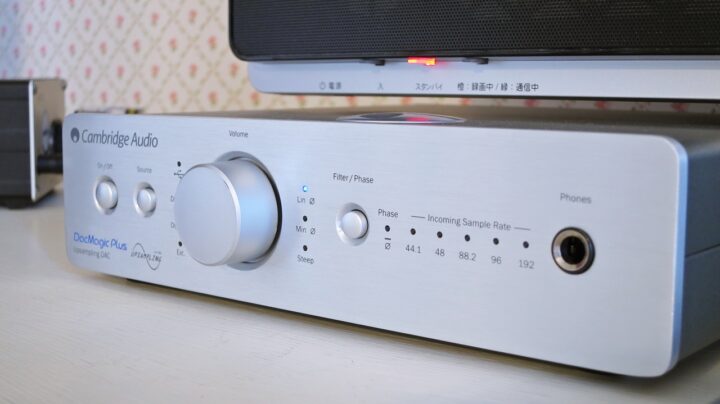
That said, I have come across user comparisons overseas in which the V90 DAC is rated above the Cambridge Audio DacMagic 100. And personally, having previously owned the DacMagic Plus — a step up from the DacMagic 100 — I still feel that the Musical Fidelity V90 DAC comes out ahead sonically, setting aside matters of personal preference. In short, for an entry-level product, it is competently put together in the best sense — a capable performer that manages to cover the important bases. I think it is fair to call it genuinely good. ※ The sound quality assessment on this site is based on listening with the transformer-type AC adaptor from the Musical Fidelity V-CAN II, described below.

Unit-to-unit variation between the two I bought
As I mentioned at the outset, I bought two units at the same time — one for myself, one for an acquaintance. When I did a quick listening test before delivery to check for any faults, I noticed that the two sounded noticeably different from one another. Audio equipment, even brand new, does vary in sound from one unit to the next — though this is something that rarely gets talked about openly. With second-hand audio that has had years of use, the unit-to-unit divergence can be so large that trying to judge a piece of equipment’s true sonic potential purely from a used example is, I think, essentially impossible unless you happen to be psychic. Of course, I myself am permanently tuned in to cosmic transmissions from outer space, so that is not a problem for me.
In this case, both units were brand new and of the same model, so naturally the sound fell well within the range described in the review above — they were extremely similar. Even so, the first unit had a brighter, more open warmth in the midrange, with a richer, more musical quality overall. The second was more subdued in the mids, cooler in temperature, and leaned further towards a passive, delicate, soundstage-oriented character. The first had a relaxed ease to it alongside a musical fullness in the midrange; the second, with its thinner mids, opened up a flatter soundstage that extended further in both directions. I believe the first unit is closer to what the Musical Fidelity V90 DAC is actually meant to sound like — but there was something about the second unit’s slightly wistful, shadowy, nervously delicate quality that appealed to me personally, and so I deliberately chose to keep the second one for myself. That said, I suspect the tonal target the manufacturer was aiming for is probably closer to the first… It surprised me somewhat that even with build quality as precise as this, and with the component count pared back to an absolute minimum, audible unit-to-unit variation still clearly exists.
How the AC adaptor affects the sound
British audio equipment is rated for 220–240V mains, so if you buy a unit directly from an overseas retailer and bring it to Japan as-is, it cannot be used in a normal household here. ※ It is possible to repurpose the 200V supply used for air conditioning units (which requires work on the distribution board), but even then there is a real chance that the voltage will still be insufficient. However, the Musical Fidelity V90 DAC aside, many affordable compact DACs and amplifiers come with universal AC adaptors rated for 100–240V, and products of this type can generally be used as-is in Japan on 100V/50–60Hz.
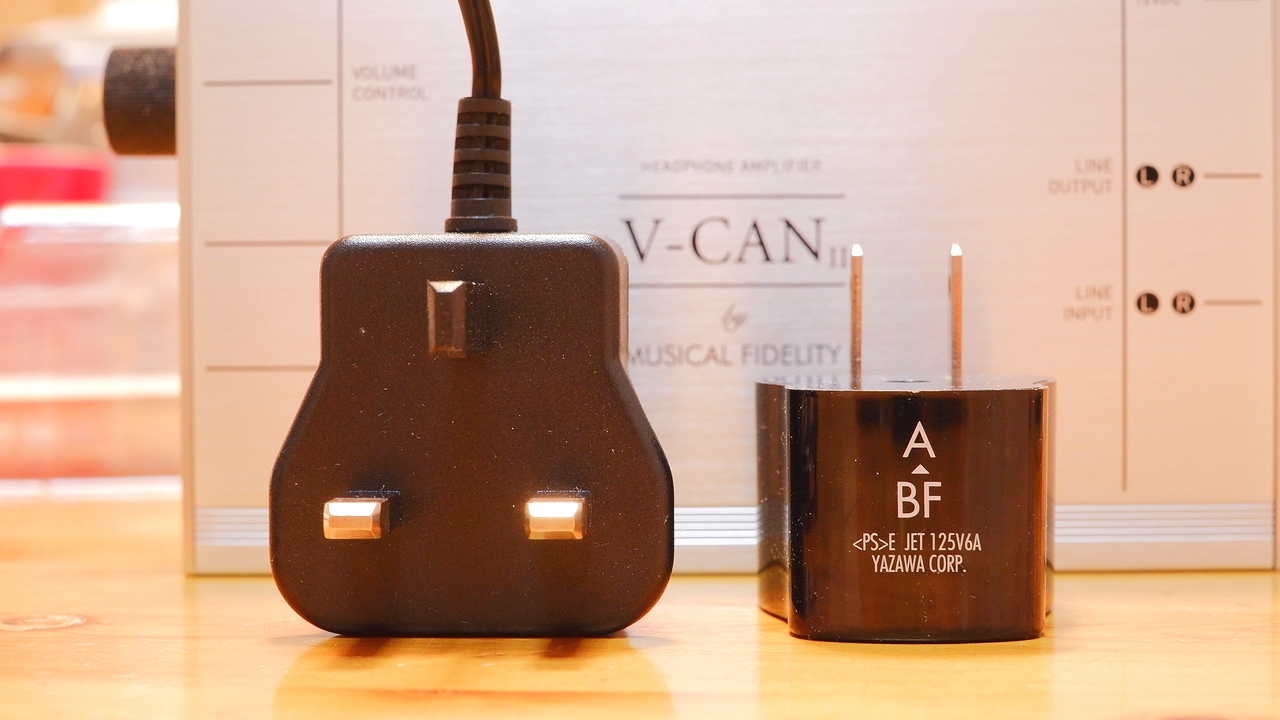
Incidentally, my V90 DAC was purchased shortly after launch through a British specialist audio retailer, so the AC adaptor has a UK-type (BF) plug. To use it in Japan (Type A), a separate BF-to-A plug adaptor is required. Ideally I would have sourced it via the US, where the plug shape is the same as Japan’s, but as it was early days for the product I could not find it there. Not long after my purchase it became available on Amazon.com in the US — which rather floored me. And of course the US route would have been considerably cheaper both in terms of the exchange rate and shipping costs. Marvellous.

 ポチップ
ポチップ
For the BF-to-A plug conversion I chose the YAZAWA HPJP5. It is not an audio-specific product, but it is a nickel-plated adaptor and the build quality is good. Sonically, for a plug adaptor it is within acceptable limits — surprisingly inoffensive, actually.
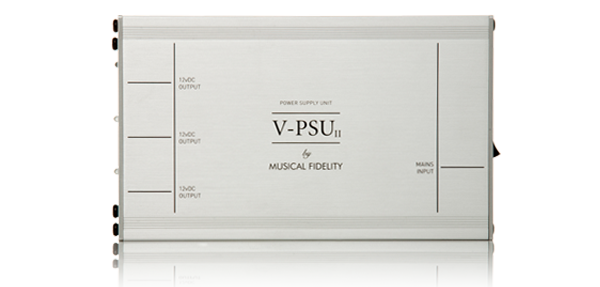
The previous V-Series (V-DAC II) actually had an optional upgraded power supply — the V-PSU II — which could provide a lower-noise, more stable, higher-quality power feed to those products. Unfortunately, no such external power supply was made available for the new V90 Series, leaving users essentially dependent on the cheap switching-mode AC adaptor supplied in the box. ※ There are small specialist manufacturers — both domestic and overseas — who will build an external toroidal transformer-based power supply compatible with the V90 Series.
 ポチップ
ポチップ
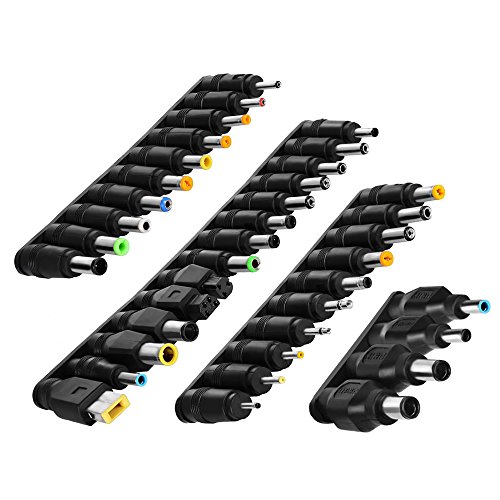
The AC adaptor supplied with the Musical Fidelity V90 DAC is a 12V 500mA DC switching supply — a tiny, simple thing. The DC input socket on the unit uses an unusually small Φ1.3mm plug (with a 3.5mm outer diameter). If you want to use a generic aftermarket AC adaptor with the more common 2.1mm or 2.5mm inner diameter, a DC plug size adaptor is necessary — but in my experience, inserting a DC plug conversion adaptor into the chain has a noticeably detrimental effect on the sound, and it is best avoided where possible. There may well be conversion plugs out there that do not compromise the sound too badly, but I am afraid everything I had to hand was clearly and audibly harmful.
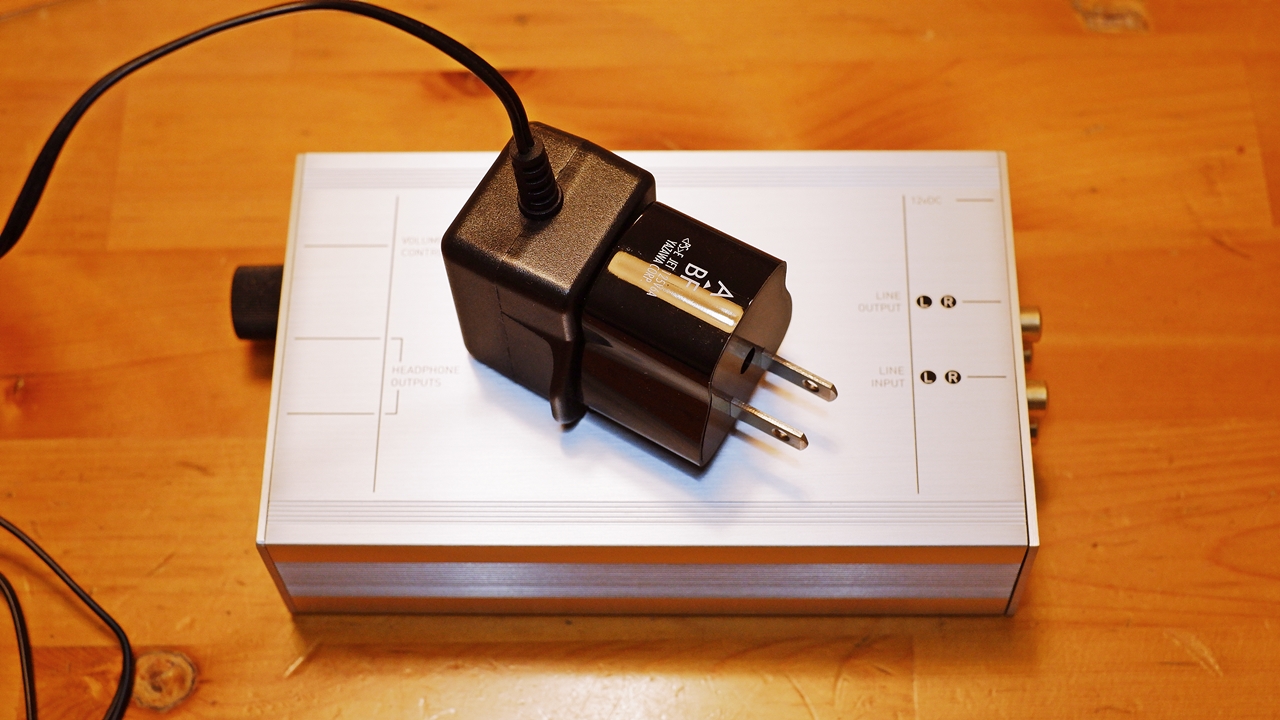
What then occurred to me was the Musical Fidelity headphone amplifier V-CAN 2 (V-CAN II) that had been sitting in storage. Being a Japanese domestic distributor import, it came with a proper transformer-type AC adaptor fitted with a Japanese plug. The adaptor itself is marked “Heinz & Company — Made in Japan”, which suggests it was not included by Musical Fidelity UK but sourced locally by the importer. It weighs 375g on the scale. As it happens, the DC plug size on the V-CAN 2 is Φ1.3mm — the same as the V90 DAC — and the power rating is also identical: 12V 500mA. The reason the V-CAN 2 had been sitting unused was not that it sounded bad; I simply do not listen to music through headphones very often. ※ Lately my headphone use is almost exclusively for my electronic piano (Clavinova). I may write a review of the V-CAN 2 (V-CAN II) one day if the mood takes me.
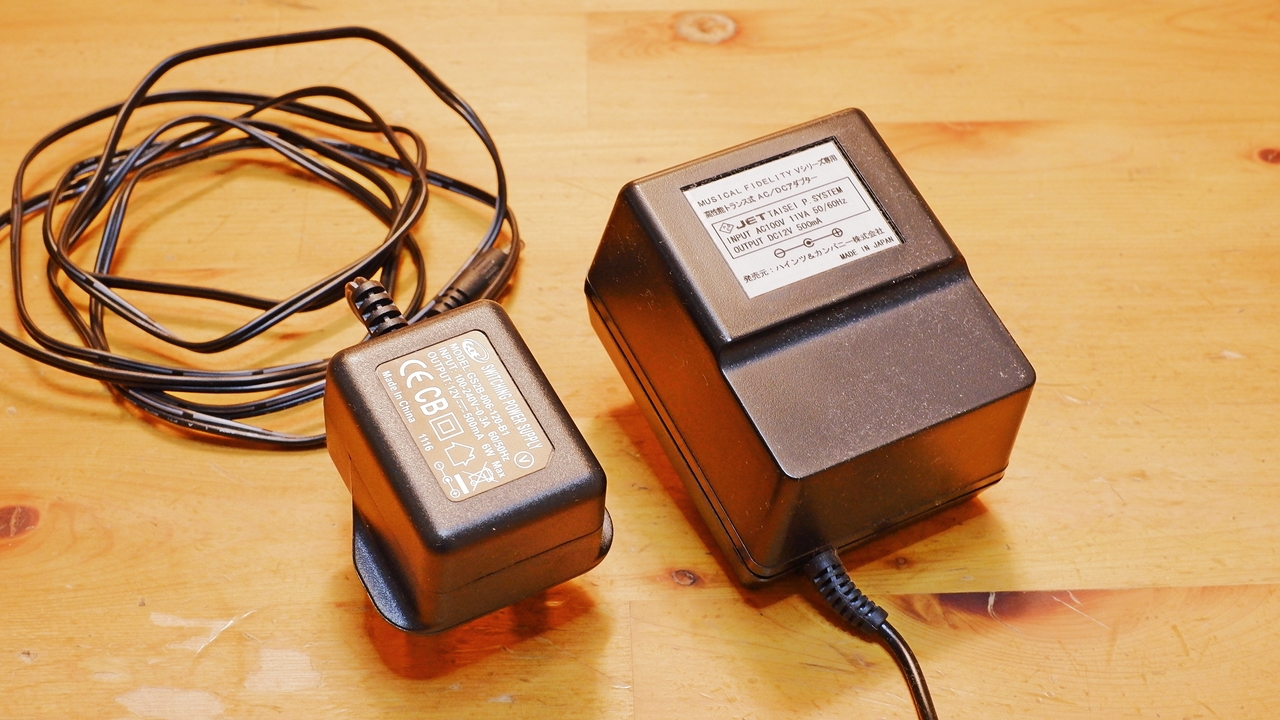
When I tried this Japanese-spec transformer-type AC adaptor with the V90, the improvement over the original switching adaptor was substantial — the sound took on a far more solid, composed, authoritative character. By comparison, the standard UK-supplied adaptor sounds light and nimble, but also rather thin.
Before I thought of the V-CAN 2 adaptor, I had actually tried several generic 12V/500mA transformer-type AC adaptors (regulated types) sourced from Soundhouse and parts shops in Akihabara. Every single one of them was a poor match for the V90 DAC, and none managed to surpass the supplied switching adaptor. Part of the problem was the 2.1mm-to-1.3mm plug conversion degrading the sound, but beyond that, a transformer-type AC adaptor that is not of decent quality will produce a heavy, sluggish, murky sound. The Heinz & Company unit, by contrast, is well-balanced: it keeps the pace-dulling weakness of transformer types in check, and in overall terms the sound quality improves by a clear two steps or more compared with the standard switching adaptor. Writing this entry has prompted me to reconnect the original switching adaptor for the first time in a while, and listening now — there is indeed little harshness, and the sound is easy on the ear, but the low-frequency weight is a touch slight and the soundstage transparency falls short. I suspect that the rather harsh assessment from What Hi-Fi, and the relaxed impression it gives, were largely down to the bundled switching adaptor being the bottleneck.
Getting the best from the V90 DAC: insulators
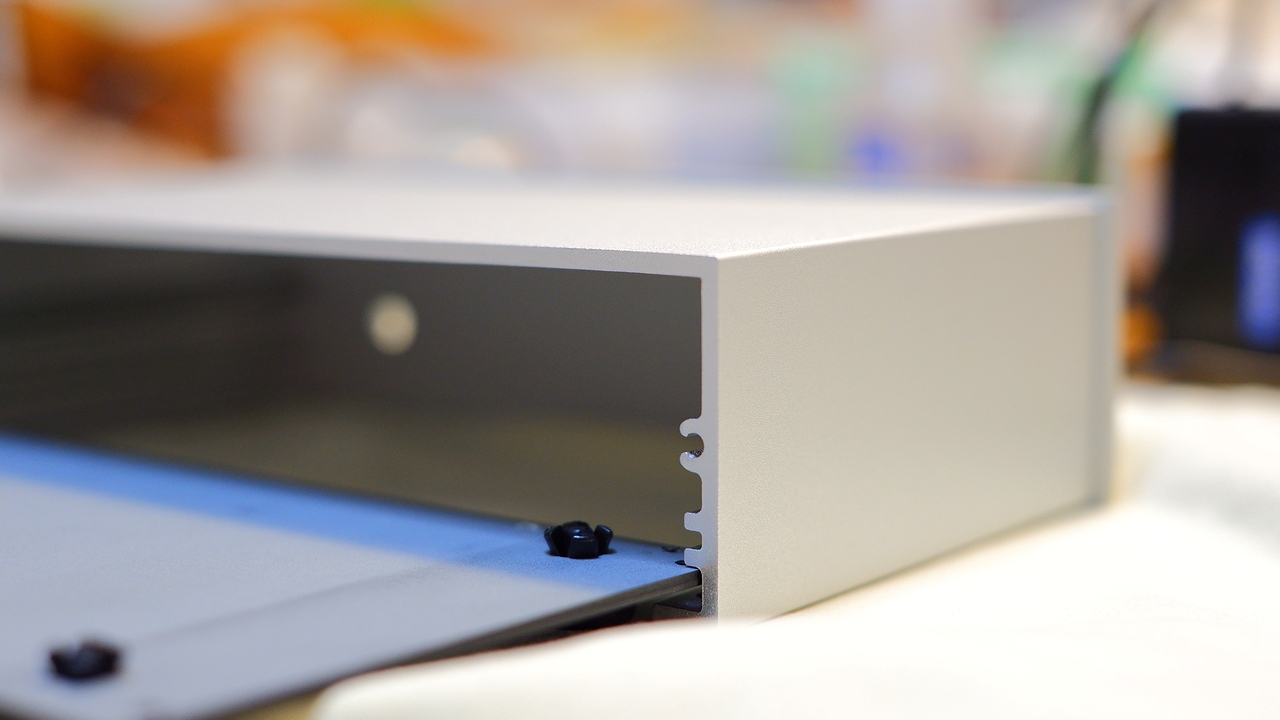
The 2mm solid aluminium enclosure is a genuinely good thing at this price — rigid and well-made — but the resonant character of the case can tend towards a certain dryness, and combined with the solid capacitors, there is a faint but persistent lack of bloom in the sound. Left simply sitting on a shelf, the V90 DAC has a slight tendency to make the fine-grained information that fills the soundstage a little smoky — which is, I think, a genuine weakness of this product. Of course, if that tonal character suits you, there is no problem at all; but personally, I find myself wanting just a touch more lustre and moisture in the presentation.

I tried a number of inexpensive Hi-Fi insulators, and the one that worked best was the AET SH-2007B. ※ To avoid confusion: this is the B type — the heavy, polished industrial brass version — not the SH-2007A, which uses an A2000-series alloy (non-magnesium) aluminium. The SH-2007B has a naturally easy, moist, and richly resonant character, which adds just the right degree of moisture to the matt quality of the Musical Fidelity V90 Series, clearing away the slightly smoky impression and bringing things to a neutral, well-balanced state. It is not an insulator that adds pace or drive, but then neither is the V90 DAC, so the result is that the soundstage-oriented character becomes more pronounced, lending the whole presentation an elegant, refined quality. I have not tried it, but the SH-2014B — the same material in twice the height (14mm) — might well be even more effective. The one drawback is that the smooth surface makes it rather easy for the DAC to slide around. Also, the Musical Fidelity V90 DAC has small black plastic feet on the bottom that appear to be non-removable, so I work around them and use three-point support placement.
Getting the Most from the V90 DAC: Digital Cables
The Musical Fidelity V90 DAC is currently in use as the DAC for the sub-system within the main system, connected to the CD player MARANTZ CDR630 and the SACD player ONKYO C-S5VL. Connecting the MARANTZ CDR630 to the V90 DAC on the TOS optical digital side is the AUDIOTRAK GlassBlack2+/50cm, which uses a quartz glass fibre core. On the coaxial digital side there is the Acoustic Revive DIGITAL-1.0R-TripleC-FM. Between the ONKYO C-S5VL and the DAC sits the single-crystal quartz audio-technica AT-SDP2000/1.3m. These three connections allow for audio playback from both CD and SACD (4.14kHz/16bit PCM converted data).
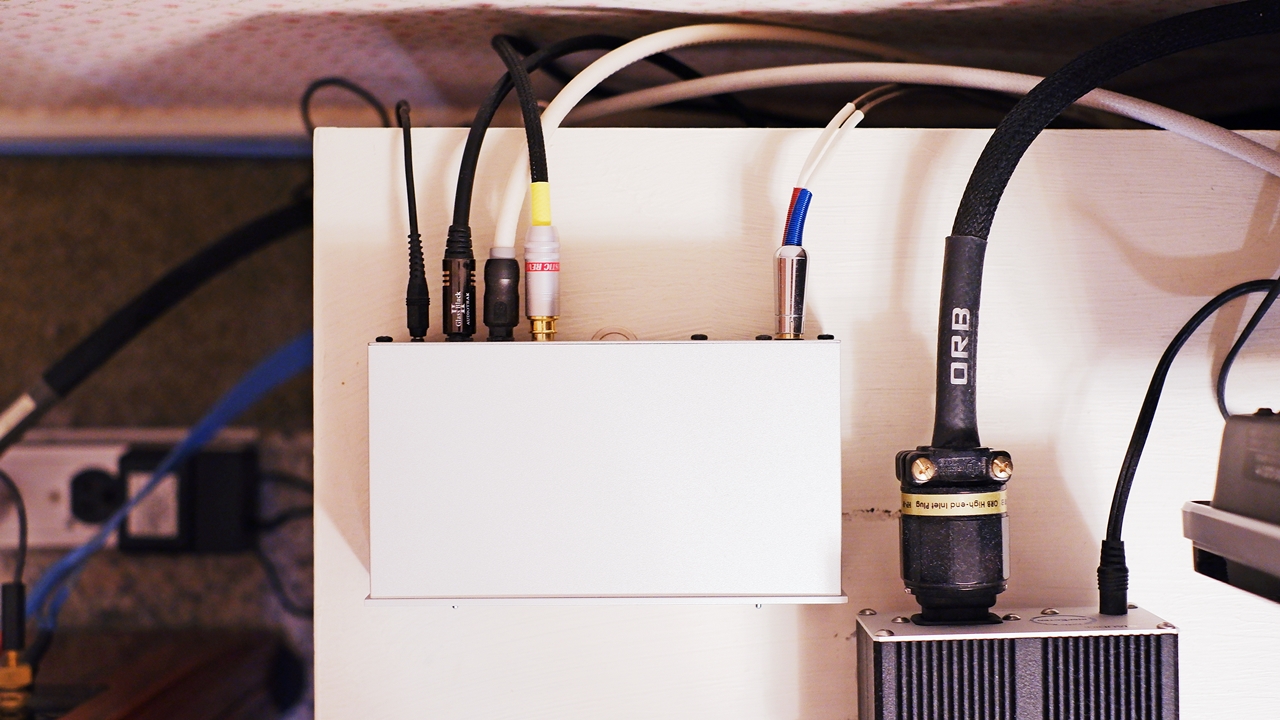
Compared against the analogue output through the MARANTZ CDR630’s own PHILIPS bitstream DAC under these conditions, the Musical Fidelity V90 DAC predictably delivers a more modern, higher-resolution sound with greater soundstage width — a quality a step above. As for the digital cables, switching between the Acoustic Revive coaxial and the GlassBlack2+ optical depending on the source material allows for different tonal nuances from each, though the one I reach for more often is the GlassBlack2+. The reason I deliberately keep the Acoustic Revive DIGITAL-1.0R-TripleC-FM in the chain as well is that — presumably due to the amorphous core — simply plugging it in improves the perceived S/N ratio of the DAC, so it can be expected to function as a kind of parallel noise reducer. As for how it is connected, the amorphous core end goes to the DAC input side — a reverse connection.
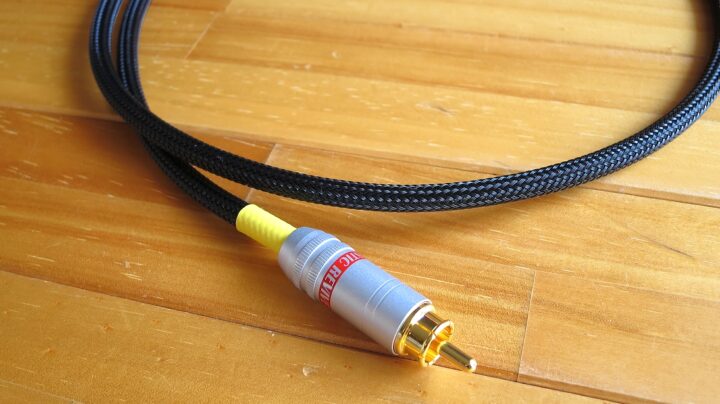
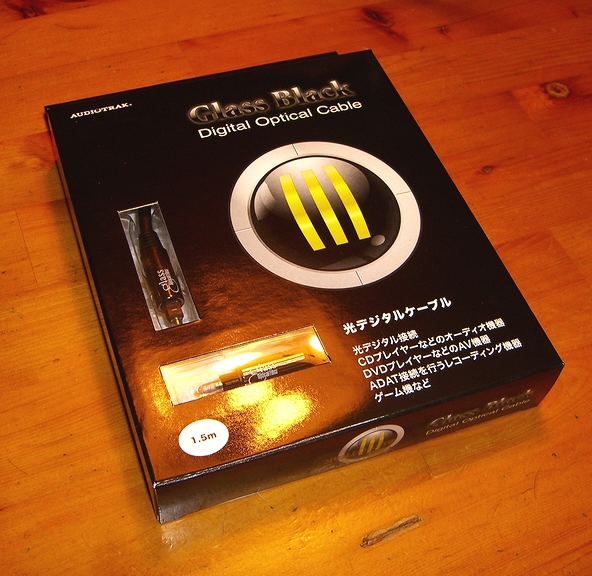
The sound character of the GlassBlack2+ is a sparkling, beautiful-sounding type with a high note count and excellent clarity. The Acoustic Revive side has a more solid, sharp tendency with an enhanced sense of S/N, so when a source sounds murky, switching to the DIGITAL-1.0R-TripleC-FM side sharpens things up nicely.

For the digital connection to the ONKYO C-S5VL, I am using the audio-technica AT-SDP2000/1.3m — a pure quartz core TOS cable that is now something of a rarity. The pure quartz core is said to represent the pinnacle of TOS digital cables, yet the AT-SDP2000 is, if I am honest, no match for the sound of the GlassBlack2+, which uses a less expensive pure quartz fibre core. It simply happened to be the best of the remaining TOS cables I had on hand. ※Compared with the majority of plastic (acrylic) fibre optical digital cables, the quartz core/quartz fibre cables are indeed in a different league.
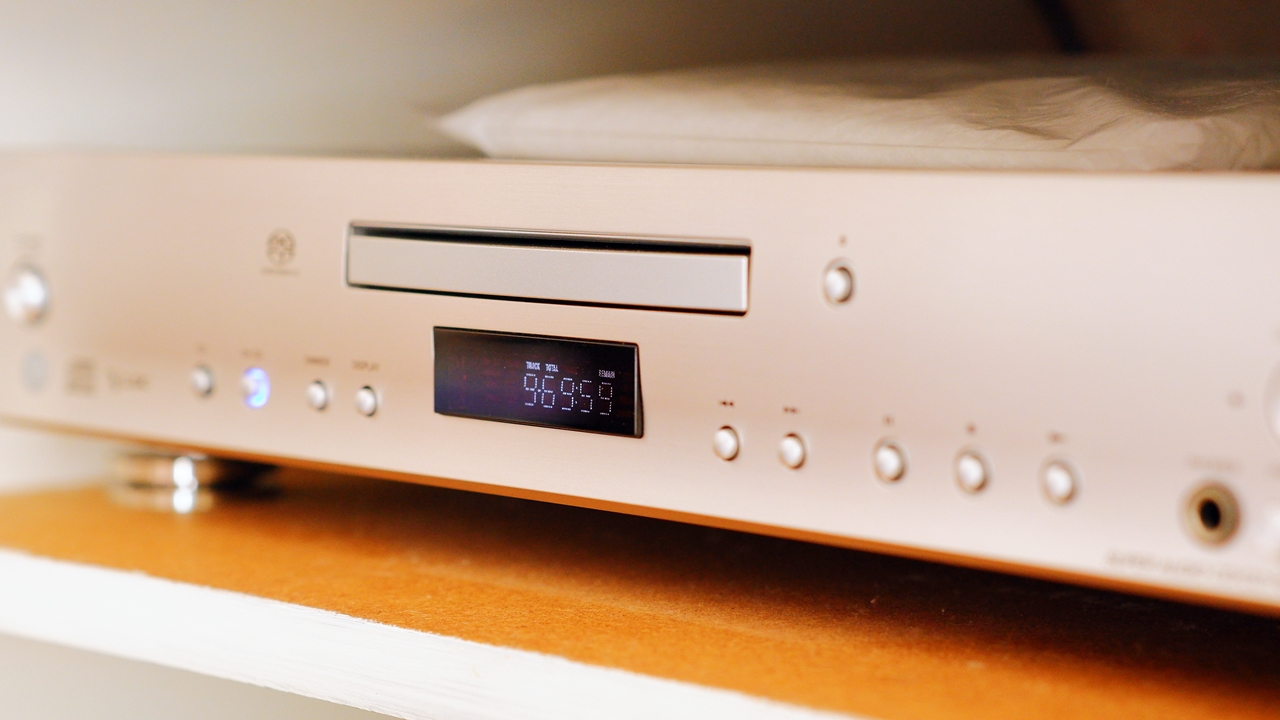
Compared with the analogue output of the C-S5VL itself, the sound through the Musical Fidelity V90 DAC has a more filled-out low end, resulting in a more conventional overall balance. ※This is not because the V90 DAC has a heavy bass, but rather because the C-S5VL’s low end is itself somewhat thin. Going through the V90 DAC gives a calmer, gentler tonal character, but the C-S5VL’s own distinctive quality — that spine-tingling transparency — is lost, and the result becomes a rather ordinary, neutral-sounding image. To be honest, in this combination the case for using the V90 DAC as an external DAC is rather questionable… I am essentially connecting it simply because the TOS input happens to be free. On top of that, the C-S5VL does not allow digital output to be switched on and off via remote control, which is a nuisance, so I do not use it regularly.
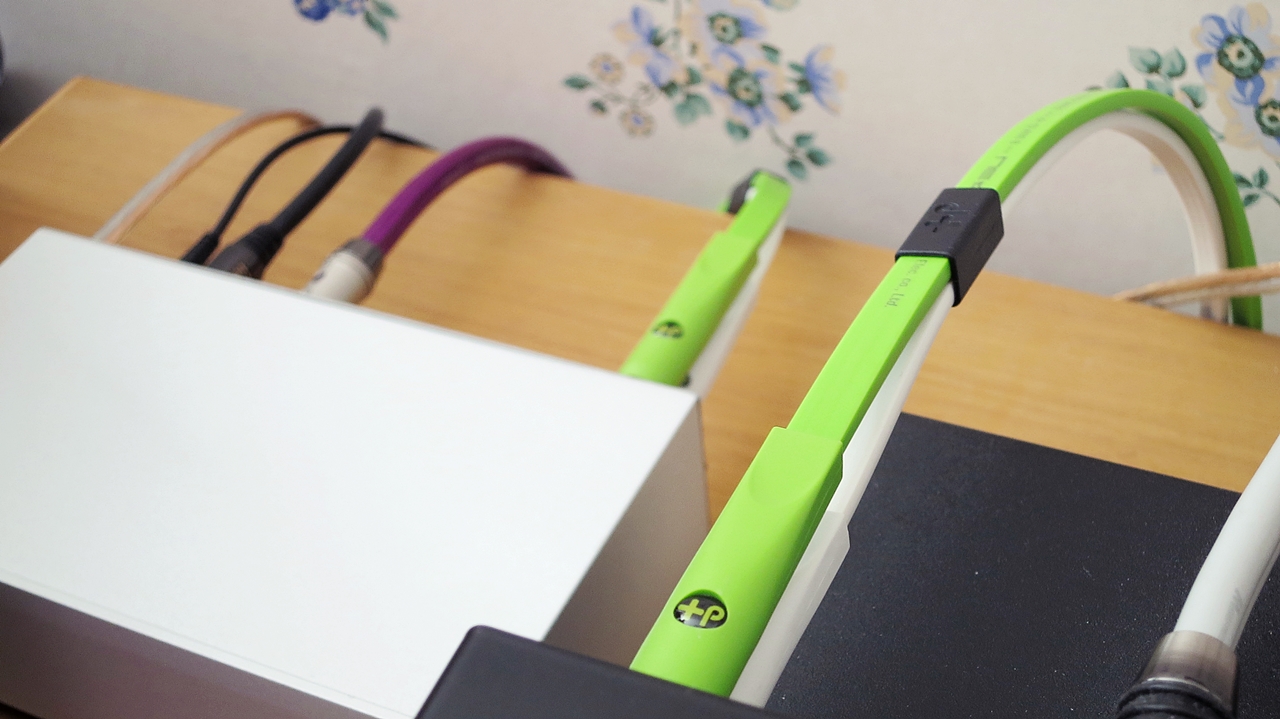
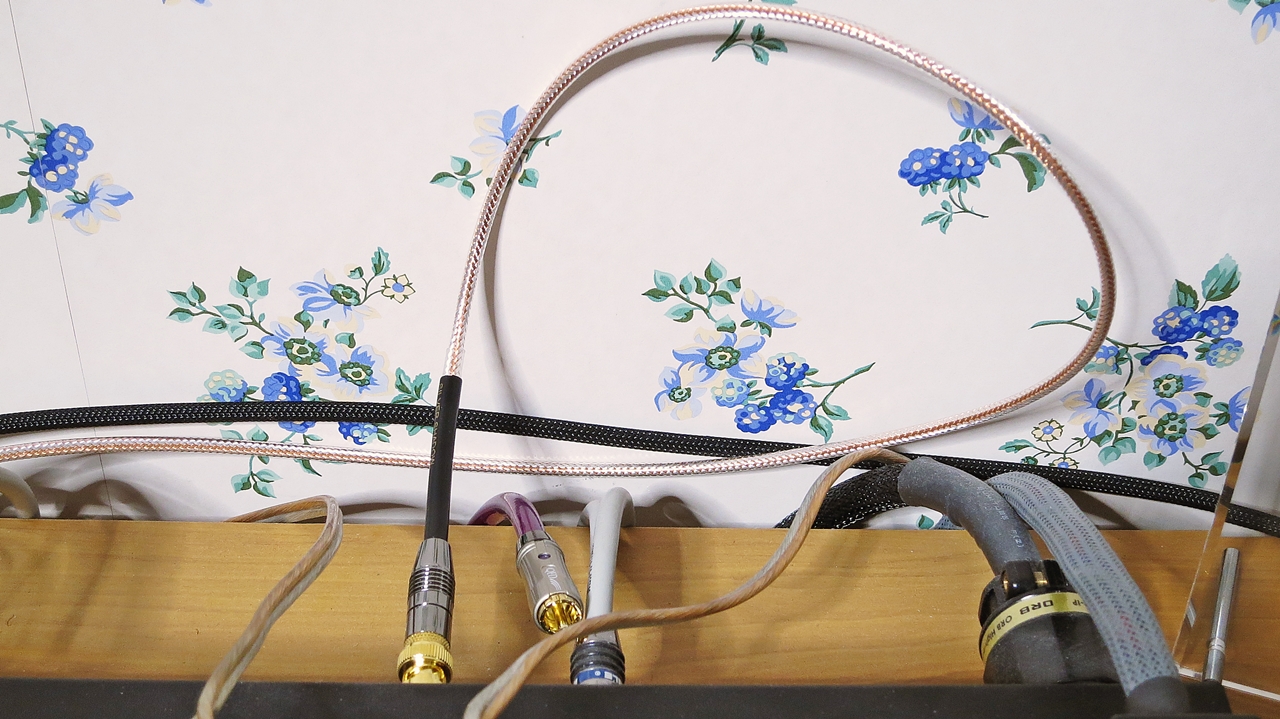
Getting the Most from the V90 DAC: RCA Cables
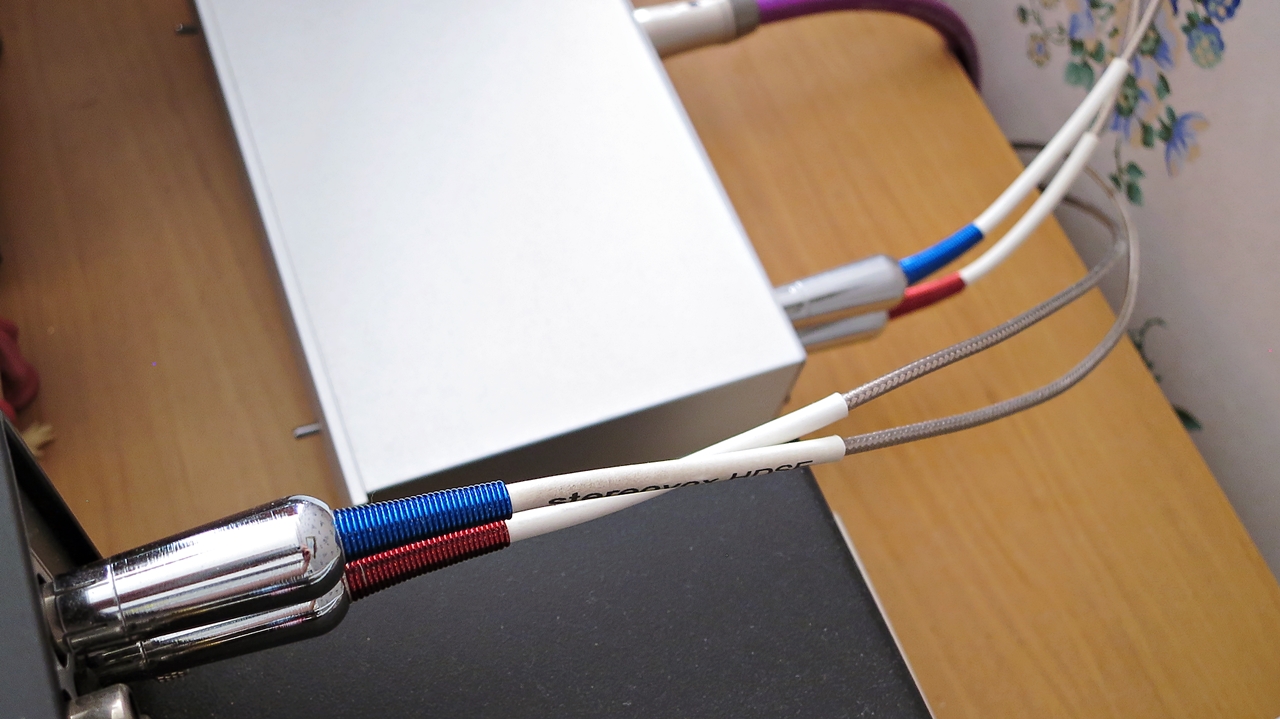
The placement requires an RCA interconnect cable of 1 metre or more (and even that is barely enough), but most of the decent RCA cables I have on hand tend to be short ones, and I do not actually own many high-grade cables over 1 metre in length. From what is left, the one I have ended up using by a process of elimination is the Stereovox HDSE. It has a somewhat dry tonal character and I cannot honestly say it is an ideally matched choice, but everything else suits even less, so there is not much to be done about it… There does seem to be a sense that things could be improved further if I were to find an RCA cable that brings a degree of warmth and brightness to the pairing.
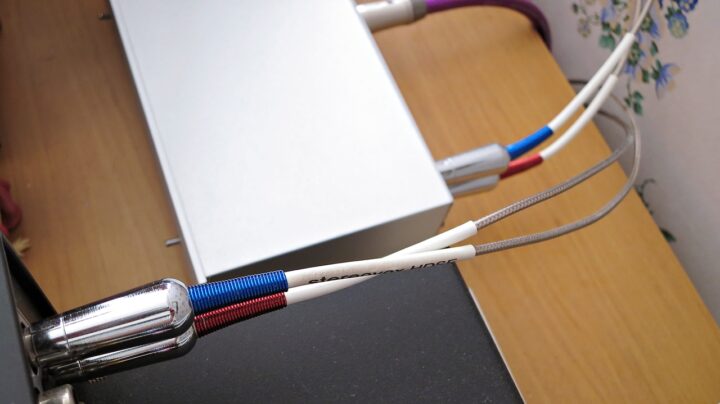
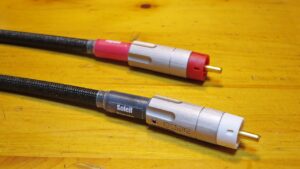
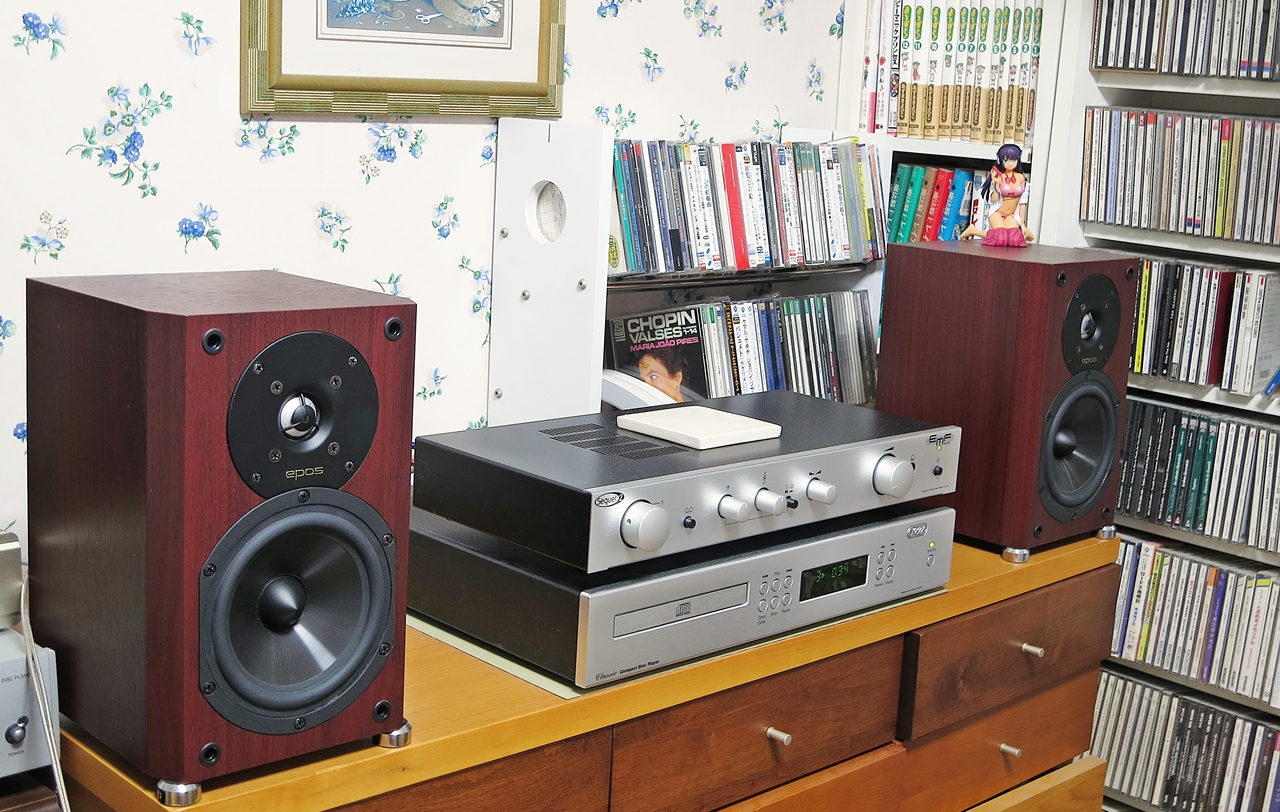
Getting the Most from the V90 DAC: Power Distribution
With AC adapter-powered products, the power distribution unit and power line downstream tend to be overlooked, yet in practice they affect the sound quality just as significantly as with equipment that has an internal power supply. I had previously tried connecting to the J1 project PT-4 in the main system, but the tonal character became oddly thick and heavy, so the compatibility was not particularly good. The FURUTECH e-TP60 on the main system’s sub-system delivers a clean sound, but… the AC adapter’s power cord simply does not reach. So I tried connecting it to the audio-technica AT-PT900, which I had introduced the previous year for the visual equipment such as the plasma television, and the result was a complete metamorphosis into a sound — firmly wide-range and quite sumptuous — that I had never imagined possible from the Musical Fidelity V90 DAC.
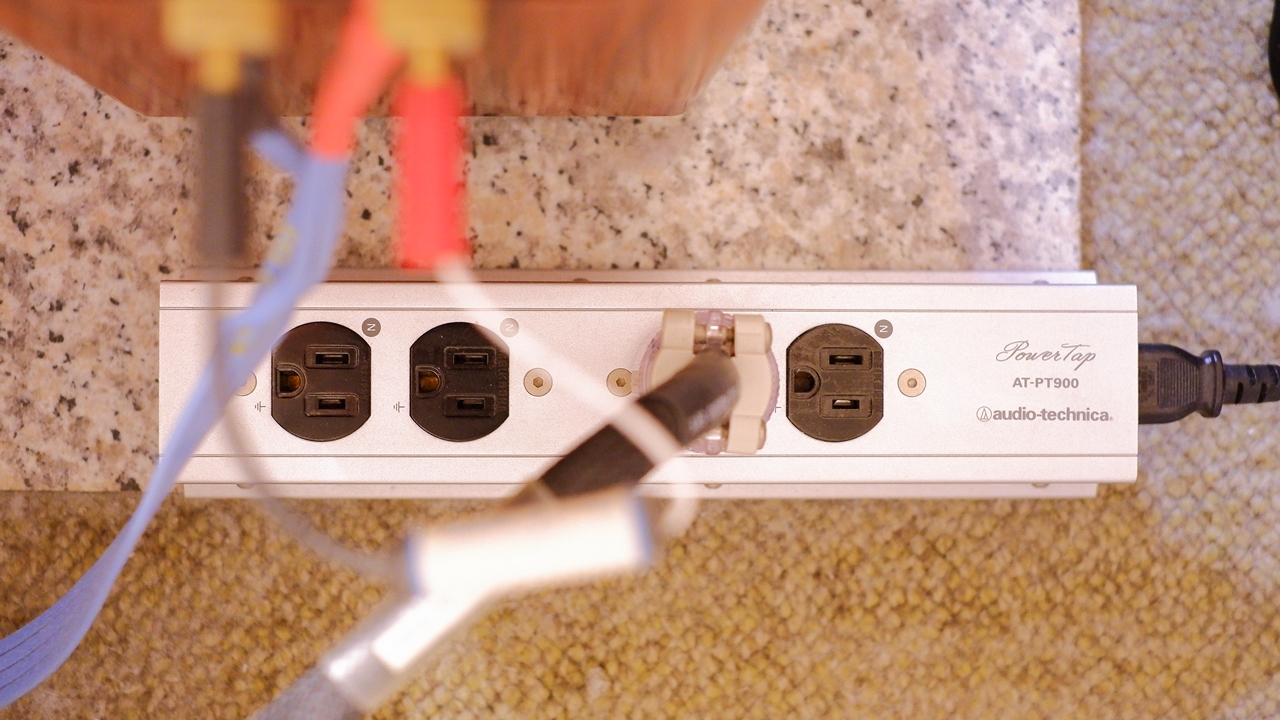
The weakness of this combination is that the tonal character leans cool, with the temperature becoming a touch too low. It seems that some balancing will be needed — by changing the wall socket or choosing a different power cable between the wall socket and the AT-PT900 — to bring the temperature up and brighten the sound. ※Due to the 4-metre length requirement, I do not have a suitable high-quality power cable on hand, and for the time being I am using a cabtyre cable from Sanwa Supply intended for general OA use.
~ Summary ~
For someone like me who, for whatever reason, has taken to collecting compact D/A converters for a miniature hi-fi setup, the Musical Fidelity V90 DAC cannot quite be said to have outstandingly superior sound quality, or to be a DAC with some absolutely indispensable characteristic. Even so, it has no serious shortcomings as a piece of equipment; the neatly put-together British sound, and the chic, quietly stylish atmosphere of its well-made small enclosure, are more than enough to satisfy the desire to own it.
ポチップ
As an entry-level D/A converter, for the purpose of lifting the sound quality of a lower-end CD player or a modest PC audio setup, the Musical Fidelity V90 DAC is an inexpensive and well-made product, and it compares favourably with Chinese DACs on price as well. On top of that, you can enjoy a musical sound with the sensibility that is particular to Musical Fidelity’s British-designed products. Among budget Hi-Fi enthusiasts overseas, there is a well-established culture of slotting affordable, stylish DACs like this into existing older equipment and enjoying it all without spending too much money on Hi-Fi — something I find rather enviable. A bare-faced, barely-there aesthetic beauty that is only achievable precisely because the component count is low. For those of you who want that kind of sound without spending too much money, looking beyond just this Musical Fidelity V90 DAC — towards the many simple, compact D/A converters available from overseas — may well lead to a richer and more enjoyable musical life.
 Category:UK / Musical FidelityCategory:D/A Converters (DAC)

Auto Translated by CS4.6

List of comments (2)
DACを検索していてたどり着きました。基板写真を見る限りでは、電解コンデンサーの極性表示カラーが黒なので、高分子アルミ固体コンデンサーではなく、通常のアルミ電解コンデンサーだと思われます。OSコン(三洋→パナソニック)などに見られるように、高分子固体コンデンサーは、紫や青などを使っている場合が多いです。千石電商や秋月電子通商などで「チップコンデンサ」を確認してみてください。本家のホームページでも、特にコンデンサーについて言及されていないので、特殊な物は使っていないのではないかと思います。また、基板上の「Cxx」表記の茶色い部品はチップ積層セラミックコンデンサーです。ですので「すべて置き換わった」というのも無理があると思います。
管理人長期不在のことが多く、何年もスルーしたままになってしまい申し訳ありません。内容を修正しました。御指摘ありがとうございます。