This takes us back six years… though as I have two lost years in my life, it feels more like four years ago to me.
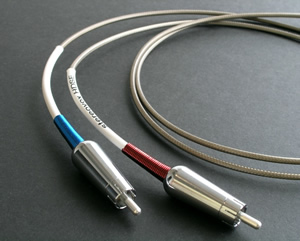
After writing that entry in 2005, I actually acquired the Stereovox RCA cable HDSE and have been using it ever since, but as I never wrote a purchase review at the time, I thought I would set that right here. The HDSE is currently in use with the FM tuner DENON TU-1500N in Sub-system B. ※ As of 2021, I am using it with the Musical Fidelity V90 DAC.
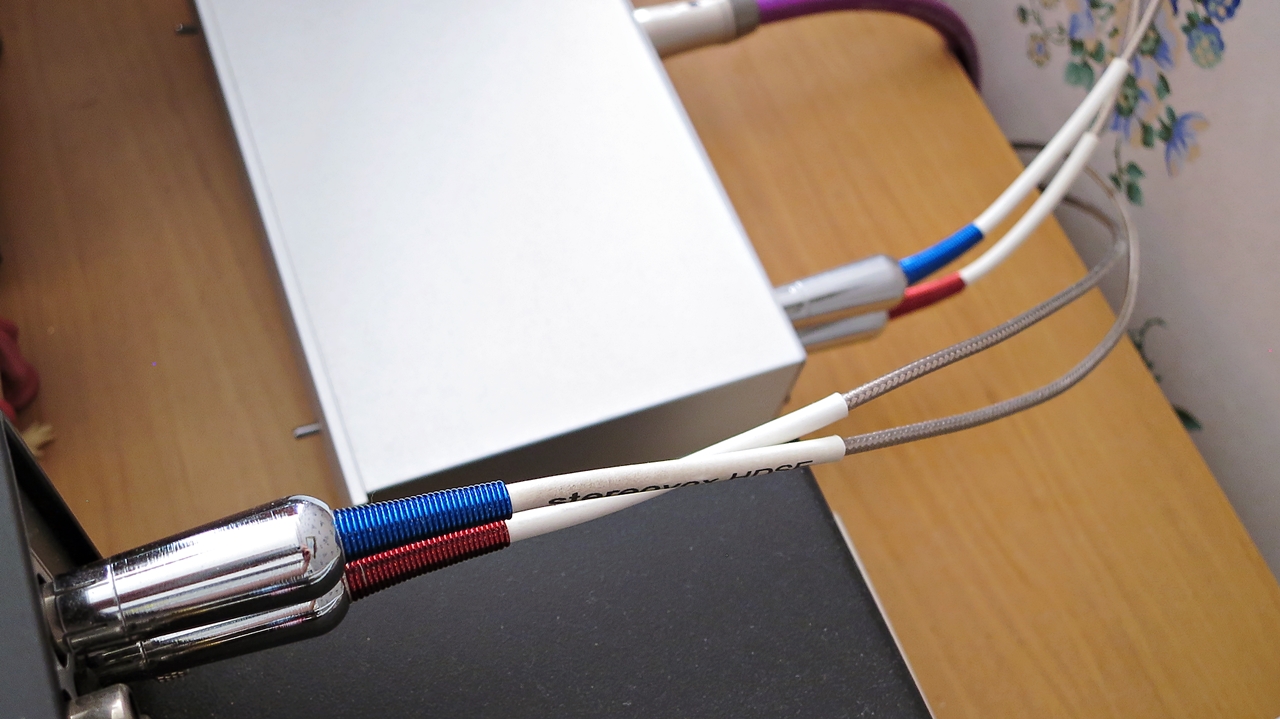
Due to the demands of my setup, this is a position that requires a 1-metre RCA cable, so I arrived at the HDSE by a process of elimination from the cables I had on hand — though in all honesty, it is rather too good a cable for the DENON TU-1500N. There is something fundamentally back-to-front about having a cable that costs more than the component it connects, and besides, the tonal character of the DENON tuner and the Stereovox HDSE does not really suit each other, so this is very much a temporary arrangement until it can be moved somewhere more fitting…
Stereovox and Black Cat Cable
Stereovox was a company based in Florida, USA, but as you can see from the link, they have quietly vanished at some point. I have a feeling they were still around as of 2008, so perhaps the collapse came relatively recently?
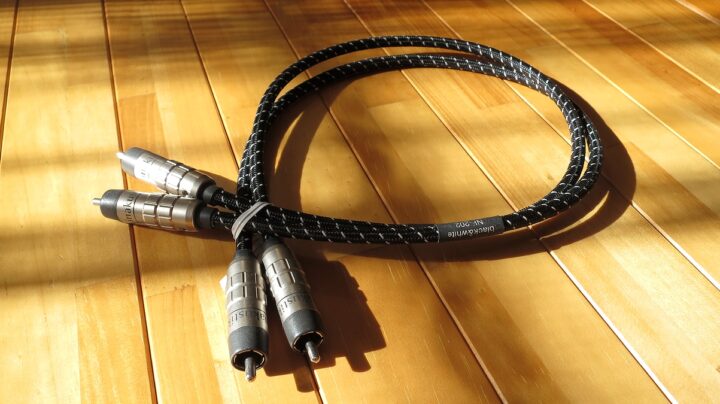
Since they have not removed the URL, there may be some intention to revive the company — but when a brand launches an extraordinary range of eye-wateringly expensive cables only to disappear within a few years, one cannot help but wonder whether it was all rather deliberate, and find oneself feeling a little cynical about the whole thing. Oh well… if they do come back, I shall give them a proper welcome then. ※ On looking into what happened afterwards: it seems there were various circumstances, and the company went bankrupt in 2006, but founder Chris Sommovigo subsequently started a new company called Stereolab and is selling successor products under the Black Cat Cable brand.
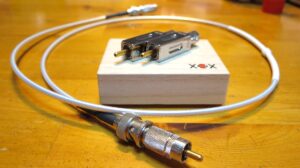
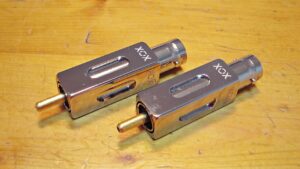
Reviews of Stereovox audio cables from their back catalogue can be found in various places, including American sites, and for an overview of the products sold in Japan, data is available at Phile-web.
The Construction of the Stereovox HDSE
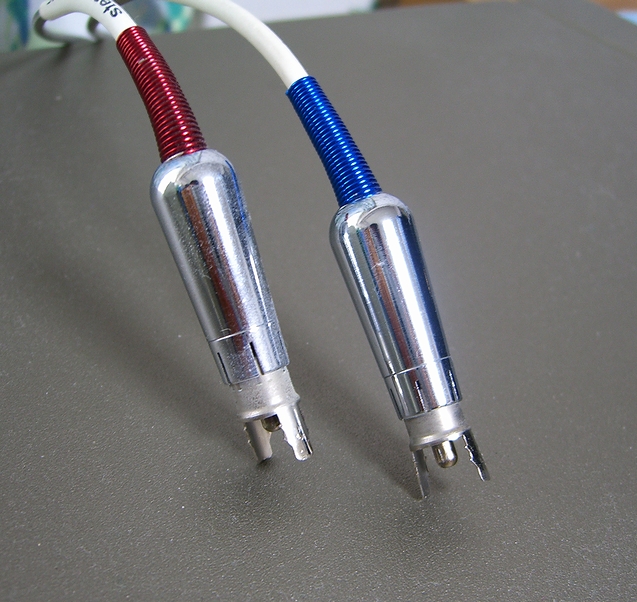
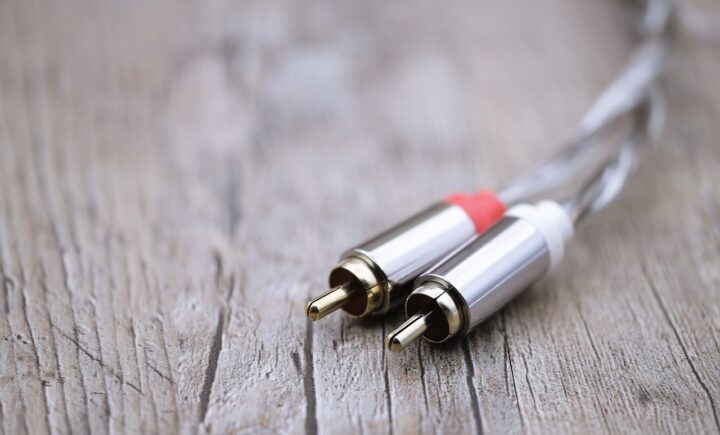
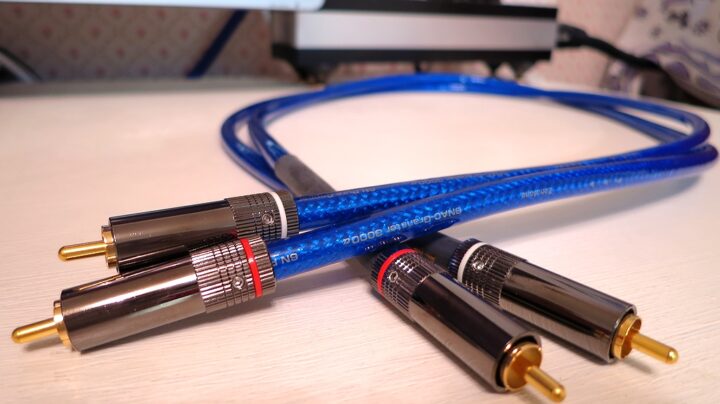
The HDSE is an RCA/BNC cable from the company’s more affordable Studio Series, released in 2004. At a retail price of ¥29,400, it is by no means cheap as far as I am concerned — though that is only by comparison within Stereovox’s high-end lineup. It looks absolutely lovely. To be honest about it, I have a weakness for cables with slender conductors and elegant designs. There is a vaguely sound-related rationale for this too, but really, it all comes down to a fondness for small, delicate things — a rather aesthetic preference more than anything particularly serious.
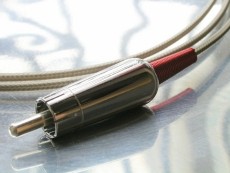
The conductor is solid-core. It appears to use an oval hollow-core construction — a so-called Microtube — though no cross-section diagrams have been published, so I honestly cannot work out quite how such a structure is achieved. The texture has a wire-like quality, and it is fairly stiff; once bent, the kink tends to stay, and does not spring back easily. The plugs are silver-coloured, but what plating is it, I wonder? After five years, the inside has gone noticeably dull. To restore the original shine, my usual Pando 29D simply will not do — I wonder whether the red CAIG DeoxIT D100L might manage it…



The Audio Accessory Magazine Review
The Stereovox HDSE sits in a somewhat awkward price bracket in Japan, making it rather difficult to audition anywhere. However, in issues of Audio Accessory magazine from 2004 and 2005, Stereovox products were featured in what seemed like every issue in reviews by Mr. Chiitake Inoue, where descriptions of high speed, high resolution, and so on filled the pages — and I found myself reading along with considerable anticipation. What follows is a quoted excerpt from Mr. Inoue’s impressions of the HDSE, published in Audio Accessory No. 115 (2004).
— stereovox HDSE —
This is the high-value model from the American company Stereovox, which has been attracting attention as a new force in high-end cables. Like the already-released digital cable HDXV, it belongs to the Studio Line series. The conductor is a solid-core high-purity copper wire, and its most distinctive feature is the Microtube hollow-core structure, in which the conductor itself forms an ultra-thin tube with a wall thickness of just 0.2mm. This design allows a significant reduction in the influence of the skin effect. PTFE Teflon is used for insulation, and the shielding is a silver-plated braided construction. The outer jacket is FEP fluoropolymer resin. The RCA plugs, too, are an original high-precision design.
The presentation is highly accurate and consistently composed. At the same time, musical expression is conveyed with vivid life, and there is no inorganic quality to the sound. With boy soprano, the harmony is free of muddiness, the reproduction delicate and rich in information. The texture of the voice is natural, with a pleasing sense of rawness. The frequency range is wide, with an even, uncoloured response, and the music is transparent. Piano is fast in its transient response, with a full-bodied resonance that is richly satisfying. Touch has a generous skeletal quality, and the tone is dense and vital. With orchestra, the reproduction shows excellent purity of texture and good separation. Tonality is neutral, yet expression is captured with fine nuance and the reproduction is full of dynamic contrast.
So there we have it. As the HDSE is the lower-tier line of a high-end manufacturer, I had come to it imagining — based on its appearance — a sound with abundant information, high speed, smoothness, and a beautiful lustre. But the actual sound of the HDSE I received was, rather surprisingly, quite different from what its looks might lead one to imagine. In writing this entry, and to make sure my sonic memory was not playing tricks on me, I moved the HDSE from the tuner DENON TU-1500N to the CREEK CLASSIC CD, where I normally use the ISODA HA-O8PSR, and listened to some CDs.
As for the reviews in Audio Accessory magazine — which I have been reading avidly since my middle-school days, through more than a hundred issues — they do occasionally leave me puzzled, but that is unavoidable given the fundamental difficulty of conveying sound in words when each person perceives it differently; even my own writing on this site is far from perfect in that regard. In the quoted passage above, I have highlighted in bold the parts that match my own impression of the HDSE, while the parts I feel are somewhat different are shown in a lighter colour. I had formed quite a vivid mental picture of the HDSE from the magazine reviews, and the sound that actually came out was rather different from what I had imagined — which is why. Next, setting aside the professional critic’s review entirely, I will write my own impressions as I actually heard them.
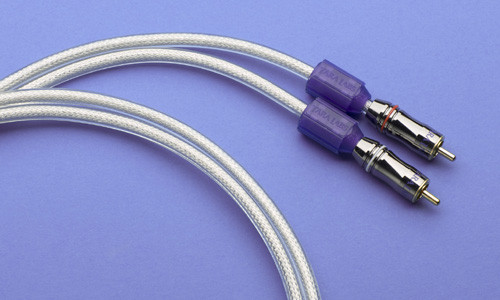
The current successor model that shares a direct lineage with the Stereovox HDSE conductor is The Tube RCA Interconnects Cable.
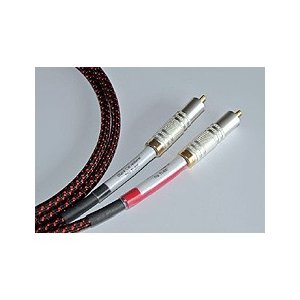
Stereovox HDSE — Sound Quality Review
First of all, the character of this HDSE is cheerful. A kind of cheerfulness you might associate with the American countryside. The musical flow is bright and unhurried — placid, even. In terms of temperature, rather than neutral, it leans toward the warm and slightly tepid. At its best, like a spring breeze: bright, open, and positively expressive. On the other hand, the melancholy in music, the shadowy side of things, a negative or inward kind of delicacy — these are not quite its forte. There is also a tendency toward a slightly dry resonance, which gives the surface of the sound image a comparatively dry character… whether one equates this with information retrieval is a matter of perspective, but it is one area where it does not quite align with my own preference for sounds that ring and resonate. That said, the HDSE is easy on the ear, and free from the harshness in the upper registers — and the attendant distortion — that often afflicts high-performance cables, which is a genuine virtue. My impression is that it excels more in image rendering than in spatial presentation; the lines of the portrayal are on the slender side, yet there is no artificial sense of outline enhancement, and the overall impression is natural. There is also something that is not quite metallic, but faintly mineral — a subtle quality that seems to enhance the physical presence and realism of plucked-string instruments such as guitar, and of string sections generally.
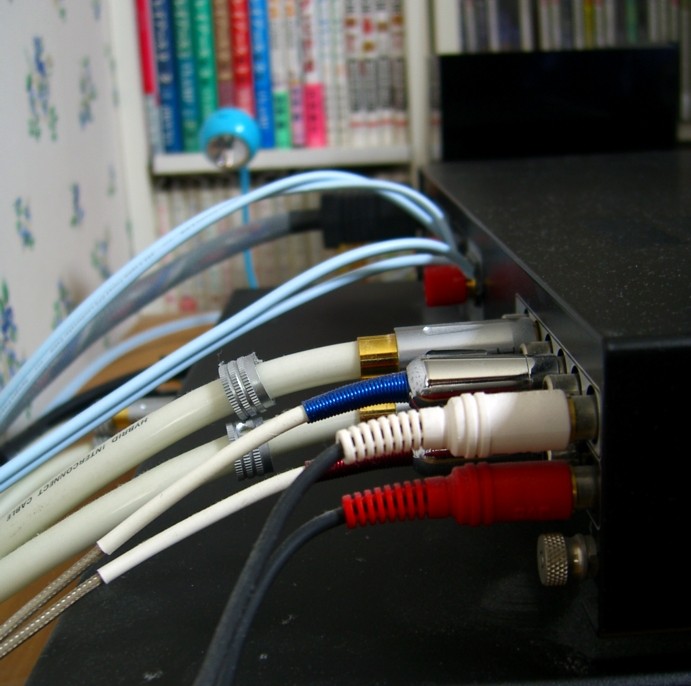
There is absolutely none of the slick metallic lustre or sheen one might expect from the appearance of those mirror-finished, premium-looking RCA plugs. If anything, it is the word “raw” that comes to mind — a stable, natural tone. It is billed as a Studio Line product, and indeed this does not feel like a high-end cable with a richly coloured, long-decaying sound; rather, it seems to be aiming for a live-recording monitor character: a broadly direct, lightly dry quality. Stereovox was also a record label specialising in classical music on minor imprints, which perhaps explains something. That said, as a pure monitoring cable, I would say it falls slightly short in terms of information retrieval and accuracy — the sort of cable where I find myself thinking that American country music or brightly flavoured jazz might suit it rather well, while wondering what to make of it for the classical repertoire that the company itself championed. There is none of the wide-ranging extension or accentuated transient attack associated with high-end cables of the so-called “high speed” variety; its strength lies in a comparatively moderate expression, notably free of glaring artificiality.
When I think of the American sound in audio cables, names like Monster Cable, SPACE&TIME, and Analysis Plus come to mind — and my personal image of them is a sound that is full in the lower registers, warm and rounded and richly flavoured in tone, with a certain generosity and looseness in expressive terms. The HDSE, however, is nothing like that kind of dense, full-bodied American flavour. Its character is bright and unaffected, without pretension, and where it does have an American quality, it is only in its expressive manner — a gently relaxed American sound, one might say. A sound that tends toward ease rather than tension.
In terms of perceived frequency response, there is no V-shaped emphasis in the bass or treble, and the midrange texture stands out. Vocals and piano come forward just slightly in the image, while the extremes of the frequency range fade out naturally and gently. The image size is neither thick nor thin; the sound opens up cleanly, but with no sense of outline enhancement whatsoever. It is a tonally stable sound centred on the midrange — the kind of tone you would expect from a solid-core cable. It is not the type to produce a particularly dense or varied range of timbres. If one is after exaggerated bass weight or incisive treble with abundant detail, dissatisfaction is likely. Nor is it a cable of especially high resolution in the finer details — yet it would be quite wrong to say it suffers the kind of wholesale information loss you hear with cheap cables. From a Hi-Fi standpoint it is middling, without sonic exaggeration, and — put less charitably — lacking any particularly striking distinguishing quality. The perceived S/N ratio is, unfortunately, not especially impressive. Rather than silence within the soundstage plunging deep into darkness, the stage is filled with the natural brightness of daytime air.
— Summary —
The appeal of the Stereovox HDSE lies in its cheerful brightness, its liveliness, and a musical naturalness that never oversteps itself. Musicality here does not mean a cable with a strong personality of its own, armed with the kind of bewitching expressiveness that pulls the listener in. The HDSE’s forward-looking, positive cheerfulness might be read as a message from Chris Sommovigo himself: don’t overthink it — just enjoy the music. That said, it is not the refined, finely-wrought sound its appearance might suggest, and it is not a cable given to beautiful tone in the cultivated sense. Nor, I think, does it deliver the kind of boldly characterful sound now expected of high-end cables — so in a way, the HDSE rather taught me a lesson about not judging by appearances. ※ Later note: it ultimately took me several years to properly appreciate the virtue of the HDSE’s moderate character, but it has since become one of the RCA cables I could not do without.


Auto Translated by CS4.6
List of comments (2)
なにをやっても変化するのがオーディオ^^
でも駄耳の私には そんなに変化が判りませんので
感だけで決めてます。…別の言い方で『いいかげん』とも言う。
なんかやってる時って楽しいですよねぇ~♪
グレアムペンギンさんこんばんわ~。
今日Livedoorブログの調子が変です・・・。トップのリンク集のBlogRollが壊れてたり、ぱすてるんの自己紹介画像wが飛んでたり・・・早く治って欲しい~。
>感だけで決めてます。
それでぜんぜん良いんですよ~d(^_-)
音楽なんて濃縮果汁還元300%感性の世界ですから、一々感性で語れない人はすっこんでろ~みたいなw 色々取り替えてみて、思ったのと違う結果が出るのもそれはそれで楽しまないとね♪