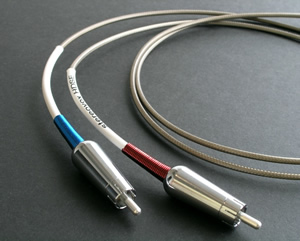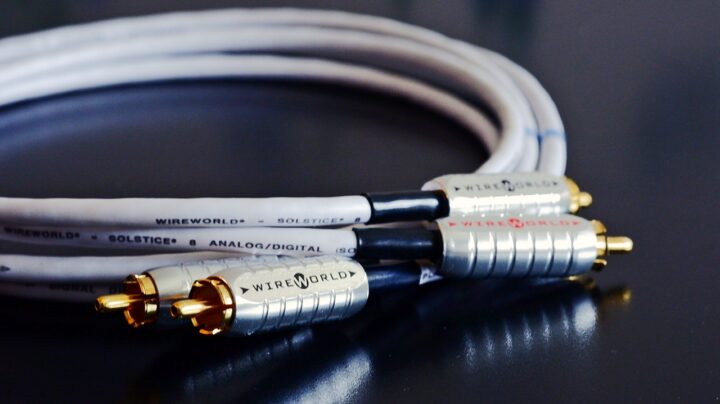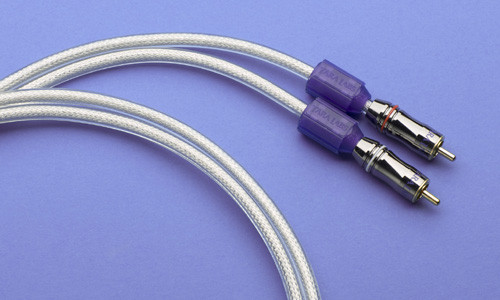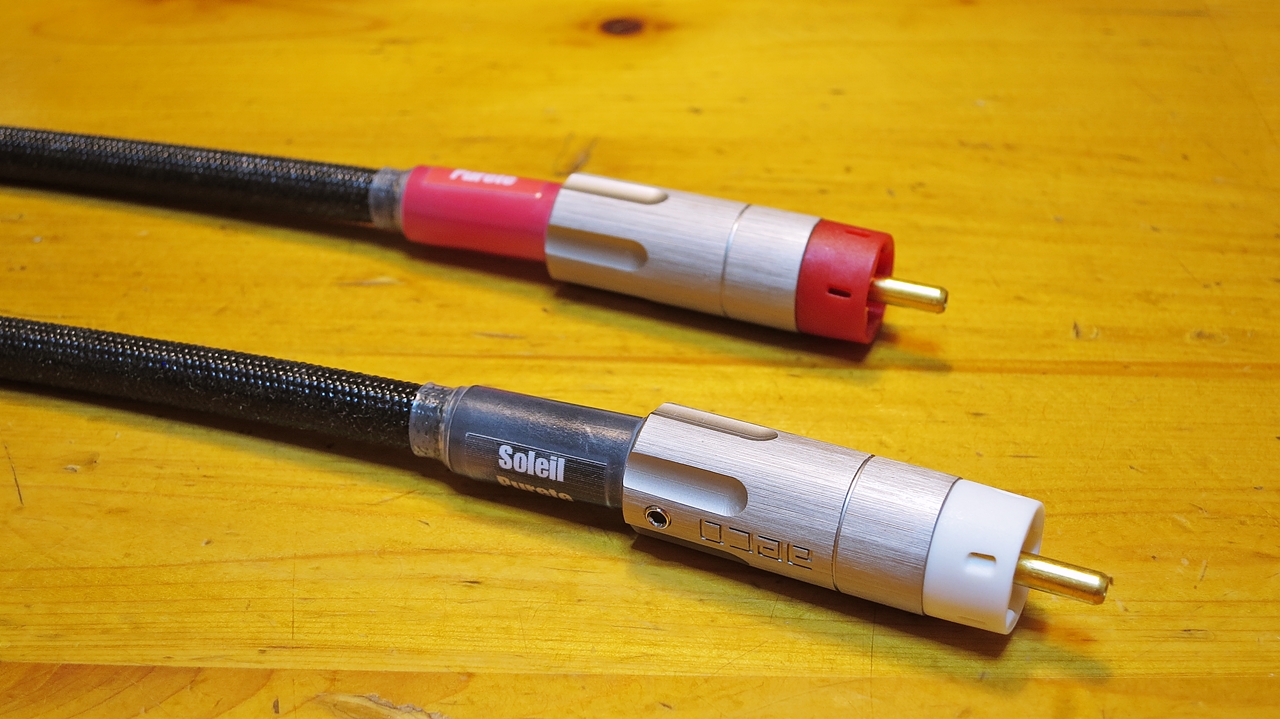
Following the entry-model Etoire I introduced the other day, today I will be looking at the higher-grade Soleil. Soleil means “sun” in French. It is priced at nearly double that of the Etoire. Like the Etoire, it pairs 5N pure silver single-core wire with aeco’s premium plug ARP-4045G, which uses tellurium copper.
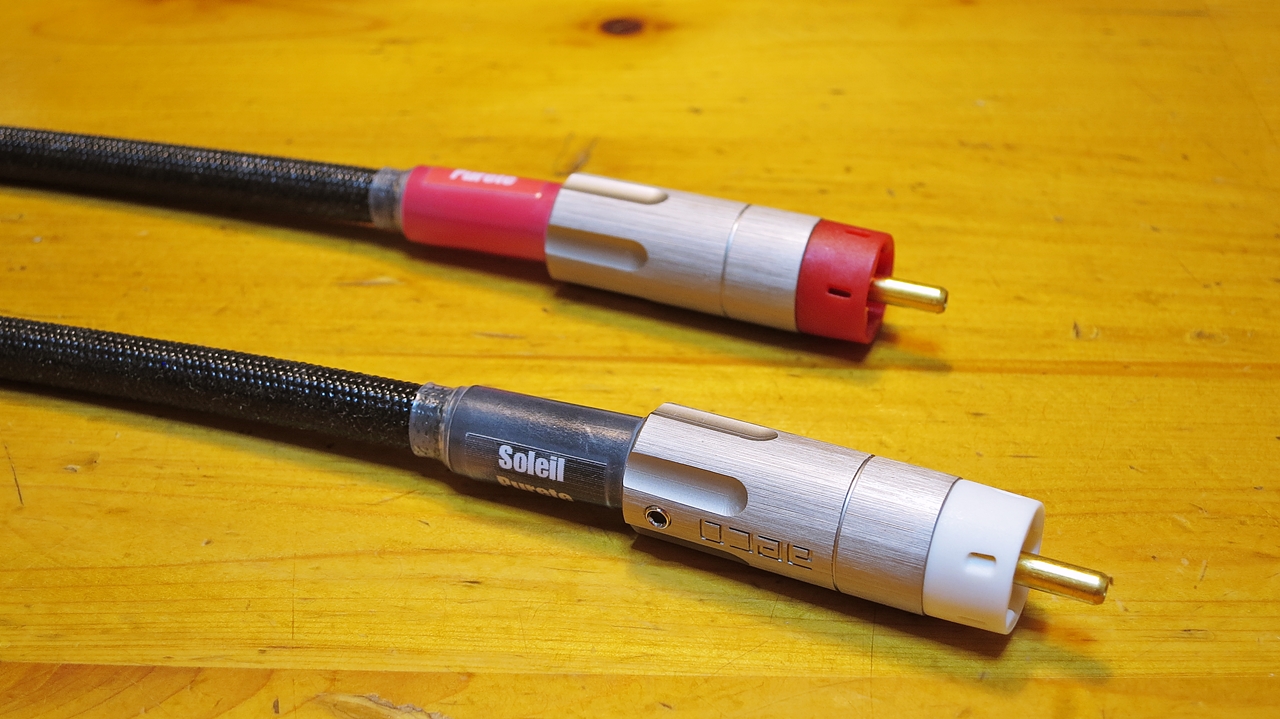
It looks like an ordinary, slightly slender black shielded cable, but it is in fact an RCA cable with a non-shielded construction and considerable attention given to vibration damping. It does not seem to require the same careful handling as the Etoire. The stated development theme was: how close to high-end sound quality can we get at a low price? — and it is apparently AudioCableCraft’s flagship model, brought to completion through more than a hundred prototypes.
Miuaudio MKTP-2 Mini Valve Sub-System
First, I swapped the Soleil out for the Etoire in the sub-system comprising the ARCAM CD72 × Miuaudio MKTP-2 × QUAD L-ite2. The difference in character is immediately apparent on first listen: where the Etoire spreads sound gently and naturally in a rather understated manner, the Soleil has a far crisper outline with a noticeably harder edge. Compared to the Etoire, the perceived S/N ratio is a clear step higher, and the background silence is more refined. The result is a monitor-like sound — cool in character, with sharply defined, highly articulate image outlines rendered at high speed.
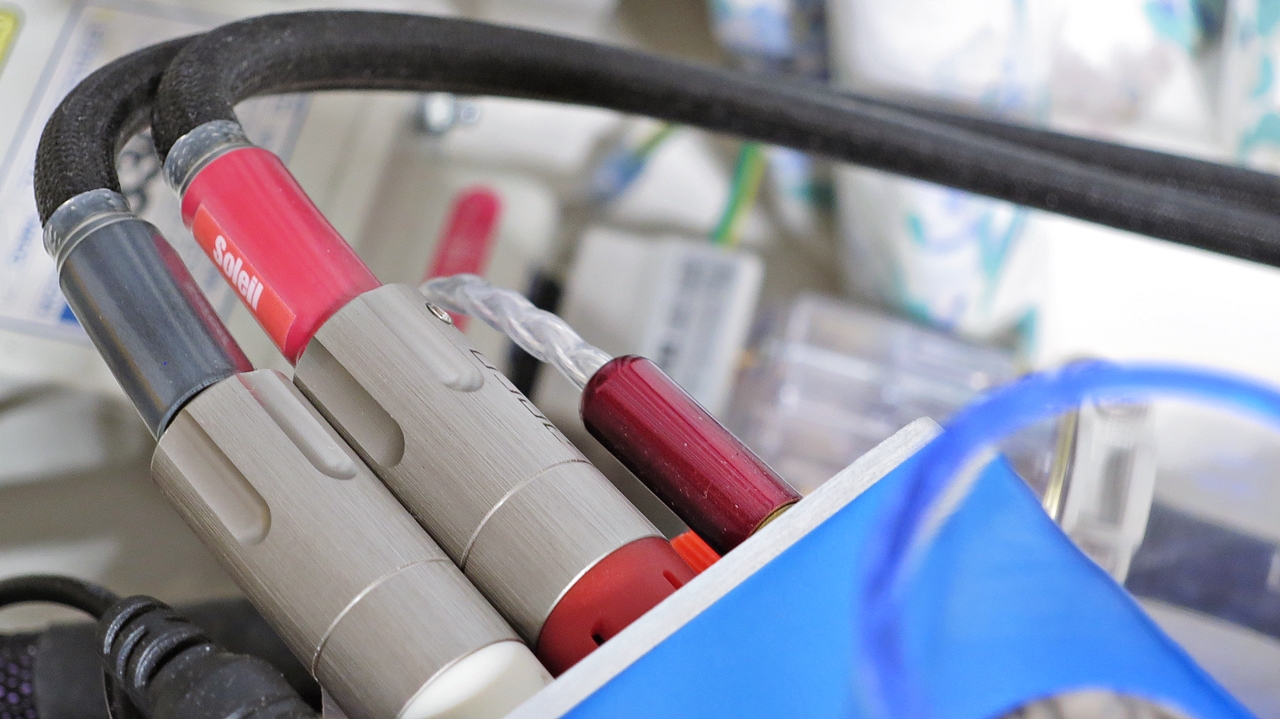
Extension at both ends of the frequency range is fairly ordinary — there is no special sense of breadth — but its flat tendency means there are no odd biases or quirks in the perceived frequency response. The Soleil has a crisp sense of pace, a silver-wire-like brilliance, and an energetic presence that the Etoire lacks. How to put it — connecting the Soleil to what should be a system centred on a valve preamplifier produces a clear, monitor-oriented character that is more reminiscent of a digital amplifier like the ONKYO A-1VL.
CREEK Sub-System: Musical Fidelity V90 DAC × EMF Sequel2
Next, between the Musical Fidelity V90 DAC and the EMF Sequel2. I had been testing the Etoire here just before, though the position is normally occupied by the Stereovox HDSE. The Soleil has a formal, reference-oriented disposition — serious, cool, and monitor-like in character. The sound opens up with a well-defined clarity and high resolution; fine detail becomes more plainly visible than with the Etoire, and in this respect — the fundamental capability of the sound quality — one senses a genuine difference in class.
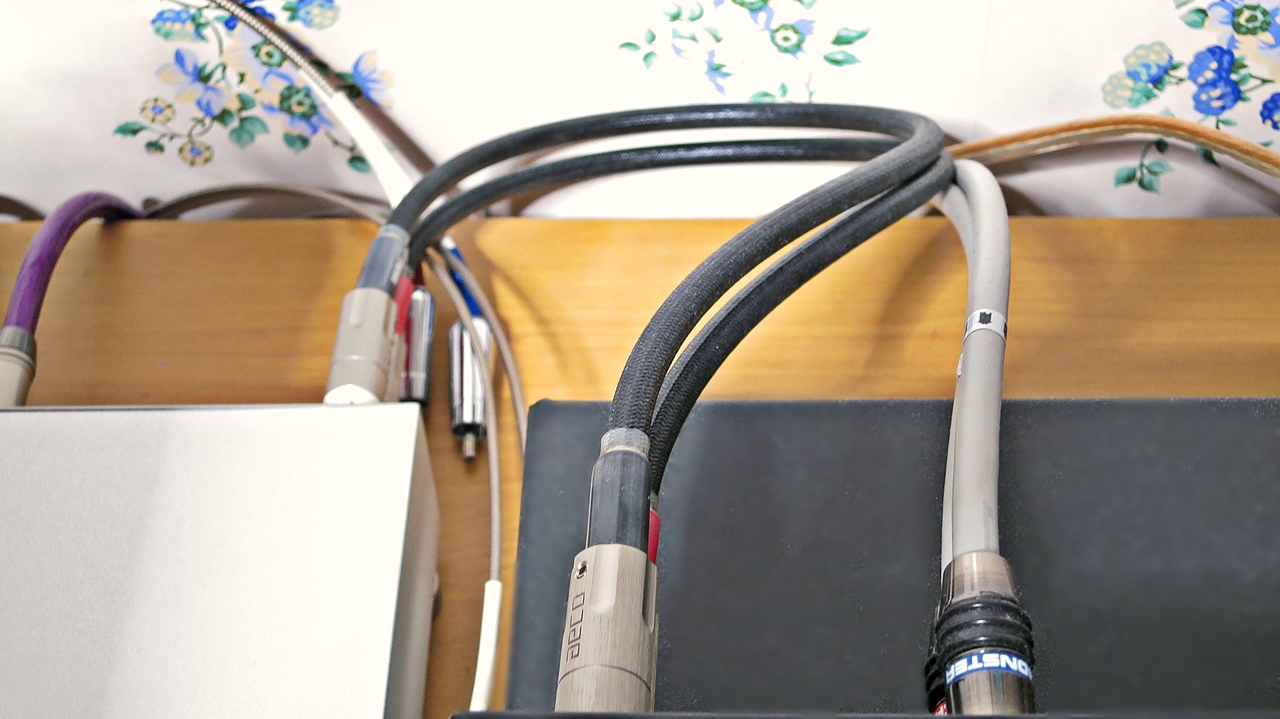
The high frequencies carry a lustrous sheen, with a silver-wire-like sensitivity that comes at you in a direct, linear fashion. The CREEK’s inherently low-information, retro-flavoured sound shifts into a more crisp and contemporary character — so it seems likely that inserting the Soleil into a system where resolution feels one step short will sharpen up the freshness and Hi-Fi performance in one go. As a character, it is not purely a dry monitor-type in every regard; the midrange has a slightly elastic quality that lets a certain gentleness and sweetness peek through now and then, though that remains firmly within the realm of a subtle flavouring.
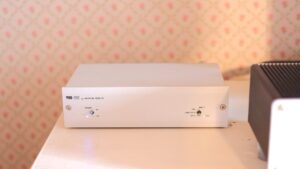
Main System: C.E.C TL5100Z × Valve Harmoniser
Here too I inserted the Soleil in place of the Etoire I had been testing immediately before, placing it upstream of the LUXMAN valve harmoniser. The impression is much the same as when it was inserted into the CREEK, Miuaudio, and ONKYO sub-systems. In this respect, unlike the Etoire — where the relative prominence of the 5N single-core silver conductor and the aeco tellurium copper plug can shift impressions depending on the system — the Soleil maintains a consistently stable tonal character. The perceived S/N is excellent, and a cool, solid, high-speed sound comes at you with a brilliant radiance.
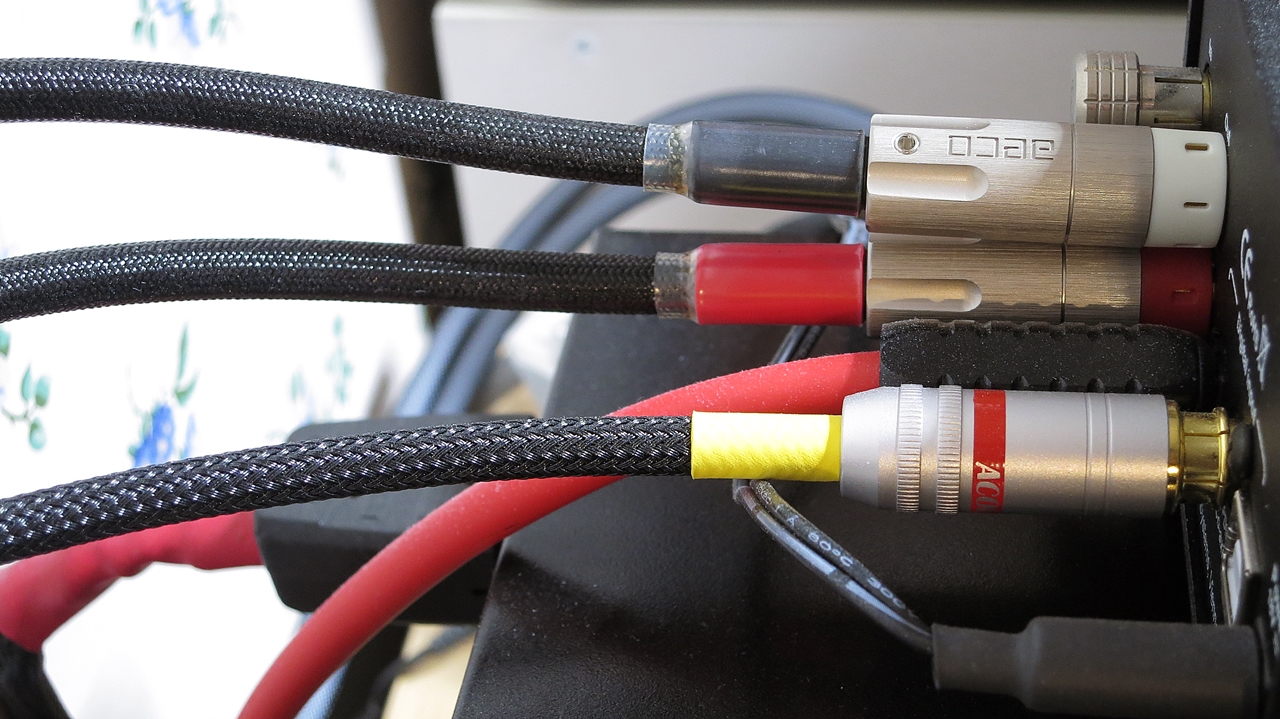
Compared to the Etoire, which extends flatly at both ends, the Soleil’s range feels more centred on the midrange. The mid-to-low region has a slight elasticity with a moderate sense of body; the high end offers a silver-wire-like vividness and sharpness to the image. Honestly, the combination with the valve harmoniser — an effects unit designed to deliberately add colour and let the sound linger and drift — is not particularly well-suited in terms of character. That said, the Soleil is finished to a sound quality befitting users who want a contemporary-system build with accurate reproduction, and it seems likely to pair well with hi-res source material.
Soleil vs Etoire
This is quite a difficult question… Rather than price difference, I think which one to choose comes down entirely to system compatibility and what each person is seeking from their Hi-Fi. As a rule of thumb for each: the Soleil suits those who want to confront modern audio head-on and pursue a dry, high-speed sound quality; the Etoire is better for those who want to relax casually and find comfort in being immersed in music. Even so, the fact that they use virtually the same 5N pure silver single-core conductor and gold-plated tellurium copper plugs — and yet differ this much solely on the presence or absence of a vibration-damping structure — is striking. The difference in character is so pronounced you might wonder whether two entirely different designers were responsible, and yet the voicing at AudioCableCraft is done by the same person throughout. One might say that AudioCableCraft has the breadth of vision to deliberately offer two options with quite different vectors, depending on what the listener wants from their system and from audio reproduction.
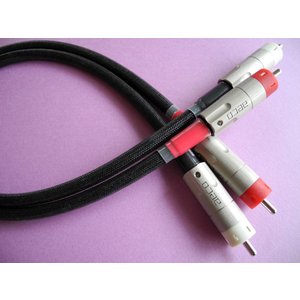
Incidentally, both the Soleil and the Etoire have a further step-up model above them — the Lune — which uses higher-grade plugs and wire, and is said to have a more distinctive character rather than a monitor-oriented one. The Lune’s plugs are an older non-aeco type originally designed for digital cables, but Sugar-san, whose site is linked below, has auditioned a variety of high-end digital cables and settled on the Lune as a regular favourite — so I would strongly recommend reading that piece as well. The price gap between the Soleil and the Lune is not that large, so I can’t help feeling that anyone who can stretch to the Soleil might just as well consider the Lune instead.
On the aeco RCA Plug ARP-4045G “The STARS”
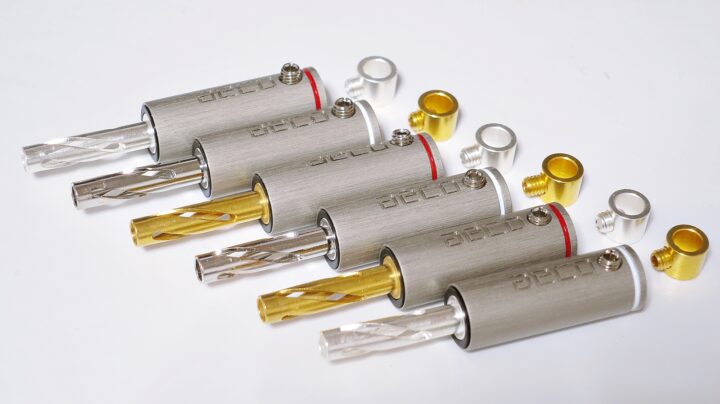
One feature common to both the Soleil and the Etoire is the use of aeco’s RCA plug ARP-4045G “The STARS”. Those who know audio cables well may already sense it by ear, but the quality of sound this plug contributes goes a very long way towards determining the overall sonic character of the cable — or rather, it covers the weaknesses of the 5N silver single-core conductor admirably, and seems to be responsible for the tight, physical presence, the resolution, the breadth of frequency range, and the rich, moist ambience of the indirect sound. To put it plainly: without the sonic uplift provided by these RCA plugs, the high regard in which AudioCableCraft’s cables have been held simply would not exist — the effect is that significant.


 ポチップ
ポチップ
 ポチップ
ポチップ
Ordinarily, in most RCA and digital cables from around this price range up to the mid-level class, the RCA plugs tend to use brass, with nickel plating underneath a thin layer of gold plating — this is the norm. With aeco, however, the signal-path pins use tellurium copper (99% tellurium copper), which has far superior conductivity compared to brass, and rather than nickel plating underneath, a direct 10-micron gold plating is applied. Direct gold-plated terminals and plugs are not something you often come across, and it is only when you actually listen to this kind of direct gold-plated plug that you realise the familiar glittery, sweet sound of ordinary gold plating is, in fact, a character that comes from the nickel undercoat — not from the gold itself.
The cold side is also pure copper. The outer cover is a copper-zinc alloy (brass) machined to a precise, attractive hairline finish. The inner body that covers the device’s RCA terminal is made from glass-fibre-reinforced nylon, which is worth noting as it suppresses the metallic resonance colouration that RCA plugs are prone to generating. The fit is precise and the insertion force is sufficient, but the engagement has a distinctive, firm feel — when inserting or removing, it is best to pull straight out rather than rocking from side to side. There is a satisfying “pop” both going in and coming out. Plating options include direct 24K gold, direct pure silver, and rhodium, and the higher-grade ARP-4055 uses pure silver rather than tellurium copper for the centre pin. If I were to place a semi-custom order, I would very much like to try that pure silver centre-pin ARP-4055.
 ポチップ
ポチップ
Speaking of which — the Ongaku no Tomo-sha Stereo Mook 2013 publication Build Your Own Audio Accessories Part 2: RCA Cable Kit was apparently not a popular title, never quite sold, and had been sitting as unsold stock until quite recently. The screw-type WBT-copy RCA plug included in the kit is an Oyaide-commissioned item; checking Oyaide’s online shop, it is listed as the AEC-made RP-1013ZAG — so, without certainty, there is a fair chance the manufacturer is the same AEC.
 ポチップ
ポチップ
Custom Cable Orders — Semi-Custom and Full Custom Are Also Available
They do not seem to keep a large amount of stock, and looking at the AudioCableCraft second store, quite a few items are out of stock — but when I enquired, I was told that with a little time, they can accommodate custom orders covering length, plugs, and so on, right down to the choice of solder. ※ Note: The Etoire was discontinued in May 2020, but as a non-returnable custom order, it may be possible to have one remade if the materials can still be sourced.
For custom orders, you can go with AudioCableCraft’s standard combinations, or combine them with other aeco plugs and plating options to create an audio cable more precisely matched to each user’s needs. There may be a wait due to the made-to-order nature of production, but this is something that overseas manufacturers and the major domestic brands producing on commission from wire makers tend not to accommodate, so having this kind of service available at an affordable price is genuinely appreciated. ⇒ About Custom Audio Cable Orders.
Which Would I Choose — Soleil or Etoire?
Since the right choice shifts depending on the system combination and personal taste, all I can really say to anyone asking for a recommendation is: it comes down to preference. But speaking for myself — with a collection of various RCA cables already on hand and the ability to swap between them as occasions demand, and as someone with a fondness for quirky, nostalgic gear — I find myself drawn to the lower-model Etoire. The reason is that the Soleil follows the orthodox path of high-resolution monitor-type sound, and while it is a clear step above the Etoire in pure sound quality terms, cables of this high-resolution persuasion — setting aside the question of price and value — tend to feel like something similar could be found elsewhere if one looked, precisely because the character is so orthodox. To repeat: I am setting aside the matter of price entirely here.
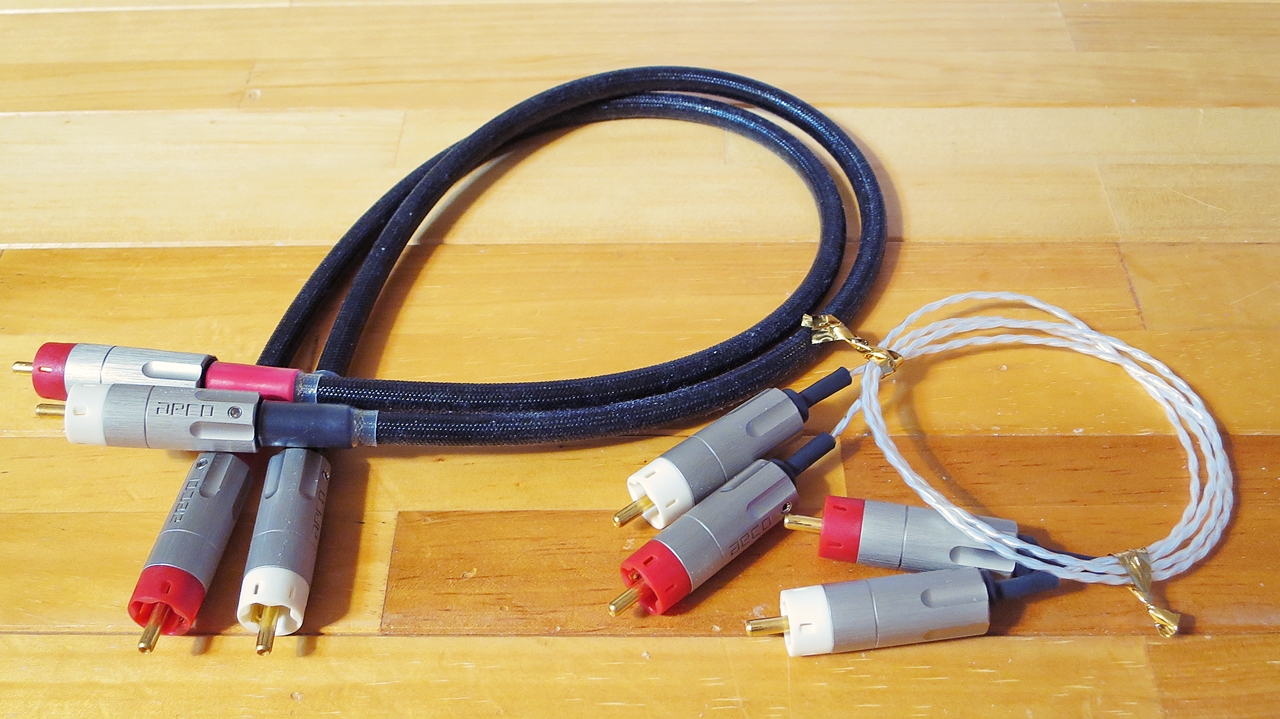
The Etoire, by contrast, has a character that is rather one of a kind — natural spatial breadth combined with tight imaging, and a gentleness that peeks through now and then, like touching the wing of an angel. In terms of character, it feels somewhat akin to the voicing of high-end cables from overseas manufacturers. With a 5N pure silver single-core conductor alone, I would probably find the tone too sweet and the sound too limp to use — but the aeco plugs substantially expand the sense of range and density, so that, for purposes other than reference monitoring, I felt the level of resolution was sufficient to leave me personally with few complaints.
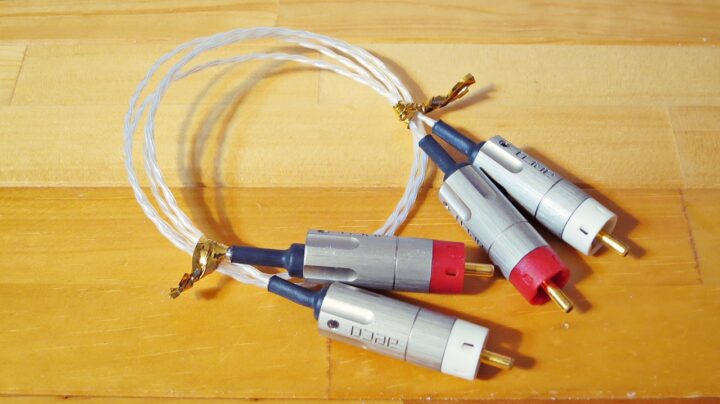
Also, the review sample of the Etoire I borrowed for this occasion (apparently a pre-production version, one step before the final product) has no directional marking, but in cases where the combination with the equipment results in a sound that leans too mild and feels slightly lacking in contrast, reversing the connection raises the perceived sense of pace and yields a clearer, more articulate sound with a crisper edge in the high frequencies. The gentle character and soft, airy atmosphere that are distinctively Etoire do diminish somewhat, but if the cable’s quietness feels like a concern in a given combination, it may be worth trying the reverse connection.
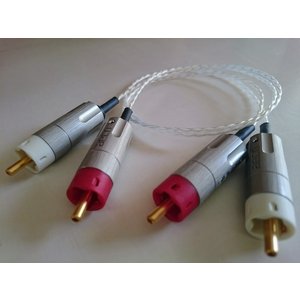
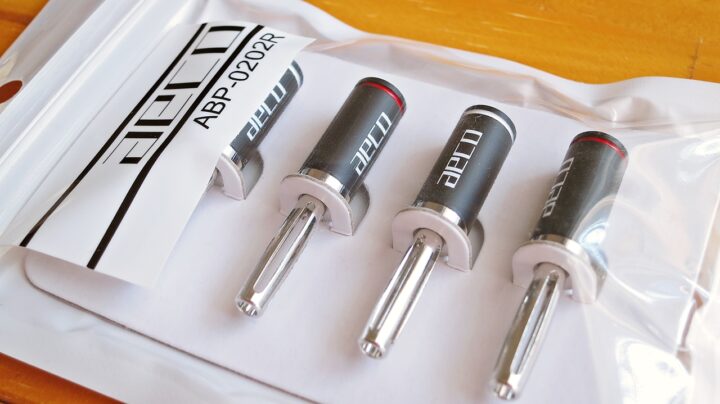
With all that in mind, what I am now thinking — having had the chance to borrow and audition the review sample — is whether to try a semi-custom order: upgrading the plugs to the pure silver centre-pin ARP-4055 and being particular about the choice of solder, as a way of taking the Etoire’s sound a step further. At around 70 centimetres in length, so it can also be used with the CI AUDIO DAC in the main system, which I was not able to test this time around. The ARP-4055 plugs are not cheap, so the price would probably end up not too far from the Soleil after all…


Auto Translated by CS4.6