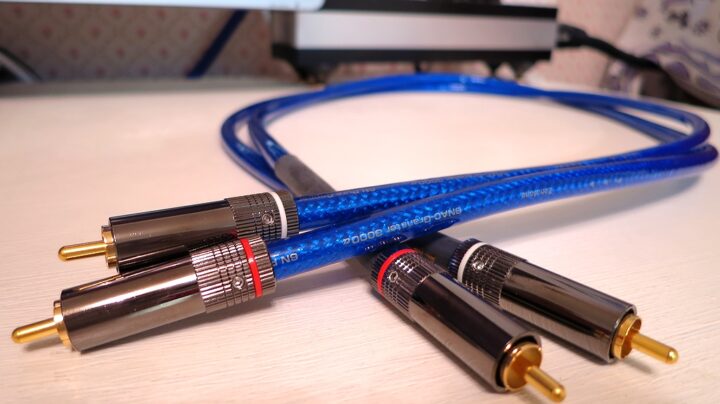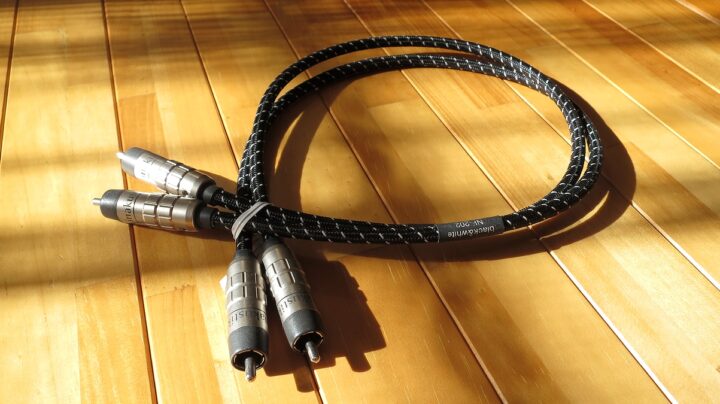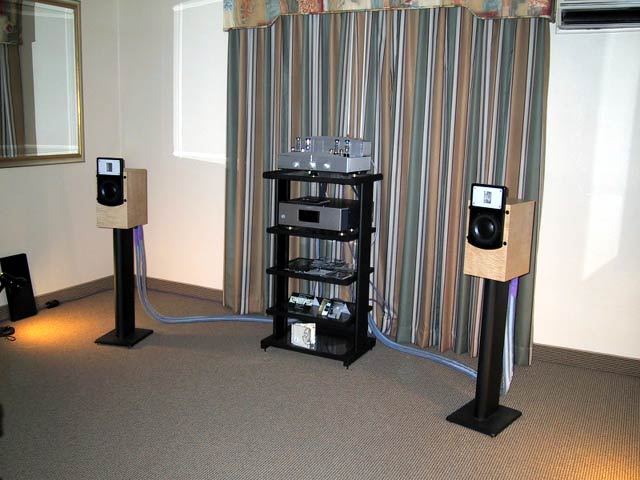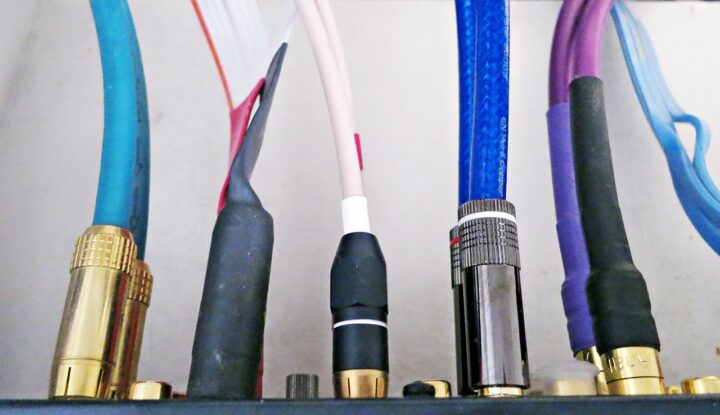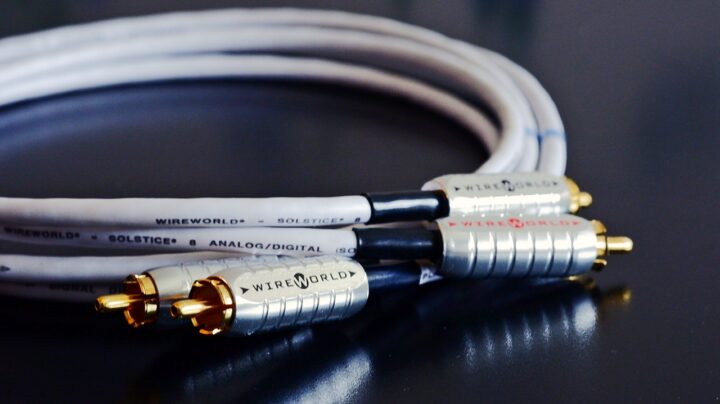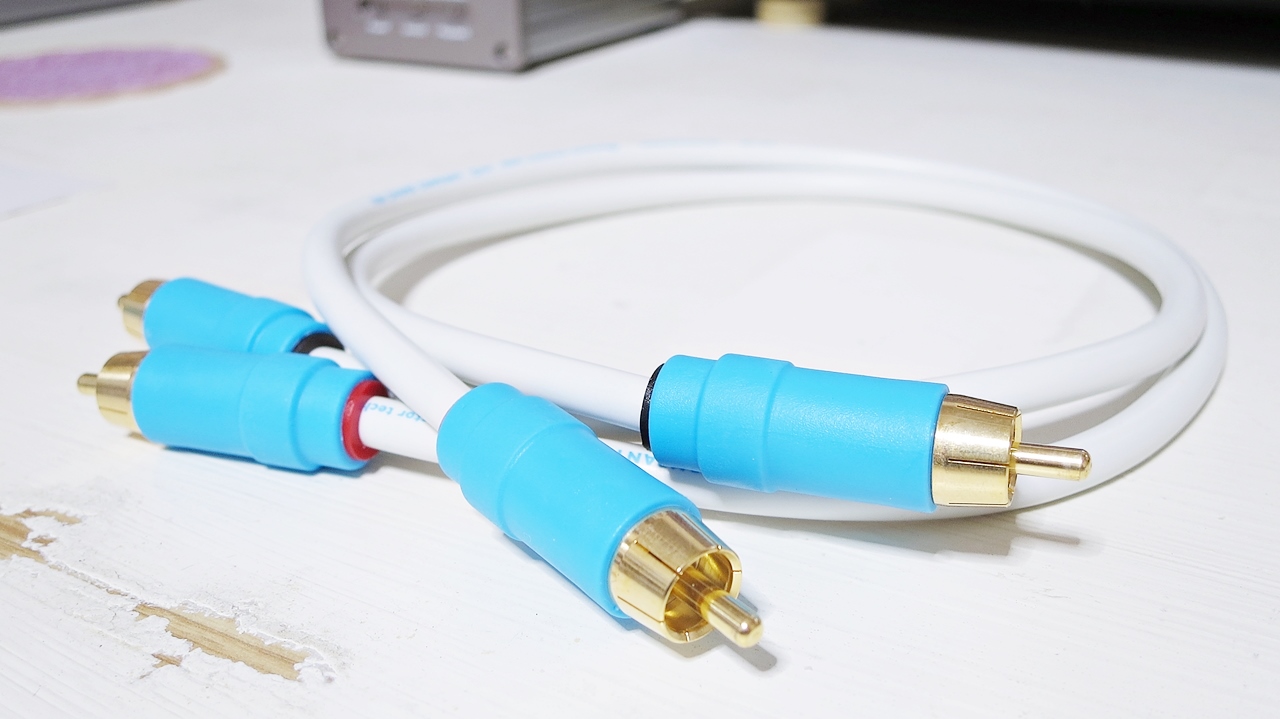
The CHORD C-line won the Audio Accessory magazine Meikinshō 2016 award (cables under ¥100,000), a five-star Award from the British WHAT Hi-Fi magazine in 2016, the Hi-Fi Choice GROUP TEST WINNER, and Hi-Fi World 5 Stars — making it the most affordable, entry-level RCA interconnect cable in CHORD’s lineup. For a cable in this low price bracket, it received a remarkable amount of fanfare, and in its home market it has been treated as something of the definitive choice in budget cables. Incidentally, The Chord Company, which makes the cables, and CHORD Electronics, which makes avant-garde high-end DACs and amplifiers, are both British manufacturers — but despite sharing a name, they are in fact entirely unrelated (which is rather confusing).
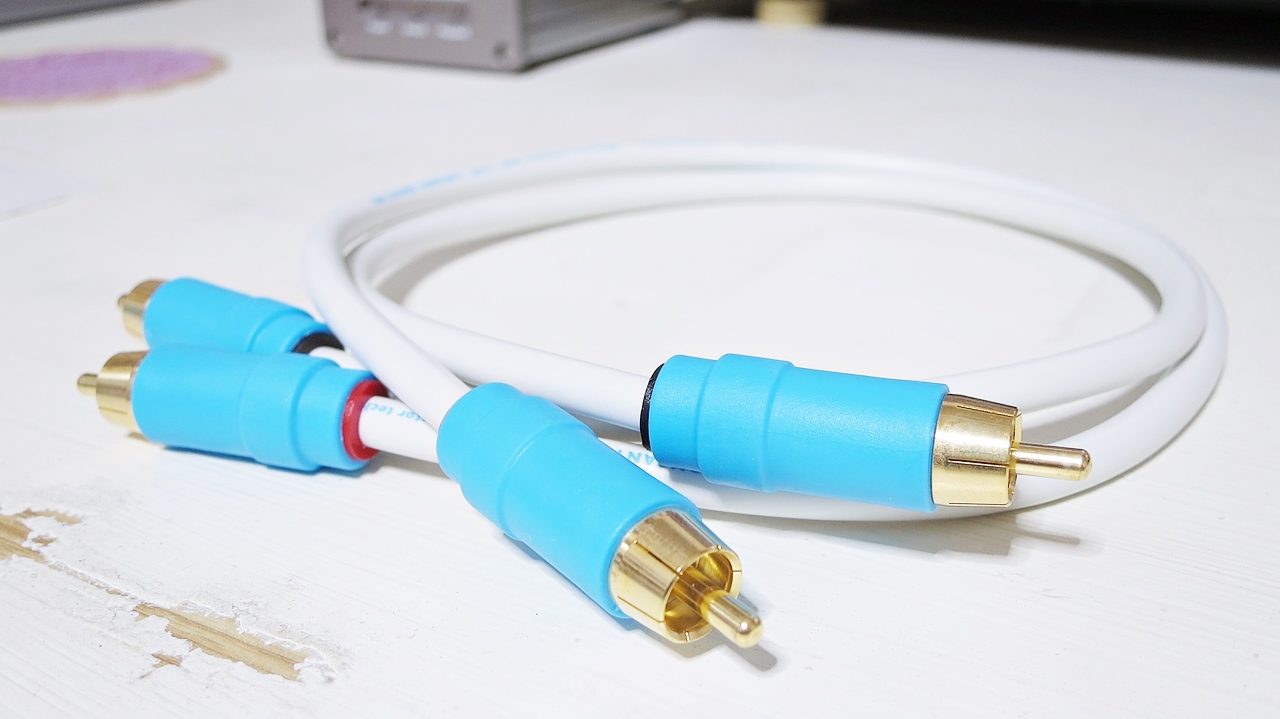
I think most people will share the same impression of the appearance: for something that passes itself off as a high-end audio cable — even if it is at the lower end — it honestly looks rather cheap. The blue RCA plugs are moulded in one piece and feel like toy plastic, and frankly, at a glance it looks like it should cost around ¥2,000 at most. That said, the white and pale blue colour scheme has a sort of Shōwa-era retro feel to it, and precisely because it looks nothing like the sort of audio product that has had money lavished on its appearance, I — who have little time for flashy ostentation — actually found it rather endearing.
How I Came to Buy the Chord C-line RCA Cable
The C-line’s domestic UK price is £35 for 0.5m and £45 for 1m. I wrote that it looks like a ¥2,000 cable, but the actual price is not quite that low. When I later checked the distributor’s website after purchasing from audio specialist shop Denkidō Square (at the time), I found that what I paid was basically the full list price — I could hardly believe it. At least it was through the Rakuten Marketplace, so I did rack up a good number of points. The price gap between Japan and overseas for the C-line is still within what I personally find acceptable, but with CHORD’s higher-end models, that gap widens considerably. And apparently the manufacturer and distributor have an agreement banning exports to Japan, making personal imports effectively impossible — which means Japanese buyers are forced to pay abnormally high prices in this otherwise global era, and I do find myself feeling somewhat dubious about that as a business practice.


 ポチップ
ポチップ
The one I purchased was the 0.5m. The actual measured length was 54.5cm. The manufacturer recommends lengths of 1m or more, but there were scattered reviews overseas where people said the 0.5m sounded better than the 1m — so, as ever, I followed my own principle that shorter is better, regardless of what anyone says. The contact of the RCA connectors is appropriately firm, and there seems to be no risk at all of damaging equipment through repeated insertion and removal. It should also be noted that, unlike the higher-tier cables in the range which are assembled by hand at CHORD’s UK headquarters, the C-line appears to be manufactured in China. The conductors are OFC, and unlike the Shawline and above, there is no silver plating on the conductors. The RCA plugs are also standard gold-plated rather than the silver-plated type characteristic of higher CHORD cables. There is a specified direction of connection, and reversing it may compromise the effectiveness of the pseudo-balanced topology.
CHORD C-line Sound Impressions
The first system I connected it to was my ONKYO sub-system. At the time the chain was CREEK Evolution CD ⇒ Pro-Ject Head Box DS ⇒ ONKYO A-1VL ⇒ audiopro Image12. Well — the sonic impression turned out to be quite different from what its colour and finish might suggest. The background noise floor is low, and there is a great deal of ambient reverberation. Quite where all that reflected sound is coming from is a mystery — there is simply so much of it. For this class of cable, the shading and depth of instrumental and vocal textures is impressive, and the soundstage is wet and full of moisture; yet the sheer abundance of reverberation means that fine overtone detail in instruments like the violin — those subtle, granular particles of information — tends to dissolve somewhat. The musical flow is quiet and unhurried. Dynamic range is there, but the sense of energy is restrained, and a lack of elasticity in the bass in particular means that bright, dynamic musical energy is rather subdued. The tonal character is dimly lit, with a low colour temperature — an image of walking through a faintly chilly, overcast English evening in the rain.
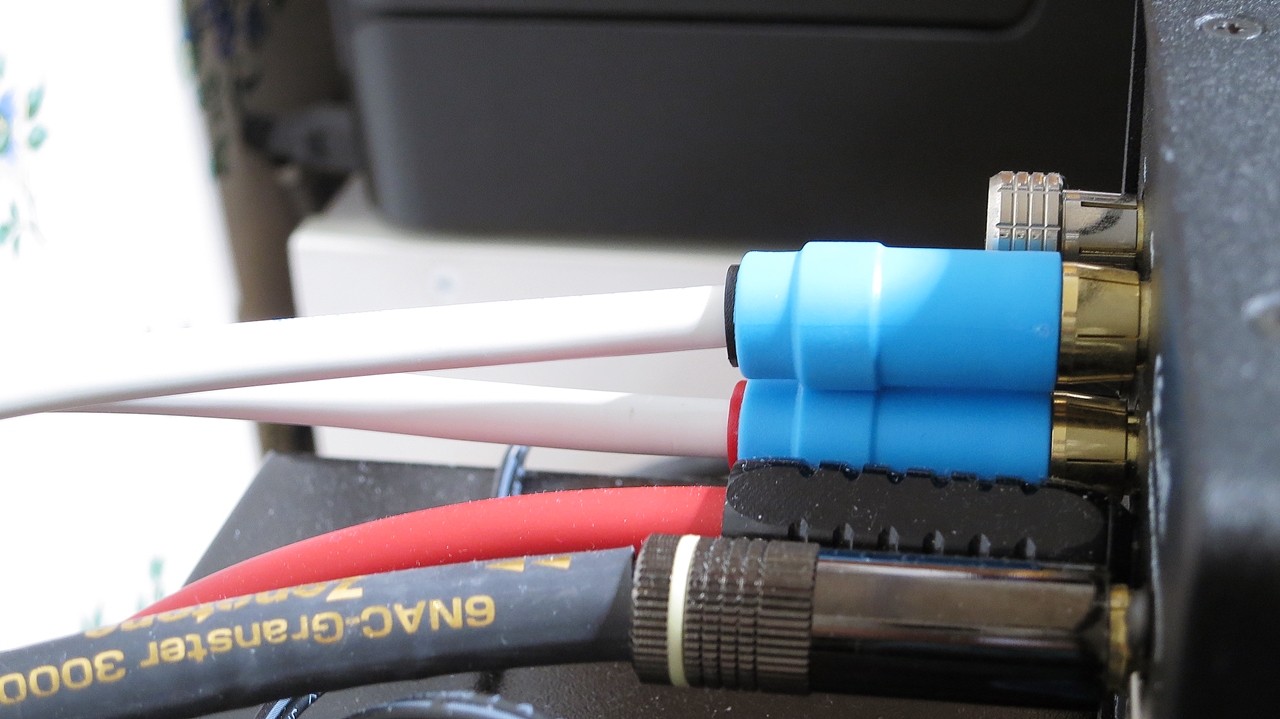
With classical music, it excels at minor-key works — melancholic spiritual expression, musical energy in the darker direction — and, belying its appearance, produces a genuinely mature, deeply shadowed sound. Dense orchestral textures feel slightly lacking in focus. The Beatles, too, come across with a thoroughly British atmosphere and quite a dry, austere quality. The female vocal range has just a hint of roundness and sweetness, which works rather nicely. Anime soundtracks are a surprisingly good match — the dry electronic textures are transformed into an acoustic resonance that blends like a concert hall, and alongside the vocals, the separation of individual instruments and sound effects is excellent, with the tonal distinctions between them laid out clearly enough to follow. In terms of my colour-hearing, the impression is strongly dark — this is not the bright, cheerful atmosphere that a fresh light blue and white palette might suggest.
It is a stranded cable, but whether through the ARAY Technology or the pseudo-balanced connection, the stereo imaging from the midrange downwards is solid. Without demanding excessive bass weight, the low-frequency resolution is unusually good for this price bracket, and it has a real quality in vividly differentiating the tonal character of bass instruments from one another. From the bass up through the midrange, the transparency is impressive for the price, and a sense of soundstage not typical of budget cables is achieved — however, the extension upwards into the upper treble feels somehow suppressed, as though something is pressing down on the top of the sound, and in terms of fine detail and information in the upper registers, it is very much in keeping with its entry-level price. There is also (and this seems likely to be simply a matter of insufficient burn-in) a sense that, for all its surface polish, there is a slight roughness in places, which may be contributing to that passive, melancholic impression. Through the midrange into the upper-mid region there is a faint brightness and a mild peak that lend the music a certain focal pull and sense of shading, but the overall balance tends towards a narrower character, and it does not quite give the impression of a wide frequency response. This is perhaps the inherent limitation of a lowest-rung model.
I will quote a brief passage from the review by Mr Hayashi Masayoshi in Audio Accessory magazine issue 156. The bold text marks the parts I personally found myself in particular agreement with.
Bright and fresh. Remarkably good S/N, with the orchestral stage structure real and three-dimensional. The tonal penetration surpasses that of the Cobra. What is truly surprising is the expressiveness of the female voice. An analogue-like weight is added, giving it a warm vitality and deep nuance. The ultimate entry-level model.
There is also a review by Mr Fukuda in Audio Accessory issue 159 (an extract) that includes the line “You will hardly believe such beautiful sound can be had at this price“ and similar remarks — but for full details, including a feature on Chord Company as a whole, everything has been compiled and published in the Cable Compendium 2017, and I would recommend anyone considering the C-line to have a read of that.
 ポチップ
ポチップ
The reviews in Audio Accessory magazine gave me a vague impression that the treble was fine but the bass was the weak point — yet for me personally, the real appeal lies rather in the expressiveness from the midrange downwards, and the bass in particular, while lacking in sheer weight, has good clarity and a realistic sense of instrumental texture that I found quite impressive. The pitch definition in the lower registers is easy to follow. Budget cables at this level often compensate for a lack of mid-bass weight by blurring everything into a soft, rounded mass, but the C-line shows little sign of that tendency. In the treble direction, on the other hand, although the upper midrange has a polished surface quality, the overall tone is dark and there is something rather underwhelming about it — full of moisture and, in its way, genuinely polished and pretty in its resonance, yes, but the overriding feeling is one of listlessness. As for the bass clarity I mentioned, that applies to the mid-bass; in the deep bass, the kick drum lacks a punchy, impulsive speed in its attack, and as a result the rhythmic quality praised by WHAT Hi-Fi and Hi-Fi World is, for some reason, entirely absent here.
Other companies’ entry-level cables at this tier often have a narrower frequency range and lower resolution compared to their higher models, with somewhat unremarkable sound quality — but in return they offer bouncy, bright, lively musicality. The C-line, by contrast, seems to aim less at the kind of immediately charming, accessible musical character typical of the budget bracket, and more at evoking the idea of a more serious sound — richer resonance, deeper expressive nuance — that suggests something above its station. Yet that sonic character is a distinctly adult one, wrapped in a particular atmosphere shaped by the British Chord Company’s vision of the world, and it is entirely unlike the thin, flat, wide-bandwidth, high-resolution sound that tends to be prized in Japan. In summary, if CHORD’s sonic direction suits your taste, this will likely be judged as something offering more than its price would suggest. For example — among entry-level gear such as the historically well-regarded MARANTZ 6006 series, the 5005 series, and Cambridge Audio’s TOPAZ range — many of which have a thin, bright character at the low end, the C-line seems well suited to calming and settling that brightness into something warmer and more composed.
 ポチップ
ポチップ
My thinking had been that if the entry-level C-line suited me, I would next consider adding a digital coaxial cable — either the Clearway or the Shawline. But if the C-line genuinely represents a faithful continuation of CHORD’s philosophy and essence, even at entry level, then I have to say it drifts somewhat from my personal preferences — and I won’t pretend there isn’t a certain hesitation about stepping up within the same brand. Higher-end models do attract reviews praising a sensuous vocal quality, or a bright and soft character, but with the C-line I actually have in my hands, there is almost no sense of brightness or positive energy — whatever sweetness there may be in the vocals notwithstanding.
As an overall assessment: the point of interest here is that it retains a strong flavour of traditional British sound while also achieving a more contemporary tonal balance. As a budget Hi-Fi enthusiast, I do think there are other interconnect cables under ¥10,000 that offer greater musical vitality in a brighter, more positive direction than the C-line, without falling far short sonically either — so the hype from WHAT Hi-Fi and other British magazines (and I use the word deliberately) may be slightly overblown, perhaps with a degree of home-nation bias. For what it is worth — if you are interested in CHORD cables, I would say, without wishing to be unkind: the right answer, even in the short term, is probably to go straight to the Clearway or the Shawline or above, both of which are hand-built in the UK.

Tried in a British Sub-System: CREEK × Musical Fidelity V90 DAC
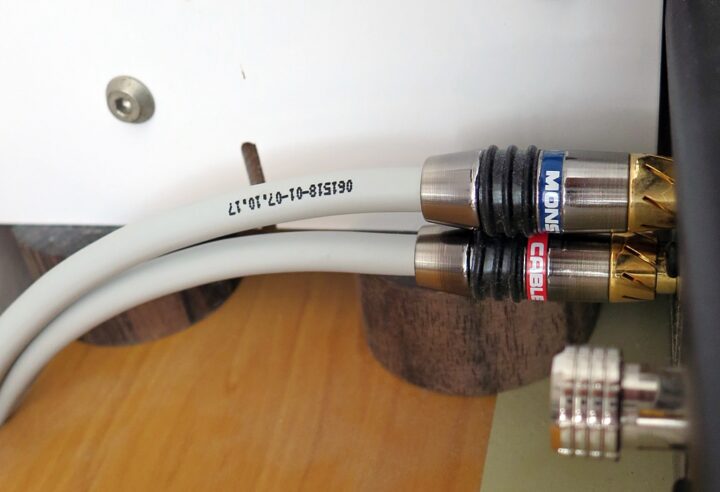
The current chain is CREEK CLASSIC CD ⇒ Musical Fidelity V90 DAC ⇒ CREEK Sequel2 ⇒ EPOS ELS3. This system was always built around a deliberately retro sound — prioritising a focused stereo image with limited ambience — and I normally use a cable that is, I admit, sonically out of date: the Monster Cable M350i. Inserting the C-line immediately floods the system with reverberation, transforming it into something resembling a proper, modern British soundstage-type presentation. Yet the stereo imaging doesn’t go soft or diffuse — it stays solid and well separated. On the other hand, the warm, lively character that defines this system becomes rather melancholic, and the atmosphere turns noticeably darker and more shadowed.
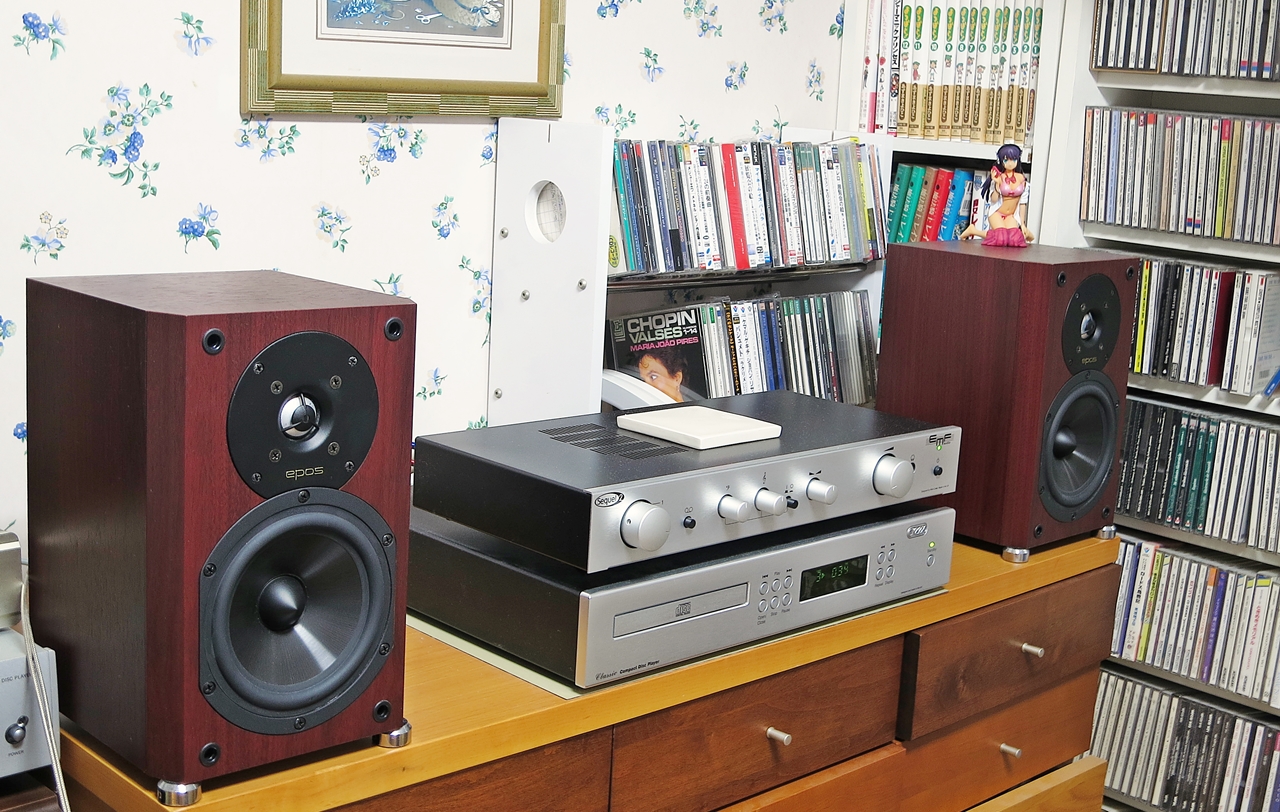
The upper midrange has a distinct, assertive character of its own — sweet vocals are brought into the spotlight, while the piano’s right hand sounds slightly pinched and pushed forward. I had a feeling that the C-line’s character might be a reasonable match for the Musical Fidelity V90’s more laid-back soundstage-orientated presentation, but when I actually tried the combination, the C-line’s wet personality dominated too much, unexpectedly blunting the V90 DAC’s strengths — its fine detail retrieval and its broad, deep soundstage. Not a keeper in this context.
In a Desktop PC Audio Setup
Even if it didn’t work in the sub-system, there was always the plan that it might find a home in my PC audio setup — that was part of the thinking behind the purchase. My desk is white, so the cable needs to be white to look right. The ELAC CINEMA 2SAT speakers in this system have aluminium and paper cones with a full-range-ish, dry character, so no matter what you do there is always a monochrome, dry quality lingering over everything — but the C-line’s abundant wet reverberation overflows to the point where it completely wipes out that dry tendency in the speakers.
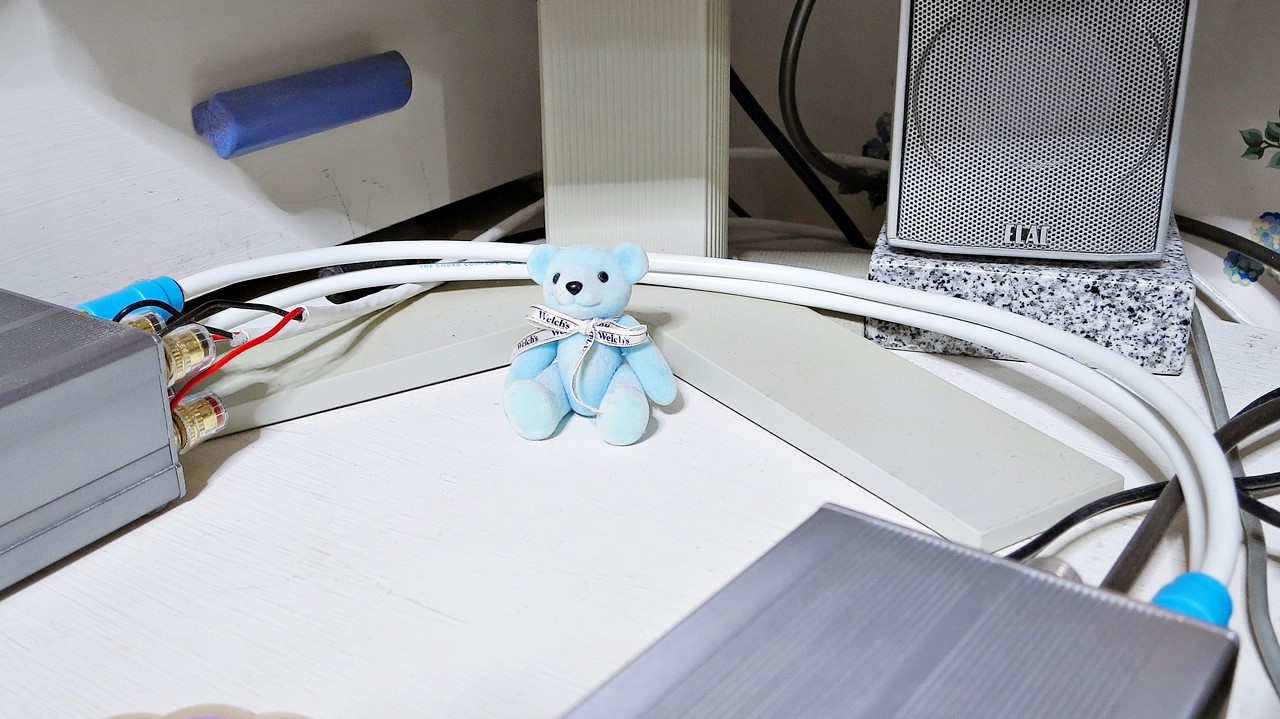
The problem was where the soundstage sat. Perhaps because of that suppression in the upper treble, the balance shifted downward — with the lean, flat-balanced ISODA HA-08PSR, the stereo image that had previously floated above the two speakers, just in front of the monitor at eye level, dropped considerably, spreading out from between the speakers at below-eye level and continuing diagonally down and backwards — an emphatically bottom-heavy presentation. The tonal colour shifted from monochrome to something deeper and denser, a dark brownish hue added in, giving a sense of deep dusk and a dark, concentrated palette. It became extraordinarily moody and grown-up, but the soundstage only expanded downwards, creating a cramped, narrow, suppressed feeling. ※ Afterwards I tried it in reverse connection, and the imaging was not quite so skewed downwards; it settled into a more usable balance. Even so, in near-field listening there is still a somewhat compact, narrow quality, and I would enjoy it more if the soundstage had a little more room to breathe in all directions.
Back to the ONKYO Sub-System
CREEK Evolution CD ⇒ ONKYO A-1VL ⇒ audiopro Image12 — this time without the Head Box DS DAC in the chain. Here the sound is relatively transparent. The C-line has something in common with the EVO-CD’s character — that mature, melancholic atmosphere — and for a taste of the British flavour it is not at all unpleasant. Even so, when compared with the DH Labs Silver Sonic Phantom RCA, another entry-level cable I have been using for years (purchased for $19 from a US shop), the C-line is superior in transparency and resolution, but falls short in terms of musical engagement — so the case for replacing it outright seems thin. At this point I tried something that felt like it ought to be forbidden: connecting the C-line in reverse. And it worked rather well, actually — the bandwidth opens up slightly and there is a touch more edge to the sound, but the suppression in the upper treble is eased and the musical character pulls back from its overly sombre quality towards something more neutral and lively. The melancholic ambience and reverberant quality thin out a little, and you could say it becomes a more ordinary-sounding cable — but personally, I have to admit I prefer it in reverse. The direction of change when reversing the connection is consistent with what I have observed with other RCA cables, so if you find yourself questioning the compatibility with your system, it may well be worth setting aside the specified direction and trying the reverse connection based on what you actually hear. That said, as a drawback, it does seem to make the perceived S/N slightly worse, which suggests that the benefits of the company’s flagship ARAY Technology and its EMI rejection properties may not be fully realised in reverse.
In the ARCAM CD72T and Miuaudio MKTP-2 Sub-System
The configuration here is ARCAM CD72T ⇒ Miuaudio MKTP-2 ⇒ QUAD L-ite2. After more than three months of burn-in on the C-line, I replaced the RCA line cable in this miniature valve preamp system — which normally gets the luxury treatment of a NORDOST Blue Heaven — with the CHORD C-line. Up against a higher-grade solid-core cable, the slight blurring typical of stranded construction is apparent, and compared with the NORDOST’s notably flat frequency response, the sound becomes somewhat narrower and more compact, centred on the midrange. If I had to say, it is a warmer, more mellow sound than the cooler-toned Blue Heaven.
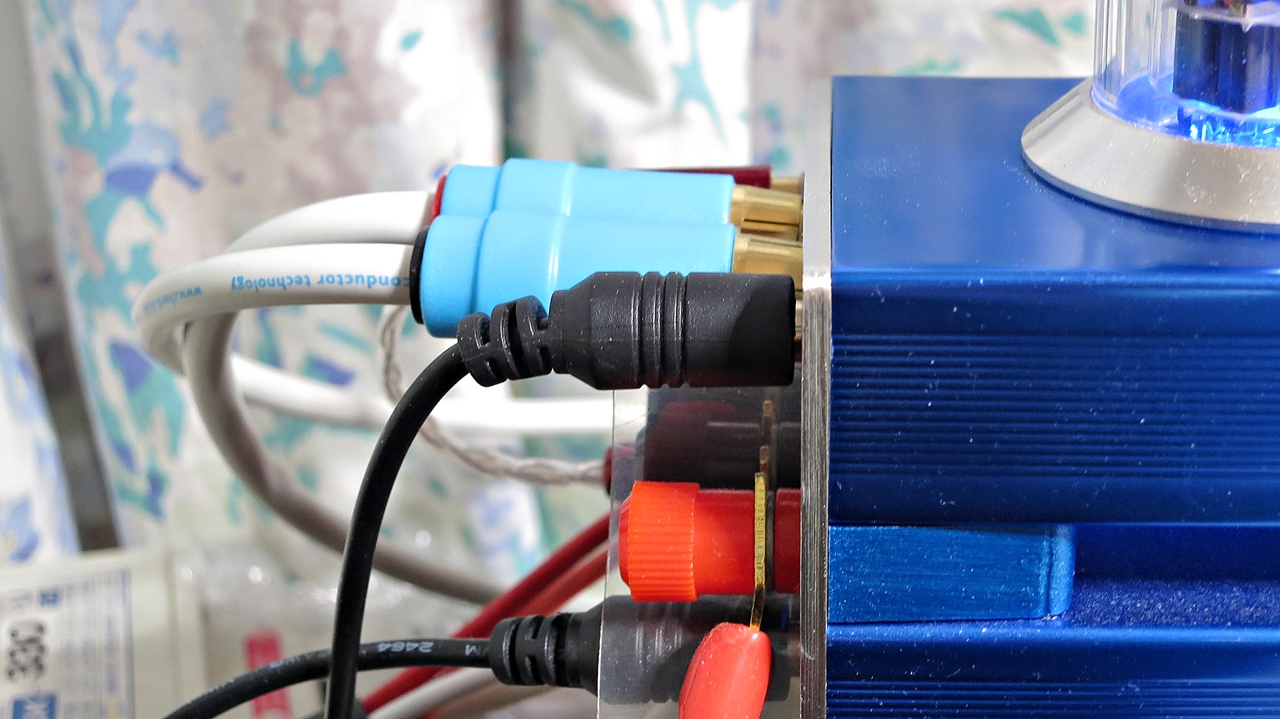
As ever, for better or worse, the assertive brightness riding on the upper midrange against the backdrop of that darker tone is the defining personality here — and with certain instruments, such as the faintly sweet and wistful quality of a female voice or the attack of a guitar, that sense of shading and flavour works in a positive direction, and the cable shows what it is genuinely capable of musically. The passive, suppressed quality that was noticeable in the early days has been eased through burn-in, and alongside the warmth in the midrange, a certain rhythmic liveliness has begun to emerge in melodic lines. That said, with piano music, which demands a wide register, there is still a sharpness in the upper right-hand range that leads to listening fatigue, and that continues to nag at me somewhat. Overall, I find it interesting precisely because its individual character gives rise to clear strengths and weaknesses. As a pairing, the compatibility is not bad at all.
~ Summary ~
Despite being an entry-level cable, it has a distinctive personality and flavour that makes compatibility difficult to judge without actually trying it in your system — but if it suits your taste, it represents fair value for money. Personally, however, I feel there is still considerable room for improvement in the C-line’s sonic quality. For those whose budget can stretch a little further, going straight to the Clearway or the Shawline will likely let you enjoy the unique expressive qualities that only CHORD can offer — qualities that have captivated many Hi-Fi enthusiasts in recent years — with fewer compromises along the way.
 ポチップ
ポチップ
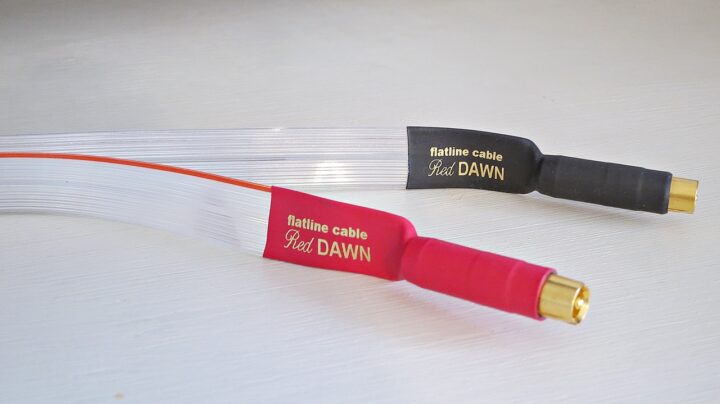
As a postscript: I have since been using the C-line in reverse connection at the input side of my LUXMAN valve harmoniser. The idea is that the valve’s colouration — which is deliberately there to add character as an effect — can be made even richer by layering on the C-line’s abundant reverberant character on top of it. Used at the input stage, the stranded-cable blurring is less of a concern, and paired with the higher-quality NORDOST Red Dawn at the output side, the result is — well, I think I can live with it, actually.

Auto Translated by CS4.6