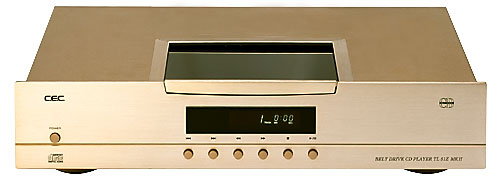
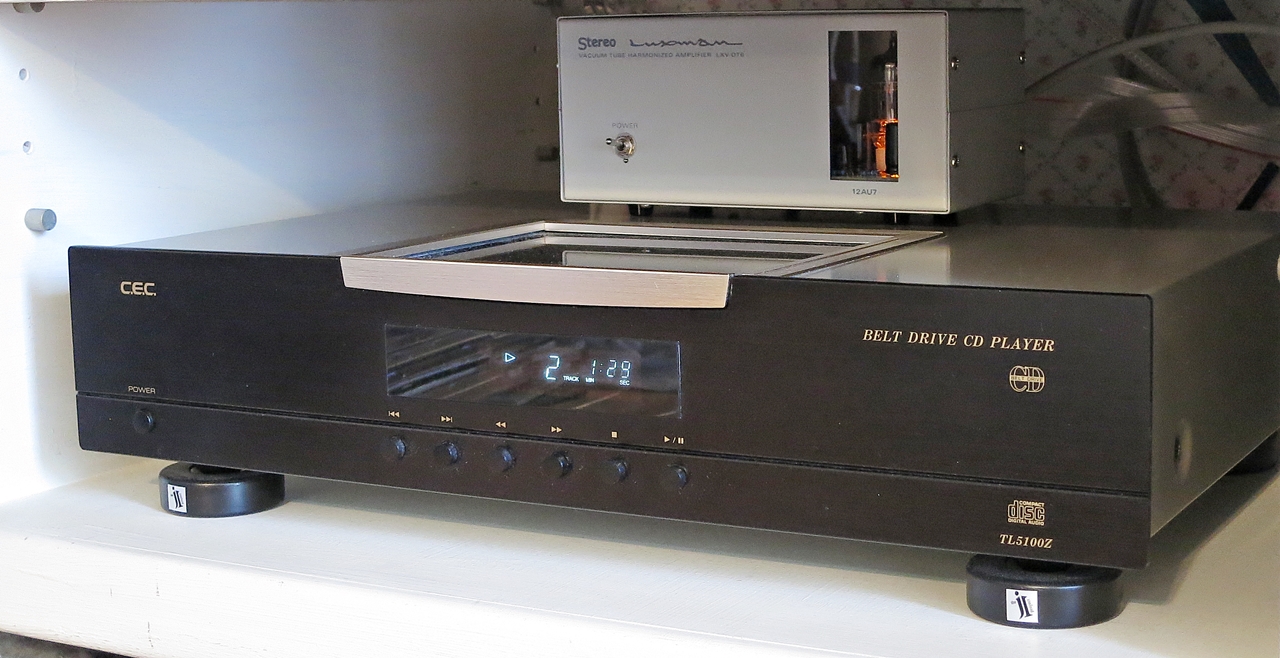
This time I would like to write about the C.E.C. belt-drive CD player “TL5100Z”, which I have been using as a reference for many years.
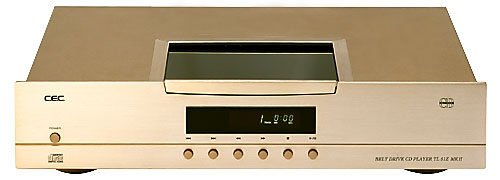
Released in 1996, the TL5100Z was the first integrated belt-drive CD player to emerge from the collaboration between C.E.C, a veteran Japanese record equipment manufacturer, and Carlos Candeias, a German engineer of immigrant heritage. It was followed by the TL51Z, TL51Z Mk2, TL51XZ, and TL51XZ again, each a minor revision that retained the fundamental design concept, and even now — more than ten years on from the original — it continues to be a bestseller, a CD player of remarkably high refinement that shows no sign of waning in popularity. The TL5100Z was, in every sense, the product that brought C.E.C — at the time little more than a minor brand — its reputation and recognition in the world of contemporary pure Hi-Fi, all at once.
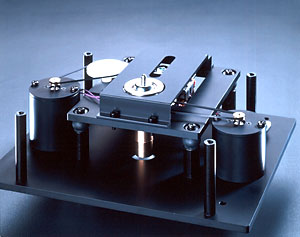
The defining feature of C.E.C’s CD players and CD transports is the “belt-drive transport” disc-reading mechanism — a design unique to C.E.C, and the only one of its kind in the world. Nearly all CD reading mechanisms in general use, whether for audio or data, employ what is known as direct drive, in which the central spindle is rotated directly by a motor. C.E.C, however, deliberately chose to carry over into the digital age — and into optical drive mechanisms — the belt-drive technology it had developed during the era of analogue turntables. The result is a rather elaborate approach in which the disc is rotated indirectly via a rubber belt interposed between the motor and the spindle bearing, and C.E.C actually brought this into reality as an applied solution for the CD format.
If one interprets a digital signal purely as 0s and 1s — as data and nothing more — then such an approach on the transport side might seem, in a sense, rather irrational and pointless. But that is merely a theoretical argument. The practical advantage of routing the drive through a belt lies in the physically and mechanically smooth disc rotation it makes possible. No matter how much rigidity one pursues with direct drive, there will always be minute electrical and mechanical vibrations generated around the motor, along with jitter — and it is only through the use of a belt that it becomes possible to float the rotation of the CD itself almost entirely free of these disturbances.
The drawbacks are: the need for a large stabiliser to increase rotational mass, which makes disc-swapping a somewhat laborious affair; the difficulty of applying the mechanism to anything other than a music player, since high-speed rotation and rapid stopping are not possible; slow access speeds (resolved in current models); and the inherently high cost of the drive mechanism itself. That said, when one compares the sound quality, the effortlessly smooth, distortion-free presence — free of that characteristic CD-induced strain — is something only a belt-drive player can offer, and the sonic appeal that sets it apart from every other drive type more than compensates for those drawbacks. Personally, I am firmly convinced that the belt-drive transport is, without question, the finest mechanism ever devised for a music CD player.
 The tonal character produced by C.E.C’s belt-drive mechanism is rich and smooth, entirely free of digital distortion or any sense of coarseness, full of warmth and natural suppleness, open and expansive — with a depth to the soundstage in the front-to-back direction that is simply extraordinary (it genuinely comes as a surprise) — and capable of conveying even the vertical height of a concert hall within the spread of the sound. The spatial presentation is alive with the realism of a concert-hall presence and musical vitality, and if you listen to a typical direct-drive machine immediately after a belt-drive player, the soundstage sounds almost as if it has been cropped into a neat little box, confined in every direction. This difference in presence seems to reflect a fundamental difference in intent: is the goal the photographically precise and accurate reading of a digital signal, or is it the reproduction of the concert-hall atmosphere and the liveness of a live performance — qualities that reside within the CD but do not appear in the data? It seems to me that this difference in starting point ultimately manifests as a difference in the realism of soundstage reproduction.
If the TEAC/ESOTERIC VRDS transport — often cited as the rival mechanism — could be described as a sound of masculine rigidity, taut and precise and earnest, then the belt-drive mechanism stands at the opposite pole: its character is a feminine suppleness, a soft, warm, and vividly living sound.
The natural, smooth tonal quality that flows from the TL5100Z has the curious ability to render subtle tonal distinctions that simply cannot be heard from any other CD player — it can bring back, with remarkable fidelity, the delicate differences in timbre that belong to acoustic instruments in their natural state. In the case of the piano, for instance, it captures the fragrant, lingering resonance that only a Steinway can produce, the distinctive character peculiar to a Bösendorfer, the individual tonal colour of specific models of string instrument or guitar — portraying each with its own identity rather than homogenising them all. At the moment, I know of no transport other than a belt-drive player that can do this.
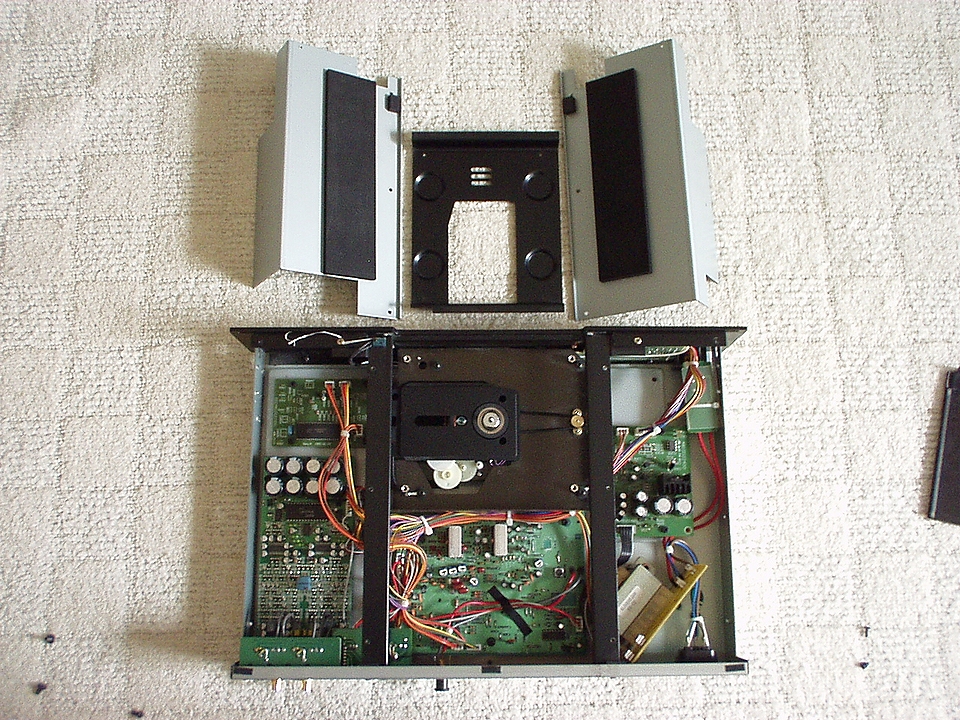
There is no shortage of players that offer high sound quality in the Hi-Fi sense — high-speed, high-resolution, and so on — but the TL5100Z seems to possess something fundamentally different from that kind of electrical accuracy: a persuasiveness in which the electrical apparatus between listener and live performance seems to vanish entirely, of the sort that only those who truly know the sound of acoustic instruments will find themselves unable to accept anything less than a belt-drive player.
The early TL5100Z that I own is, in terms of digital signal accuracy, actually inferior to an inexpensive portable drive. Things seem to have improved considerably in current models, but in the case of the original TL5100Z — when used, say, as a source transport for dubbing to CD-R — the receiving recorder could not lock to the time axis without a sampling-rate converter interposed, resulting in periodic dropouts, and one could actually hear the rotation wavering and drifting. Of course, with a standard standalone DAC on the receiving end that can reconstruct the time axis, or when connecting two C.E.C units using CEC Super Link, this is not a problem — but for those who believe that data must above all be accurate, this will no doubt be a sticking point.


That said, when it comes to domestic Hi-Fi equipment — an inherently rather questionable category of electrical product in terms of precision — I find myself thinking: surely what matters is not the catalogue specifications, which can only ever convey a fragment of the sound, but the realism one actually hears with one’s own ears? The result is everything. At the very least, from C.E.C’s belt-drive player, one obtains a genuinely faithful reproduction of the nuances embedded in a performance — a musical sound that, even from the perspective of a performer, rings true. Compared to that sound, many other direct-drive machines produce something that to the ear has no dynamic inflection, a sound all on one level, with the tonal colour uniformly flattened throughout, incapable of accurately rendering fine distinctions. However accomplished such a machine may be as a piece of electrical audio equipment, one cannot necessarily call it faithful reproduction of the original sound in the sense of being able to convey the expression a performer put into the recording.
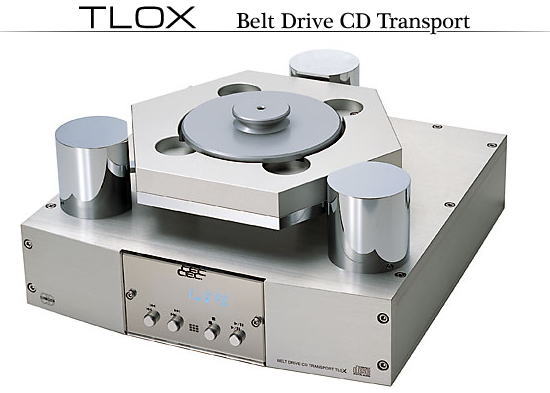
There is also, as a virtue of the belt-drive transport, the very important merit for a playback device that one’s ears do not tire even after extended listening. There is simply none of that irritating, CD-characteristic sense of distortion that one takes for granted with conventional CD players. For someone who is in contact with music for long hours every day, this is an extremely important point. The degree to which the ears fatigue really is entirely different. In terms of sheer sonic quality, the old Philips/Marantz CDM die-cast mechanism also has a musical, very appealing flow of dynamic expression — but in terms of low listening fatigue, the absence of any sense of distortion toward the high frequencies, and the way the soundstage is remarkably deep and “quiet”, I do feel that C.E.C products have the edge. In particular, for analogue enthusiasts who dislike the sound of CD and prefer the sound of records precisely because they do not suffer listening fatigue even over many hours, the mechanism with the sound quality that would — perhaps uniquely — be worth their while is surely one equipped with CEC’s belt-drive transport .
.

 ポチップ
ポチップ
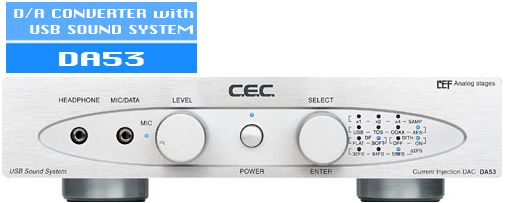
Furthermore, one cannot overlook the fact that the analogue stage in C.E.C’s belt-drive CD players is designed as a Class A amplifier — something that, alongside the musical realism and tonal truth that evokes live performance, contributes greatly to the character of these machines. The analogue stage design by Candeias lends a warm, analogue-like character that layers over the belt-drive sound and adds to its sense of naturalness. In that respect too, I think the sound will feel immediately at home for those who love analogue. And for those who wish to retain the low-distortion qualities of the belt-drive while obtaining a more contemporary high-fidelity sound beyond this analogue-tinged flavour, combining one of the company’s transports with a well-regarded DAC from another manufacturer should prove an excellent approach.
There are various reasons why I continue to use the original TL5100Z to this day, but one of them is that as the sound has been refined through successive minor revisions, I sense that the original model’s distinctive floating, unhurried quality (probably owing to the lower mechanical precision of the transport) and the analogue-like fullness and weight in the lower frequencies have become slightly thinner. I never had the chance to compare models back-to-back across a revision, and when auditioning current models in a shop the familiar analogue-like sound is still very much there, so I believe the essential appeal and sonic character have not fundamentally changed — but with the move to the TL51XZ came a change in the DAC chip, from the Burr-Brown PCM1704 multi-bit D/A converter (PCM1702 in the original) — whose richly varied tonal colour had been one of its charms, setting it apart from single-bit DAC types — to the NPC SM5865CM. And beyond that, the original was made at the Saitama factory, whereas from the second model production moved to China. Including these aspects that have nothing to do with sound quality per se, but belong more to the subjective, hobbyist side of things, I find I have a certain sentimental attachment to the build and the components of the original model. ※ In the 2006 model TL-51XR, the DAC was changed back to a Burr-Brown PCM1796 — the same DAC used in the C.E.C DA53.
A belt-drive CD player made by a domestic Japanese manufacturer, yet sounding nothing like a typical Japanese product — utterly natural, with an analogue-like richness and musicality, giving no hint of digital’s weaknesses. Once you become aware of just how good the sound is, I have to be honest: other direct-drive transports will no longer satisfy.
 ポチップ
ポチップ
To those who know the sound of fine acoustic instruments at first hand, who have experienced live performance in person, who cherish the warmth of the human voice, who regularly attend classical concerts and jazz performances, who have come to recognise the importance of musicality over mere sound quality, and to those analogue enthusiasts who have kept their distance from CD — it is to listeners with ears as discerning as these that I most want to recommend C.E.C’s belt-drive CD player.
Auto Translated by CS4.6
List of comments (4)
以前仲のよかったオーディオショップで、よく聞いてました。
そこのお店も、初代機をモデルチェンジ前に買い込んでいました。
確かに、ほかの日本製のプレーヤーとは違う音がしますよね。
まあ、海外のモデルでも大半はソニー・ティアック・フィリップス・デノンのメカですからね。
…どちらのお店ですかw
日本製・海外製というより、
この音ってベルトドライブでしか出ないんですよね。
CECがメカを海外ハイエンドにOEM販売してない?のが残念。
TL5100Zの音を明白に超えるためには、
より高品位なDACを追加する方が早い気がします。
先日、比較試聴の上でTL-51XZを購入いたしました。お書きになっているように、CDに固有の歪みを私も常に感じておりました。同時に耳には聞こえていないようなんですが、静寂感のなさも気になっていました。TL-51XZではその歪みが感じられず、また、非常に静かな印象を受けました。余韻の消え方が美しく、これは「きれいな空気」という感じがしました。音色としてはピアノは木が鳴っているように感じられましたし、シンバルなどの金属もその素材が分かるような気がしました。ボーカルは私の装置(アンプ:シャープSM-SX-100、スピーカ:B&W801F→20年前のものです)では生々しく空間に浮かびます。手を入れるところはたくさんあるのでしょうが、CDの音に初めて満足しました。このコラムも非常に参考になりました。ありがとうございます。
くま蔵さんはじめまして。
書き込みありがとうございます♪
お役に立てましたようで何よりです(*^-^*)
長い夏休みをとっておりましたが、今戻ってきたところです。
TL51XZ御購入おめでとうございます。
一度この音を経験してしまうと、いつかより高価なCDPを手に入れたとしても、
結局CEC機を併用せざるをえない…他では出ない音…
手放せない魅力があるのがベルトドライブのサウンドです。
言葉では説明しにくい究極的な説得力を持っているプレーヤーです。
スピーカーも801Fとは!素晴らしいですね。
カラヤンをはじめ、多くの音楽家に支持されたモニタースピーカー。
個人的には従来のノーチラスよりも好きだったりします。
80年代の録音はMATRIXの方がしっくり聞こえますから(^^)。
デジタルアンプのシャープのSX-100は大きな801も
ドライブできてしまうんですね。ちょっと驚きです。