【Audio USB Cable Comparison】
1|2|Oyaide|4|WireWorld Chroma|ELECOM|6 Models|SUPRA
This is a topic from two years ago, but as I had to suspend the blog for two years due to illness, this is a belated continuation. Two and a half years ago, the very idea that a USB cable could affect sound quality was still something of a novelty, and there were almost no USB cables on the market claiming “high sound quality” — yet now, before one has quite noticed, many types of audio-use USB cables have been released by various audio cable manufacturers, and it has become possible to choose from a fairly wide range, from relatively affordable products to high-end price points.
 Square Audio Specialist Shop — USB Cable Listings [PR]
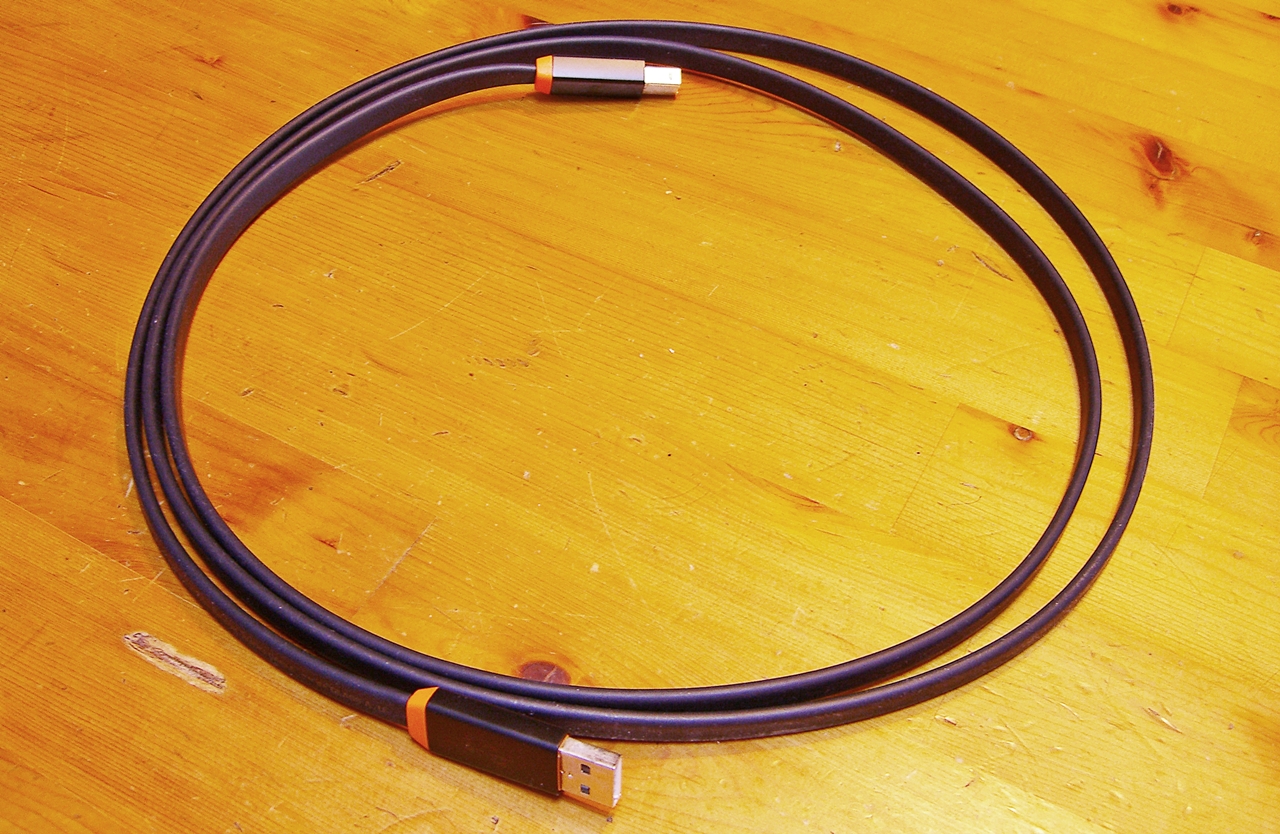
At the moment, the majority of audio-use USB cables on the market are essentially first-generation products from each manufacturer. The quality varies considerably depending on the manufacturer’s approach, and one gets the impression that things are still very much at the trial-and-error stage — and yet, among USB cables in the few-thousand-yen to ten-thousand-yen range, there are now starting to appear audio-use USB cables that genuinely feel a cut above the generic USB cables sold as PC accessories. This time, as an affordable domestically-made option from among those, I would like to introduce the d+ USB series cables released under Oyaide’s new brand for studio use and PC audio, “NEO Created by OYAIDE“.
When I purchased the DAC-1000 from ONKYO DIRECT, the campaign was supposed to include a complimentary DL USB AS-3F high-quality USB cable from Monster Cable (note: at the time) — but due to some mix-up, what actually arrived was the Oyaide d+ USB class A instead. Perhaps it was simply meant to be.

 ポチップ
ポチップ
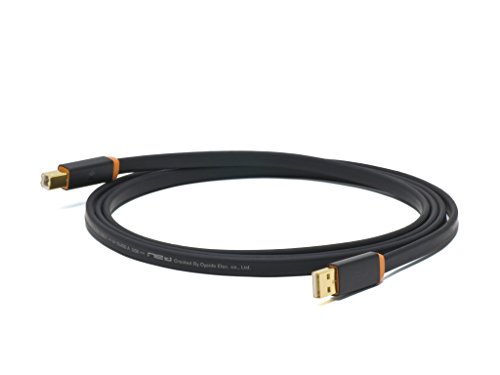
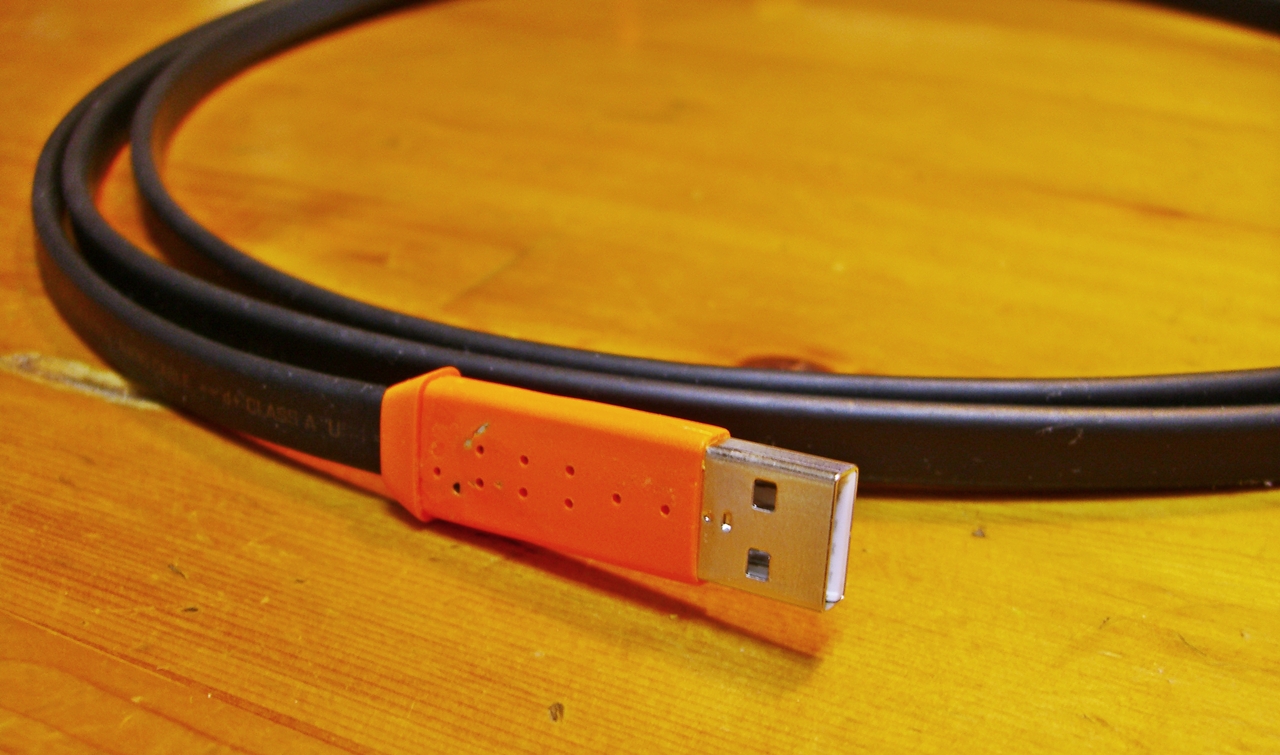
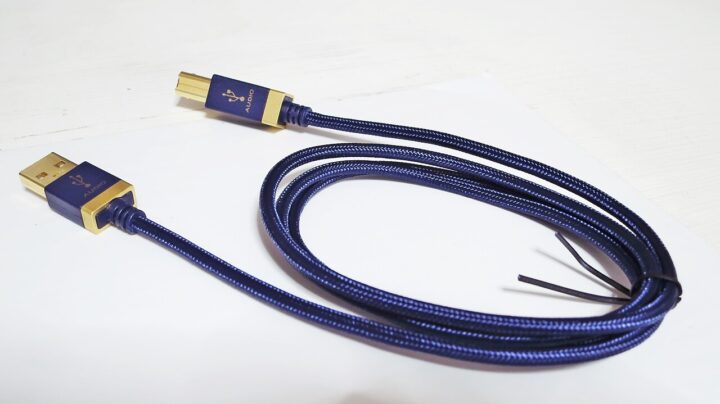
The Oyaide d+ USB class A is a flat cable, thicker than a typical PC USB cable, and — presumably due to the PCOCC-A conductors — feels fairly stiff in the hand. It does not bend flexibly, so it is probably worth buying a slightly longer length than you think you need. The stiffness of the cable is also worth bearing in mind with small, lightweight DACs or DAPs: if there is not much slack in the cabling, the tension of the cable can pull the unit and cause it to lift off the surface, so do take care.
The connectors are bronze alloy with a double coating of silver plating plus rhodium plating. The outer cover is aluminium. The conductors are PCOCC (single-crystal high-purity oxygen-free copper) in a reverse-concentric twisted configuration (0.18mm × 7, 0.18mm × 19), with a double-shield construction of tinned wire plus aluminium tape. The insulation is polyolefin. The sheath is thermoplastic elastomer resin — rather like hard rubber, and seemingly with good vibration-damping properties. Writing it all out in technical terms does make it sound rather impressive.
《d+ USB class A — Product Description》
A high-quality USB cable for next-generation sound tools centred on PC environments. To enable faster transmission over the serial bus — and with bus-power operation also in mind — PCOCC is employed, theoretically eliminating crystal grain boundaries in the direction of signal transmission. This achieves high-speed, reliable data transfer, while stable power delivery ensures that the sound’s definition and dynamics are not compromised. The conductor gauge is set at AWG21, delivering powerful sound and reducing loss over longer cable runs. The flat cable design avoids the transmission loss, impedance changes, and capacitance changes caused by internal distortion within the cable when it is bent.
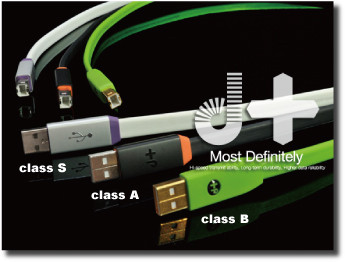
That is the blurb, more or less ↑ At present, Oyaide offers three cables under the d+ USB brand, ranked from top to bottom as d+ USB Class S, A, and B, making the Class A the middle model of the three. To put the differences briefly: it comes down to the conductor, the sheath, and the type of plating on the connectors. Class S (white): PCOCC + Thermoplastic Elastomers + platinum & rhodium plating. Class A (black): PCOCC + Thermoplastic Elastomers + silver & rhodium plating. Class B (green): silver-plated OFC + PVC + gold-plated connectors. The conductor gauges for A and B are the same at AWG25/AWG21, while S is approximately double at AWG22/AWG18.
Incidentally, this month a higher-end USB cable model using 5N pure silver conductors — the Continental 5S — is being released as a new product. The price is rather something, but as a silver-wire enthusiast, I must say I rather want one.

NEO Created by OYAIDE d+ USB class A — Sound Quality Review
Here follows my sound impressions of the NEO Created by OYAIDE d+ USB class A. This is speculation on my part, but since the Class S and Class A share the same PCOCC conductors and a broadly similar construction apart from the conductor gauge, I would imagine their tonal character is fairly close, even if the weight of the sound differs. The Class B, on the other hand, uses silver-plated OFC, which leads me to expect a rather different sonic character altogether — so I would not expect the impressions below to apply to that model. I actually rather like the sound of silver-plated wire, which is part of why I am thinking I might pick up the Class B at some point for a comparison — and if I do, I will try to write it up then.

The comparison reference is the BUFFALO (formerly Arvel brand) ultra-slim USB cable AUS10WH, introduced in Does the USB cable change the sound quality of PC audio!? Part 2. The source was a Let’s note CF-T2, the DA converter on the receiving end was the ONKYO DAC-1000, connected to the main system for testing.
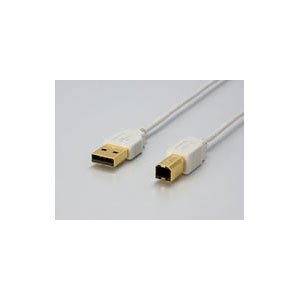
With the NEO by OYAIDE Elec d+ USB class A in use, the sound image becomes slim and sharply defined from bottom to top, the leading edges are clearer, the perceived S/N improves, and the soundstage has a sense of clarity and openness. I had expected that any difference, if there was one, would be rather small — so the direction of the change caught me off guard. It is perhaps surprising coming from an Oyaide cable, but in a good way: the sound has a subtly dark, refined, and cool quality to it. It is neat and precise, and the way the soundstage unfolds is rather contained, like a miniature garden. Rather than a sense of wide expansiveness, it presents everything flatly and neatly arranged within the speaker boundaries — perhaps slightly recessed, but well-ordered in all directions.
With violin, for instance, there is an emphasis on the steel-string quality of the sound — a faint wire-like quality, one might say. Not that there is any sense of distortion; it is more that the sound image is very tightly shaped and lean. Piano comes across as appropriately tight with a hint of resilience, each note clearly articulated. Plucked string instruments such as guitar are generally realistic — the sound is one where subtle pitch nuances are easy to follow. As for the quality and quantity of sonority, it still cannot quite match the rich resonance of a dedicated CD transport, but the approach to sound image rendering and tonal character does take on a certain appeal in the Hi-Fi sense — enough so that with a single USB cable, PC audio can begin to sound genuinely listenable.
Thinking perhaps I was imagining it, I switched back to the iBUFFALO Arvel AUS10WH — and sure enough, the outlines of the sound image became blurred, and the lower frequencies also felt looser and less defined. The left-hand register of the piano in particular felt noticeably unclear, and in terms of bass-note definition and legibility, there was a clear gap compared to the d+ USB class A. A kind of woolly, indistinct quality. I had always thought the AUS10WH was perfectly good up until now, but having heard this, going back is no longer something I can readily do.
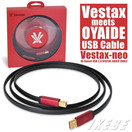
This is sold under the Vestax brand, but I thought the design looked very familiar — and indeed, it appears to be the d+ USB class A in all but name. Just the housing in a different colour — the Char custom model, if you will. Needless to say, the sound quality improves at three times the speed… or perhaps not quite.
What I found interesting about the Oyaide d+ USB class A is this: starting from the premise that PC audio simply cannot yet reproduce the lush resonance of a proper Hi-Fi-grade CD player — if that is the case, then rather than pursuing spacious soundstage reproduction, why not instead steer towards creating a slim, tight sound image with a clean and pleasant tonal quality? There is something admirably clear-headed about that approach. Before trying it, I had honestly thought to myself: surely expensive USB cables are pointless? — but if this is the sound you get at this price, then it is, well, within acceptable bounds. At the very least, I have no desire to go back to the cheap generic USB cable I was using before, and as for the price — given that production runs are extremely small, which drives costs up considerably, this seems like a reasonable enough proposition for music production environments or enthusiast use.
Aren’t expensive USB cables pointless?
On this point — I am someone who genuinely believes that audio cables make a difference to the sound (and actually hears that difference), and who actively uses different cables for different purposes; and as regular readers will know, I am of the occult-friendly, RF-wave-enthusiast persuasion. Even so, with ears like mine, the range of sound quality change achievable with a USB cable still feels, at this point in time, fairly limited. In terms of the magnitude of audible change, analogue cables and speaker cables and mains cables tend to produce quite obvious differences, and even S/PDIF optical digital cables, where the differences are smaller than with analogue, still tend to show more variation than USB cables. With that in mind, using an expensive USB cable (or indeed an HDMI cable) for such a marginal sound quality difference is, at this early stage of development from each manufacturer, not exactly cost-effective — that is also true. (That said, I do think that as development matures, USB cables will eventually appear that offer more clearly audible improvements at a reasonable price.)
 ポチップ
ポチップ
And yet, once you have used something like the Oyaide d+ USB class A, the fact is you cannot go back. In the end, I think the practical path to happiness is to use something decent within whatever budget one can comfortably accept — and with that in mind, taking into account the costs associated with the use of selected components and small-batch production and manufacturing (for both USB cables and HDMI cables), it depends on the specific product, but at a retail price of somewhere in the range of a few thousand yen to ten-odd thousand yen, one might tentatively say it is not exactly extortionate — or something to that effect. Oh, and on a slight tangent: HDMI cables are also interesting in that picture and sound quality (particularly sound quality) can be unstable and variable. With cables going for under 1,000 yen, there are mass-produced items out there that are frankly questionable as to whether they properly meet the HDMI specification — so do be careful. Continued in Does the USB cable change the sound quality of PC audio!? Part 4.
【Audio USB Cable Comparison】
1|2|Oyaide|4|WireWorld Chroma|ELECOM|6 Models|SUPRA


Auto Translated by CS4.6
List of comments (3)
デジタルもノイズの影響によって変化はあるようです
デジタルにもいろんな現象があるようです
http://www.cybernet.co.jp/eda/mailmag/minami_study/16/tech.html
私もオーディオアクセサリーにハマってしまった一人です
ただ、日によって気分だったり天候によっても変わる気がします ので、「違うなー」と思ったらケーブル等を変えてみる
これを繰り返していると「違うなー」と思わない期間が長いアクセサリーが見つかります
それでも敢えて変えてみると結局同じアクセサリーに戻っています
こんな事を数年繰り返しているとケーブル類はすべて単線になっていました
自分はこういう音が好きなんだと実感したところです。
>>ポチさん
コメントありがとうございます。僕も単線好きなのでなのでわかりみが深いです。