【QUAD L-ite2 British Small Speaker Review】
Prologue|Part 1|Part 2|Single-Wire|Bi-Wire|Reservations|Jumpers
I was rather pleased with the sound quality of the tweeter-side single-wiring described previously, and yet I still want to escape the shackles of the supplied jumper plates. So anyway, first things first — in order to properly understand the speaker’s potential, I need to hear what it sounds like with bi-wiring. That said, this is really just a matter of swapping around the cheap offcuts of speaker cable I happen to have on hand and looking for a combination I can be reasonably happy with — nothing more ambitious than that.
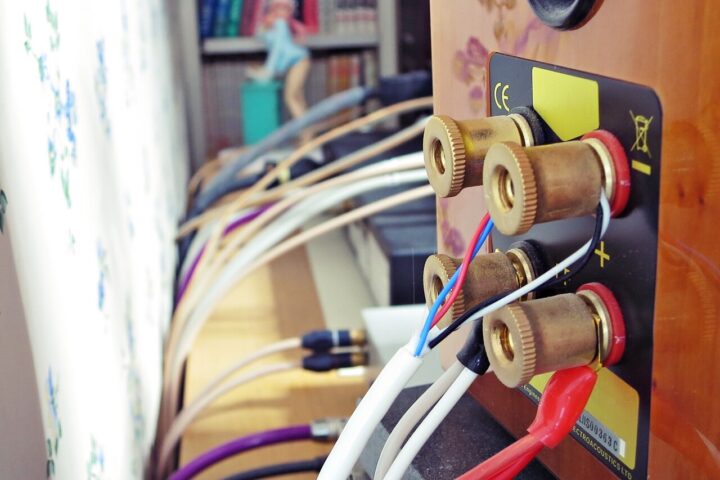
Tweeter: SUPRA CLASSIC 2.5H + Woofer: Tara Labs Omni 8N
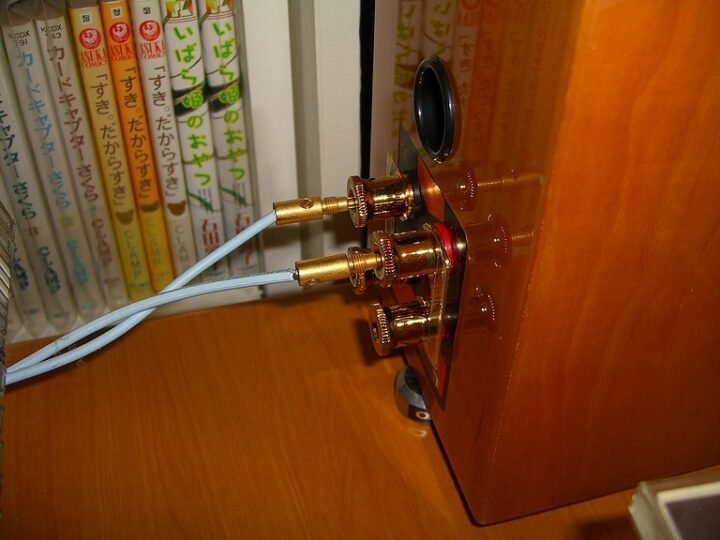
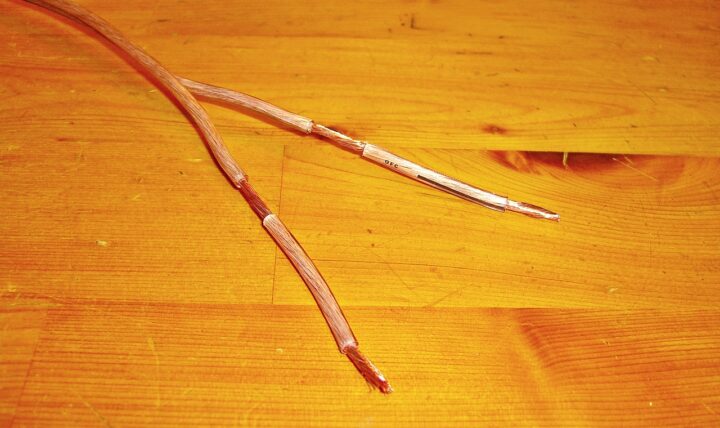
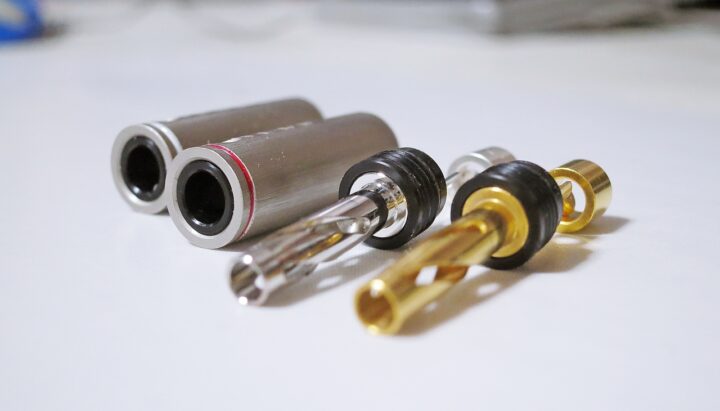
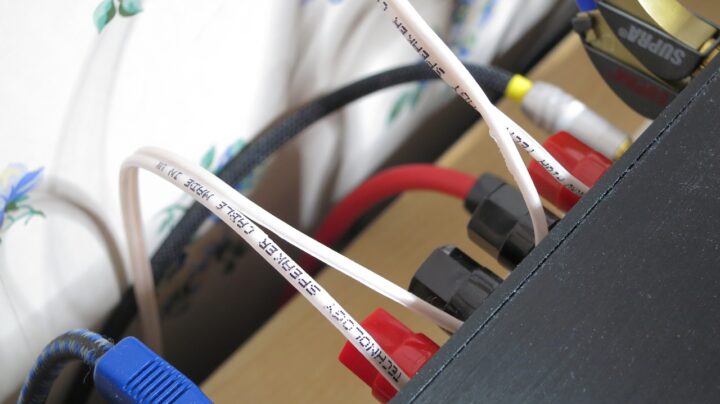
Unfortunately, I don’t currently have two matching pairs of the same speaker cable to hand. So for the high-frequency side I’m carrying over the tin-plated, ultra-fine multi-strand SUPRA CLASSIC 2.5H as before. The short-bar is removed, and for the low-frequency side I connect the Tara Labs Omni 8N. The Tara Labs Omni is a shielded cable comprising seven strands of hard, 8N-purity single-core wire twisted together, and its tonal character is very much that of a single-core cable. There is only one set of speaker terminals on the amplifier side, and physically you cannot insert two cables into a single terminal, so I wired things up like this — running the low-frequency cable (PRISM) in direct contact, and using banana plugs for the high-frequency cable (CLASSIC 2.5H). As a general rule of thumb, it would be better to use banana plugs on the low-frequency side, where any slight degradation in sound quality is less likely to catch the ear — though as this varies by setup, it would need to be verified. But this is just a test, so please bear with me.
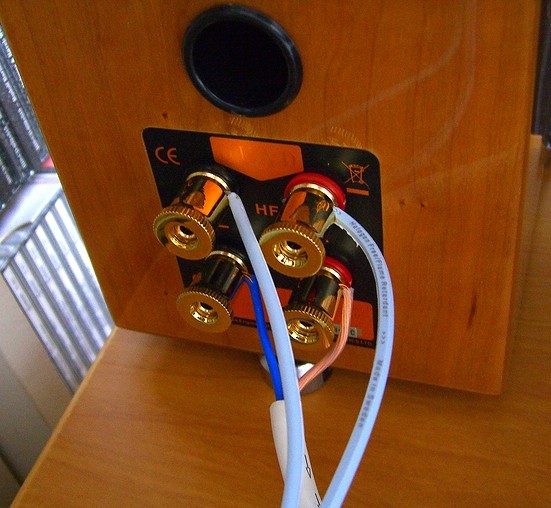
With this combination in bi-wiring, the sound is immediately quieter compared to single-wiring — calm and flat. The range is considerably wider from top to bottom than it was just a moment ago. With single-wiring the frequency response had a narrow, kamaboko-shaped curve, giving the impression of a small speaker straining to squeeze out every last bit it had. With bi-wiring, the range is simply wide and natural. With this, compared even to the larger QUAD 11L2 or 12L2, the soundstage may simply be more compact in scale, but in terms of quality it may well hold its own. It is not perfect yet, but the sense of distortion in the high frequencies that had been bothering me is roughly halved, and the overall presentation becomes far more proper. The amount of reverberation is greatly tidied up and there is a clean, uncluttered impression. In the low frequencies, the character of the Tara Labs Omni 8N brings a warm, monotone quality with well-organised detail.

 ポチップ
ポチップ
Tweeter: QED Silver Anniversary-XT + Woofer: Tara Labs Omni 8N
The combination above was not particularly bad at first, but after leaving it to burn in for a few days, the sound became rather ambiguous. Once it had settled, the sense of freshness that had come from the initial distortion was lost, and the result was an extremely dull tonal character — and on top of that, all that remained in the high frequencies was the characteristic scratchiness and roughness of multi-strand cable. A disappointing outcome.

 ポチップ
ポチップ
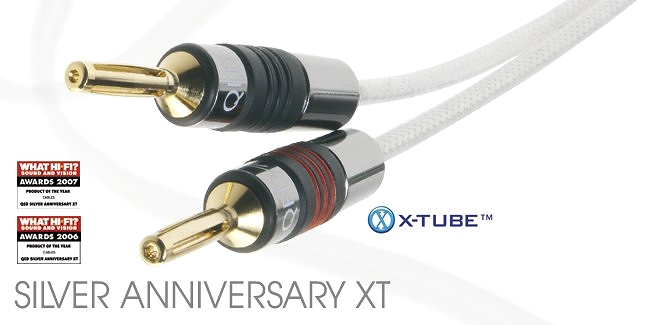
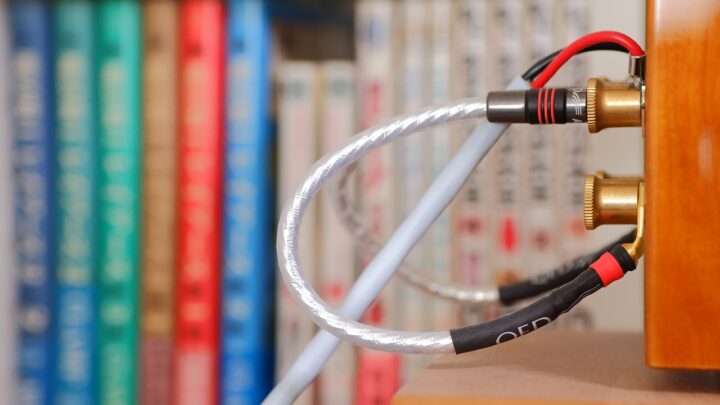
The QED Silver Anniversary-XT, being a silver-coated cable, noticeably reduces the visual sense of colouration in the midrange and above. If the SUPRA gave a brick-red tint, this one turns it to a pale, powdery white. The sense of range is moderate — the image seems to project outward in a kamaboko shape centred on the midrange. The sound image is soft yet has a core to it, with a cheerful, uncomplicated character in its portrayal. The hall-tone in the high frequencies goes completely missing. Rather than Hi-Fi in the strict sense, the overall sonic flavour is that friendly, approachable British speaker sound — for better or worse. The sense of distortion in the high frequencies does clearly diminish. The problem is that the forward, firm midrange projection characteristic of the QUAD L-ite2 and the midrange projection of the Silver Anniversary-XT blend together rather too well, making the midrange even more assertive than before. There may well be someone out there who’d say British rock needs exactly this kind of pushiness — but still… In terms of musicality, it is moderately lively and bright and has its appeal, but using this speaker cable makes the “shadow” side of “light and shadow” disappear entirely. Like someone who’s a perfectly nice person but lacks depth. (Cryptic, I know.)
The Merits and Demerits of Bi-Wiring
Summing up all the swapping around, and setting aside personal preference for tonal character, I feel that in terms of the direction pure Hi-Fi should take, bi-wiring is the correct connection method. It conveys the intrinsic character of the recording and performance most faithfully, without deforming it. Having experienced this difference first-hand, I cannot help but conclude that speakers with bi-wiring capability are unquestionably designed with bi-wired sound as their reference. And it is only when trying bi-wiring that you can really tell you have a CREEK system upstream. The detail of the connected equipment and source is no longer masked by the character of the speaker and jumper plates as it is with single-wiring.
However, even correct bi-wiring may not be all benefits and no drawbacks. If I were to dare to point out a downside of bi-wiring, it would be that the overall sonic tendency can become too neat and tidy — too uninteresting. There is a sense that passion, or energy, is somehow being shaved away; the sound is too composed, too objective, too cool. It is as though the amplifier’s driving power has become ever so slightly insufficient — though separating the woofer and tweeter electrically and connecting them in parallel should only have a minor effect on impedance, yet perceptually there is this strange tendency towards under-powering. Conversely, unlike the EMF Sequel2 used here, a more powerful amplifier that tends to overdrive the speaker and produce a cramped, over-driven sound might actually find its driving balance corrected through bi-wiring, resulting in a good, open soundstage.
 Category: Integrated AmplifiersCategory: Speaker Cables
There is also the matter of using different brands of speaker cable for the upper and lower runs in a bi-wiring setup — frankly speaking, this too seems rather problematic. When using two cables with entirely different sonic characters, as in this case, with something like piano the tonal colour between the right-hand register and the left-hand register is noticeably different in a way that is hard to ignore. The left-hand bass and middle registers have the warm, rounded-attack character of Tara Labs, while right-hand passages carry the richly reverberant, delicate, and detailed character of SUPRA. That said, between the two, the character of the high-frequency cable does seem to overlap more strongly and leave the stronger impression on the ear. If you keep listening for a while you do end up getting used to it and thinking “well, I suppose this is how it is” — but in any genuine pursuit of pure Hi-Fi, this may not be the most advisable way to go about things.
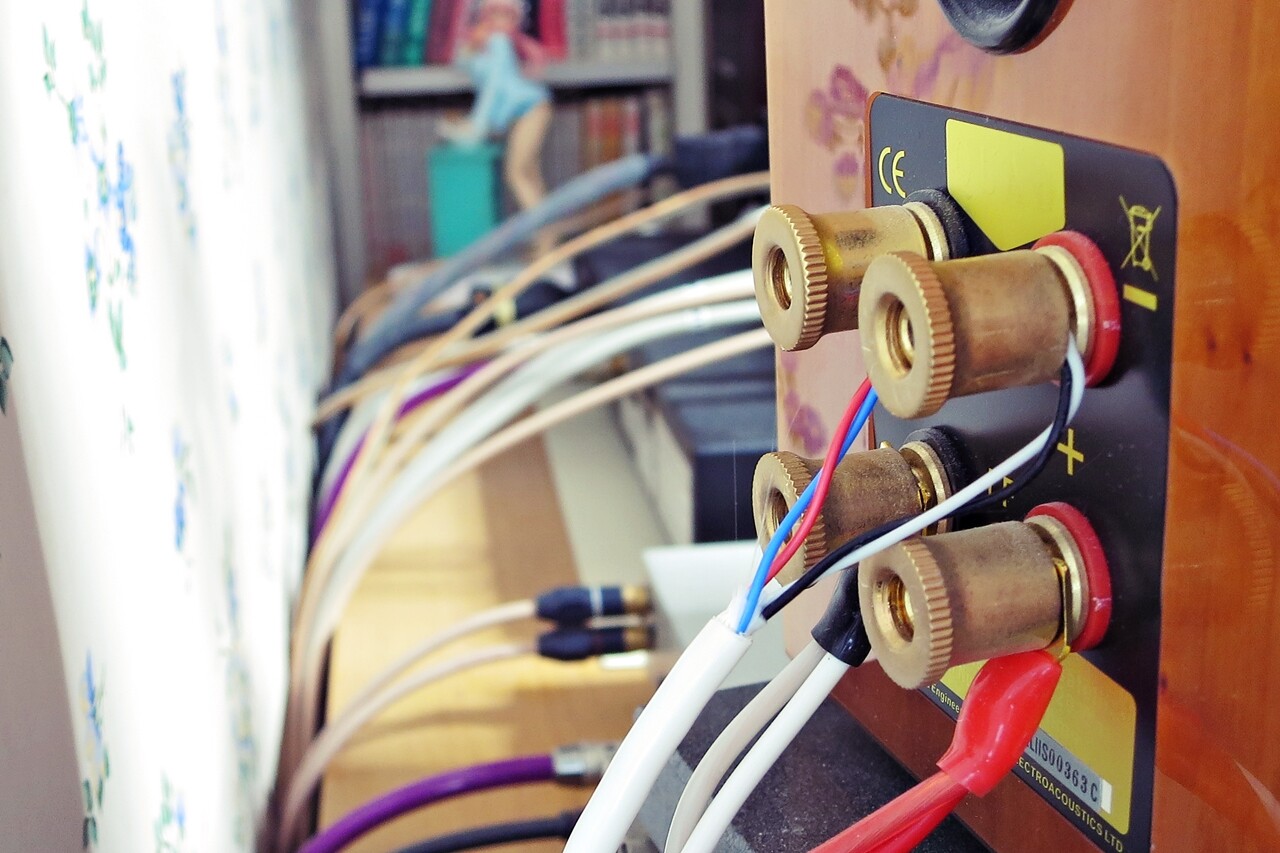
When trying bi-wiring, the ideal approach is to use a four-conductor bi-wire speaker cable, or two runs of the same cable. Next best would be two cables of the same design but different gauges — thinner for the tweeter side, thicker for the bass side. Last resort would be trial and error with different cable types, keeping within a range where tonal character and soundstage phase feel acceptably coherent. That seems to be the textbook approach, more or less. Finding a combination of different-brand cables where the phase relationship is genuinely correct, beyond mere personal satisfaction, seems like it would be extraordinarily difficult. Even with mixed cables, limiting yourself to cables from the same manufacturer with similar tonal characteristics would probably give you a better chance of success.
 ポチップ
ポチップ
Also, something that has long been discussed in pure Hi-Fi circles: in terms of time alignment within the bi-wiring setup, it is important to keep the lengths of all eight cable runs — upper and lower, left and right — equal. A moderate difference in length is unlikely to cause the sound to shift in any obvious way, but if the mass differs between upper and lower or left and right, the resonant points of each will differ, and together with the differences in resistance, back-EMF timing, noise shielding, and all manner of other miscellaneous influences, this can become the source of slight tonal deviations between upper/lower and L/R — leading to muddiness in one channel or a sense of wrongness in the soundstage. (If such things made no difference, there would be no need to go to the trouble of carefully matching left/right component tolerances in audio equipment, or of designing internal wiring and circuitry in as symmetrical a layout as possible.)

~ Summary ~
And here is the dilemma. As an objective assessment, bi-wiring is clearly the correct approach for getting the best from the QUAD L-ite2 — that is what the evidence points to. But then, as always, when personal preference enters the picture, the tweeter-side single-wiring actually has a certain appeal that is hard to give up. In particular, the high-frequency reverberation — incidental colouration and all — had a richer sense of soundstage with “tweeter-side single-wiring”. That said, if one were to deliberately go with single-wiring, the supplied jumper plates become a considerable sonic bottleneck in various ways, which is not ideal. So one would need either to strip the speaker cable insulation back a long way and thread the bare conductor through both terminals, upper and lower, or to obtain some form of “※ sonically superior” jumper cable. ※ Continues in: A few question marks about commercially available jumper cables?
 ポチップ
ポチップ
【QUAD L-ite2 British Small Speaker Review】
Prologue|Part 1|Part 2|Single-Wire|Bi-Wire|Reservations|Jumpers

Auto Translated by CS4.6