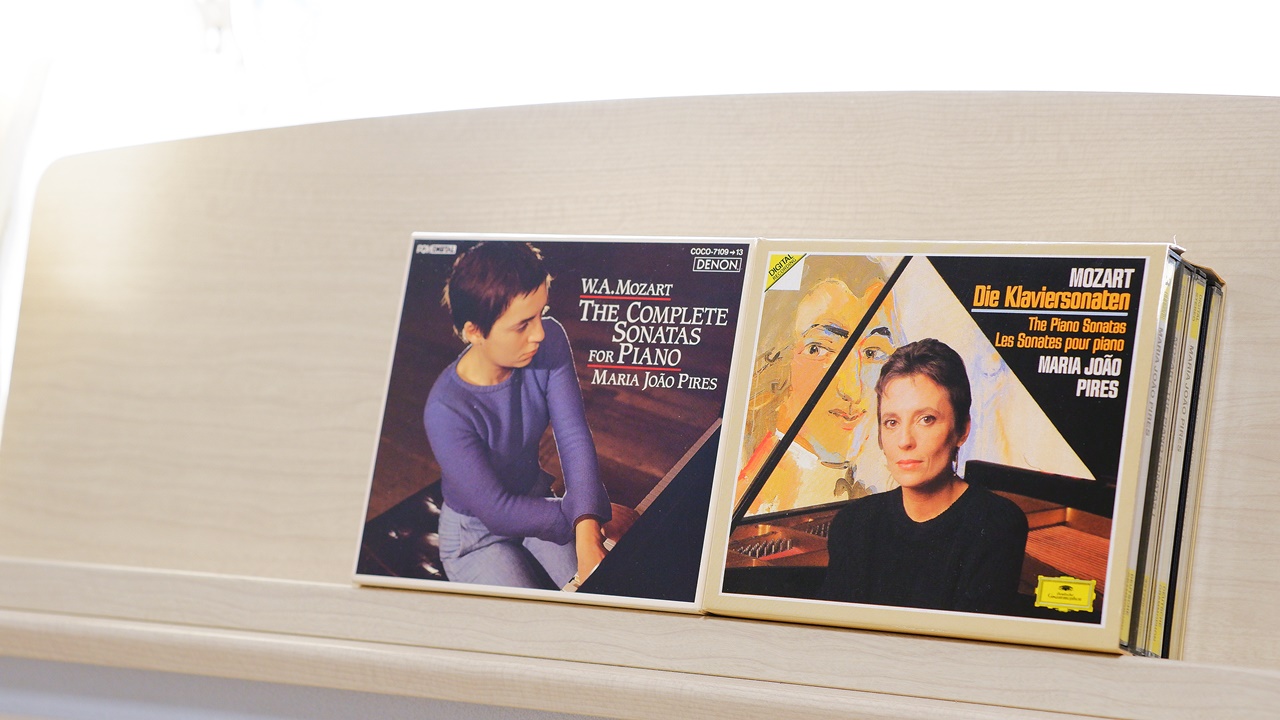
This is the first complete recording of the Mozart Piano Sonatas by Maria João Pires (often referred to as Maria João Pires), the Portuguese pianist who is already stepping into the realm of the great masters. It was reissued as part of DENON’s 250th anniversary Mozart edition, which is what prompted me to write about it here. The disc won both the ADF Grand Prix and the Edison Award. Recorded when Pires was thirty years old, it was captured — remarkably — at Iino Hall in Tokyo in 1974 as a digital recording. It is quite possibly one of the earliest PCM digital recordings ever made for commercial release.


 ポチップ
ポチップ
Pires now plays the Yamaha CFIIIS at recitals and in the recording studio, but according to the liner notes the piano used at the time of this recording was a Steinway. The recording itself is a rather experimental affair — digital technology being what it was back then — and I should say upfront that this is not a disc where one can meaningfully discuss audio quality in the usual sense, or speak of the tonal character of  Yamaha or Steinway.
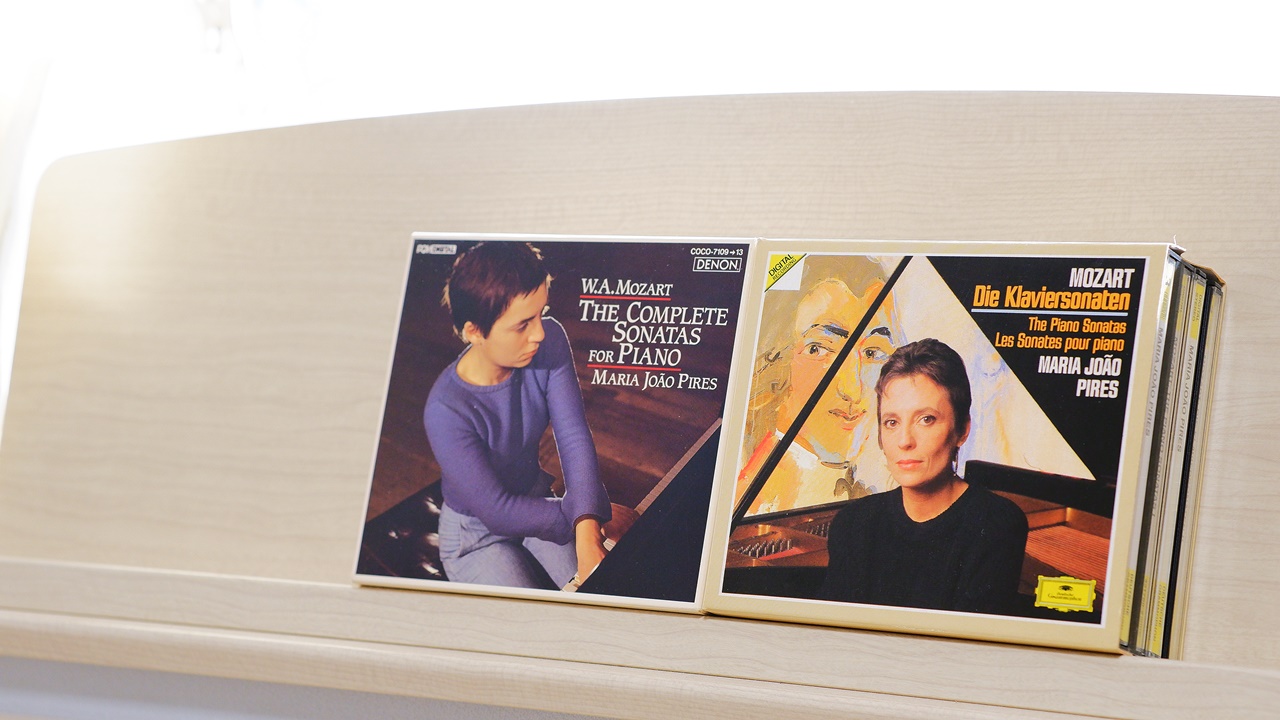
In my case, this Pires recording was the very first complete set of Mozart’s piano sonatas I ever encountered as a child. Let me just say it was a most unfortunate introduction. I love Mozart dearly now, but I do think it is hardly surprising if a student handed a record like this for study purposes ends up taking a dislike to playing the music altogether. There is something about listening to it that builds into a tremendous sense of frustration. The dry, shrill sound quality was unpleasant enough, but beyond that, each touch seemed to carry a kind of uniformly pain-laden tone — sunk in a weariness that could only be read as extreme inward world-weariness — with a suffocating quality, as though one were being made to listen to a Bach Passion, as though the inner suffering of Christ bearing the cross were being gouged out from within. This is nothing like Mozart at all, I felt at the time. And yet when I looked through the reviews, I was astonished to find the disc held in extraordinarily high regard. Even so, quite apart from what the wider world made of it, when I listened as a child with whatever purity of instinct I still had, it struck me as an interpretation of Mozart that I simply could not accept on any visceral level.
Now, having reached the same age she was when this recording was made, I have pulled the disc off the shelf and listened again, and things do indeed sound different from those days when nothing but a wholly negative impression remained. I still sense something in the deeper layers — a latent suffering, a kind of frustration — but it is not nearly as intense as it felt in childhood (which no doubt says something about the dulling of my own sensibilities), and rather, it now comes across almost as a powerful personal voice, a distinctive quality that belongs to her as a performer. The extraordinarily delicate and nuanced playing, and the richly detailed interpretation in the pianissimo passages — creating what feels like a vacuum wall between the music and the listener — speak to something quite exceptional in Pires as a pianist. The expressive quality in the inflection and articulation of her emotional world, that interplay between outward technique and inner spirit — it is expressiveness at the visible surface level, one might say, rather than at the deeper layers — and that is what now catches hold of me. Yet that is still a matter of emotional expression alone, and when one digs deeper into what one might call the spiritual dimension, that which seeps out from one’s very humanity… something catches, somewhere, at that level.
 ポチップ
ポチップ
 ポチップ
ポチップ
As it happens, Pires fell ill some years after this recording and withdrew from performing for a time. This Mozart Piano Sonatas set is a valuable document as a recording from before that withdrawal, but compared with her work today alongside Augustin Dumay on Deutsche Grammophon, she sounds in spirit like an entirely different person. Even in the performances she gave after returning to the stage, there are moments that carry a kind of exhausted, laboured quality, but nothing with quite the same strangely inward, isolated feel as this recording. And when she is at her best, there is a simplicity of touch — like freshly washed white sheets drying in the sun — full of confidence and warmth. One genuinely wonders how it is possible for someone so slight to produce an expression so dynamic; it is astonishing, really.
In particular, at that deeper level beyond technique and emotion — at the spiritual level — I am strongly struck by the sense that something has changed profoundly within her between then and now. It is as though her feeling towards the people who listen to her, and towards herself as a human being, has shifted: from something in which one glimpses an aversion to worldly noise and bustle, towards a love that seeks to share life on equal terms. There is, underlying all of this, her religious sense — she is Portuguese, so presumably Catholic — some orientation towards the divine, and if I may put it this way, it seems as though what was once a solitary purity confined within the framework of religious stricture has moved towards an approach to truth that now carries a greater generosity, one that embraces all living things. Perhaps that is overstating it. But at the very least, as some inner vector within her shifted in that direction, I find myself thinking — as I listen back through the old and new Mozart sonata recordings one by one — that it is from that shift that the empathy and the uniquely poetic, deeply personal touch of today’s Pires have emerged, that quality of imprinting each individual note deep into the listener’s heart.
 ポチップ
ポチップ
This is the new recording from 1990. A wonderful performance that never grows stale no matter how many times one returns to it. The recording quality is admirably clear and beautiful — Deutsche Grammophon at its very finest. This is a disc well worth keeping to hand as a reference for the modern interpretation of Mozart’s piano sonatas.
The box set containing all 20 of Pires’s Deutsche Grammophon solo recordings is here
 ポチップ
ポチップ

Auto Translated by CS4.6


List of comments (12)
初めまして。こんにちは。
よく交響曲とか協奏曲とか音楽でありますけど、どうゆうことなのですか???
教えて下さ~い。
若い頃のピレシュのモーツァルト、懐かしいですね。孤高のピュアリティ:当時の彼女は確かにその様な感じの張りつめた演奏で、レコ芸などで評価が高かったのですが、私もなかなかついて行くのが辛く感じたのを覚えています。少し世代が異なりますが、エッシェンバッハの若い頃の演奏も聴いていて辛くなる種類のものだったと思います。二人とも、近代的なピアノ奏法をベースに、タッチや響きなど純粋にピアノの「音」そのものを追い求めた、感覚的な演奏では無かったでしょうか?
復帰後のピレシュは音楽に対するあり方が変化して、音楽の中で人との繋がりを求める様な部分を感じます。デュメイと組んだのもそう言った変化の反映かも?と思っています。デュメイとの競演では、デュメイ色が強く出ているのかも知れませんが、かつてほど音楽の掘り下げが無くなっている様にも感じます。デュメイ/ピレシュは1995年のフランクのVnソナタがありますが、例えば1997年の五島みどり/R.マクドナルドの演奏と比較すると、最終楽章の緊張感と集中力にかなり差があります。
その五島みどりさんも最近は演奏が随分変化して、かつての集中力一本の凄い演奏から、オーケストラとのハーモニーを重視する様なスタンスになっていると思います。ブログのトップに庄司さやかさんを取り上げられていますが、むしろ今では集中力や緊張感では庄司さんの方が充実しているかも知れません。この辺は年齢的/世代的なものでしょうか? 庄司さんは年末のNHKで放送されたブラームスの協奏曲をエアチェック(死語?)しましたが、堂々とした演奏だと思いました。メンデルスゾーンはまだ未聴ですが、どんな演奏になっているのでしょうか?
昨日は「デュメイ/ピレシュと五島みどり/R.マクドナルドの演奏では最終楽章の緊張感と集中力に差がある」と書いたのですが、今日改めて別の再生装置(SONY ZS-M5)で聴き直してみましたら、大分印象が違います(汗)。前者の方がしなやかで表現力の巾が広いのに対し、後者はコンクールから出て来たかの様な緊張感を感じさせます。特にピアノの表現力の差は格段でした(当たり前?)。技巧派のデュメイを取るか、作品に真っ向から勝負のみどりさんを取るか、辺りが好みの分かれるところでしょうか?
こんにちは。
私はやっぱりモーツアルトのソナタはEMIのリリー・クラウスのが好きですね。。これがあれば他はいいという感じです。別路線ではグールドも好きです。
レス下さった皆様お久しぶりです~。読むの遅くなりすみません(汗) GW休暇してました~。
>ラララさん
はじめまして。改めて訊かれると難しいかも。 ものすごーく大雑把に分けると、交響曲(シンフォニー)はオーケストラのための曲で、協奏曲(コンチェルト)はピアノやバイオリン等のソロ楽器+管弦楽の編成で書かれた曲です。
>ufugi0331さん
サイト放置してGW休暇してました。ぼちぼち何かブログの記事を書かないと…(滝汗) えっと、エッシェンバッハについてですが、ツェルニーの練習曲集のCDしか持っていなかったりします。これは今聴くとかなりの速さでテクニカルに弾いているように聞こえますが、メトロノームに合わせて弾くのが当たり前的な、杓子定規で音楽的感性に乏しい当時の日本に於けるピアノ学習では、これでもかなり崩した解釈という認識だったと思います。ペダル入りで模倣して披露したら先生にボロクソ言われた気が…。
庄司紗矢香さんのメンデルスゾーンは実は未だ未聴ですm(__)m新譜で高いんだもん…。デビューアルバムとかは持ってますが、確かに女性には珍しく堂々として意志の強い弾き方ですね。かなりこう、ピアノと喧嘩しているみたいな気の強さ。
デュメイ/ピレシュのデュオについてですが、これは3年前にベートーベンのソナタ演奏で来日した際にも生で聴きましたが、私はこの2人を技巧派だとは思っていません。ていうか私は音楽的表現力を二の次にしたような技巧派の演奏家が基本的に嫌いです。勿論2人とも一流のテクニックを持ってはいますが、そのテクニックを全面に押し出した機械的な演奏とは対極にある、楽器を使いこなした上で極端なまでに音楽的に歌い上げる情感溢れる演奏に感じました。ご指摘のように大変にしなやかで表現力の幅が広いです。デュメイのヴァイオリンは音符が羽のように舞い、まるでハーメルンの笛吹のように、こちらの意識が抗せずぐるぐる振り回されるようなものすごい求心力があり、「春」など座席でじっとしているのが辛かったくらいです♪で、帰ってきてから同じ曲を自宅のオーディオシステムで再生したら…特にバイオリンのあまりの違いに少々悲しくなりました_| ̄|○
>byd designさん
Lili Kraus盤、そんなに良いですか~♪棚を探してみたのですがシューベルトしか見つかりませんでした。機会があれば全集手に入れたいと思います。ソニー盤の全集は何処にでもあるみいですけど、EMIのはなかなか見つかりません~。一応、HMVに廉価国内盤(抜粋)のサンプルがありました。
http://www.hmv.co.jp/product/detail.asp?sku=1778220
グールド盤は持ってます。SBMでマスタリングがおかしくなる前のCD初期盤です。これは、凄いですね♪ はっきりいってピレシュなんて目じゃないというか、音楽的完成度の次元が違います。DGに於けるピレシュ二度目の演奏も録音が非常に素晴らしく、表現力豊かで捨てがたいのですが、ある意味良識的な解釈の範疇で音楽的な抑揚と間とニュアンスを徹底して掘り下げたノーマルな印象。今風に高等な上手さとでも云えましょうか。グールドのはもうカッ飛んでいて、音楽そのものがよりモーツァルト本人に近い。当時のモーツァルト本人の演奏よりは大分早回しではあるのでしょうが、もうこれは凡人が何と言おうと本質的且つきち○い的にモーツァルトに近いです。但しあまりの凄さにこれを聴くと耳が感化されて暫く上手くピアノが弾けなくなっちゃうんですよね。ギクシャクおかしくなります。という事でピアノ学習者には禁忌の逸品でしょう…。
kanさんはじめまして。スレ違いですので申し訳ありませんがこちらに移動しますね♪
「音楽情報サービス」のkanです。こちらへ来てみたらリンクを張って頂いていました。有り難うございました。私の方からもリンクはらせて頂きました。
デザイン良いですね。落ち着いた色遣い、雰囲気の素晴らしいサイトですね。これからもよろしくお願い致します。
レス、ありがとうございました。デュメイ/ピレシュのデュオは改めて聴き直してみたいと思います。自分のオーディオが生演奏と同じ音で鳴っているかは難しい問題ですよね。自分の場合、FMの生放送では比較的生演奏に近い感じがしていると思いますが、CDは正直言って余り自信が持てません。CDとオーディオ装置の相性みたいなものがあるのでしょうか? スレ違いになってしまいますが、お勧め版に挙げられている五嶋龍君の演奏について、ブログで取り上げて頂けませんでしょうか? 来月から日本ツアー始まりますし、、、
こんにちは。最近更新ないですね、楽しみにまってますよ。クラウスのモーツアルト、M黒区の図書館にありました、なんと5枚組。