SD Card Comparison |SSD Comparison|USB Drive Comparison
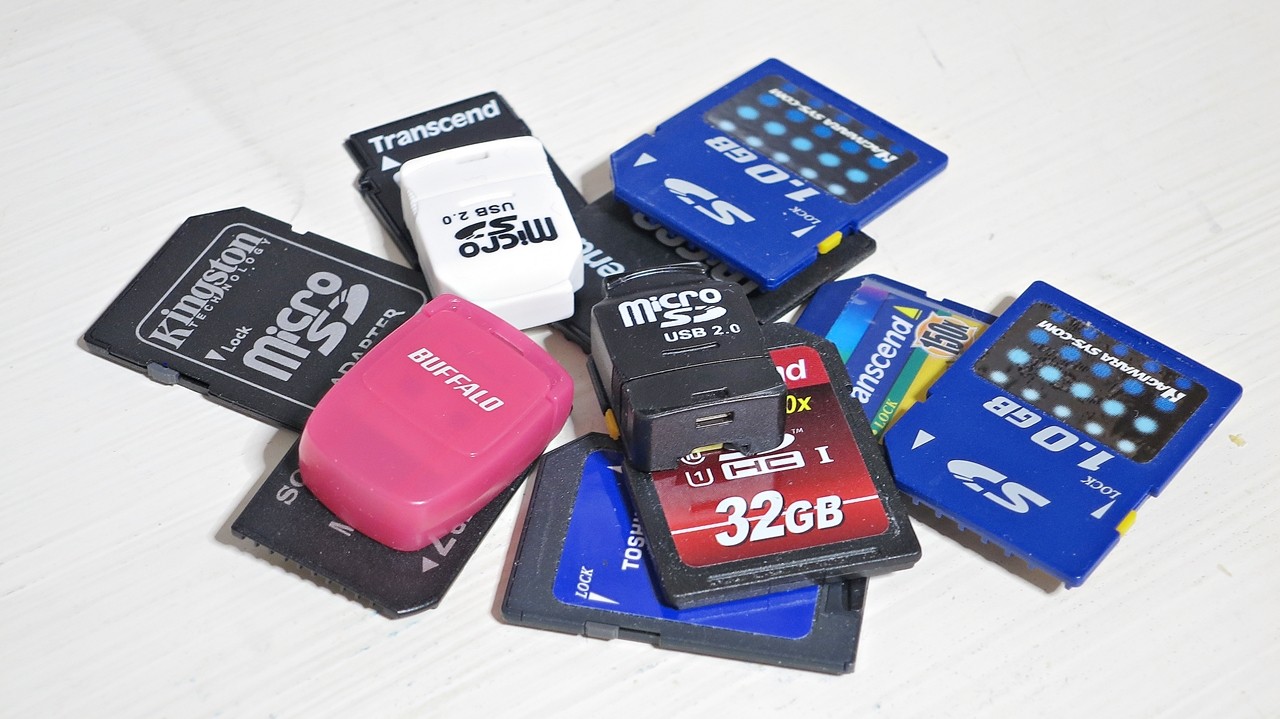
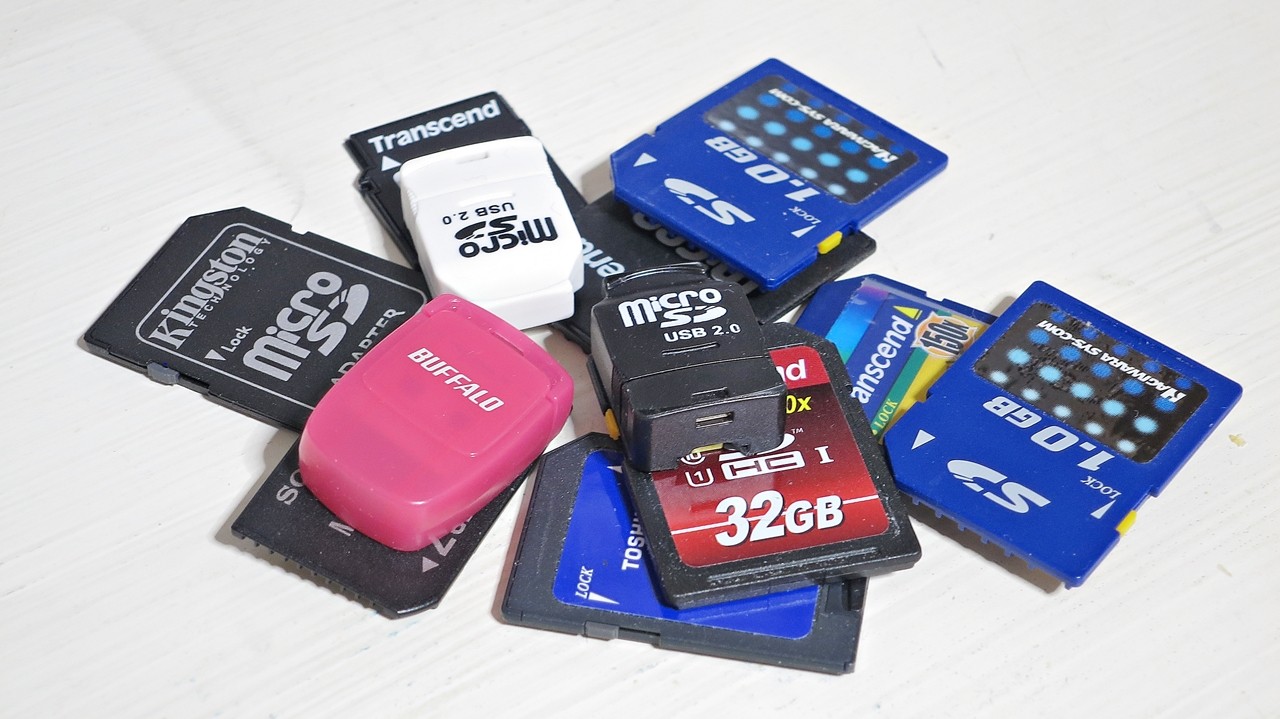
SD cards whose read and write speeds creep steadily upward with each new purchase. On this page I publish my benchmark results for the SD, SDHC, and SDXC cards in my collection, as a personal reference. ※ In 2023, after updating my PC I was finally able to obtain speeds close to the theoretical maximum, so I have re-tested everything from scratch.

Test Environment
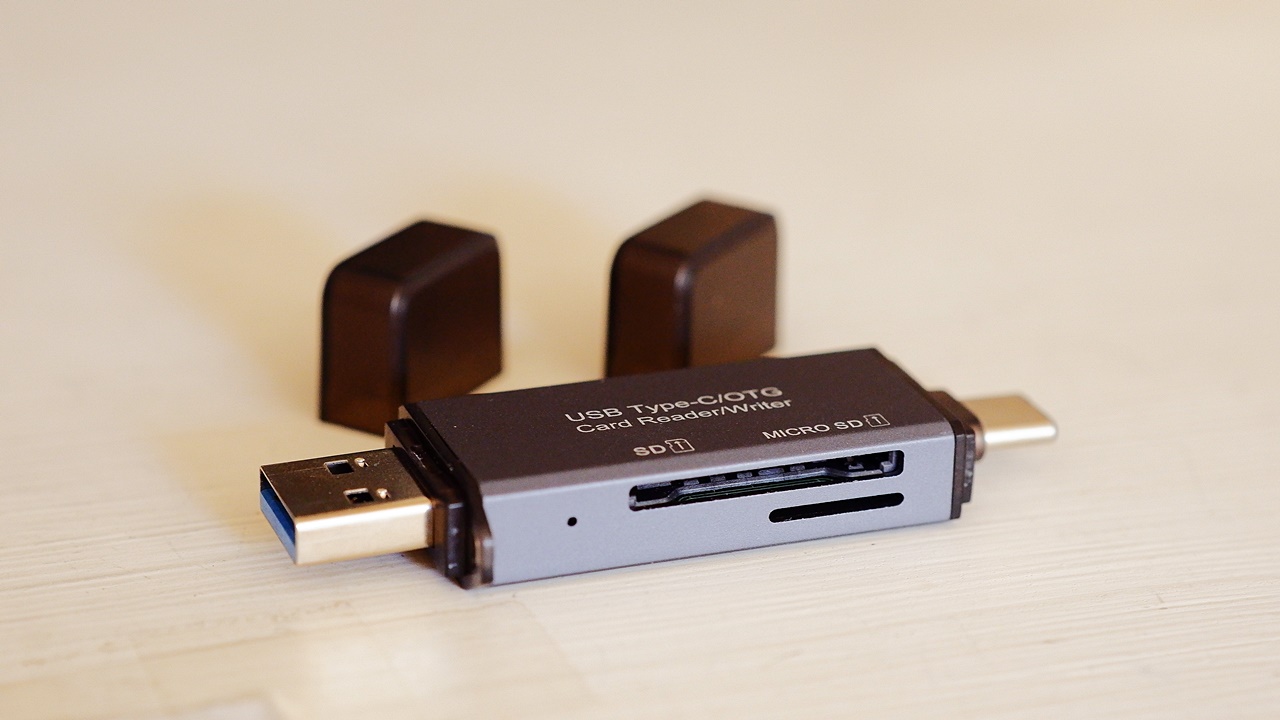
・Lenovo ThinkCentre M75q Tiny Gen2 USB Type-C / LUONOCAN UHS-I Multi Card Reader
・HP d325 AMD Athron XP2400+ USB 2.0 port / SD card reader ※ Pre-2009
・MicroSD card reader BUFFALO BSCRMSDC ※ Pre-2009
* Benchmarking software: CrystalDiskMark.
* These measurements were taken in my normal desktop environment, where the other USB ports are occupied by various connected devices such as a portable SSD and a display adapter, so the test conditions are not ideal. More accurate speeds would be obtained by disconnecting all peripherals and testing in isolation, so please treat these figures as a rough relative comparison only.


 ポチップ
ポチップ
SanDisk High Endurance microSDXC SDSQQNR-128G-GN6IA (2023)
 ポチップ
ポチップ
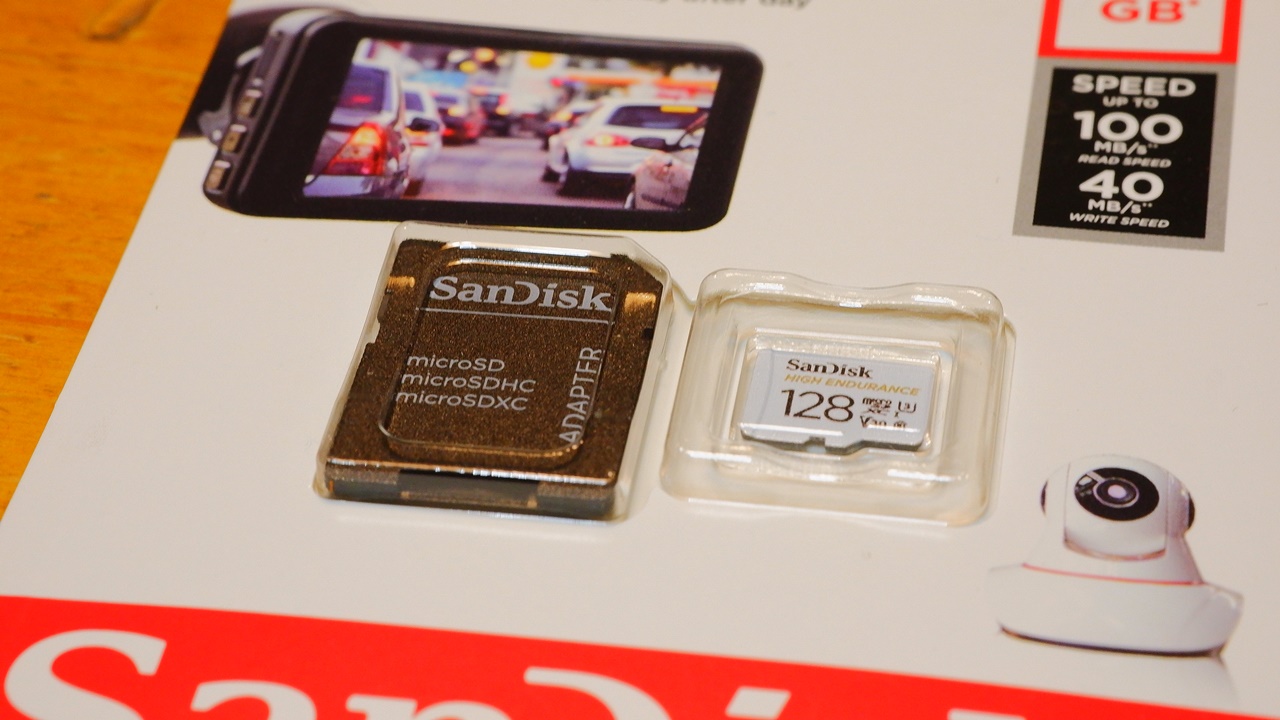
Made by SanDisk (Western Digital), USA. Model SDSQQNR-128G-GN6IA. Purchased in January 2023 as a parallel import in overseas packaging. The manufacturer’s datasheet is here. The distributor warranty is 1 year, though the original manufacturer warranty is 2 years. Rated specs: Read 100 MB/s, Write 40 MB/s. Speed Class: Class 10 UHS-I U3. Video Speed Class: V30. I had been using an ordinary microSD card in my dashcam and was looking for a more reassuring high-endurance model — but despite the existence of the higher-spec MAX Endurance SDSQQVR, I somehow went and bought this High Endurance instead by mistake…
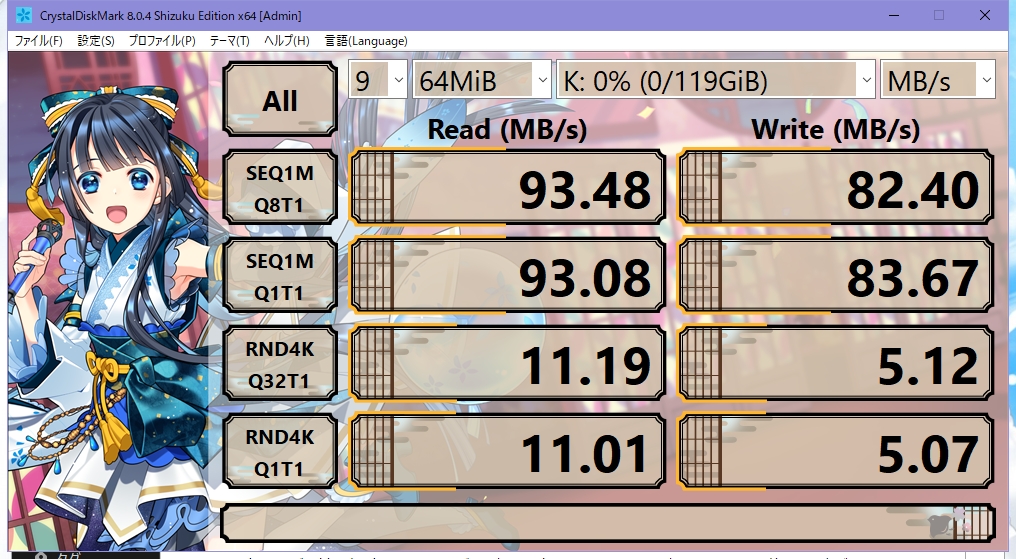
| Read (MB/s) | Write (MB/s) | |
| Sequential 1MiB Q8T1 | 93.48 | 82.40 |
| Sequential 1MiB Q1T1 | 93.08 | 83.67 |
| Random 4KiB Q32T1 | 11.34 | 5.12 |
| Random 4KiB Q1T1 | 11.15 | 5.07 |
This is a model that prioritises endurance over speed, so it does not reach the speeds of the fast types whose rated sequential read exceeds 100 MB/s. That said, the sequential write comes in at over 80 MB/s — more than double the rated 40 MB/s — which is rather impressive. It is designed for video recording and dashcam use, with a Video Speed Class rating of V30. Come to think of it, sequential write speeds have been steadily improving with each new SDXC card I add to the collection. This one now surpasses the 2018 SAMSUNG model across every single metric. Unlike USB memory sticks, SD cards have long had a tendency in my experience to fall short of the rated speeds on the packaging — though I wonder if that’s down to my test setup. On the other hand, random write performance does tend to be better than USB memory sticks.
I really wanted the MAX Endurance, with its even greater durability than the High Endurance…
 ポチップ
ポチップ
SanDisk Ultra microSD SDSQUA4-128G-EPK 128GB (2020)
 ポチップ
ポチップ
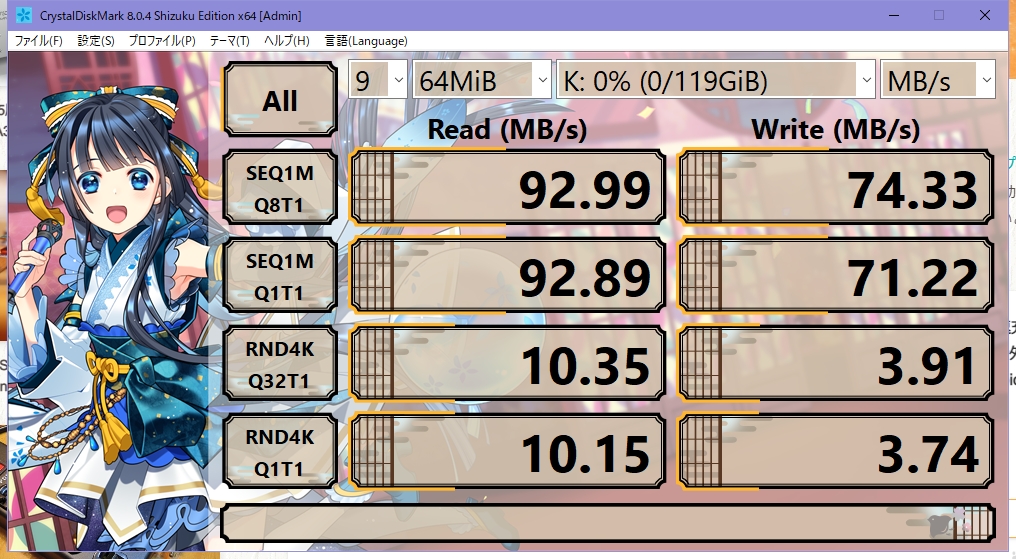
| Read (MB/s) | Write (MB/s) | |
| Sequential 1MiB Q8T1 | 93.31 | 74.33 |
| Sequential 1MiB Q1T1 | 92.89 | 71.22 |
| Random 4KiB Q32T1 | 10.57 | 3.93 |
| Random 4KiB Q1T1 | 10.15 | 3.89 |
SanDisk (Western Digital), USA. Ultra microSD SDSQUA4. 128GB UHS-I Class 10, maximum read speed 100 MB/s. [Nintendo Switch manufacturer-verified compatibility] Eco packaging. Product warranty: 30-day initial defect return only from Amazon purchase date. This was purchased for the mirrorless camera FUJIFILM X-A5, which I bought to take photos for the blog. The microSD adapter used during testing was the SanDisk-supplied one. Compared to the Samsung EVO Plus 64GB purchased in 2018, the sequential write is faster, but it falls behind on random write and random read. ※ At a later date, this SanDisk SDSQUA4-128G-EPK 128GB was moved to dashcam duty, and the SAMSUNG 64GB that had been in the dashcam was repurposed for the digital camera.
Samsung microSD EVO Plus MB-MC64GA/ECO 64GB (2018)
 ポチップ
ポチップ
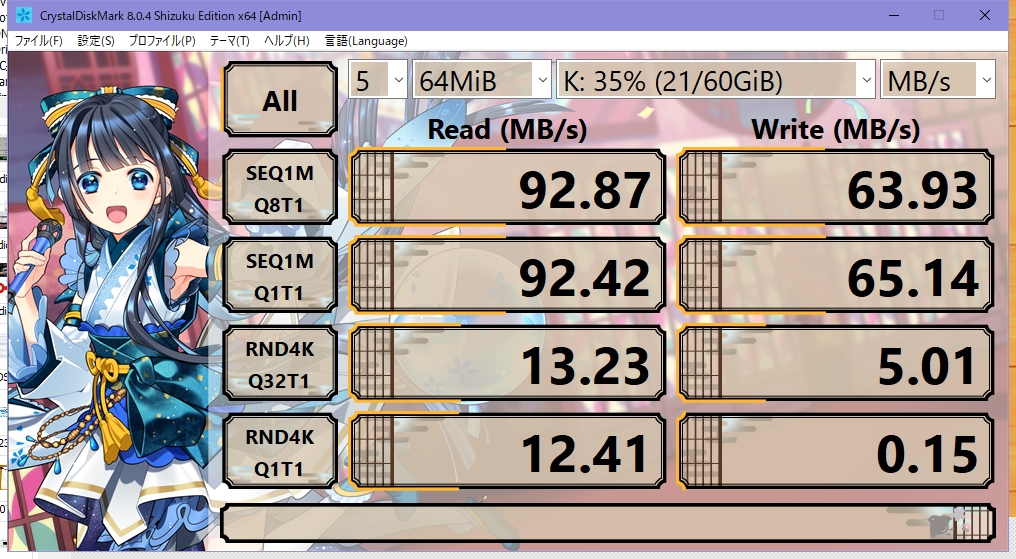
SAMSUNG EVO Plus 64GB MicroSDXC. UHS-I U3, Read: 100 MB/s, Write: 60 MB/s. Full HD & 4K UHD. Nintendo Switch compatibility verified. And remarkably, a 10-year warranty. There was a screenshot showing even faster results, but I accidentally stopped the test partway through RND4KQ1T1, so I’m posting the next-best result instead. Being the newest card, it is the fastest in my collection, though it makes no claim of high endurance, which does leave me a little anxious about using it in the dashcam. I really ought to set it aside for the study and buy a proper high-endurance model for the dashcam. The trouble is, high-endurance SDXC cards with MLC flash suited to dashcam use cost about twice as much as ordinary models.
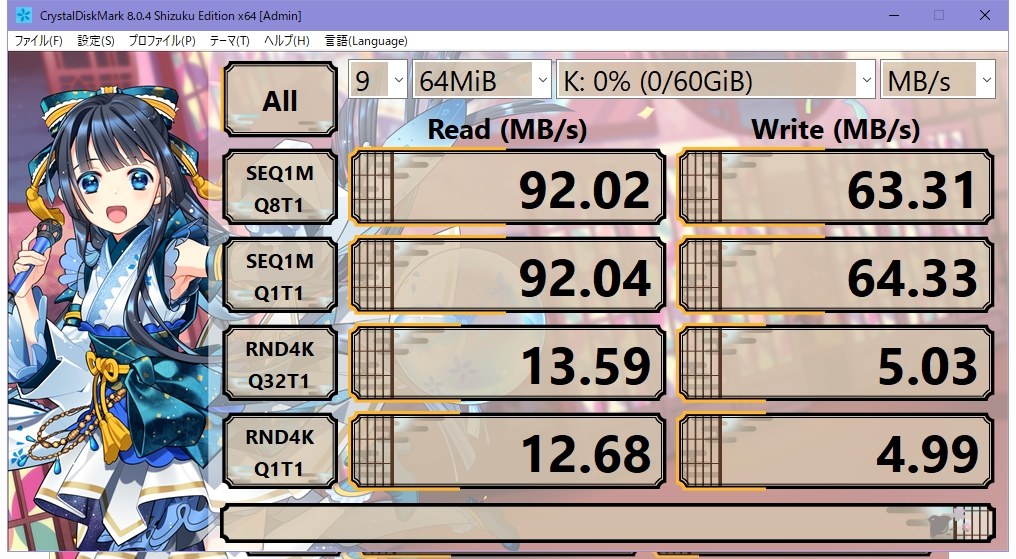
| Read (MB/s) | Write (MB/s) | |
| Sequential 1MiB Q8T1 | 92.87 | 63.93 |
| Sequential 1MiB Q1T1 | 92.43 | 65.14 |
| Random 4KiB Q32T1 | 13.59 | 5.03 |
| Random 4KiB Q1T1 | 12.68 | 4.99 |
 ポチップ
ポチップ
After purchasing the SanDisk microSD, this one was switched to digital camera use. With the card being inserted and removed so frequently after that, the SD conversion adapter apparently wore out, and the camera started failing to recognise it. The microSD card itself is fine — no errors with the SanDisk adapter. I’m rather fond of the SAMSUNG SD adapter with its white finish, but it seems that even a plain SD conversion adapter — not the memory itself — can simply give up the ghost…
Transcend SDHC TS32GSDHC10U1 32GB (2018)
 ポチップ
ポチップ
Class 10 UHS-I (maximum transfer speed 90 MB/s). An SDHC card purchased from Sanwa Direct for use with a PC and digital camera. Sequential read performance matches the rated spec and comes close to the SAMSUNG EVO Plus. However, write speed falls significantly short of the Samsung. On my previous PC, the ASUS VivoMini VC65, the gap was not nearly this pronounced, but re-testing on the newer Lenovo ThinkCentre M75q Tiny Gen2 revealed a much more substantial difference.
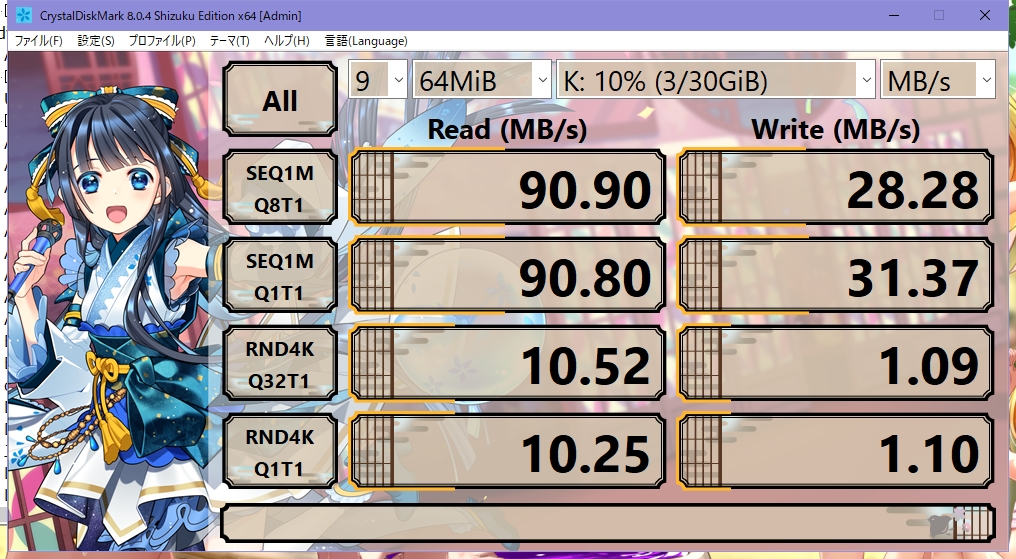
| Read (MB/s) | Write (MB/s) | |
| Sequential 1MiB Q8T1 | 90.90 | 31.41 |
| Sequential 1MiB Q1T1 | 90.80 | 34.53 |
| Random 4KiB Q32T1 | 10.52 | 1.09 |
| Random 4KiB Q1T1 | 10.85 | 1.10 |
Transcend SDHC TS16GSDHC10 16GB (2012)
 ポチップ
ポチップ
Purchased for use with a digital camera, advertised as high-speed Class 10. Lifetime warranty. At the time, 200x and 400x speed ratings had not yet appeared, and performance was about half that of current models — not particularly impressive. The same model number is still on sale today as a long-running product, though the internals have naturally been updated to keep up with the times. (Note: this was my impression at the time of purchase in 2012.)
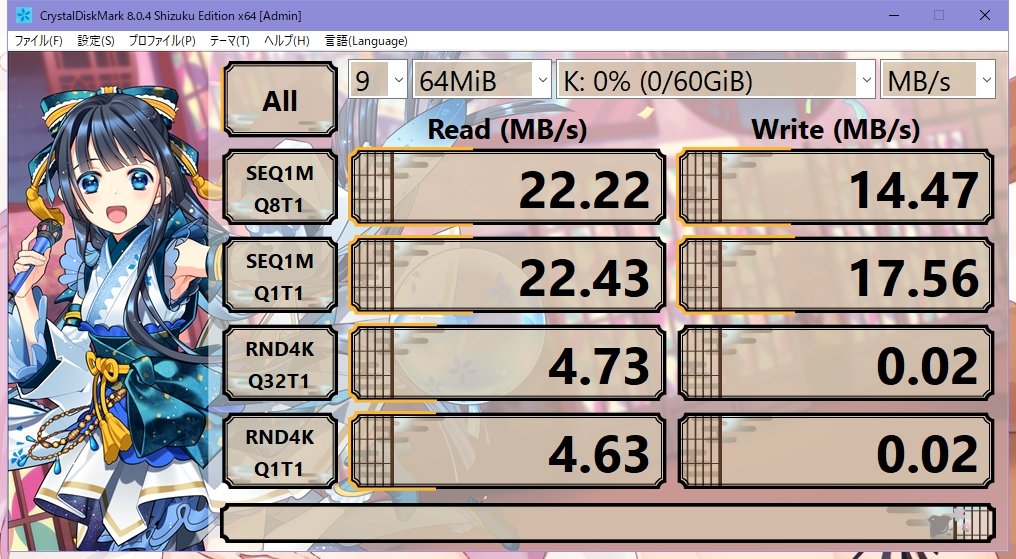
| Read (MB/s) | Write (MB/s) | |
| Sequential 1MiB Q8T1 | 22.22 | 14.47 |
| Sequential 1MiB Q1T1 | 22.43 | 17.56 |
| Random 4KiB Q32T1 | 4.73 | 0.02 |
| Random 4KiB Q1T1 | 4.63 | 0.02 |
Kingston SDC4/4GB MicroSDHC (2009)
 ポチップ
ポチップ
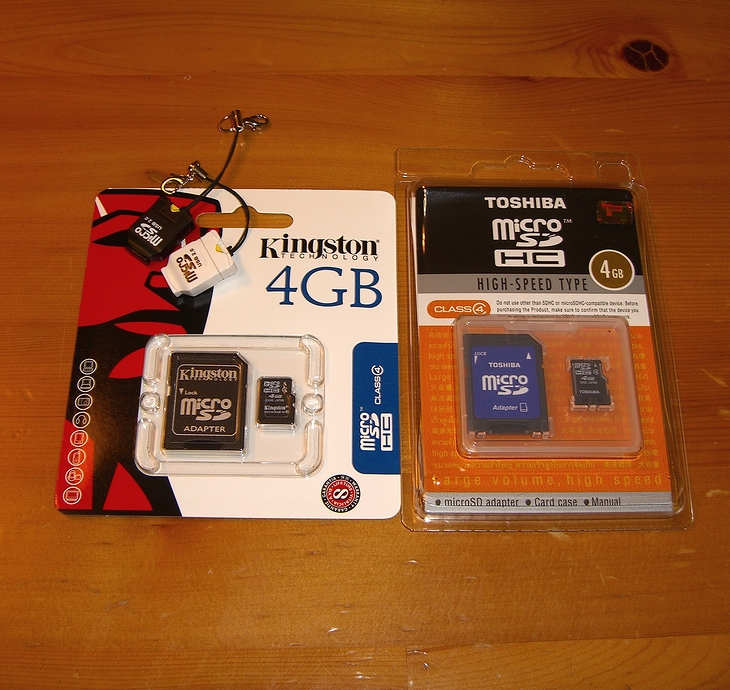
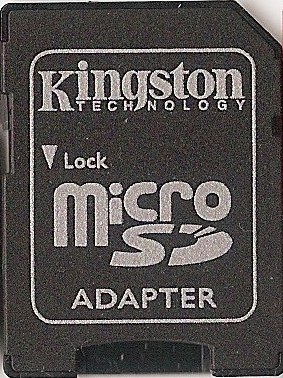
Class 4. Purchased from Dospara / Shanghai Shokunin. Labelled as made in Japan. The figures are virtually identical to the Toshiba below. It even comes with a case, and at a lower price — so Kingston is probably the better buy.
 Sequential Read : 18.536 MB/s
Sequential Write : 11.102 MB/s
Random Read 512KB : 18.323 MB/s
Random Write 512KB : 1.901 MB/s
Random Read 4KB : 4.081 MB/s
Random Write 4KB : 0.017 MB/s
TOSHIBA SD-C04GR5W4 4GB MicroSDHC (2009)
 Sequential Read : 18.878 MB/s
Sequential Write : 11.064 MB/s
Random Read 512KB : 18.664 MB/s
Random Write 512KB : 1.981 MB/s
Random Read 4KB : 4.077 MB/s
Random Write 4KB : 0.017 MB/s
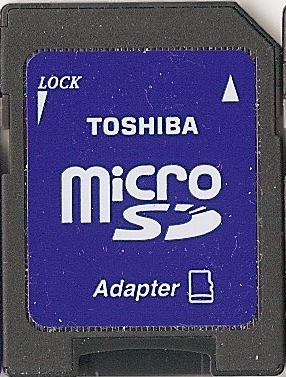
Class 4. Purchased from Dospara / Shanghai Shokunin for use with eBoostr. Overseas packaging, complete with a conscientiously translated multilingual instruction booklet and a storage case. A genuine Toshiba product made in Japan, yet there is no meaningful difference from the Kingston SDC4 above in either specs or appearance.
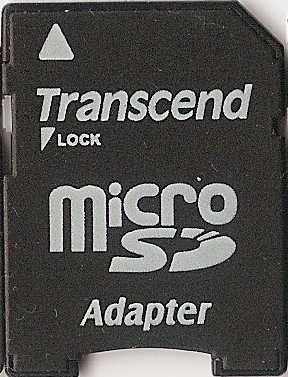
Transcend TS2GUSD 2GB MicroSD (2008)
 ポチップ
ポチップ
 Sequential Read : 18.040 MB/s
Sequential Write : 8.334 MB/s
Random Read 512KB : 17.465 MB/s
Random Write 512KB : 2.441 MB/s
Random Read 4KB : 4.735 MB/s
Random Write 4KB : 0.018 MB/s
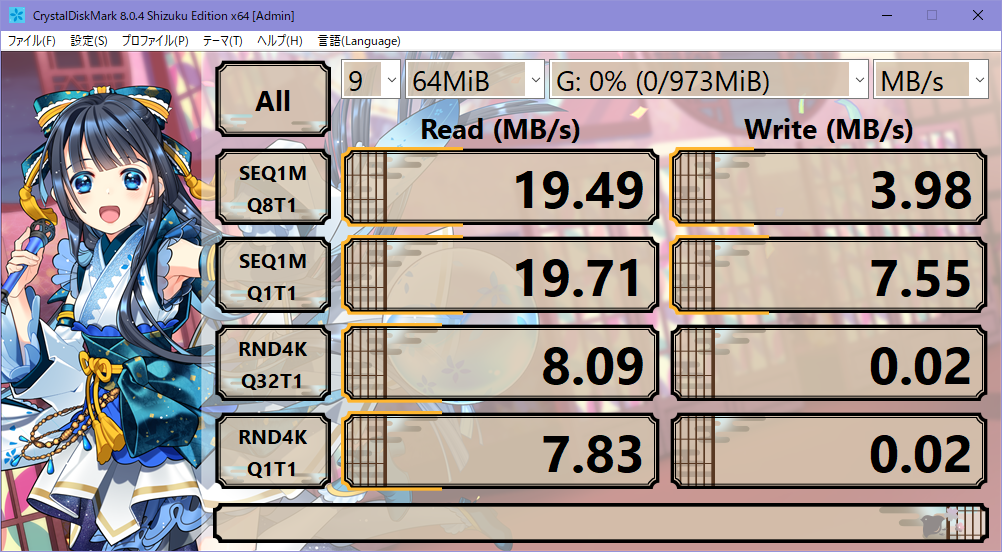
Purchased from e-Supply at the same time as the portable HDD Transcend 320GB StoreJet 2.5 mobile. The SD card I used in my mobile phone. Transcend tends to get a reputation for being a step below the competition, but the random read figures here are actually quite respectable.
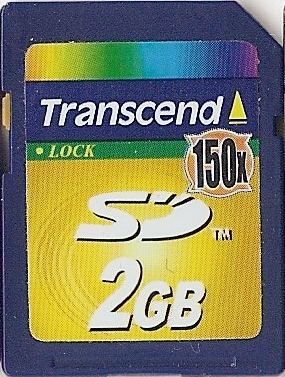
Transcend TS2GSD150 2GB ×150x (2006)
 Sequential Read : 16.845 MB/s
Sequential Write : 15.750 MB/s
Random Read 512KB : 16.589 MB/s
Random Write 512KB : 4.560 MB/s
Random Read 4KB : 4.029 MB/s
Random Write 4KB : 0.050 MB/s
Purchased from Camera Mitsuba. This was the x150-speed SD card I used most frequently in my CASIO EX-Z750. Sequential Read had been hitting over 20 MB/s the last time I measured it, but this time it came out slower. Looking at the Random Write figure, I’d guess it’s an SLC chip. It wasn’t quite as fast as I’d hoped — and perhaps because it had been driven so hard, shortly after I reformatted it the card died on me… Incidentally, it’s Transcend so it carries a lifetime warranty, but the hassle of arranging an exchange put me off, so I just threw it away… Late addition: unearthed another unit from the same card from the back of a drawer. Since I had it to hand, I re-measured it in the 2022–2023 environment, and it came out faster than the Transcend 200x TS16GSDHC10 16GB 2012 model above…
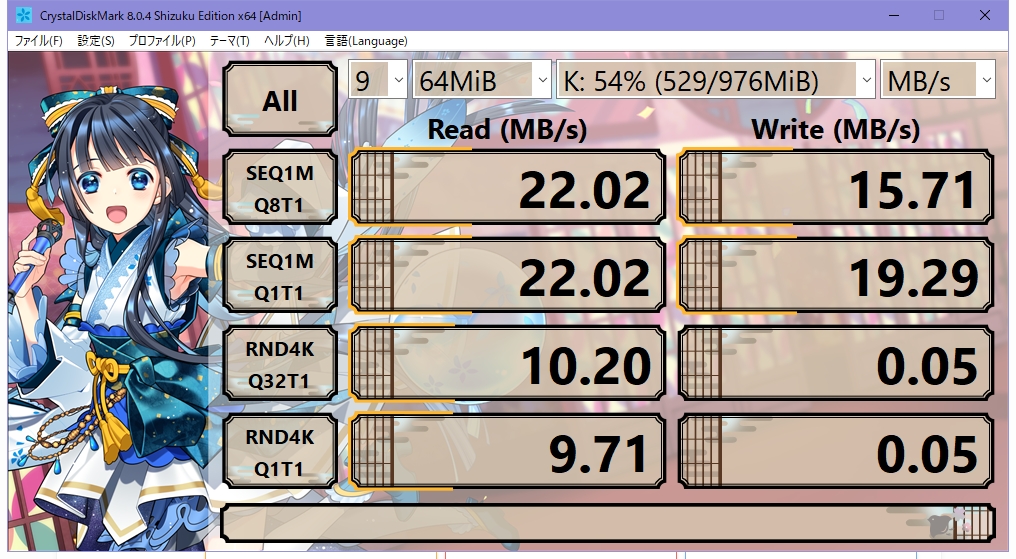
| Read (MB/s) | Write (MB/s) | |
| Sequential 1MiB Q8T1 | 22.02 | 15.71 |
| Sequential 1MiB Q1T1 | 22.02 | 19.29 |
| Random 4KiB Q32T1 | 10.20 | 0.05 |
| Random 4KiB Q1T1 | 9.71 | 0.05 |
Hagiwara Sys-Com HPC-SD1GT 1GB (2006)
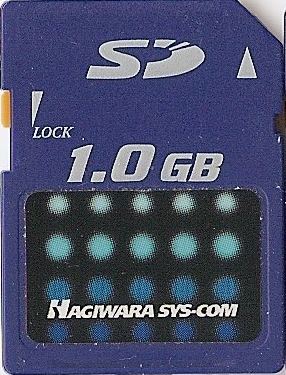 Sequential Read : 9.463 MB/s
Sequential Write : 4.666 MB/s
Random Read 512KB : 9.444 MB/s
Random Write 512KB : 1.406 MB/s
Random Read 4KB : 2.872 MB/s
Random Write 4KB : 0.024 MB/s
Bought two of these together. They’re much cheaper now, but I’m fairly sure the in-store price at the time was something like 6,000 to 7,000 yen per card. The chips inside are Toshiba. But when I measured them, the results were terribly slow… The price suggested SLC, but the internals were MLC — which would explain it… I trusted them, and then this. This SD card had also been sitting dormant at the back of a drawer, but late addition: I re-measured it in 2022, sixteen years on — and it does seem to have degraded slightly?
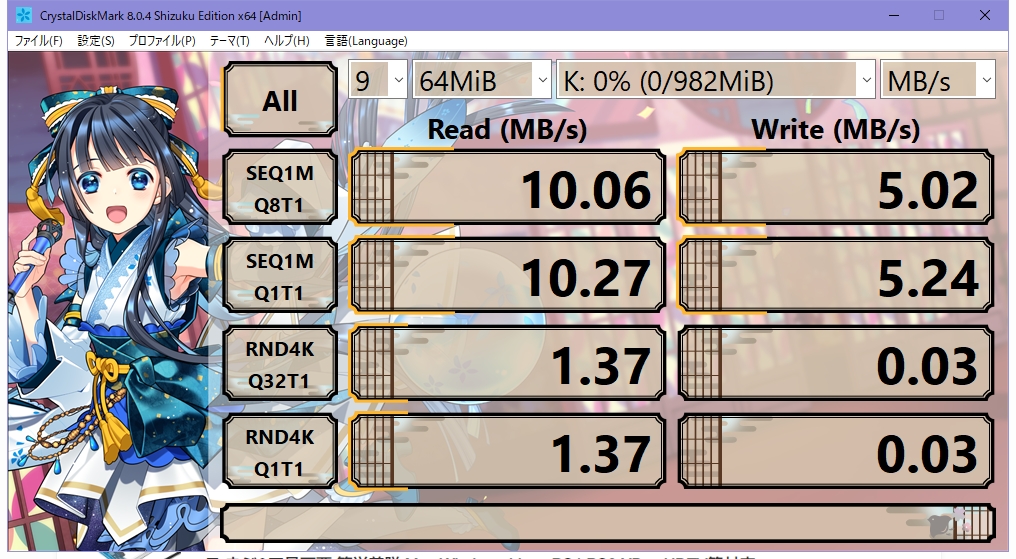
| Read (MB/s) | Write (MB/s) | |
| Sequential 1MiB Q8T1 | 10.06 | 5.02 |
| Sequential 1MiB Q1T1 | 10.27 | 5.24 |
| Random 4KiB Q32T1 | 1.37 | 0.03 |
| Random 4KiB Q1T1 | 1.37 | 0.03 |
KINGMAX SD Card 256MB SD2004 (2004)
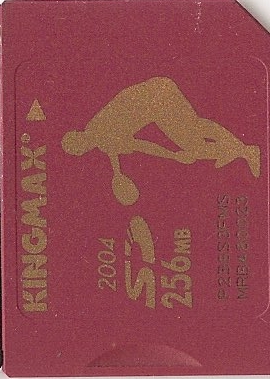 Sequential Read : 6.698 MB/s
Sequential Write : 5.776 MB/s
Random Read 512KB : 6.590 MB/s
Random Write 512KB : 3.601 MB/s
Random Read 4KB : 2.562 MB/s
Random Write 4KB : 0.074 MB/s
Purchased quite some time ago from i-digi! (now Nojima Online). I believe this was around 4,000 yen, an era when I would jump at anything that seemed like a bargain. The sequential speeds are jaw-droppingly slow, yet on the other hand the Random Write is quite respectable. Perhaps because it is an older SLC chip? This was the first SD card I ever bought, and as a result I went on assuming for years that SD cards were simply slow. In practice, a decent product in the same price bracket as a USB flash drive will turn in much the same sort of speeds.
My vague general impression had been that SD cards are slower than ordinary USB flash drives, and that the even smaller MicroSD cards are slower still — but when I actually ran CrystalDiskMark on the SD and MicroSD cards I had to hand, the results were largely indistinguishable, or rather the format seemed to make almost no difference. SD cards cannot match a handful of very expensive ultra-fast USB flash drives, but between an ordinary cheap USB flash drive and an SD/SDHC card (including Micro), performance is broadly comparable, with the numbers varying simply according to each product’s own specifications.
The real issue is the chip. Better-performing products — and most of the pricier USB flash drives and SD cards up until fairly recently — used SLC flash memory chips, but the budget cards available now for around 1,000 yen per 4GB use MLC chips, which means their write cycle endurance is roughly one-tenth that of SLC. MLC can produce quite good read speeds depending on the product, but write speed is invariably a weakness. That said, for use with eBoostr, as long as the Random Read (4KB) speed is at least 4 MB/s or above, write speed and other figures beyond that probably don’t matter much. The real concern is dash-cam use, where the card is continuously overwriting recorded footage in an endless loop. You hear quite often of people repurposing an ordinary SD card without much thought and finding it has died within a few months — so for dash cams, it really does seem essential to use a MicroSDHC card with a high-endurance SLC chip.
I intend to continue adding speed test results for SD cards and USB flash drives as I acquire them to this page.
SD Card Comparison |SSD Comparison|USB Drive Comparison

Auto Translated by CS4.6
List of comments (13)
こんにちわ。エラックとのりたまでご飯おかわりできるぱるるです。アレから頑張ってC-1VLをメーカーからB級品を特別5万で譲って貰い、エラック310.2は新品なんと10万で手に入れました。これで全てが揃いました。
あっ、このサイトなかなか見つから無くて、出来ればメールとかでアドバイス欲しいです。携帯しか無いのですが、どこに送れば良いやら…。
ぱるるさん(ぱるるんさんですよね?)お久しぶりです(*^-^*)
ELAC CL310.2とC-1VL御購入おめでとうございます。新品10万円って安いですね~(@_@;)その値段なら私も欲しいです…。良かったらお店教えて下さいませ♪スタンドも購入されましたでしょうか?
メールは↓です。
¥削除しました¥
このブログ限定の連絡用アドレスです。このアドレスについてメールボックスを毎日は確認してませんので、メールを送った場合にはブログに一言コメントいただけると幸いです。
えーっとパソやった事無いのでメールボックスとかプログとか専門用語?。さっぱりで、スタンドはとても手が出なくてお店は横浜の辺りでした。実は逆相って言うらしいですけど、わざとスピケとかの極性を逆に繋ぐ…それが結構サラウンドぽくって好きで、最近に成って初めて逆相って言葉を知りました。評価の星はなんなのかな~?
ブログの意味ですが、ココのウェブサイト・要するにホームページのことです。ブログ形式(日記)で書かれているのでブログと呼びます。
メールボックスはメールを送受信するためのネットワーク上のサーバー、郵便受けです。このメアドはLivedoor付属のもので、公開している都合上スパムメールが来るので、普段/業務使いのメールソフトには登録してません。Livedoorの管理画面から内容を確認できるのですが、毎日は見に行かないので(滝汗)
逆相ってスピーカーの接続を左右で逆にするんですか?
これは、定位が滅茶苦茶になりますのであんまりオススメできませんです。
今は310に6099のインシュ入れました。初めて使うんで…相変わらずトランス中毒です。ぱすてるさんはシンセの音とか好きですか?やっぱ自然派かな? (^-^)
A-1VL元気ですよ?(^^)ただうちのスピーカーではエラックCL310.2 JETと組み合わせた時と同じレベルの音は出せません。そんなんで、組み合わせの限界は感じています。(出来ればCL310.2かB&WのCM1が欲しいところです) 名前はぱすてるぴあのでOKです♪普段は大体クラシックですが、シンセの音も好きです。ヒーリング・ニューエイジとか。トランス系はよく知らないんですけど、シンセはBOSEで聴くよりELACの方がずっと立体的で高音質で合ってると思います(^^)
毎回返事ありがとうございます。俺は音とかは解らないけどとにかくこのキラキラウーハーの虜で。ぱすてるさんさそーゆのありますか?端子系も金メじゃなくてWBTの透明端子が大好き!とか。ぱるる的にはコンポからシフトしたチェリーなんでモーターボリュームにビビりました。スゲーボリュームがリモコンで動いてるって。
あっ、あと気になるんですけどパステルさんはA1どれくらいの音量で鳴らしてます?俺は常用9時の位置でピークで11位かな。アパートなんで…多分パステルさんは結構な音量で鳴らしてますよね?ちょっと興味あるのがアルテックが5万くらいで出してるフルレンジ
色々こだわりがありますよ。オーディオも見た目や質感は大切です。うちは音楽と住環境の融和、ライフスタイルオーディオがモットーですから。
ボリュームがリモコンで動くのは…今はミニコンポの方が普通じゃないかな?高級品では割と少ないです。私、リモコンそういえば元箱に入れたまま開封してません…。
音量はぱるるさんと全く一緒。A-1VLのボリュームは案外反応シビアで9~10時の狭い範囲ですね。
*
*
*
*
*
このエントリは過去のエントリを削除して再利用したものです。2006年の上の一連のコメントと2009年のSDカード等の速度測定に関連はありません。
*
*
*
*
*
次はUSB/SD/SSD/HDD/RAMDISKで音質比較とかされるのかと思いました(笑)
残念、これは全然オーディオとは関係ないエントリでした~♪