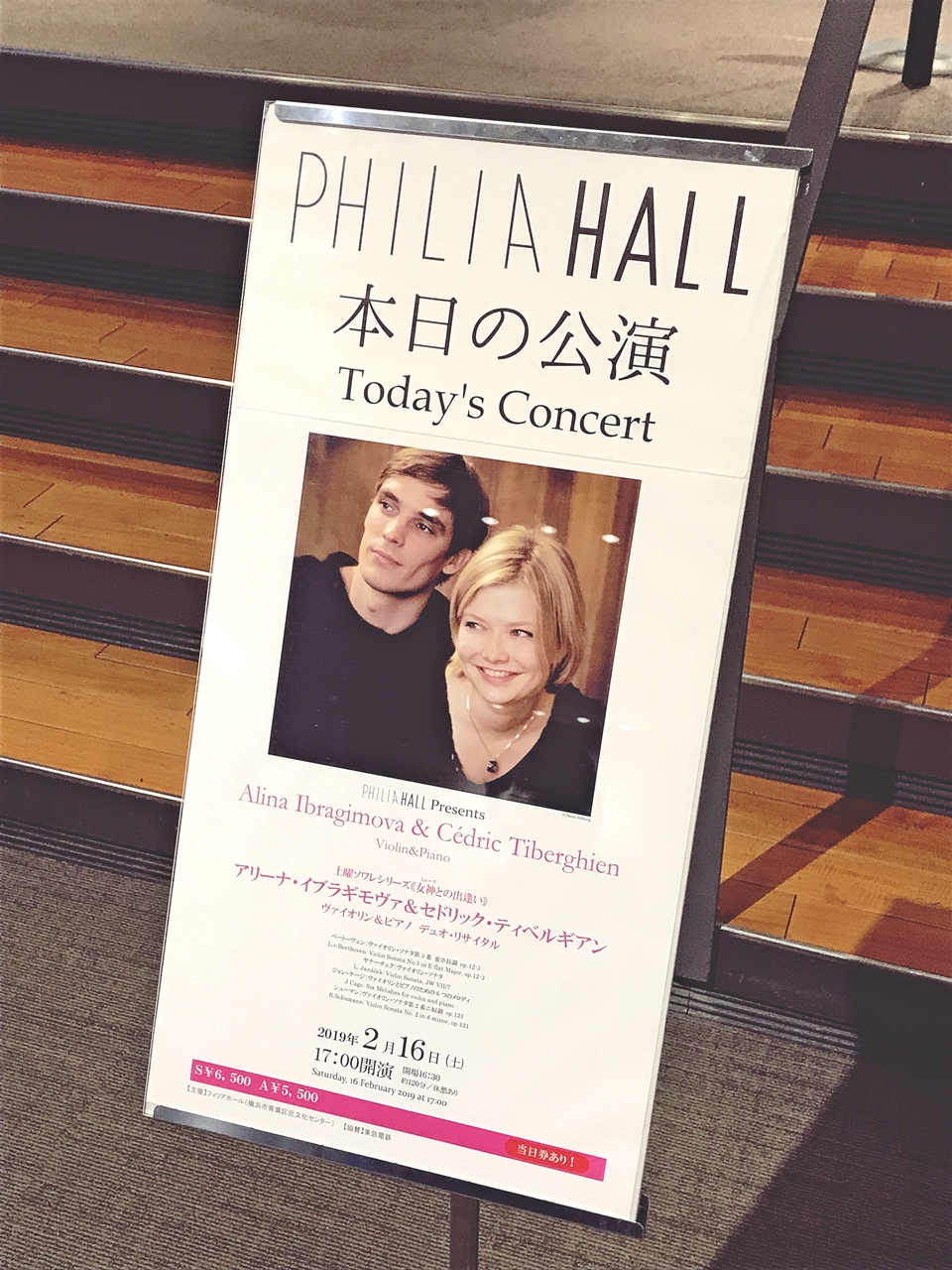
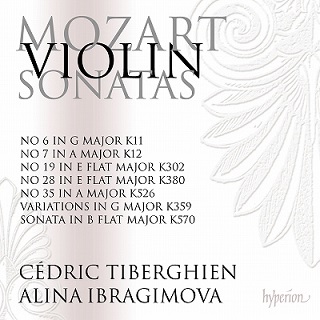
Last Saturday, I went to a duo recital by the young Russian violinist Alina Ibragimova and the French pianist Cédric Tiberghien. Their duo has previously been broadcast on NHK’s Classic Club, and personally I own three live CDs of the complete Beethoven violin sonatas recorded at Wigmore Hall in London, plus a couple of discs of Mozart violin and piano sonatas they recorded for Hyperion.
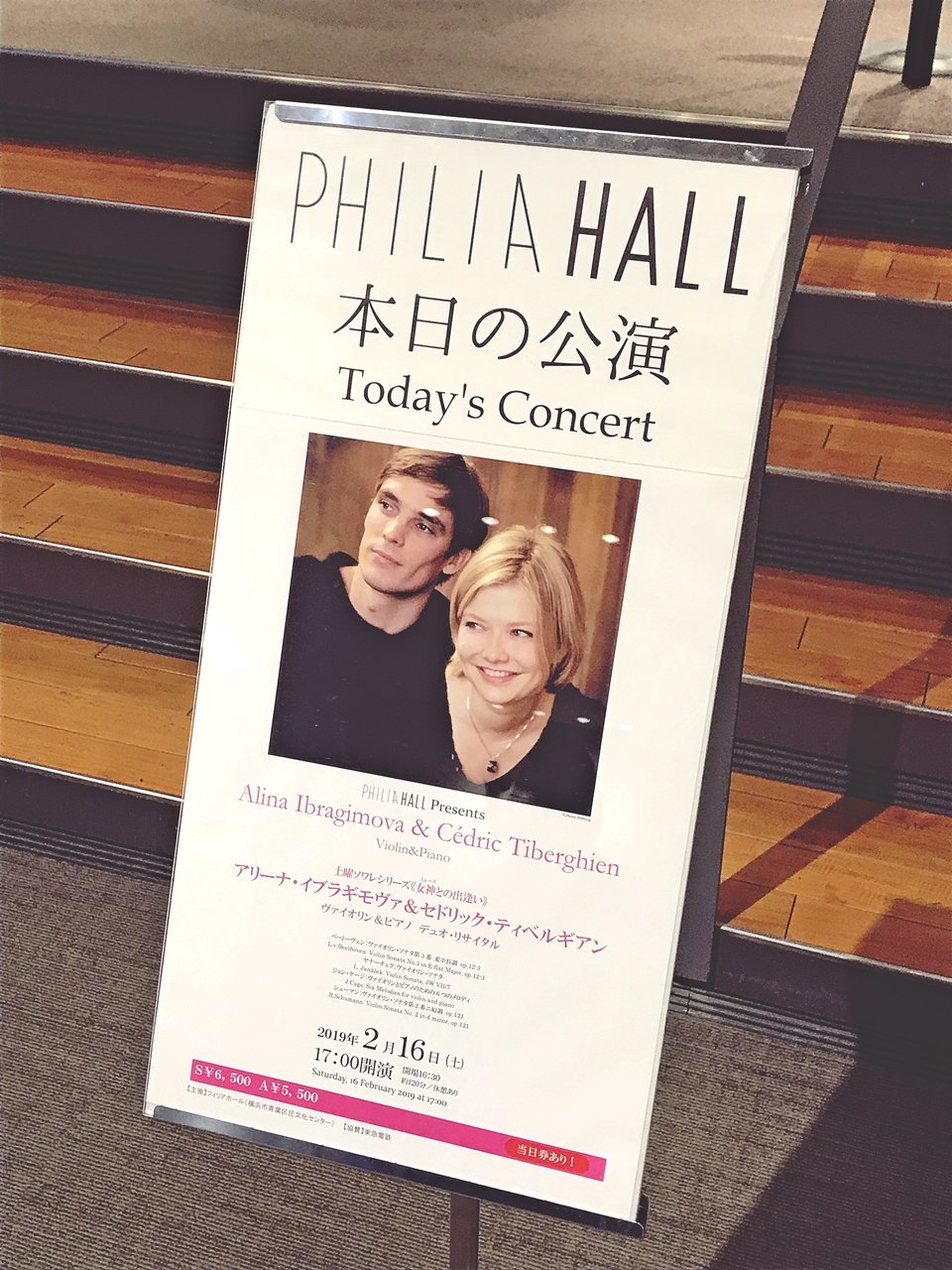
The venue was the usual Filia Hall. The programme consisted of Beethoven’s Violin Sonata No. 3 and Janáček’s Violin Sonata JW VII/7 in the first half, followed by John Cage’s Six Melodies and Schumann’s Violin Sonata No. 2 in the second. Her violin, incidentally, is an Anselmo Bellosio made in 1775.
※ A few CD reviews of the pair are included below
With the Beethoven violin sonata — perhaps because it was the opening piece — the balance between Tiberghien and Ibragimova was subtly off. Since Tiberghien’s role is that of a duo partner rather than an accompanist, the piano lid was fully open, but this meant the piano was relatively louder than the violin, which felt slightly awkward.
The second piece was Janáček’s Violin Sonata JW VII/7 — my favourite work on today’s programme. From this point on, the volume balance between the two improved. Alina Ibragimova, being very much a young musician of her generation, was using an iPad with a wireless foot pedal for her score, but for this piece alone she had paper. That said, those tiny notes displayed on an iPad — I do wonder how she can read them from so far away at the music stand.
The second half opened with John Cage’s Six Melodies. I had done no preparatory listening and was hearing it for the first time, but it turned out to be a set of simple, pleasant miniatures — my stubborn refusal to prepare in advance was quite wrong of me… I must reflect on that. And the finale was Schumann’s Violin Sonata No. 2. The musical interpretation was rather different from what I carry in my head, and there were occasional moments in the piano part that nagged at me technically, so I couldn’t quite lose myself in the music — yet the violin itself struck me as a splendid performance, full of presence. The encore was a single piece: Schumann’s Abendlied (arr. Joachim). It was a delicate performance that drew you into the gradations of Ibragimova’s tonal colours, and I think that was the finest moment of the evening. For that encore piece alone, Tiberghien also used a tablet. As a duo, my impression was that they were perhaps not quite at their best on this particular evening, but overall the playing was assured, and a pleasant afterglow remained once it was over.


 ポチップ
ポチップ
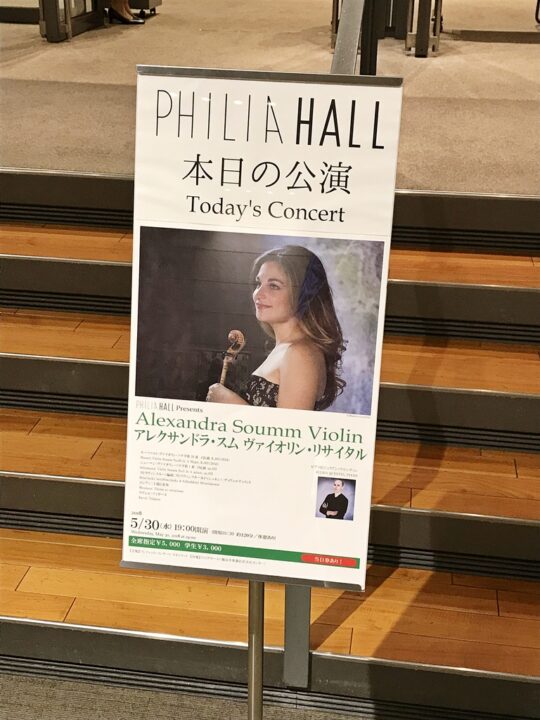
Cédric Tiberghien is of my own generation and won the Reine Elisabeth Competition in 1998 (with Takeshi Kakehashi taking second place) — but hearing him live this time, I felt he is not really a pianist whose fingers fly around with particular ease these days. Last year I also heard the violin of Alexandra Soumm in a similar pairing of a young Russian-trained female violinist with a French male pianist, and the French pianist on that occasion, Julien Quentin, struck me as considerably more accomplished. That said, the Ibragimova and Tiberghien duo clearly has a following — the hall was perhaps ninety per cent full, which was quite a contrast to the Alexandra Soumm concert, where the performers were at a broadly comparable level. (Soumm, in my personal view, is underrated…)
How to put it… Tiberghien possesses a distinctive, sweetly flavoured quality that sets him apart from a mere accompanist, and it resides in his tone colour itself rather than in his interpretive choices as such — that is both his attraction and the thing that divides opinion. I had assumed that the slight unease I feel with the Mozart violin sonata recordings on Hyperion came down to the recording balance, which places the piano ever so slightly more centrally than the violin; but hearing him live made it quite clear that the real reason is simply that Tiberghien’s tone and personality are not personally to my taste, and that is what keeps catching my attention. The Hyperion recordings themselves are far more vivid than the Wigmore Hall live recordings — heard this way, they capture the freshness of a live performance much more closely.
 ポチップ
ポチップ
On the other hand, Alina Ibragimova’s violin — which was the whole point of the visit — was magnificent. The varied and nuanced pianissimo, the robust and consistently steady fortissimo, and above all the vivid, richly colourful tonal world spread out before you — all of it was genuinely arresting. The acoustics of Filia Hall no doubt play a part, but rather than the incisive, high-contrast playing I had anticipated, what I found was a violin of smoothly connected lines and finely graded, well-grounded tone — and it was entirely easy to see why she has so many admirers.
[PR]
 Search for Alina Ibragimova CDs at HMV
 Search for Cédric Tiberghien CDs at HMV
 Adrift in Classical Music

Auto Translated by CS4.6