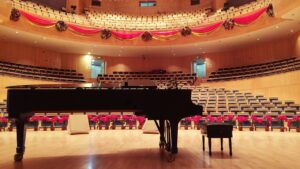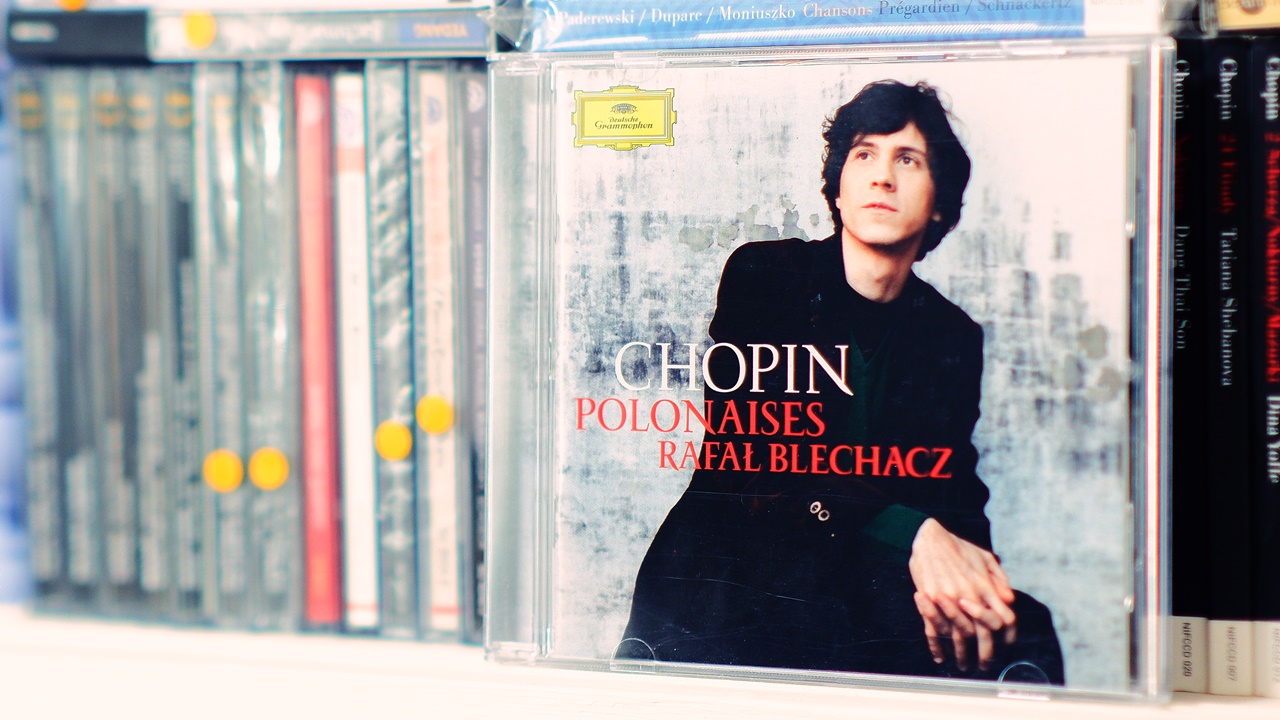
I am currently watching (and listening to) a recording I made the other day from NHK BS Hi-Vision — a Japan tour recital by Rafał Blechacz, winner of the 15th Chopin Competition (2005). The broadcast programme was all Chopin: the first half of the Preludes, three Mazurkas Op. 50, and Piano Sonata No. 3. Recorded at Tokyo Opera City Concert Hall.
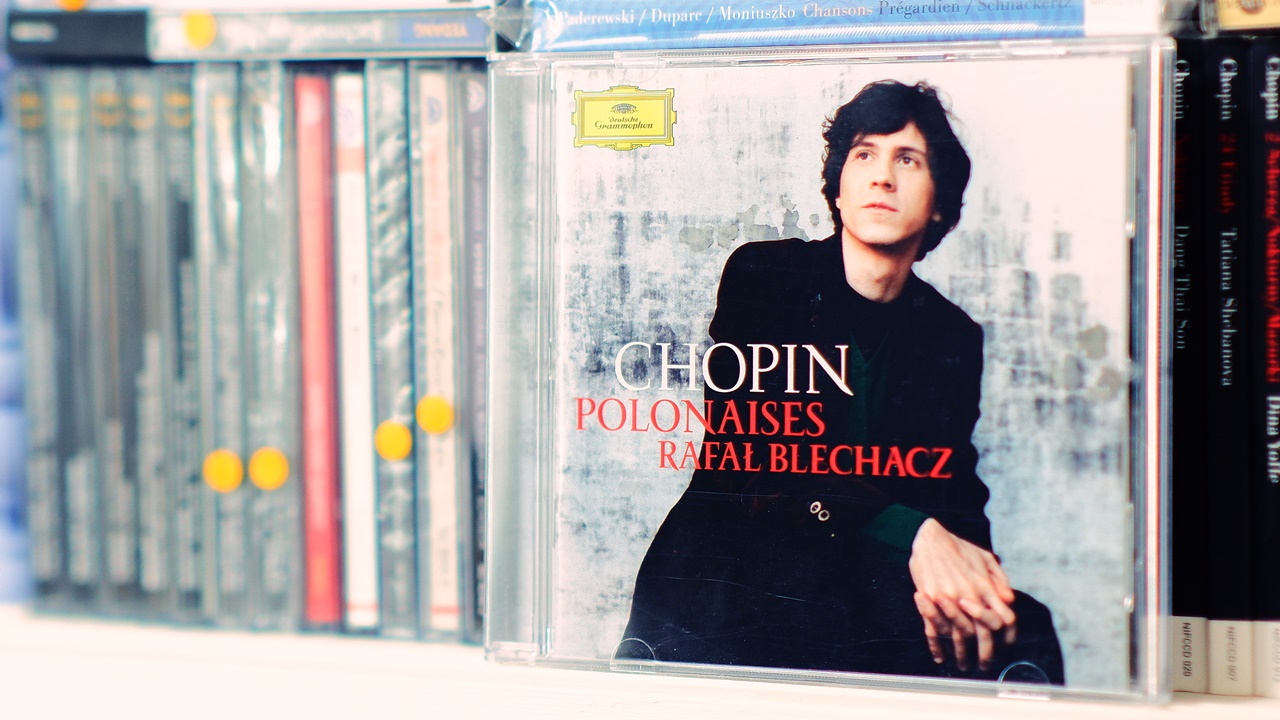
Rafał Blechacz is the pianist who drew attention as the first Polish winner of the Chopin Competition in thirty years. Thirty years prior, incidentally, it was Krystian Zimerman. Right after he won, I managed to get hold of a Polish import CD of the concerto finals — the First Piano Concerto — listened to it once, and then somehow he just slipped off my radar entirely. I do wonder, though, how the wider world has come to regard this young man.


 ポチップ
ポチップ
As for my impressions from watching the broadcast: as one might expect from a young musician of today, he is technically quite exceptional, yet what strikes me is that he never simply dashes through the music on momentum alone — his playing is painstakingly careful right down to the finest details. Even in the most demanding passages there is not a single moment of muddiness; every single note is treated with care and comes through with perfect clarity — a constructive, lucid approach to harmony and touch. To put it less charitably, there is much about it that is thoroughly modern, cool, and light in that way of young people today — a kind of digital flavour, if I may use a Hi-Fi analogy — yet because the background of the sound is so quiet, so clear, and so pure in tone, it never carries that arid, disagreeable quality that intellectualised interpretations tend to have.  It goes down as smoothly as natural mineral water. Because he never forces the piano, the tone is truly crystal-clear and beautiful. That said, his expressive range is most pronounced in the direction of soft, quiet playing, and the overall sense of volume — of presence and depth of sound — is not particularly great. I think part of this may be that his bench is set rather high, which raises the centre of gravity of the sound as a whole and causes his expression to become somewhat compact — and in that respect it does not quite feel like what one would expect of a professional pianist. (Many first-rate pianists tend, without exception, to have a very low centre of gravity in their sound — though of course that must never mean the playing becomes heavy.)
 ポチップ
ポチップ
And there is another thing — his manner of expression is, overall, rather like print-script, as though one were reading a poem set in a sans-serif typeface. Chopin, to my mind, is poetry written in cursive by hand. He handles the instrument with remarkable skill, yet I cannot help feeling that as music — as something that transcends the framework of the piano — it does not quite sing freely enough. As a pianist he is wonderful, but as an artist — how to put it. In that respect, when it comes to singing out the poetic feeling of Chopin, there is a slight insufficiency of emotional expression; it feels less like spontaneous self-expression and more like he has been taught an interpretation and is demonstrating it, and one senses a certain lack in the natural, innate magnetism of a born Chopin interpreter, a born soloist. There is no flamboyant individuality in the theatrical sense, nor any particularly deep personal character. Sitting at the piano, he gives the impression of a genuinely beautiful and refined young man — but not much of the light and shadow peculiar to those who are searching through art, nor that fierce, inborn individuality and presence. The sound itself draws one in with a quality of stillness, and the way he speaks through the music is rational and persuasive — yet when one asks whether there is, in the spaces between the notes and in the spread of the resonance, a gradation of aura that stirs some invisible inspiration, one feels, somehow, a certain loneliness there. His interpretation is restrained, modern, and faithful to the score — but I have to say plainly, I do not think it is the playing of a Chopin interpreter in the true sense. (I say this as a deliberate word of caution, since I suspect people may say he even resembles Chopin in appearance.) That is why, when I first heard the live competition recording, I — having expected the kind of breathtaking, brilliant individuality of past winners — found myself going “hmm…” and quietly moving on.
 ポチップ
ポチップ
That said — while those questions arise when I think of him as a Chopin interpreter, or in terms of how far his expression reaches outward — if one sets aside all that, the stage persona of the concert pianist, the showy theatricality of the professional musician, and simply listens; if one wants to sit quietly before the music of one young man, without pretension, and lend it one’s ear — then his music is very pure, and very quiet. It is exactly the kind of performance one would want to hear at low volume on a still winter night with snow falling outside. The various noises blown in from the clamour of the world, the mind is set free from the bustle and everything else, and the soul is washed clean. Perhaps it is already something precious just that there is a young person today who can offer sound this pure. I can only hope that Rafał will not lose this purity as he goes forward — in today’s world that is the hardest thing of all to hold on to, and it is a fragile thing, I know — but as a listener, it is what I find myself quietly wishing for him. I have not yet heard the recital live album released since then… though perhaps I ought to.

Auto Translated by CS4.6