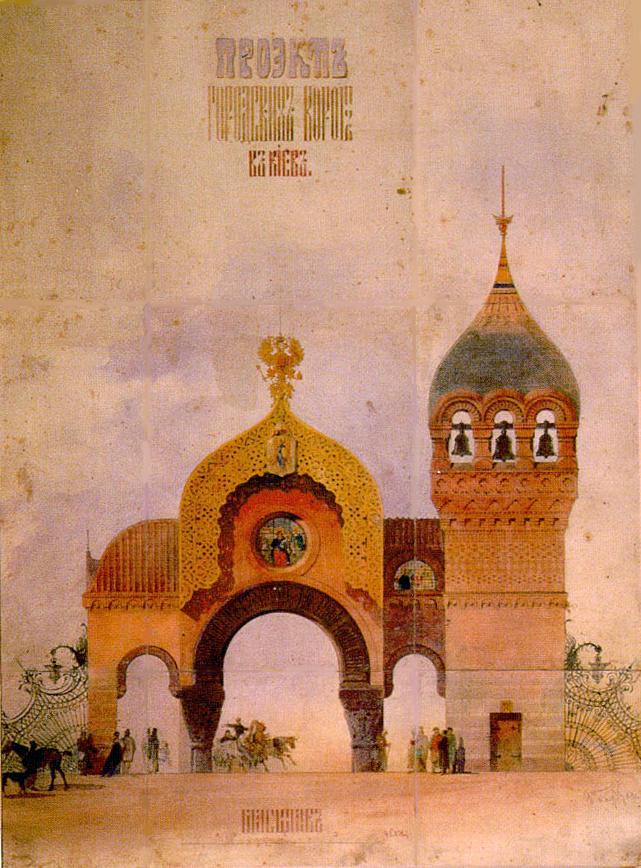
 The theme music used in the winter 2009 anime series RIDEBACK is Mussorgsky’s Pictures at an Exhibition. The piece that plays throughout the scene in the first episode where the heroine, ballerina Rin Ogata, is dancing is the tenth and final movement of Pictures at an Exhibition — The Great Gate of Kyiv. The piece exists in various versions — the orchestral arrangement by Ravel, Mussorgsky’s own piano original, and so forth — but for those who heard it in RIDEBACK and thought, oh, that’s a lovely piece, I’d like to introduce some CD recordings of Pictures at an Exhibition in its “solo piano” version, performed by outstanding classical pianists. In my usual style — without being tied down to the tedious constraints of old recordings, great masters, and canonical albums — with sound quality factored in as well.
2024 Addendum: Some Thoughts on “Kyiv” vs. “Kiev” in the Title…
Thanks to the Russia–Ukraine war, all sorts of Ukrainian place name spellings in Japanese have changed. Should “キエフの大門” now be written “キーウの大門” — The Great Gate of Kyiv? But the origins of this puzzling romanisation “Kyiv” appear to be English in derivation, and it is, strictly speaking, neither Ukrainian nor Russian. If one were to write it in katakana closer to actual Ukrainian, it would be something like “クイユ” or “クイウ”; in Russian, something like “キーフ” or “キーェフ”. I had long wondered how things ended up this way, and it does seem that nearly all the newly adopted katakana spellings presented as Ukrainian pronunciations are in fact English pronunciations. “Odessa” — a city that has produced a great many Jewish musicians over the years — has likewise been respelled “Odesa” in Japanese, yet the original “Odessa” was already closer to the Ukrainian pronunciation; in Russian it is “Одесса” (Odyessa). When war breaks out, propaganda distorts the truth and warps people’s understanding in all sorts of ways — and it seems that distortion creeps in even here.
Listening to Great Performances of Mussorgsky’s Pictures at an Exhibition
The performer is Lilya Zilberstein — a Jewish Russian pianist from Saint Petersburg who won the 1987 Busoni International Piano Competition. The recording was made in Hamburg in 1993 by Deutsche Grammophon (UCCG-8053). It also dates from Deutsche Grammophon’s golden age, before compressed remastering techniques entered the picture, and the sound quality is excellent. Though even so, when compared to a live performance, the tone here is perhaps a little too clean, a little too light.


 ポチップ
ポチップ
 At the time of this recording, I had the chance to hear Zilberstein play this very piece from the front row of the hall, directly facing the pianist, and I remember being quite struck by her soft yet weighty touch, the grandeur of her structural sense, and the sheer power and dynamism of it all. Bold, fearless, and expansive — a performance that seemed the very embodiment of the Russian female pianist in the mould of the Russian steppe. The vivid, rhythmically alive playing never sacrificed detail, and it was far too substantial to be dismissed as rough or superficial.
She visited Japan for the first time in years last spring, and there was a studio recording broadcast on NHK Classic Club — a studio session in which she played the Rachmaninoff preludes, the very first pieces she recorded for DG. She seemed to struggle a little with the studio’s Steinway, but musically she has not declined in the slightest — if anything, she appears still to be evolving, which is a relief. After her recording contract with Deutsche Grammophon ended, there was a long period during which no new Zilberstein recordings were available, but in recent years some fine performances have appeared on minor labels as import releases, and I hope to introduce them here when the opportunity arises.
 ポチップ
ポチップ
The coupling pieces — Sergei Taneyev’s Prelude and Fugue in G-sharp minor, Op. 29, and Nikolai Medtner’s Forgotten Melodies — are equally outstanding. Having once heard Zilberstein play Medtner in person, I have to admit that performances by Irina Mejoueva — well-known to Japanese audiences — now leave me feeling rather unsatisfied.
 ポチップ
ポチップ
And one more. A performance by Vladimir Feltsman — winner of the 1971 Long-Thibaud International Competition and likewise a Jewish Russian pianist, born in Moscow. This is the Pictures at an Exhibition he performed during his Japan tour in 2007 to great acclaim. I myself had only caught a fragment of it once, in passing, on FM radio while driving — and yet that was enough to leave me astonished. How to put it — rather than the classical, orthodox approach that Zilberstein takes, this is a performance full of fresh, avant-garde interpretive choices at every turn. And somehow it feels slightly tongue-in-cheek, which makes it tremendously enjoyable.
The darkness and heaviness embodied in “Bydło” — the ox-cart, a metaphor for the oppressed — and the other messages Mussorgsky encoded in the work: Feltsman overturns one’s entire image of Pictures at an Exhibition with an exhilarating freshness. Though, to be fair, I only heard it once in the car over a year ago. I had completely forgotten about it (…it just came back to me now) and I still haven’t bought the CD. Having written about it here, I really must get hold of a copy.
The Opening Theme of the Anime RIDEBACK
 ポチップ
ポチップ
The use of Pictures at an Exhibition in RIDEBACK felt very much like ballet and classical music within the world of the anime, but separately from that, the opening theme is a terrifically exciting track and I quite like it. I had a vague sense I’d heard that sound somewhere before — and then I realised: “MELL” is the same person who did “Red Fraction,” the opening theme for BLACK LAGOON. Now that I think about it, that one had the same surging darkness that worked so well. In fact, at this point I’d say it goes well beyond the realm of anime songs — and yet when I found out that the production behind it was I’ve, I honestly didn’t know what to think.
MIRAGE, the MELL album containing both the RIDEBACK theme and “Red Fraction.”
 ポチップ
ポチップ
2009/2/2
Vladimir Feltsman — Mussorgsky’s Pictures at an Exhibition and Tchaikovsky’s Album for the Young
An addendum. The Mussorgsky Pictures at an Exhibition by Vladimir Feltsman, the Russian pianist I mentioned recently, has arrived. I put it on straight away, and was immediately struck by the brisk tempo of the opening Promenade. Yet it is not merely fast — it is sung with great musicality, and draws you in with an irresistible catchiness. From there the performance continues with musical phrasing and a rhythmic vitality that never lets attention drift, and in the closing Great Gate of Kyiv, he deliberately enters not with a forte but a mezzo-piano, playing it legato and gradually building the volume into a dramatic climax — a theatrical stroke. It would surely be thrilling to hear live. Against the classical, orthodox Russian approach of Zilberstein’s recording, this one weaves together a masculine scale with an abundance of lyrical feeling, resulting in an avant-garde Pictures at an Exhibition entirely its own.
ポチップ
Programme notes (quoted from CD Journal review)
Feltsman had all but vanished from Japanese music lovers’ awareness when Music Masters — the label he had moved to after CBS — withdrew from the classical market. Three years ago he finally re-emerged on the Mexican label Urtext, but the discs themselves were frustratingly difficult to obtain. It is therefore most welcome that they are now being distributed widely in Japan as domestic releases. To discover where this mystical thinker currently stands, having honed his acute poetic sensibility yet another degree finer, I would first suggest the Tchaikovsky — seemingly a makeweight, yet a performance without equal. The spellbinding expressiveness born of his chameleonic tonal sorcery, his profoundly suggestive pianissimo, his lightly leaping staccato, and his inspiration-charged, fragrant cantabile will surely captivate the listener entirely. In the Pictures, the ironclad technique of the man hailed as the last Soviet virtuoso shines throughout; particularly outstanding is his tonal control in sounding the countless chords that recur throughout this work without any muddying of the texture. Resolutely pursuing a clear acoustic while avoiding an excess of imposed meaning, this performance stands a head above the rest not only in its awe-inspiring boldness but also in its delicate and hypersensitive beauty. (Sakuya Kawata — January 2005)
 ポチップ
ポチップ
The recording is clear and modern-sounding with a high-speed quality that Hi-Fi enthusiasts will no doubt appreciate. The combination of an analogue-ish, warm, full and rounded mid-to-low range with a strikingly fast-rising, clear and sparkling mid-to-high range is rather pleasing. The resolution is high, and on Sub-system A — CREEK EVO-CD + ONKYO A-1VL + Audio Pro Image 11 — the information density feels almost saturated, though the amplifier’s speed does make the high-fidelity quality stand out. On Sub-system C, which prioritises the warmth of a European character over outright sound quality, it is rather less impressive. On the main system, the sound quality is so high that it actually begins to reveal the shortcomings of the Steinway used in the recording session and the acoustic of the recording venue itself (the overall tonal character is not particularly attractive), yet the vitality of the playing is such that those flaws are simply blown away. For conveying the dynamics of Pictures at an Exhibition and Feltsman’s lyrical spirit, the main system — with its greater expressive depth — is clearly the one for the job.
The recording dates from May 2002 in Mexico, with a Mexican recording crew. It appears to have been the original release on a minor label over there. Judging from the sound quality, I have a feeling that some form of remastering was applied when Camerata Tokyo released it in Japan — though of course, not having the Mexican CD to compare, I cannot say for certain. This sound quality and tonal balance simply doesn’t feel like something that would come out of a Mexican production. The obi strip mentions K2 laser cutting — a technology for producing high-quality press masters — but beyond that, to my ears it has the sound of JVC Victor’s 20-bit K2 processing.
 ポチップ
ポチップ
The coupling work, the Album for the Young, is a collection of short pieces for children composed by Tchaikovsky — essentially required repertoire for Russian children learning the piano. Unlike Burgmüller’s 25 Études, Op. 100, which I find musically rather vapid (a personal opinion), this is an impeccably crafted and musically refined collection of miniatures. It is quite unusual for a professional pianist to record this set at all, but Feltsman brings to it a profound musicality and a wealth of lyrical feeling that would stand up perfectly well in a recital programme.
 ポチップ
ポチップ
Tchaikovsky’s Album for the Young was apparently written in response to Schumann’s Album für die Jugend, and now that it’s been pointed out, I can see the resemblance — though I’ll admit I didn’t actually know this until I looked it up just now. If I had to characterise the difference: Schumann’s feels somehow lolita-ish, while Tchaikovsky’s has more of a shota quality. Feltsman plays through this collection of miniatures with free expressive phrasing and rich musicality — charmingly, at times coquettishly — and it is beautifully done, yet this is undeniably an adult’s interpretation of the music.
 ポチップ
ポチップ
If I were to venture a mild criticism — it is that his talent overflows rather too abundantly. With the Album for the Young, I feel that rather than giving full rein to that talent, a more straightforward touch, following Tchaikovsky’s melodies naturally with an unaffected clarity — like a boy soprano in a children’s choir, or like the small children who aspire to become ballet dancers — would allow the inherent simplicity and plain beauty of the pieces to come through more fully. That said, if a professional recording took that approach, it risks becoming nothing more than a pleasant but unremarkable study collection, so it is a genuinely difficult balance to strike. Years ago I heard on the radio a performance of this Album for the Young by a Russian pianist named Lyubov Edlina, and it was quite wonderful — but sadly, searching for it now yields nothing. Should I ever come across that recording again, I would very much like to secure a copy.

Auto Translated by CS4.6

List of comments (3)
全然関係ないけど電脳コイルが再放送します。
ぜひ見てみて下さい。
http://www.tokuma.co.jp/coil/news.html
…おry
惜しむらくはハイビジョン教育テレビと違いヨレヨレSD画質のBS2ですかぁ。とにかくリンク多謝です。
あとここで1話視聴できます。
http://www.b-ch.com/cgi-bin/contents/ttl/det.cgi?ttl_c=1097
とりあえず観てみてください。