【ONKYO A-1VL & C-1VL — In-Depth Review】
A-1VL/C-1VL Launch|A-1VL (Part 1)|A-1VL (Part 2)|C-1VL
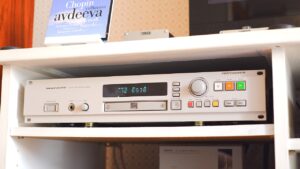
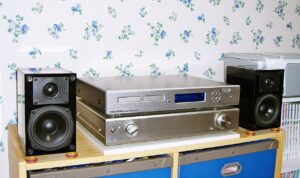
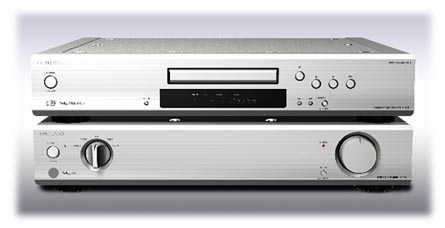
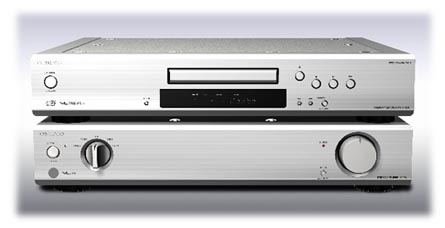
Our subject this time is the first product marking ONKYO’s return to pure Hi-Fi from ONKYO, one of Japan’s leading AV manufacturers — namely the combination of the ONKYO A-1VL and C-1VL, built around the much-talked-about digital integrated amplifier. The moment I first laid eyes on them in a shop, I was caught off guard — they were so slim and stylish I nearly mistook them for British-made components. As an aside: the correct Japanese katakana spelling of ONKYO is オンキヨー, with a full-size ヨ — not オンキョー.
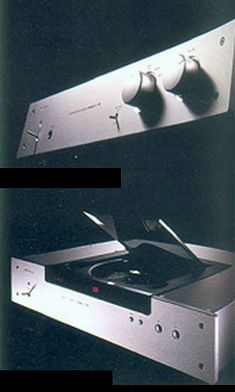 Those who have been into Hi-Fi since the 1990s will likely remember that, some twelve or thirteen years ago, ONKYO collaborated with British engineers on the sound design of a slim, elegant high-end system called the Integra A-1E/C-1E — a product that bears a striking resemblance in spirit to this new model. Japanese build quality and British-flavoured sound tuning came together remarkably well, and the result was a product of exceptional sonic purity that could stand toe-to-toe with British makers like Aura Design and CREEK. I had bought the popular ONKYO integrated amplifier ONKYO A-917 shortly before the A-1E and C-1E set came out, and I remember feeling genuinely gutted when it did. The new ONKYO A-1VL and C-1VL appear to have been developed as 21st-century successors carrying on the concept of that fondly remembered Integra A-1E/C-1E.
Looking closely at the casework of the integrated amplifier ONKYO A-1VL and CD player C-1VL, the fineness of detail in the construction is exactly what you’d expect from Japanese audio equipment — yet their slender dimensions and unassuming presence strongly suggest that  ONKYO — a company that, like other domestic manufacturers, spent years building tank-like, mass-laden amplifiers of considerable bulk — has, after a period of stepping back from pure Hi-Fi, returned to the very roots of music reproduction with a determined intention to break free from the established conventions of Japanese audio equipment and reinvent itself.


 ポチップ
ポチップ
I happened to come across a demonstration unit of the ONKYO A-1VL + C-1VL in a shop one day, and put on a MARIAH CAREY The Ones SACD that was there for audition. From the very first note, I was honestly taken aback by a kind of modern “high fidelity” I had never heard before. Whoever voiced this product has a genuinely fine ear. That a single note could arrest my attention so completely… I take my hat off to them. The freshness and purity of the sound, combined with the high-quality British monitor loudspeakers used for the audition — B&W 703 — produced a sense of realism so vivid I nearly turned around thinking a live performance had started somewhere behind me.
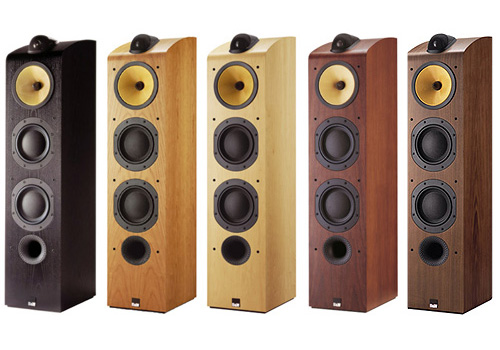
The vivid, sharply defined imaging overturns completely the miniaturised, box-garden impression one might associate with slim pure Hi-Fi systems. The sound quality is enough to make my TAG McLaren 60i — a British integrated amplifier that I had rated highly for its sonic qualities — drain of colour and flee barefoot from the room. By any conventional measure, this is simply not the kind of sound you would expect from a stylish, slim amplifier of this type. A life-sized soundstage with convincing depth and solidity unfolds before you — the sort of thing you’d more readily associate with some expensive high-end separates system — and it takes some believing. Particularly noteworthy is the high-speed manner in which the midrange through to the upper bass is rendered: the drive and authority are simply relentless. How many amplifiers, even larger and more expensive ones, could control the high-quality, demanding tweeter of a B&W monitor loudspeaker with this degree of effortless authority?
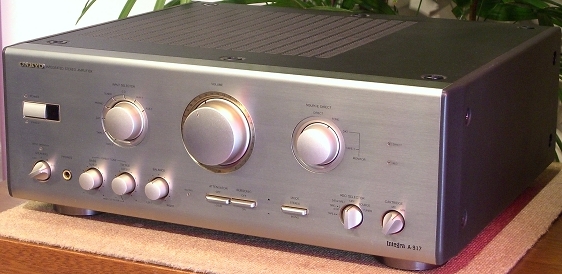
My impression when I used the company’s Integra A-917 years ago was much the same, and indeed ONKYO amplifiers have traditionally been notable for their low-frequency drive compared to rivals in the same class, while the freshness through the mid-to-upper registers was more moderate — a hint of shadowy sweetness and a certain languorous quality being part of the character. In the new digital amplifier A-1VL, however, the blurring of fine detail that was a feature of the old heavyweight analogue amplifiers — that tendency to present the music as one large mass — has been completely banished. The resolution through the midrange and treble, underpinned by ample bass, is very high; the imaging is rendered at high speed with sharp clarity rather than dissolving into vagueness. And because the upper midrange and treble do not push forward in that slightly exaggerated way common to many integrated amplifiers in this class, the result is an exceptionally stable, three-dimensional soundstage with solid phase coherence and very little congestion. With violin music accompanied by piano, lesser amplifiers lacking sufficient drive will often let the treble get overassertive, which flattens the sense of depth and, at worst, causes the soundstage to tip and waver left and right as the tweeter pulls things off-centre — but with the ONKYO A-1VL, there is not the slightest trace of any such instability.
 ポチップ
ポチップ
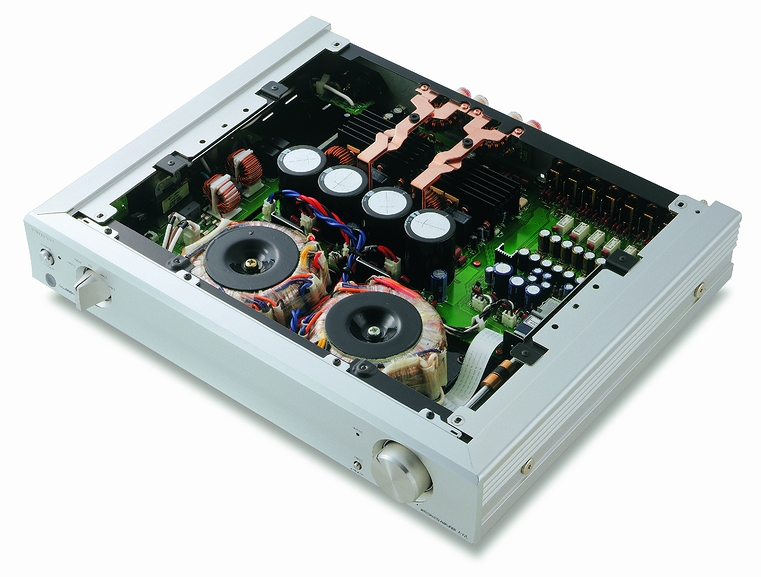
As for the core new technology — the “VL Digital“ — there is none of the lightweight, plasticky, somehow unconvincing tonal quality that tends to taint other manufacturers’ digital amplifiers, SHARP’s among them. You would honestly struggle to identify it as a digital amplifier at all, were you not told; it presents a thoroughly orthodox sound. The richly satisfying presence, which speaks of Onkyo’s sonic tradition and a grounded approach to sound design, has an analogue-like naturalness woven organically into the overall musical coherence — and yet it simultaneously brims with the cutting edge and freshness that a digital amplifier ought to have.
Speaking frankly about my personal preferences: there is a gloss to the treble, and compared to live sound it can feel at times as though the top end has been polished just a little too brightly. (Note added later: this was largely due to the loudspeakers used in combination — the B&W 704 and the German ELAC CL310.2 JET.) But that is also part of this system’s beauty, and a slight personality of its own. It is a matter of tonal texture, and quite different in character from the sort of treble emphasis that disrupts the phase. With the A-1VL and C-1VL used together, the expressive shaping of the music through the midrange feels somewhat understated compared to European audio equipment, and if I am to be greedy, a little more active sense of “song” — of music being sung — in the musical dimension would leave me with nothing further to ask for as a listener. But then again, this is precisely where one catches a faint whiff of Japanese-ness, and it can equally be seen as an intelligent, composed restraint befitting a product of genuine sonic quality. Besides, I think the tonal balance in this area is quite easily compensated for by the choice of speaker cable and loudspeakers.
 ポチップ
ポチップ
On the question of loudspeakers: pairing the system with ONKYO’s own products — such as the ONKYO INTEC275 D-302E, which earned outstanding praise in leading European specialist publications — is certainly an option, but personally I think pairing it with higher-priced overseas monitor loudspeakers — the B&W 800 Series and so on — would draw out the potential of this system at an even higher level.
 ポチップ
ポチップ
The A-1VL leans towards the cool, monitor-like, accuracy-oriented side of things, yet it is by no means at a loss when it comes to warmth and atmosphere. The distinctive deep tone that underpins the background of the soundstage — the refined sense of colour in its lingering resonance — conveys a new-generation kind of refinement, and makes a powerful impression that Japanese-made Hi-Fi designed and built by Japanese people need not concede anything to products from overseas. And I cannot help but feel a genuine delight that many who hear this system will surely agree: it is a fitting demonstration that Onkyo, as a Hi-Fi manufacturer, is staging a remarkable comeback. The ONKYO A-1VL is, I think, a splendid piece of work — and the first Japanese product in quite some time that I have found myself genuinely wanting to bring home.
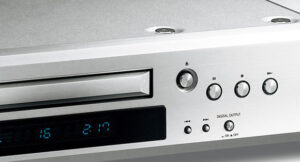
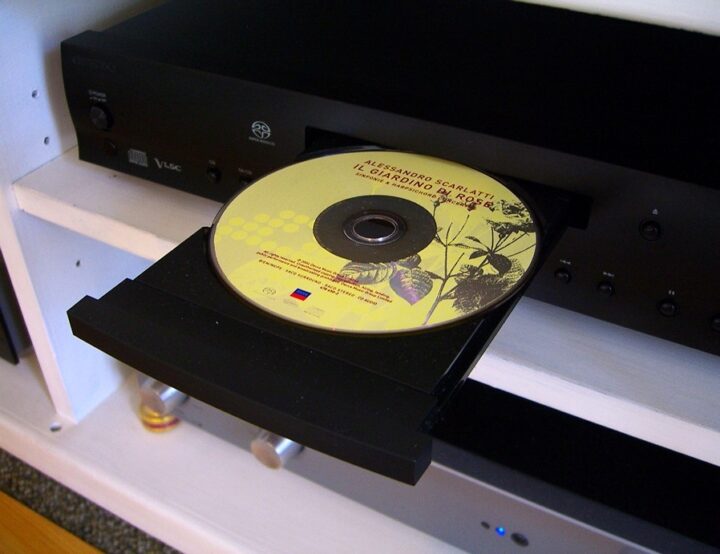
The CD player C-1VL shares the same design language as the A-1VL. As a dedicated CD player in the ¥100,000 class — a category where new releases have become increasingly rare of late — it is an attractive proposition not only as a natural ONKYO partner but also as a candidate to pair with slim European integrated amplifiers.
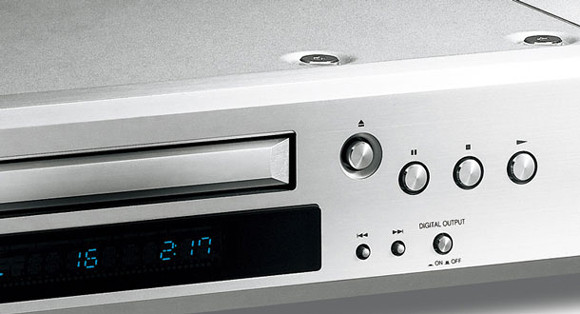
The attention paid to timing accuracy — arguably the most important factor in musical playback — clearly counts for a great deal. The transparency and the wonderful imaging and phase coherence that the C-1VL + A-1VL combination produces appear to depend to a significant degree on this CD player’s design, and I had the impression that the A-1VL and C-1VL have a relationship in which each compensates for the other’s weaknesses while reinforcing each other’s strengths. As a general observation: if you are using only one component from an amplifier and CD player pair designed together, and you cannot quite get a satisfying sound — say, the amplifier alone feels too laid-back, or the CD player alone causes listening fatigue or sounds top-heavy — this may well indicate that the other component is not a good match with whatever you have paired it with. When using the VL Series, I would recommend, if at all possible, using both the A-1VL and C-1VL together as a set, in order to draw out the full quality and precision that this product is capable of.
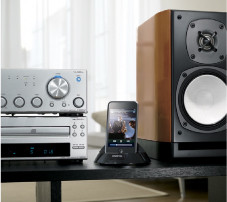 As an addendum, I will say a few words about the INTEC275 Series and INTEC205 Series, which launched in March as lower-tier mini/hi-fi component systems sharing the same digital amplifier design concept. The INTEC205 retains the sweeter, more mellow character of older Onkyo products, while the INTEC275 A-933 + C-733 combination inherits the sonic direction of the VL DIGITAL series with a noticeably crisp, well-defined presentation — and when paired with ONKYO’s own loudspeaker ONKYO D-302E, the impression is even cooler and faster than the A-1VL + C-1VL. The INTEC275 is half the size and half the price — I would like to say that the sound of the A-933 + C-733 comes close to matching the A-1VL + C-1VL, but that would really be pushing it. Listening to them side by side, you do sense that the lower-ranked model has its limits, as you would expect. That said, even the INTEC275 series offers a highly capable, contemporary-sounding performance with excellent resolution and cutting edge, and represents outstanding value for money as a modern hi-fi component system.
 ポチップ
ポチップ
When it comes to the deeper musical richness that lies one step beyond pure Hi-Fi, however, the difference is real. The depth of soundstage, the rendering of cold and warm, hard and soft — the inner resonance and rich musicality that go beyond surface-level sonic freshness — these are areas where the A-1VL and C-1VL combination demonstrates qualities that are sufficient to make the class difference between a hi-fi component system and separates clearly felt. As a serious, prestige product on which Onkyo has staked its reputation, the qualitative gap between the A-933 × C-733 and the A-1VL × C-1VL — particularly in terms of expressive power — is unmistakable.
 ポチップ
ポチップ
This may be something of a provocative suggestion, but speaking as a personal recommendation to fellow music lovers: rather than immediately buying the C-1VL, I would suggest either delaying that purchase by six months, or making do in the meantime with an inexpensive stopgap source — such as a generic slim Pioneer DVD player, or a lower-tier model like the C-773 or ONKYO C-7030 — accepting a compromise on the digital source for now, and using the budget that would otherwise go on a complete INTEC275 setup to get the superior A-1VL instead. Stretching slightly to acquire a higher-end component that opens up a new world of sound will, I believe, make a difference to the quality of your musical life that goes well beyond what the price difference alone might suggest.
 ポチップ
ポチップ
As a footnote: the A-1VL and C-1VL are not products designed solely for the Japanese domestic market — they are global products in ONKYO’s international strategy. Their European selling prices are €1,990 for the A-1VL and €1,490 for the C-1VL. Converting to Japanese yen, that is approximately ¥280,000 and ¥210,000 respectively (as of March 2005). That alone should give some sense of the level of quality on offer. Don’t you think Japanese consumers are, in a way, rather fortunate to be able to buy a product of this calibre at such a reasonable price?
 ONKYO (A-1VL + C-1VL / C-S5VL / DAC-1000)Compact Pure Hi-Fi
April 14, 2005
ONKYO A-1VL: overwhelming demand leaves manufacturer unable to keep up with shipments.
I was rather surprised. Having written the entry a little while ago — and having let slip in part of it that I intended to buy one — I finally placed an order for the integrated amplifier ONKYO A-1VL at my dealer yesterday. Then today an email arrived: out of stock — and the expected delivery date is late May.
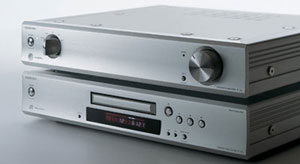
I had written a rather enthusiastic audition report, and yet I had been vaguely puzzled, as the person who introduced the product, that no one on any blog or forum seemed to be posting about having actually bought one. It turns out everyone who wanted to buy it simply could not… orz In any case I have at least put in a reservation. In the meantime, I find myself rather drawn to the valve integrated amplifier Valve300 from Tokyo Sound ex-pro, which is another thing currently on my mind.
【ONKYO A-1VL & C-1VL — In-Depth Review】
A-1VL/C-1VL Launch|A-1VL (Part 1)|A-1VL (Part 2)|C-1VL
Auto Translated by CS4.6