I mentioned it briefly the other day, but at the end of December I purchased a new speaker cable for my main system. The manufacturer is SILTECH, the Dutch brand known for its silver cables. The model is the FT-12G3 — a 1.5m pair with a list price of ¥158,000. It uses SILTECH’s third-generation mixed conductor of pure silver and pure gold, and is a discontinued, top-of-the-line high-end cable. I had heard it some years ago at the LIVINADIO section of the old Yamagiwa Tokyo flagship store and was utterly captivated by the sound, and had been wanting one ever since — though at the time the price was simply out of reach.

 Shortly after that, the SILTECH distributorship transferred to Harman International, but the previous distributor, Nicole Marketing, still had a small remaining stock of the old models from before the changeover, and had been quietly continuing to sell them on their website even after the distributor change. The stock was beginning to look as though it would run out before long, however, so this time I took the plunge and bought the SILTECH FT-12G3.
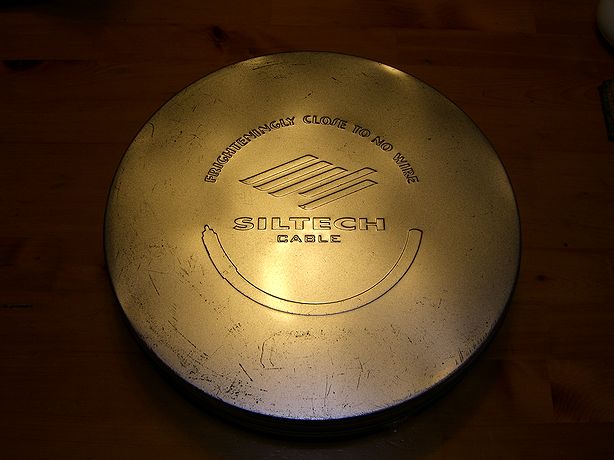
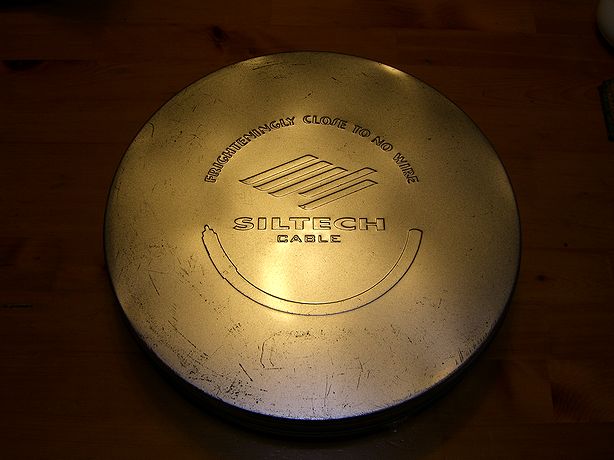
The speaker cable arrived stored in what looked like a film canister of the sort used to keep movie reels, and when I opened the lid there was, for some reason, an overwhelmingly strong smell of cresol… The can itself was quite battered from what must have been years of storage, but the contents were in pristine condition. It seems that not only SILTECH, but also their Dutch sister company Crystal Cable (whose CEO is the wife of SILTECH’s president) likewise ships their speaker cables in film canisters.


 ポチップ
ポチップ
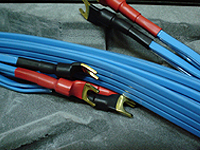
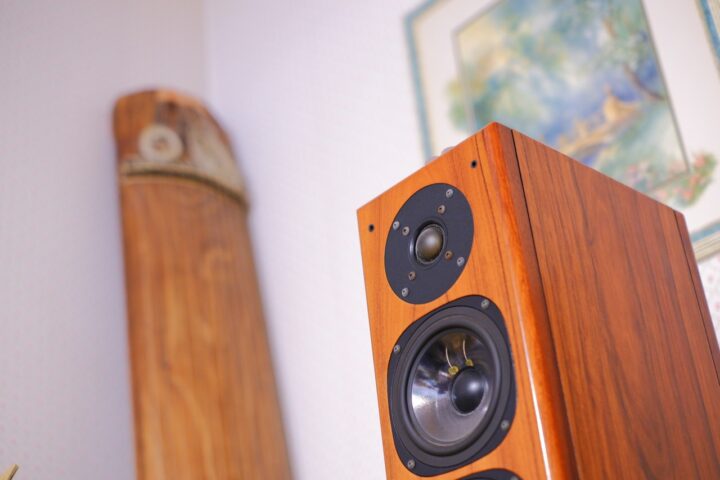
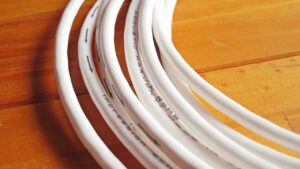
In terms of appearance, the FT-12G3 is a slim flat cable with a vivid blue jacket, and at first glance it does not give the impression of the weighty, luxurious finish one often finds on high-end cables — rather, it has a clean, unassuming design that would sit happily in a tastefully decorated room without calling attention to itself. The Y-lugs at both ends are WBT, made in Germany. The fit and finish of the connectors is noticeably more precise than the stock terminals on the TAG McLaren F3-10SPK (1.5m pair, ¥53,000) I had been using until now, and they make considerably better contact with the speaker binding posts. The lingering smell of cresol was a little disconcerting, but in any case I connected the cable between the TAG McLaren 60i (under construction) and the Vienna Acoustics Mozart T-2 and set about listening.
My first impression: the tonal quality is simply beautiful. The SILTECH instructions noted that a minimum of 24 hours of burn-in is required, and I had prepared myself for the sound to be somewhat underwhelming at first — but from the very first note it was on an entirely different level from anything I had heard before, in terms of both soundstaging and tonal transparency. The contest was decided in an instant; the F3-10SPK was left without a leg to stand on. ※ The F3-10SPK has since been relegated to the secondary system.
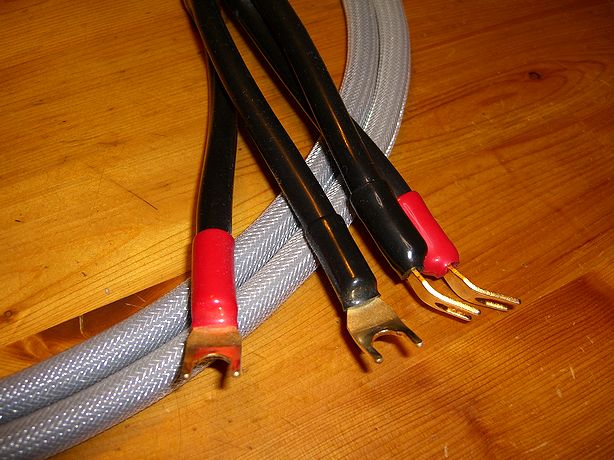
The British-made TAG McLaren F3-10SPK (under construction) is itself a cable of a very high order, and at least when compared against the cut-to-length cables in the ¥1,000–3,000 per metre range that I have tested in the past, the TAG McLaren is simply in a different league in terms of sheer information retrieval and bandwidth, regardless of differences in tonal character or personal preference. This had already led me to conclude that a decent cable in the tens-of-thousands-of-yen class must possess some fundamentally different quality compared to budget cables — yet stepping up to the level of SILTECH takes things even further beyond that, to a degree that feels like comparing the moon with a tortoise. I was amazed that this much sound was waiting inside my own system (which I had thought was already reasonably good), while at the same time realising that a single cable had exposed, quite nakedly, just how much of the system’s potential I had been failing to unlock all along. Once you have heard this sound, there is simply no going back. That is the impression it left me with.
The FT-12G3’s tonal character has that bright, lustrous quality distinctive to silver cables: piano takes on a brilliance closer to the real instrument, and the entire soundstage is filled with a spilling-over quality of reverberation and moisture. The vocal range is astonishingly sensuous — so real as to create the illusion that one could reach out and touch the singer. On the other hand, string instruments may be almost too lustrous, with overtones dissolving into the reverberant tail in a way that could strike some listeners as slightly artificial.
The frequency range is startlingly wide. I genuinely thought my legs might give way. The resolution and pitch accuracy in the bass register, and the depth to which it reaches, are extraordinary. Living in a flat where playing at high volumes is difficult, I had never paid much attention to the quantity or quality of bass reproduction — but what I am hearing here is not simply more bass: within a richly resonant low end, the fundamental tones descend flatly and deeply. The result is a stage image with far greater realism than anything I had experienced before — one in which the very architecture of the soundstage is entirely different from that produced by cheaper cables. By comparison, one can hear that with other cables the phase of the bass is simply not being controlled in the first place, leaving the pitch either slightly adrift through lack of body, or as an indistinct, bloated mass with quantity but no definition.
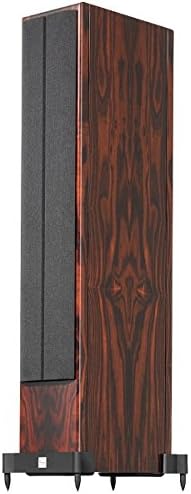
The bass boost introduced by the Vienna Acoustics Mozart T-2‘s dual bass-reflex design has always tended towards phase confusion, and I had more or less resigned myself to this as a limitation of the speaker’s design — but I now notice that with a good cable it presents no problem whatsoever, and even the resonance of the piano’s lower strings becomes clearly audible well into the lower register.
The midrange is bright and pleasant to the ear, and manages to achieve simultaneously a fast transient response and a naturally rounded touch — which are contradictory qualities, and how they coexist here is something of a mystery to me. And over the entire frequency range there is that spilling quality of reverberation. The musical flow is startlingly natural and smooth. Pitch and melody are rendered with extreme accuracy, accompanied by a richness of resonance, and each individual note breathes carefully as it seeps into the mind — I have never before heard a cable convey “musicality” with such vivid immediacy.
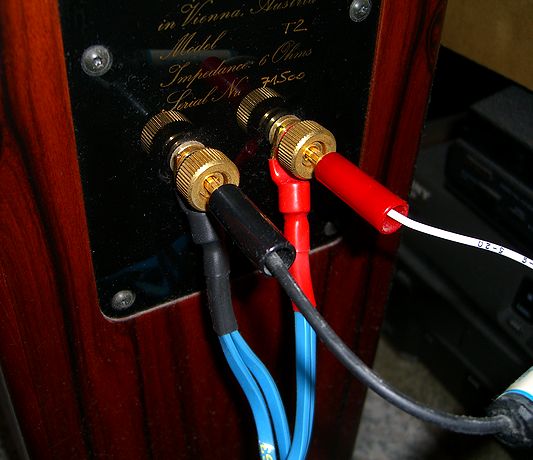
The stereo image has considerable front-to-back depth; one can perceive the piano hammers arranged horizontally, and the subtle tonal differences between the left and right hands are rendered with clear distinction. Inner voices are easy to follow, with each melodic line separating cleanly, which allows one’s ear to reach unconsciously into the deeper structural layers of the music. The bass register is clearly defined and the stage descends with real depth. In the treble, the perceived frequency response has an impression of rolling off in a gentle arc, and the Scan-Speak tweeter never emits any unpleasant harshness. Because there is none of the audiophile artificiality of hearing the treble as if it were on the same flat plane as the midrange — no sense of upper-frequency emphasis — the phase confusion that causes high-frequency images to scatter upwards is entirely absent, and instruments remain steady in their positions, giving a stage image that feels very close to that of a live performance.
And yet the treble is by no means blurred: the level of detail retrieval is, as one would expect at this price, exceptional, and sibilants in vocals and the cutting edge of string instruments are reproduced with high speed — but with so little sense of distortion, and everything integrated so naturally, that there is no harshness whatsoever. The rustle of a singer’s clothing or the background ambience of a concert hall — details utterly inaudible through cheaper cables — are reproduced here as a matter of course; yet because the cable does not labour the point of audiophile resolution, listeners who are accustomed to cables that artificially boost transients and upper-frequency surface detail to create the impression of greater information retrieval may find the hi-fi quality here somewhat understated by comparison.
The overall stereo image is excellent, with a firm and stable centre image — not the kind of artificially sharpened, hard-edged focus, but rather a centre image whose density is satisfyingly precise within naturally contoured outlines. It is a little puzzling that the stereo image should improve so dramatically without having moved the speakers so much as a millimetre with a laser setter, but perhaps it is one piece of evidence that phase disturbances within the cable are causing audible changes in the sound, to a degree that is perceptible in a visual sense as well.
The perceived signal-to-noise ratio and the overall cohesion of the sound are excellent, the whole bound together with a single, unified sense of character; the dream-like, sweet and gentle richness of the reverberant decay, and the gradation with which notes fade into silence, are particularly beautiful. While clearing all the basic sonic benchmarks at an exceptionally high level as a matter of course, the cable does so without making one consciously aware of those elements — and I think one can fairly say it is an extraordinarily accomplished cable, combining high artistic sensibility with musical expressiveness.
Honestly, I personally have no complaints about this speaker cable. The musical talent of those who made it — their musical sensibility — probably surpasses my own. I rarely feel that way about the sound of an audio component, as opposed to a recording by a fine performer, and with SILTECH I am left with nothing but gratitude alongside a genuine sense of defeat. Which is precisely why it would feel presumptuous to find fault, and anything critical I might say would very likely be wide of the mark, reflecting my own limitations rather than any shortcoming in the cable.
I believe the sound of the SILTECH FT-12G3 possesses a kind of value that cannot be measured in money. And this is not a matter of extravagance: the difference in musicality between before and after its introduction is the difference between music that is truly alive and a stage that is merely constructed — between music, and mere sound. With every piece of music I listen to, the emotional impact is simply on a completely different level. And for me, that is the most important thing of all when choosing an audio component.
ポチップ
Musicality, unlike sound quality, is not necessarily something that money can buy, yet true encounters with audio products capable of conveying it fully are rare — which is why, when one does find such a thing, it becomes a kind of treasure for which, in a sense, no price is too high. The FT-12G3 acquired on this occasion was a wonderful cable that, for the first time in a long while, allowed me to feel that “music” with vivid, direct immediacy. And in terms of pure sound quality, given the price, it has reached a level of refinement quite unlike anything I have heard before.
It is frustrating to have to admit, but I do think that a well-realised high-end cable inhabits a different dimension. If the components it is connected to are not worthy of its sound, it may end up exposing their crudeness — but by the same token, one might equally say that without a cable of this calibre, those components will never realise their true potential. I would not go so far as to say that certain things can only be expressed through the cable — but within a given system, a world exists that inexpensive audio cables will never be able to unlock, however long one waits; a spring of music lies there. I want those who care deeply about audio and music to know that such a world exists, and I hope that anyone with even a little room in their budget will actively seek out high-end cables, domestic or imported. An expensive cable, if you have the money, can simply be purchased — but the musical emotion and experience one gains from it is too precious to measure in monetary terms, and can become an irreplaceable, once-in-a-lifetime encounter.
 ポチップ
ポチップ
Finally, I would like to reproduce a review by the critic Mr Fukuda, which appeared in issue 97 (Summer 2000) of Audio Accessory magazine — a publication I have subscribed to regularly since my school days. His impressions of the FT-12G3 are, incidentally, almost entirely in agreement with my own. Reading his words, I had been slightly apprehensive that the sound might be somewhat more relaxed than I was hoping for, but the openness of the presentation means it is soft without sacrificing separation, and there is no sense of congestion.
“Rich in volume, smooth, with speed and a moist nuance”
https://www.phileweb.com/
SILTECH is a Dutch cable brand distinguished by its pure silver conductors. The FT-12G3 has a flat construction, measuring 23 × 2.5mm. Four conductors arranged in parallel are used in alternating pairs for positive and negative. Its response is smooth in outline, characterised by a bright, lustrous impact and a soft, richly voluminous expression. The bass has a flexible, energetic density, is large in scale, and extends well into the deep bass. Damping and resolution leave something to be desired, and this is not a sharply cutting type — but it has speed without hardness. A moist, mild image. Quality is high, but those seeking tautness and clarity may find cause for dissatisfaction. The vivid, breathing quality of vocals and the nuanced, open presentation carry a strange realism.
【Ratings】
◎ Treble delicacy · Mid-bass volume · Artistry · Tonal softness · Tonal balance
○ Neutrality · S/N · Naturalness · Clarity · Intelligibility
△ Realism · Damping
Auto Translated by CS4.6

List of comments (2)
良いものを購入なさいましたね。
僕はこのメーカーの姉妹ブランドであるクリスタルケーブルを、ケーブル作成の参考にしています。
今回は本当に成功でした(^^)。シルテックのケーブルは極度のヨーロピアントーンで個性の強い物ですので、万人に薦められる物ではありませんが、クラシック音楽を好まれる方なら大抵は感銘を受けると思います。
先に店頭で試聴してある程度キャラクターを理解していた分、結果的に失敗せずに済みました。このクラスになると試聴をしないではとても怖くて買えませんが、それでも試聴できる機会自体が本当に少ない(汗)。
経験上、ハイエンド機器の性能を活かせるまともな音のするケーブルは、最低数万円~からだとは思うのですが、好みや機器との相性を外すと洒落にならないのと、市販品は価格と音質が見合わない、作り手の思い込み的な音のするブランドが結構あるので、この辺りの選択が難しいところです。変なケーブル買わされるくらいなら自作の方がマシだと思います。
構造や導体も大切ですが、所詮素材の原価なんて二束三文。結局は音決めをする人のセンスや感性の比率が大きい。そんな風に聴いてしまうと、SiltechやCrystalCable含め、国際的に定評のあるメーカーの方が結果的にバランス感覚に優れ、間違いが少ないのかなぁと思ったりします。