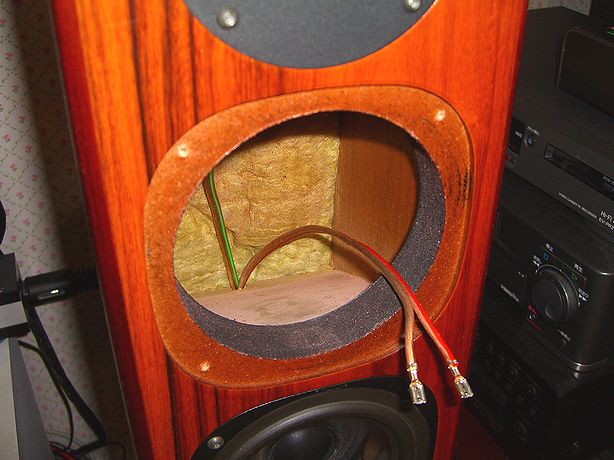
My Vienna Acoustics T-2, purchased eight years ago, has been intermittently misbehaving ever since. Every so often, a buzzing, crackling resonance noise emerges from the bass reflex port on one of the speakers. It only appears with certain CDs — classical piano, clarinet, horn, and the like — and sometimes doesn’t manifest at all depending on humidity or temperature, so the reproducibility is low and I’ve never had it properly repaired. For the past several months there had been almost no trouble, but today — perhaps due to the atmospheric pressure changes that come with the first storm of spring — the buzzing from one speaker has returned…..
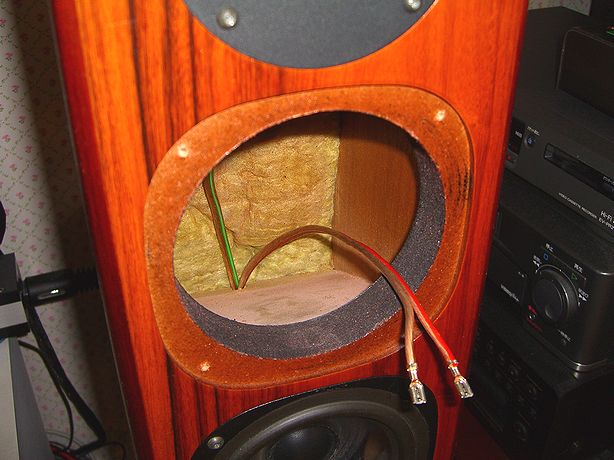
That said, the thought of packaging up a speaker that weighs over 30 kg per side — including the ELAC damping material ELAC LS FILLER stuffed inside — shipping it off to the importer C.E.C, and then being handed a repair bill of however many tens of thousands of yen, is, to put it honestly, more than I can face. With that in mind, I decided today to take matters into my own hands and, summoning some resolve, remove the speaker drivers to try to get to the bottom of things myself.


 ポチップ
ポチップ
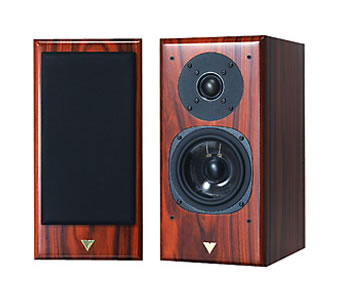
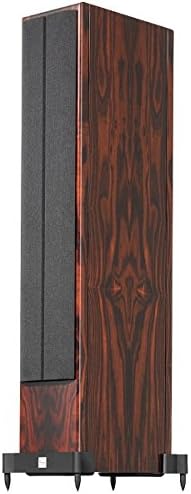
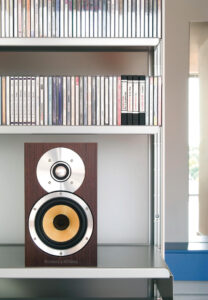
The Vienna Acoustics T-2 has a somewhat unusual dual bass reflex design, with two ports positioned at the top and bottom of the cabinet. The driver configuration looks like a 3-way from the outside, but the two woofers below the tweeter apparently operate in what is close to phase alignment (note: with some degree of difference), making it effectively an unconventional 2-way. Incidentally, the successor model, the Vienna Acoustics T-2G, was redesigned as a fully separate 3-way configuration, with the bass woofer moved away to its own lower section.
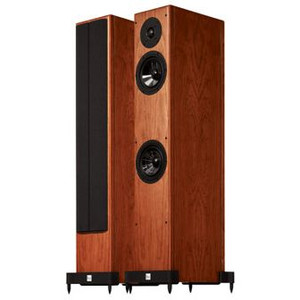
The lush, richly resonant midrange — with its slight admixture of out-of-phase components — that characterises the older T-2 seems to me to stem in large part from the subtle phase irregularities inherent in this in-phase multi-driver arrangement. The T-2G, now a proper 3-way, is wider in range and higher in resolution, but in exchange the T-2’s particular richness and its rather theatrical musicality feel a touch more restrained — the sound has become more composed, cleaner, tidier; it has stepped back one pace, so to speak. (The Vienna Acoustics T-2G Limited Edition, of which only 150 pairs were sold worldwide last year, was apparently in a completely different league from the standard production T-2G in terms of sound quality — unfortunately I never managed to encounter one in person. Apparently, of the 150 pairs, 100 sold in Japan.)
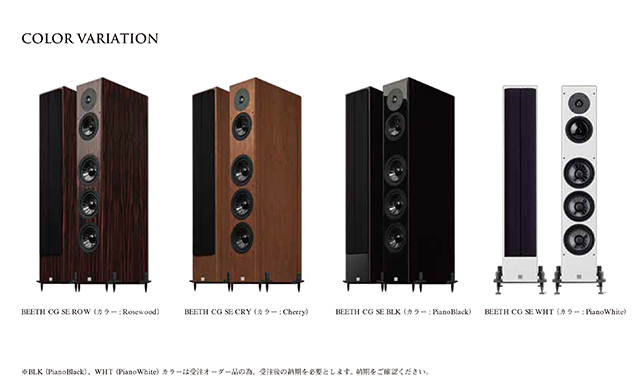
The higher-tier Vienna Acoustics T-3G uses five drivers in an unconventional 3-way configuration, with a triple in-phase woofer arrangement handling the bass. Its character takes the T-2’s distinctive richness of resonance and amplifies it further, with a lively, animated musicality. My own T-2, if anything, resembles the full-bodied tonal quality of the T-3 and T-3G more than it does the more refined T-2G — personally I think of it as something like the T-3G scaled down to half the size. ※ Naturally, the older T-3 without the G designation resembles the T-2 even more closely, and that goes without saying.
Let me return to the fault. This buzzing, crackling noise… I’ve been bothered by it for some time but simply cannot pin down the cause. For the moment, since it was only audible from the left speaker, I tried swapping left and right — whereupon the noise duly appeared from the right side instead. So the cause lies with the speaker itself, and not with the amplifier or any other component in the chain.
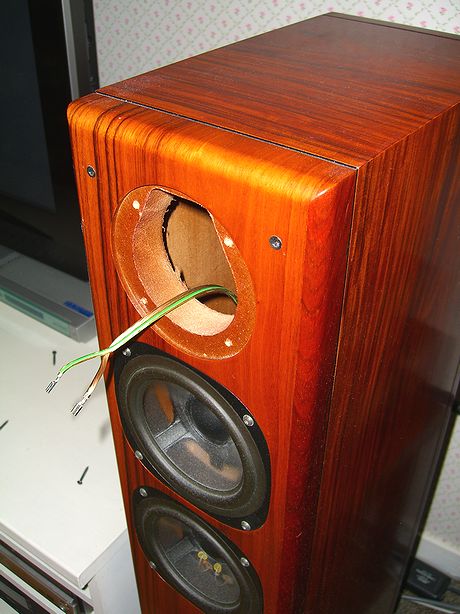
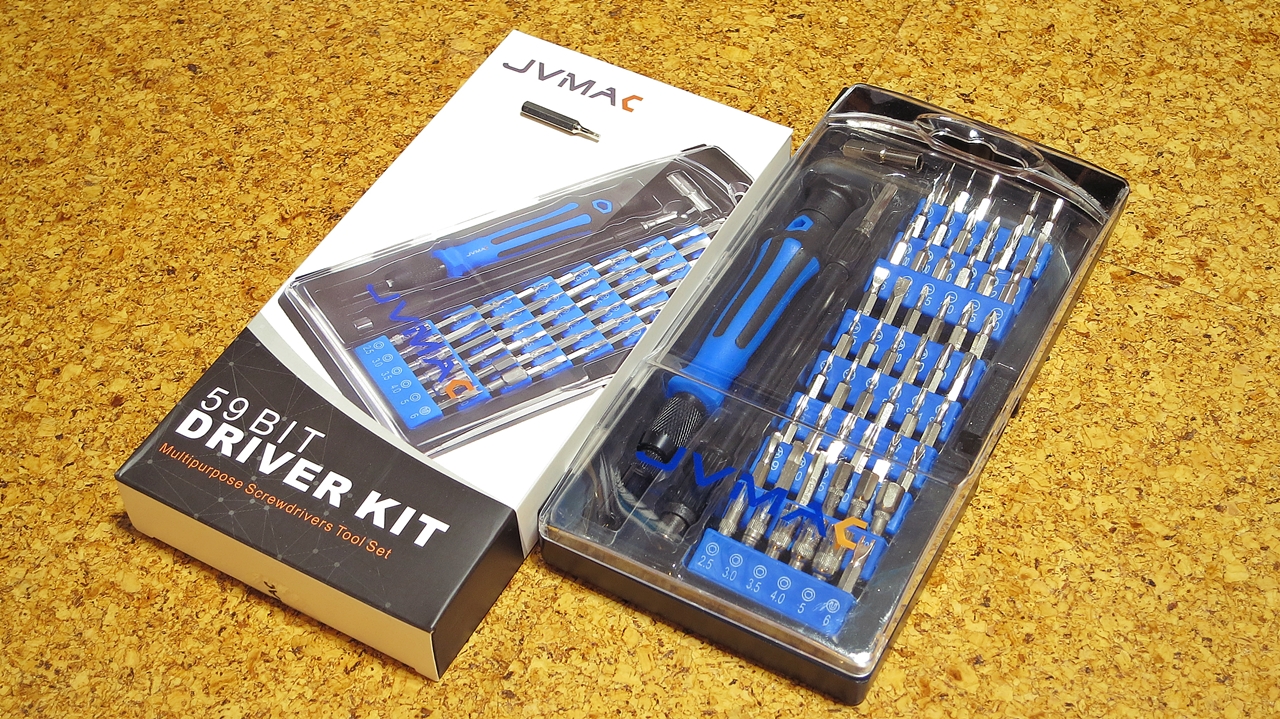
The noise is coming from inside the bass reflex port that sits directly behind the tweeter — the upper of the two ports. My first thought was that the plastic port itself might be resonating, so I unscrewed it and pulled it free of the cabinet, but the symptom didn’t change in the slightest. Next I decided to take the plunge and remove the tweeter, swapping left and right. It must be about seven years since I last touched it. Removing and refitting drivers almost always changes the sound — whether for better or worse is anyone’s guess — so it’s not something I particularly want to do, but in this case there’s no getting around it. For the record, removing the drivers requires a T10 Torx (hex lobe) key.
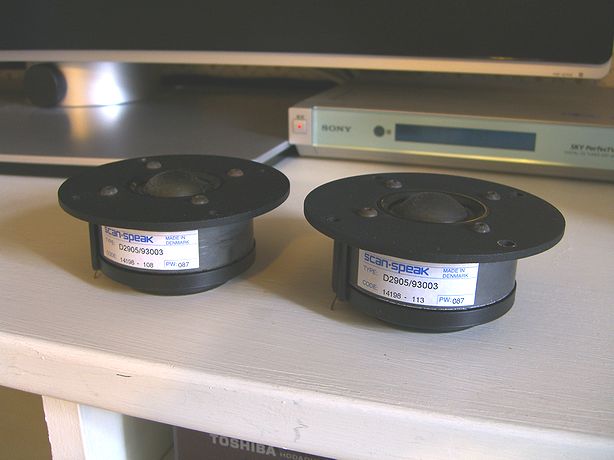
With Vienna Acoustics, the drivers are not soldered to the internal wiring, so they come away easily if you simply pull the connectors off carefully. The tweeter turns out to be what appears to be an off-the-shelf Scan-Speak D2905/93003. Made in Denmark. A 25 mm silk dome tweeter. At the linked page it is listed at 33,000 yen a pair as a component. I don’t know the full details, but rumour has it that swapping in a higher-grade tweeter improves the sound further still. It would cost far less than replacing the entire speaker, so if the D2905/9700 series or similar could be fitted without modifying the crossover, I’d be rather tempted to try it at some point.
As for the result of the swap — unfortunately, no change in the symptom. The tweeter appears to have nothing to do with the buzzing. The last time I removed the tweeter, the mechanical stress introduced during the original factory fitting with a power driver was evidently released, and the chronic distortion from the tweeter that had been plaguing me at the time cleared up completely — a great success. This time around, swapping left and right somehow improved the sound slightly as well, for reasons I can’t quite explain. Whether it’s a matter of matching with the respective crossovers, and whether I’m really allowed to just swap drivers around like this, I’m honestly not sure — but at least the volume balance between left and right seems fine for the moment.
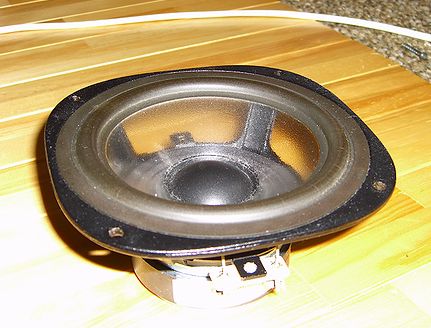
So, on to the next step: swapping the mid-woofer units left and right. I’ve never removed the T-2’s drivers before. The unit is a beautifully transparent skeleton XPP polypropylene woofer. Touch it and you find it’s a surprisingly soft, elastic material, and the distinctive bouncy, pliant tonal character common to all Vienna Acoustics speakers is unmistakably a product of this driver’s personality. It’s made by Norway’s SEAS. There’s no model number printed on it — just a Vienna Acoustics label — so I suspect it may be a custom-order item, though rumour has it that the closest off-the-shelf SEAS equivalent is something like the T14RC or T14RCY (note: the Vienna Acoustics OEM version apparently differs in certain details). There are close-enough drivers available on the open market that could in theory be fitted as a drop-in replacement, so if this one turned out to be damaged, it might be rather interesting to attempt a driver upgrade while I’m at it. (The RCY variants are apparently tighter in the bass, which could throw the tonal balance off…)
One often hears about debris entering the voice coil and causing a buzzing noise, but looking at the driver, there honestly doesn’t seem to be much of a path for anything to get in from outside. At this point I was surprised to look inside the T-2’s enclosure and discover that there is a diagonal partition separating the upper two drivers from the lower one. So even though they are driven in near-phase alignment, the cabinet is actually divided into separate chambers. No wonder that, when you put your ear close, the upper and lower sections sound slightly different — the woofer excursion is visibly greater in one section than the other when drums or timpani strike. And the fact that there are two bass reflex ports, one top and one bottom, is because the cabinet interior is partitioned… The upper section alone is essentially a complete small ported bookshelf speaker in its own right. As a structural analogy, it’s perhaps as though a high-cut full-range floorstander had a Vienna Acoustics S-1 — the HAYDN — sitting on top of it.
At this point I tried playing music with the mid-woofer removed, just for a laugh — and the result actually sounded rather good. It’s somewhat V-shaped in frequency response, yes, but the Scan-Speak tweeter’s delicate, high-resolution, hyper-sensitive character comes to the fore, and the whole thing ends up sounding strikingly articulate and well-defined, rather like a B&W Nautilus 805V — I burst out laughing. I suspect if I played this to people without telling them what it was, quite a few of them would agree it sounded like seriously high-quality audio.
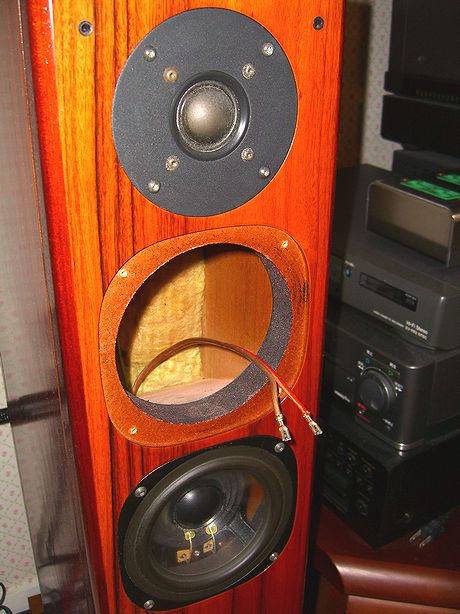
Right then — I removed the upper woofer unit and swapped left and right. Result: the buzzing disappeared completely. If the fault lay with the unit itself, I’d have expected the noise to migrate to the left side, but instead it simply vanished entirely. The sound quality, however, has taken on a distinctive quality of its own — the resonance has increased and the soundstage has opened up considerably. There’s no sense of distortion at all and it’s very pleasant to listen to, but in exchange there seems to be more out-of-phase content, and the imaging has become a touch less precise. ※ The ± polarity connections are correctly wired. Since Vienna Acoustics apparently matches left and right pairs and assigns serial numbers accordingly, perhaps there’s some per-unit crossover compensation going on — which makes me wonder whether arbitrarily swapping drivers between sides is really a good idea. The sound has changed quite dramatically either way. Strictly speaking, I should probably swap the lower driver between sides as well, since it’s presumably matched in characteristics with the upper one, but for today I’m putting that off — it’s too much trouble.
 ポチップ
ポチップ
Addendum, 10 March 2008:
Today I went ahead and swapped the lower woofer left and right as well — the one I’d abandoned halfway through yesterday when I ran out of patience. All three drivers have now been swapped between sides. I also went back and properly tightened the drivers that I’d only finger-tightened yesterday with a straight Torx key, this time using an L-shaped Torx key to apply a firm final torque. The rather loose, expansive sound pulled itself together — tighter, with clearer imaging. I also increased the torque on the tweeter screws slightly beyond what they were before, but the gain in resolution and Hi-Fi precision has come at the cost of a slight excess of tension in the sound. The looser setting was more musical, really. And the bass is lacking. Perhaps because the drivers and enclosure haven’t yet settled into each other. It started sounding a bit muffled and congested, so I backed the screws off just a fraction. The tension eased somewhat, but the bass still isn’t coming through, and there’s a general feeling that the drivers haven’t found their footing yet. It may be some time before things return to their previous condition.
Well, having laid hands on the drivers, this sort of thing is unavoidable, so I’ll wait patiently for the burn-in to bring everything back into harmony. One thing — the connections between the drivers and the internal wiring: I forgot to clean them when swapping the tweeter and mid driver yesterday. Repeatedly removing and refitting drivers risks stripping the cabinet’s screw holes, so I’ll leave those two alone rather than pulling them out just to clean the terminals. The lower driver’s terminals I did clean with solvent. There was just a little contamination — not much, but it was there.


Auto Translated by CS4.6
List of comments (1)
はじめまして。
モーツァルトグランドを愛用する素人愛好家です。
実は、我家でもこの記事と殆ど同じ症状がでておりまして、大変参考になりました。
ありがとうございます(^-^)
へクスローブドライバーを購入して、今週末にでもユニット着脱を試してみようと思います。
トラックバックをお許し下さい。