This morning’s record is a set of Preludes from a series of Chopin recordings by Dang Thai Son, the Vietnamese pianist who won the 10th Chopin Competition. As I have written on various occasions before, Dang Thai Son has been my favourite pianist since childhood, and that has never changed. His Chopin recordings have been appearing at a leisurely pace — as though it were a life’s work — and this one belongs to his early period: a recording made in 1987, when he was 30.


 ポチップ
ポチップ
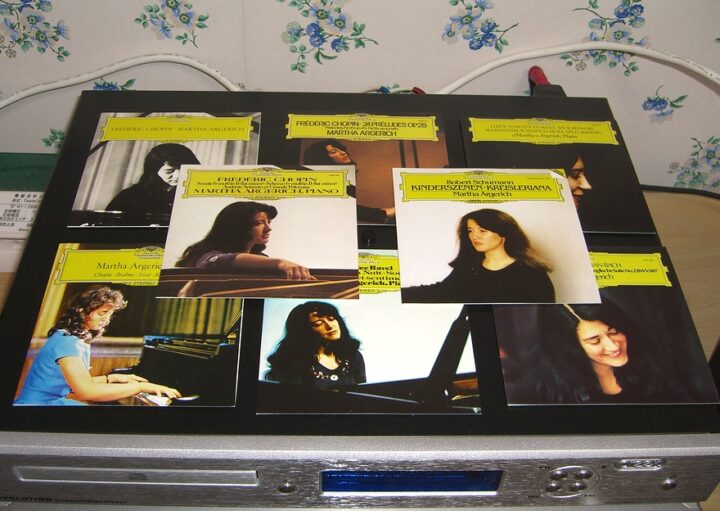
Compared with the live recording of the same work he gave at Yokohama Minato Mirai Hall in 1999 (a public recording broadcast on NHK-FM), this one is, to put it in a word, youthful and fresh. Chopin’s Preludes Op.28 are required repertoire for advanced piano students (note: technically less demanding than Chopin’s Études Op.10/Op.25), and as a result there are a great many recordings by younger pianists — I own a dozen or so CDs myself — yet I know of no other performance of the Preludes played with such richness of colour. In terms of sheer objective pianism, the standard Argerich recording has the upper hand, but whereas Argerich’s playing is mature and shadowed — weighted, one might say, towards darkness — Dang Thai Son’s Chopin brings into sharper relief the bright, fresh imagery of landscape that is written into the score.
 ポチップ
ポチップ
Unfortunately, however, the sound quality from Victor Japan around this period seems to have had something wrong with it: the piano string tension is strangely prominent, giving the recording an odd character. It is clear enough, but something is off. That said, listening back now, I notice it comes down to system matching — with the main system and Sub-system B (to be covered in a future post) it is noticeable, but with Sub-system A — the Audio Pro Image11 paired with the ONKYO A-1VL — the Image11’s clarity curiously compensates for the recording’s shortcomings, and it plays back reasonably well. Among Dang Thai Son’s Chopin recordings from the same period, both this Preludes disc and the Complete Waltzes (VDC-1356) have this slightly odd sound quality, whereas the Complete Nocturnes VDC-5029–30 / VICC-75013 (20-bit K2 remaster) is a comparatively good recording.
 ポチップ
ポチップ
 ポチップ
ポチップ
Victor Japan has periodically released compilation discs drawing a handful of tracks from these Preludes, Waltzes, and Nocturnes CDs, and what is puzzling is that the sound quality differs considerably from one release to the next — and that some of those releases actually sound quite good. Particularly impressive in terms of audio quality was the 1993 disc issued to mark the Crown Prince’s wedding: “Chopin Favourite of Princess Masako (VDC-1157).”
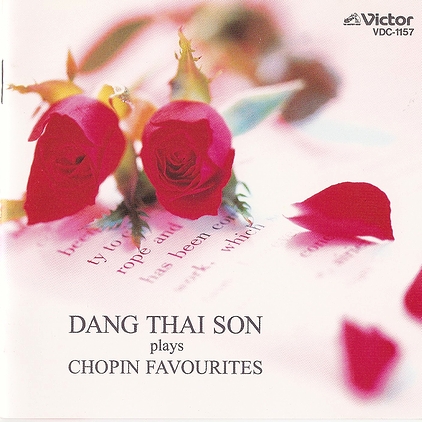
← This is my own copy of the royal wedding commemorative edition, released at the time. I bought it at Suntory Hall during a 1993 recital, and the sleeve artwork and label printing differ from later pressings.
I cannot say for certain whether this is true, but the story goes that Princess Masako’s favourite pianist was Dang Thai Son, and so this was a reissue — with the sleeve and label redesigned as a wedding commemoration — of an existing Dang Thai Son compilation, “Chopin: Famous Works,” originally released in 1987. The sound quality of every track on this disc is superior to the corresponding original, and the waltzes, preludes, and études are completely free of the sonic unease described above. In terms of its tonal character, this limited edition shares the clean, distortion-free beauty of recordings made around the same time — such as the Complete Ballades (VICC-127) and the Complete Scherzos/Impromptus (VICC-160).

 ポチップ
ポチップ
 My guess is that the original master tape itself was fine, and that something odd was done to it during the mastering stage before the pressing master was made — or perhaps the stamper was in poor condition — back in that period (1987). I have bought subsequent pressings of the same disc every few years, hoping the sound might have been corrected somewhere along the way, but there is no sign of any remastering, and they all sound exactly the same. On the other hand, if it were to be digitally remastered via Victor K2, the result would probably be a completely different-sounding disc — which is something I would rather not have happen. There was apparently a US pressing import edition↑ in existence at the time, but by the time I became aware of it, it was already out of print. I do wonder what that one sounded like.
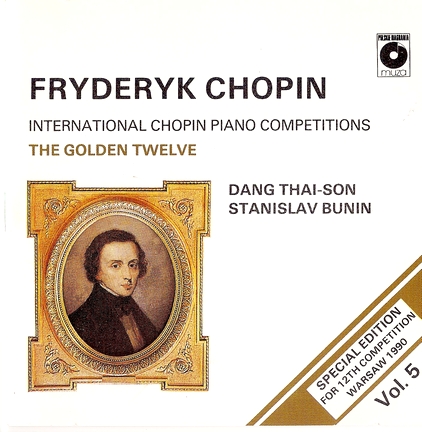 The final track on the disc is Chopin’s late masterpiece, “Barcarolle Op.60 in F-sharp major” — and what is particularly unfortunate is that this Barcarolle, which was coupled with the Preludes, does not appear on the otherwise superior-sounding royal wedding commemorative edition. Of all Dang Thai Son’s Chopin performances, it is this Barcarolle that stands out above all others. It was also the piece that held audiences captive during his second-round performance at the Chopin Competition. The photograph shows the Warsaw Chopin Society disc capturing that competition performance. As a live recording made behind the Iron Curtain in 1980, the sound quality is far from ideal, but one can only wonder what impact it must have had on the audience hearing for the first time that left hand swaying dynamically in 12/8, with the brilliant right hand pressing forward in waves — that particular vision of the Barcarolle.
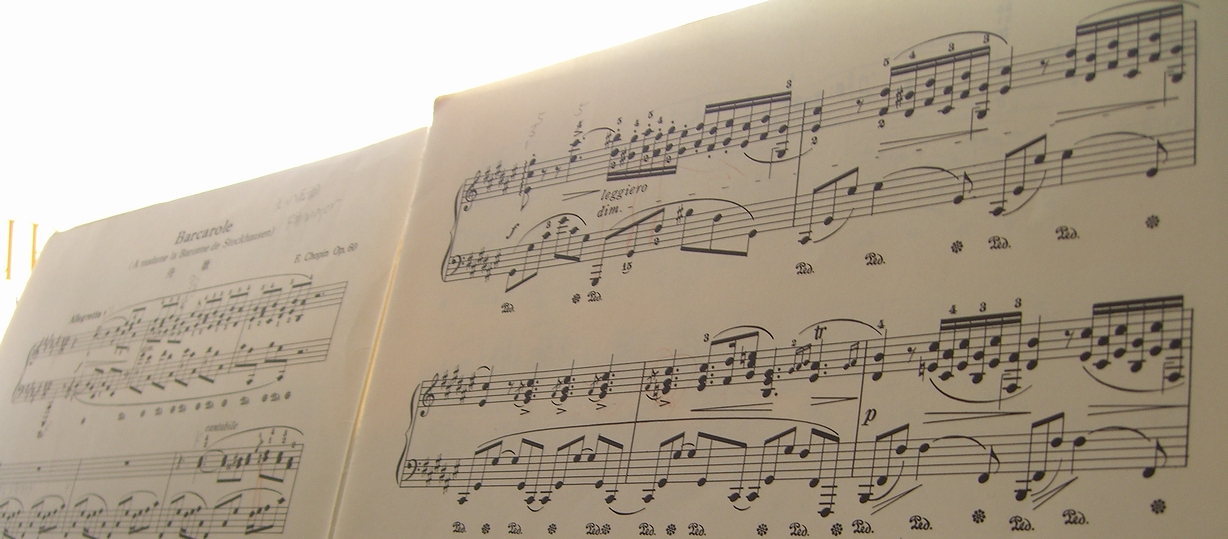
This is purely my own personal image, but the scene depicted in Chopin’s Barcarolle is not — I feel — the small-scale Venetian barcarolle written in 6/8, with its canals and waterways, but something conceived on a far grander scale. If I were to put it into words: the sea and a ship — the left hand is the rocking rhythm of a vessel, the right hand with its intricate chords and ornaments is the waves surging against the hull, the glittering, shimmering light and foam on the water’s surface, the salt wind — the scenes from the several sea voyages Chopin made back and forth to Majorca with George Sand — Chopin, who on account of his tuberculosis was not permitted to enter the ship’s cabin, alone on deck, coughing blood — a piece, as I understand it, in which the contrast between that solitary, ailing Chopin and the magnificent sea and sky stretching before him is what is being described.
In the Barcarolle in particular, and also in works such as the Nocturnes, what sets Dang Thai Son apart from all other pianists is the beauty and finesse of his ornamentation — and this piece, in which demanding ornaments and trills press forward relentlessly one after another, is, I would say, where he is at his most quintessential. For some of the Nocturnes, new recordings have been made in recent years for NIFC — one on a modern piano and one on a period instrument. The white-packaged edition (NIFCCD202) is on a Steinway, and the black-packaged one (NIFCCD020) on an 1849 Érard. Both are deeper in expression than the 1980s recordings, and I think one could fairly say that no finer performances of the Nocturnes exist.

Auto Translated by CS4.6