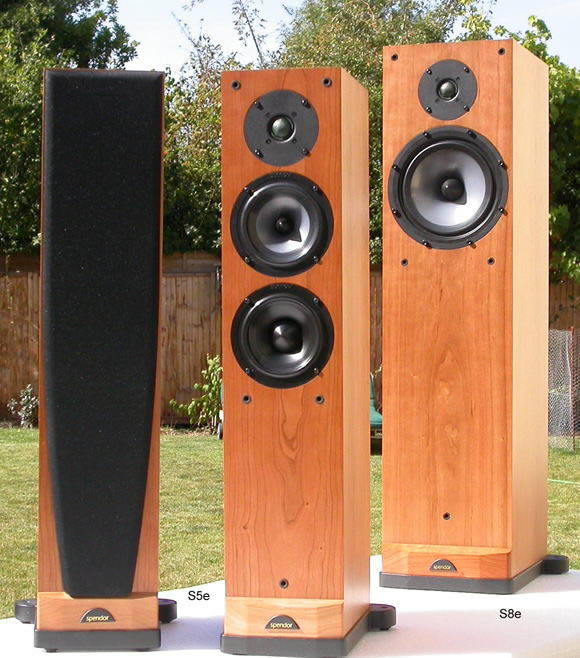
Wait — a miniature-scale system with a floorstander? Yes, this still counts as miniature-scale. Enough of that cryptic preamble, though: this speaker is actually rather reasonably priced for a floorstander. It is, if anything, cheaper than some of Spendor’s smaller bookshelf models — which is reason enough to introduce it here.
The retail price is ¥189,000 (per pair, tax included), with street prices somewhere in the mid-¥100,000s. Whether that counts as cheap is another question, but for the record, the price in the UK itself is £1,295. Remarkably, even with shipping factored in, Japan actually works out cheaper at current exchange rates. Grey market importing is completely defeated here. These things happen from time to time — or rather, it speaks well of the Japanese distributor Triode and their fair pricing.


 ポチップ
ポチップ
Spendor is a traditional British speaker manufacturer with roots in the BBC monitor lineage. The LS3/5A, famous as a BBC monitor, was made by manufacturers including Rogers, Spendor, KEF, Harbeth, and others — but in recent years KEF has broken away from that tradition entirely and reinvented itself as an international brand, while Rogers has been more or less off the radar for some time, only recently reviving the LS-3/5a and its 65th Anniversary Edition. The result is that among the original BBC monitor makers, the ones still genuinely carrying on that old-fashioned, traditional British sound — not just with the LS3/5A but across their ranges — have narrowed down to essentially Spendor and Harbeth.
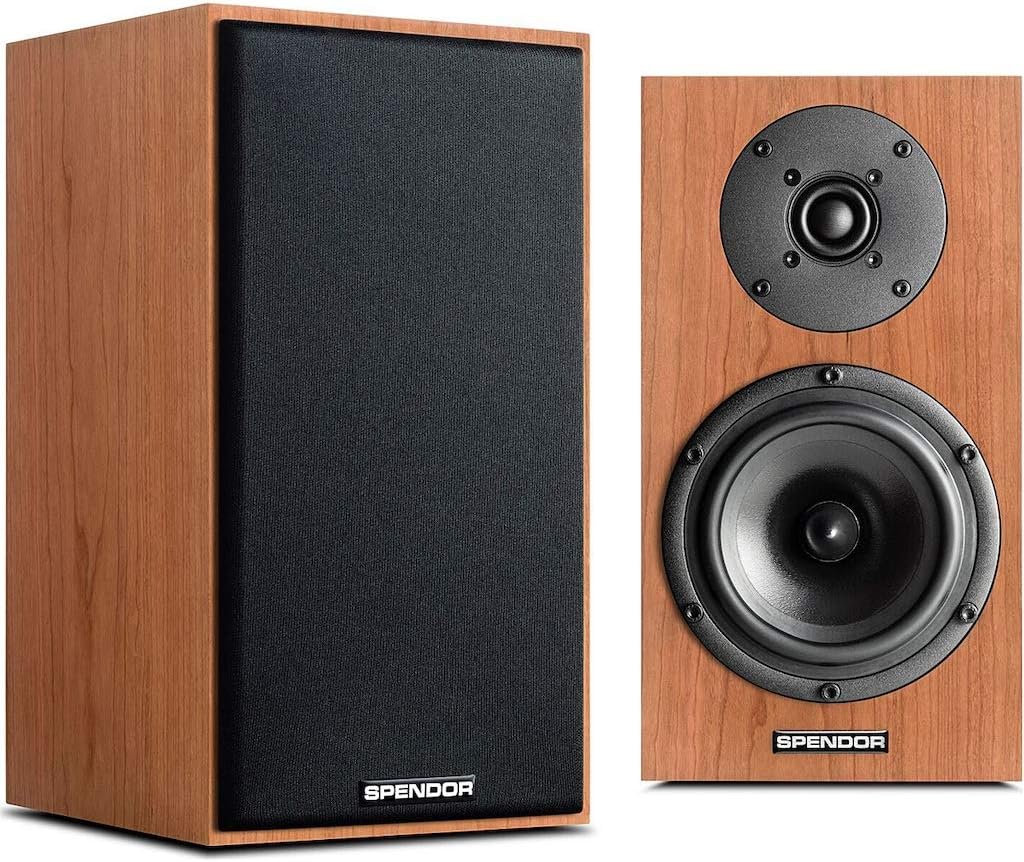

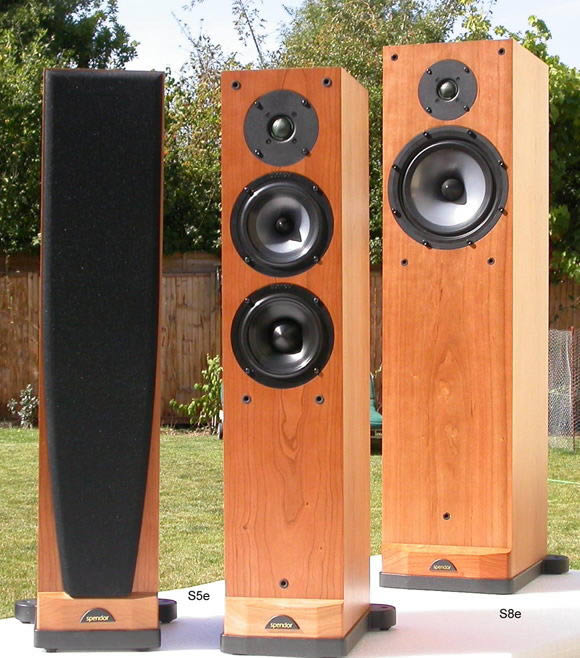
Spendor continues to release new products today, retaining the traditional simple, solid British furniture aesthetic and their signature milky translucent polymer cone woofer, while gradually refining the internals. The A3 is the entry-level model in the “A Line,” their higher-grade range. In Japan it is pitched squarely against Vienna Acoustics in terms of price — and like Vienna Acoustics, speakers at this level are essentially built by taking higher-end components and crossover designs and simplifying the package in terms of size and driver count, rather than enlarging a budget AV speaker into something grander. The result is that even at a modest size, they produce genuinely good sound. Think of it as a compact car built with the same parts as a luxury model. For what it is worth, the A3 was designed as a derived successor to the Spendor S3/5R — itself based on the LS3/5A — drawing on the technology of the floorstanding A5 and the high-end bookshelf SA1.
As of 2024, the Spendor A Line available in Japan includes the compact bookshelf A1, the A2 (which is nearly the same size as the old A3), and the two-way floorstanding A4 and A7.
 ポチップ
ポチップ
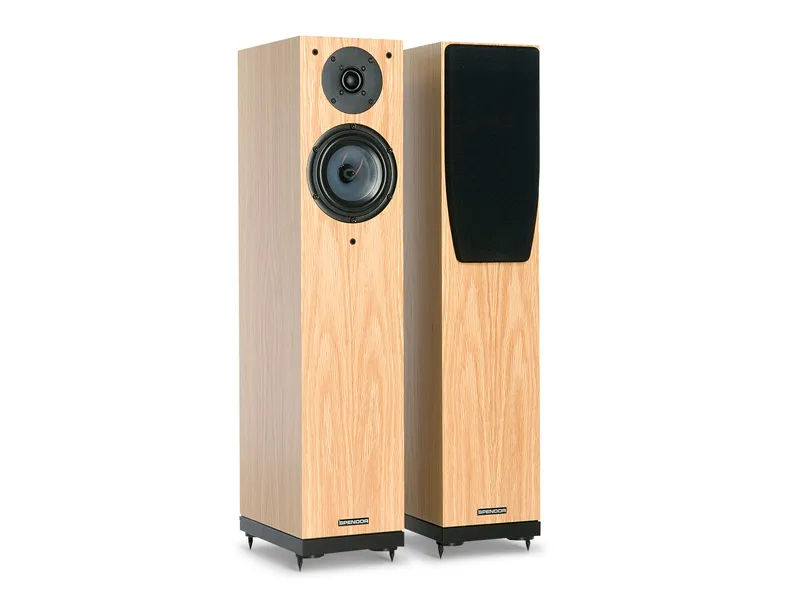
The A3 measures 165mm (W) × 755mm (H) × 250mm (D), with a 15cm polymer cone woofer and a 22mm soft dome tweeter. The enclosure is a slim floorstander that is essentially a bookshelf-sized cabinet stretched vertically — and at 755mm tall, it is actually quite low for a floorstander. Perhaps the easiest way to picture it is that it would sit comfortably on either side of a medium-to-small flat panel TV, say a 26- or 32-inch display, without looking out of proportion. The rear terminal panel is bi-wire capable, with high-quality WBT binding posts. The crossover point is a relatively high 4.2kHz, which should mean the transition between drivers is fairly seamless. Impedance is 8Ω, though sensitivity is 85dB — modest by today’s standards — which perhaps suggests the characteristic leanness of older Spendor designs has been somewhat addressed. Being a floorstander, a good set of high-quality spike shoes will also be essential.
 ポチップ
ポチップ
I have not yet auditioned the A3 itself, as it had only just come out, but having heard the upper-model floorstanders I can say that the Spendor sound is very much alive and well. It sits a step back from contemporary high-resolution Hi-Fi — a natural tonality in the traditional British vein, with a clean and composed character that makes use of the wooden cabinet’s natural resonance. It is the polar opposite of what modern Hi-Fi tends to pursue: the vast dynamic range, the metallic speed and transient snap, the gloss, the artificially inflated soundstage. This is fundamentally a solid sound that does not flatter through the sort of “impressive-sounding trickery” that passes for high fidelity. It will sound frankly dreadful through a mediocre system, so regardless of what the speaker costs, I would very much want to hear it driven by a reasonably well-chosen European-made valve amplifier or solid-state amplifier, ideally something with a bit of character.
As for the music that suits Spendor speakers: British rock and pop are a given, reproduced not with the kind of heavy, punchy modern impact but with all the atmosphere of the era intact. And then, of course, there is classical music. Not so much contemporary classical, but older recordings — Baroque and chamber music seem particularly well-matched. The presentation is refined and thoroughly English in character, though without the richly saturated quality that tends to mark European speakers in general. This is fundamentally a speaker that improves with time — the sort of thing that would suit someone whose life has that same unhurried consistency. A Spendor in a Western-style study lined with years of record collecting and musicological texts… writing that, I find myself wanting one. The only snag is that in Japan, presumably in exchange for the lower price, only the Cherry finish is available. In the UK there are apparently also Light Oak, Dark Walnut, and Black Ash options — it would be nice if at least special orders were possible here.
The Spendor A3 received four stars from What Hi-Fi in the UK. Spendor products are usually five-star regulars, so that is a slight surprise — but it seems the reviewer felt that while the punch was there and the mid-to-upper frequencies were of high quality, the bass quantity left something to be desired. Apparently the A5, which is only 3cm taller, has more headroom in that department and comes out ahead. Well, it does have a woofer, so that is hardly surprising. That said, the A5 is five stars, with the caveat that while the sound quality exceeds its price point in scale, it is too small a speaker to work in a small room — rather a contradiction.
The Hi-Fi Choice review similarly found the presentation almost excessively composed and well-mannered — delicate midrange, good imaging, voices in particular standing out. Treble extension and sparkle were considered unremarkable, bass was on the dry side, and while the midrange quality was high, there was felt to be a lack of urgency and punch, with a slightly soft, somewhat compact manner of expression. Range is moderate, and dynamics are not a strong point. The second half of the review diverges somewhat from What Hi-Fi, perhaps reflecting differences in setup or associated equipment. Personally, the Hi-Fi Choice assessment feels more in keeping with what I understand Spendor to be about. Being a reflex design, bass quantity will be something to manage through distance from the rear wall. The quoted frequency response of around 70Hz–20kHz keeps the range compact — on a par with a small bookshelf speaker — which is perhaps simply the nature of what this is.
All the same, for Japanese living conditions — a compact flat, a modest-sized television, played at relatively low volumes — I cannot help thinking that the A3 might actually strike a better balance than the A5. For now, with the DALI Royal Tower no longer obtainable, the Spendor A3 and the Vienna Acoustics Bach Grand stand as two of the top choices for a compact, traditional, European-sounding floorstander at this price level.
ポチップ
 ポチップ
ポチップ
For my own part, I am perfectly happy with Vienna Acoustics for the floorstander in my main system, so what I would really want as a high-quality bookshelf speaker for a secondary system is either the Spendor A Line A1, or the Classic 4/5 — the direct evolutionary successor to the S3/5R (2007), S3/5R2 (2010), and Classic 3/5 (2017). Both are nearly identical in height at around 30.5cm, and their street prices are not far apart either. They are intentionally offered side by side with different design philosophies, each catering to a different listener preference. Which of the two — the A1 or the Classic 4/5 — I would actually prefer is a question I suspect I could agonise over quite considerably.
Auto Translated by CS4.6
List of comments (1)
貴殿のブログに惹かれ、A3実機到着致しました!音はセッティング中ですが、低音域は結構出てますよ♪因に、ターミナルはバイワイヤ仕様ではなくシングル仕様です。