Part One|Part Two
Here at last is the second half. This is, more or less, the part where I actually say what I wanted to say all along. . .
(4) Speaker and Headphone High-Frequency Reproduction: Capable of Reproducing 40kHz and Above
So it turns out that for speakers too, only the high-frequency reproduction capability is defined. If one were to take a cynical view, would even an inaudibly faint signal count? After all, only children, dogs and cats, or measuring instruments would be able to hear it anyway.


 ポチップ
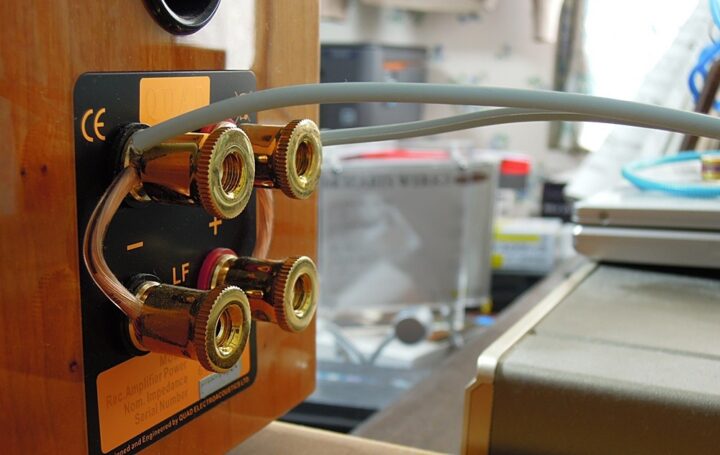
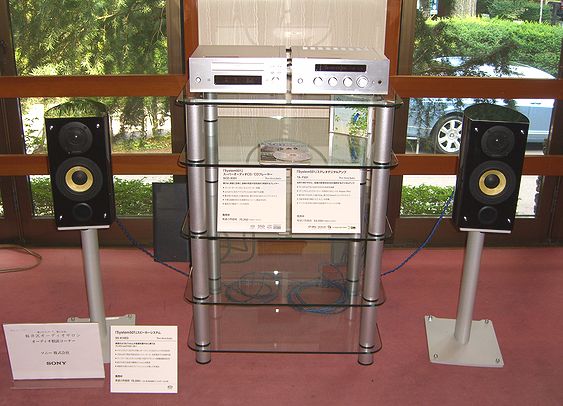
There are speakers out there beyond counting, but among Hi-Fi speakers in the pure audio class costing tens of thousands of yen a pair or more, and among high-performance monitor speakers, might there not in fact be many that are effectively Hi-Res capable, regardless of their nominal spec listings? — or so I dare to suggest, perhaps somewhat provocatively.
 ポチップ
In catalogue data, you will see things written with great conviction such as “frequency response 35–20,000 Hz / ±3 dB” or “50–30,000 Hz / −6 dB”, but a good number of these products predate the spread of Hi-Res audio, and overseas manufacturers who don’t engage in catalogue spec wars often simply haven’t measured or guaranteed performance beyond a certain point in the upper registers — so they measure up to about 20 kHz or 25 kHz as required for convenience, and list that as the guaranteed spec value. Best not to take it too literally.
With the tweeter units found in typical pure audio-class speakers, the ultra-high frequencies are not being deliberately cut by a low-pass or high-cut filter, so in most cases 30 kHz, 40 kHz, and beyond are all coming through to some degree — however, high-frequency reproduction capacity does attenuate gradually as frequency rises, and the degree of that attenuation varies not only with tweeter unit performance but also with how the audible band has been voiced. Some tweeters, even expensive ones, may simply not be well-suited to ultra-high-frequency reproduction in the first place, and in practice it all comes down to the driver units each speaker uses, and the tuning philosophy of each individual manufacturer.
 ポチップ
If you are really the sort of person who cannot help worrying about it, then whether new or old, choosing a model whose catalogue spec explicitly states 40,000 Hz or above would be one sensible approach — but then again, “30–50,000 Hz (attenuation at upper limit: classified)” essentially means you’re expected to fill in the blanks yourself, doesn’t it.
 ポチップ
The SRS-X9 is, if you like, an all-in-one speaker positioned as a supremely luxurious PC audio solution.

Ω
As a personal opinion — and one that differs from the Japan Audio Society’s Hi-Res definition — I believe that a speaker’s ultra-high-frequency reproduction capability is, compared to the importance of sound quality within the audible band, rather a secondary concern, and not something one really needs to worry about at the fundamental level when choosing a speaker.
The Effect of Super-Tweeters
That said, if you do want to experience the refreshing quality of a sound with the ultra-high frequencies deliberately emphasised, then adding a good super-tweeter to your favourite, truly great-sounding speakers might just bring you a measure of happiness. There is always the question of tonal compatibility with the main speakers, but whether they are premium overseas speakers whose catalogue specs don’t exaggerate, or whether the speakers you already own happen to have significant attenuation above 20 kHz, simply adding a super-tweeter will metamorphose them, without question, into “Hi-Res compatible speakers” — just like that.
 ポチップ
Hi-Res Compatible? The Reality of Headphones and Earphones
Everything said above applies equally to headphones and earphones, but in the case of headphones and earphones, practical reproduction capability tends to peter out somewhere around the 10,000 Hz range plus a little more, with sensitivity dropping sharply beyond that — and in fact, quite a few products have even their catalogue-listed high-frequency figures looking rather dubious. Even so, feeding the signal through headphones or earphones of genuinely high quality and with a good reputation for in-band sound quality does convey the sonic difference of SACD or Hi-Res quite clearly — which to my mind suggests that ultra-high-frequency reproduction above 20 kHz is not necessarily the essence of Hi-Res audio. But what do you think?

 ポチップ
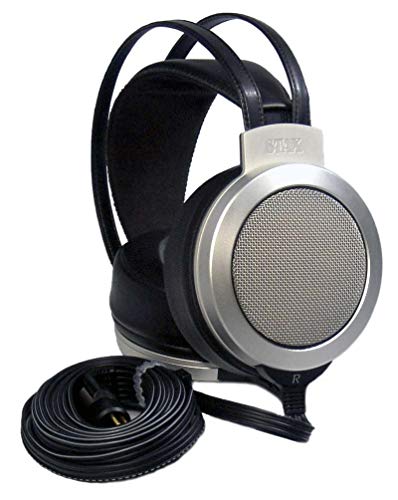
For those who are particularly set on ultra-high-frequency reproduction in headphones, I would personally recommend the ear speakers from STAX — for their wide frequency bandwidth of 7–41,000 Hz, and also for the low sense of distortion that their electrostatic driver design affords. I rather regret having let my pair go before the Hi-Res boom arrived. There are now countless headphones of every description in the current boom, but STAX occupies a class entirely its own among Japanese-made products, admitting no rivals. It is a genuinely exceptional product that holds its own alongside the finest overseas designs.
From here on, speakers, headphones and earphones, amplifiers, and even cables and accessories claiming Hi-Res compatibility will no doubt continue to emerge, primarily from Japanese manufacturers — but the musical frequency range, harmonics included, is ultimately a world of only a few thousand hertz, and the meaningful ultra-high frequencies and upper harmonics that a human adult can actually perceive extend only to somewhere between ten-odd thousand and 20,000 Hz. Moreover, for all that acoustic classical music and jazz are said to benefit most from Hi-Res in terms of listening experience, the frequency content they actually contain is in reality considerably lower than that of electrically produced pop music sources.
And I do wonder whether people are simply ignoring the reality that the high-performance microphones and recording equipment used at the recording stage are generally not capable of faithfully capturing anything much above 20 kHz in the first place. As for Hi-Res remasters claiming to recover ultra-high-frequency content above 96 kHz from analogue sources such as tape or vinyl — in practice, there is either nothing there at all, or very nearly nothing but noise.
The Advantages of DSD Hi-Res Format SACD
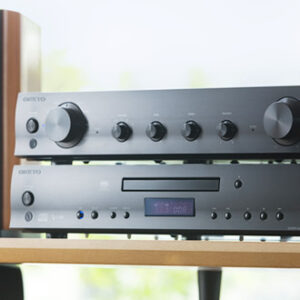
Ah, but please don’t misunderstand — I am not dismissing Hi-Res audio in the slightest! I am, in fact, very much in favour of Hi-Res, and enthusiastically so. Listening to SACD on my ONKYO C-S5VL at home, I constantly find myself thinking wistfully about how wonderful it would be if every CD I own were SACD quality. The sense of air around the performance space, the naturalness of the soundstage, the level of distortion — the difference between CD and SACD is really quite significant. The resolution of pianissimo detail, the trailing edge of notes — that is precisely where the gap between CD and SACD becomes most apparent.
 ポチップ
When you directly compare the same source on a hybrid SACD, the CD is like looking at the world through a pair of spectacle lenses with strong curvature aberration and clipped edges. Perceptually, the stage in front, behind, left, right, and above the speakers sounds as though it is playing within a transparent miniature garden — confined. With SACD, the sound is not bounded at the edges of the space; instead it fades away like a gentle gradient, thinning smoothly into silence. For those of you who are sensitive and attentive to fine detail, SACD and Hi-Res audio will surely repay you well.

Also, as I have written before, I believe there is a considerable advantage — in terms of depth of sensory experience and emotional development — in being able to hear Hi-Res and DSD/SACD audio during childhood, when the audible frequency range is still wider, and so I would particularly like to recommend an SACD player or a Hi-Res compatible network audio player for households with children. These are the kinds of invisible advantages that make themselves felt further down the line. Oh, but please — do not give young children headphones or earphones. There is a very real risk of damaging their hearing before they are even aware it is happening. It is not quite like the rule of “one hour of video games a day” — but with earphones and headphones, I am completely serious: ten minutes at most.
The Essence of Hi-Res Compatible Audio Equipment and the Challenges Ahead
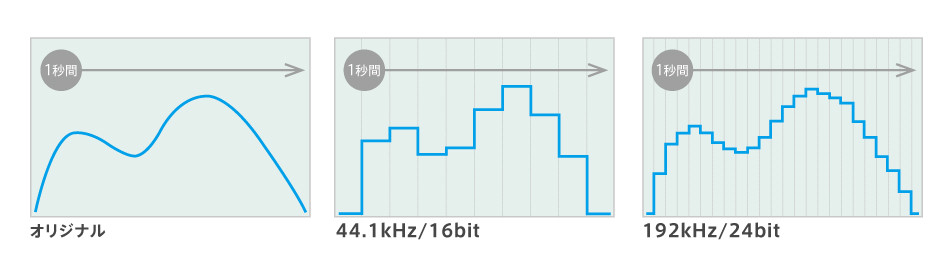
It is easy to assume that the benefit of Hi-Resolution audio lies in its ultra-high-frequency reproduction capability, but this is in fact a secondary benefit among its merits. The aspect that human listeners can actually experience — the essential part — is the fineness of texture within the audible band that comes from the greater number of quantisation bits: the breadth of dynamic range, the sense of gradation, and the sheer volume of absolute information in the detail regions. When it comes to Hi-Res, both those who sell it and those who buy it — definitions included — seem rather too fixated on out-of-band specs, and one cannot help wondering whether there is a deliberate attempt to misdirect people in that direction.
For speakers and headphones, then, I believe that products receiving Hi-Res certification from the Japan Audio Society going forward carry the strong implication of “guaranteeing” their high-frequency reproduction capability. Speakers, headphones, and earphones capable of reproducing 40 kHz and above in a broadly flat manner are, I suspect, almost entirely non-existent — but since the definition does not spell that out explicitly, perhaps it is sufficient for a signal of some impossibly shaped waveform and amplitude to register, however faintly, on a measuring instrument.
Also, products developed with satisfying high-frequency specs as the primary objective — driven by marketing considerations — tend to treat audible-band sound quality and refinement as an afterthought, and that is something to be wary of. In this industry, there has always been a considerable gap between catalogue specifications and real-world performance. No matter how wide a frequency range an inexpensive AV surround speaker may claim on paper, designed as it is with aesthetics and cost as the priorities, it will not deliver the information density, realism, or refinement of a well-made pure audio speaker or a studio monitor.
Even so, by going to the trouble of defining Hi-Res clearly and raising the hardware bar for this new era, there is at least some possibility of lifting the performance floor for those speakers, headphones, and earphone products that were previously rolling off rather alarmingly even within the audible band. And beyond that — as an antithesis to the compressed, paper-thin audio sources that strip away the depth and soul of music — whatever criticisms one might have, I am personally very much in favour of seeing Hi-Res audio become more widely adopted.
Part One|Part Two

Auto Translated by CS4.6