Part 1|Part 2
I felt like I’d seen this logo somewhere before — turns out the SONY product logo had metamorphosed, just as it was, into the official logo.
To summarise my personal impressions: it seems fairly safe to say that Hatsune Miku is Hi-Res, but whether Super Sonico is Hi-Res or not is, I think, still open to debate. And frankly, high-leg is more important than Hi-Res to begin with. Besides, the in-brain digital conversion format absolutely must be limited to 2D!
The definition of Hi-Res — or High Resolution Audio — that the Japan Audio Society has now, rather belatedly, settled upon, appears to apply exclusively to consumer playback hardware, not to music software. Having spent many years playing around with Hi-Fi, the author finds the hardware-side definition honestly a bit beside the point… ← I do understand the marketing need for Hi-Res as a banner to rally behind, but given that so-called fake Hi-Res sources are currently running rampant, the real issue, I would argue, lies not in hardware performance but in the question of whether any given piece of music software is genuinely Hi-Res or not.
Is This Really an Acceptable Definition of Hi-Res???
Incidentally, when the definition was first released on 12 June, there was something of an uproar in certain quarters — talk of SONY conspiracies and deliberate sabotage — because DVD-Audio had apparently been excluded from the Hi-Res definition.
“As for discs, Blu-ray Disc Audio (BD software produced with an emphasis on sound quality while conforming to the BD video standard) and SACD will be recognised as Hi-Res disc audio, but DVD-Audio will not be included. This is because some DVD-Audio software released in the past does not meet the Hi-Res requirements as defined by the Audio Society.” AV Watch
For a definition supposedly concerned only with hardware and not software, this was rather hard to swallow — I very nearly went into full rocket-thrust mode — but a correction came through via Phile-web a few days later.
“If software falls outside the Japan Audio Society’s purview, then what catches the eye is the statement made by Chairman Kojo at the recent press conference, where he said ‘DVD-Audio is not Hi-Res.’ When asked about this, the Audio Society responded that ‘there may have been some lack of clarity in the wording.’ DVD-Audio-compatible hardware capable of playing back sources at 96kHz/24bit or above will be recognised as ‘Hi-Res compatible hardware.’ No judgement will be made as to whether the DVD-Audio format or its software is itself Hi-Res.”
So there we have it. DVD-Audio has long since faded from relevance, and both playback hardware and software are now difficult to find, but its specification ceiling of 24bit/192kHz meets the Hi-Res criteria perfectly well. As a format born in the 1990s, the DAT tape era, there are doubtless plenty of titles that were actually recorded at 16-bit or 20-bit/48kHz — but if one starts down that road, there are mountains of existing Hi-Res releases whose contents are, frankly, deeply questionable, and so the powers that be wisely choose not to press the issue. The adult thing to do, one supposes.
With that in mind, let us take a look at the Hi-Res definition as laid down by the Japan Audio Society.
(1) Digital Recording/Playback and Signal Processing at 96kHz/24bit or Above
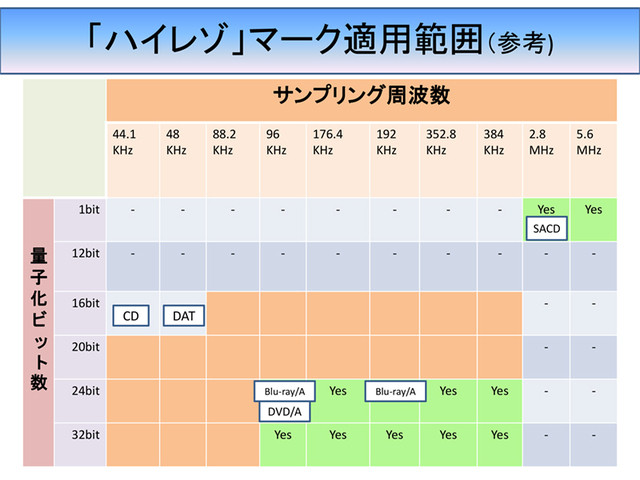
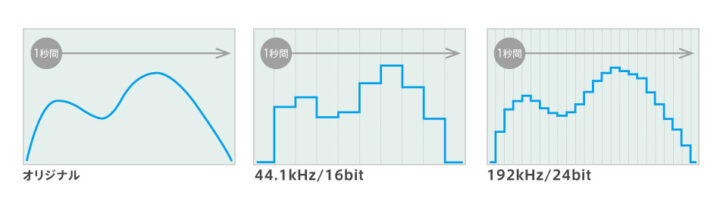
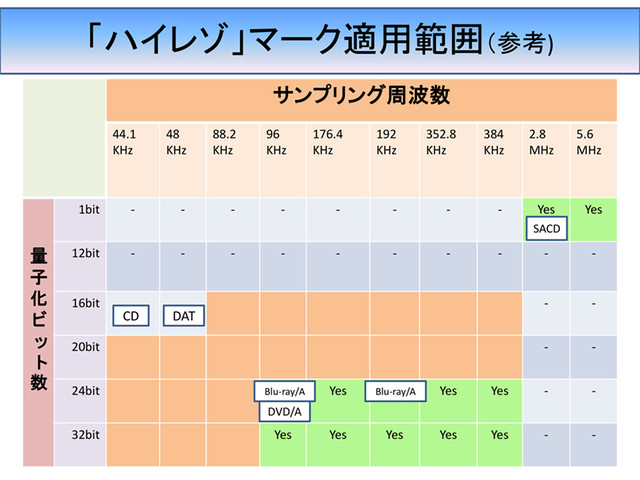
This criterion concerns whether the internal signal processing and input/output of digital systems — that is, A/D, D/D, and D/A conversion — satisfies the quantisation bit depth and sampling frequency shown in the table. The CD standard is 16bit/44.1kHz; Hi-Res hardware, with a few ambiguous edge cases and exceptions aside, is fundamentally 24bit/96kHz or above. SACD=DSD recording and playback equipment — which uses a 1-bit format rather than linear PCM — is, of course, also included in the Hi-Res category.
(2) Recording Microphone High-Frequency Performance: Capable of 40kHz or Above
Quietly slipping in something rather demanding here, aren’t they… Well, this is purely a hardware requirement and deliberately says nothing about software, so our existing catalogue of recordings is more or less written off — but just how many labels and recording studios are actually meeting this standard? A recording microphone that sounds wonderful within the audible range does not necessarily have outstanding high-frequency characteristics above 20kHz… What is to become of NEUMANN, or AKG, whose reputations rest on their sonic quality?

Does this mean we are supposed to use SONY’s affordable portable Hi-Res-compatible IC recorders — the very brand that, arguably, dreamt up the Hi-Res logo in the first place? And yet even SONY’s decent professional ECM microphones barely meet the standard. Or perhaps the idea is that as long as a microphone can capture even the faintest trace of a blasting test signal — however dramatically attenuated — that counts as technically capable? And will they start rewriting the catalogue specs on new microphones to market them as “Hi-Res compatible”?


 ポチップ
ポチップ
I looked up the microphone performance of SONY’s Hi-Res compatible IC recorder ICD-SX1000 — one of their very few Hi-Res models — on the official website. Hmm? The graph doesn’t even go beyond 20kHz, and it’s already rolling off rather sharply past 10kHz…
 ポチップ
ポチップ
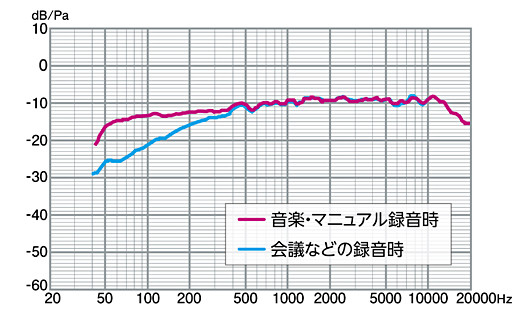
Below is the microphone frequency response graph for the ICD-SX1000 — also officially Hi-Res compatible and capable of DSD recording, the flagship portable stereo IC recorder↓. It rolls off steadily from 15,000Hz onwards, though it does hang in there to some degree. Around 20–40,000Hz / −20dB, shall we say. And… that’s acceptable, is it?
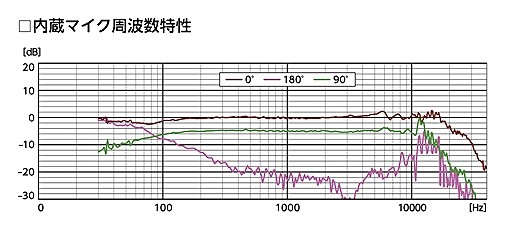
(3) Amplifier High-Frequency Reproduction Performance: Capable of 40kHz or Above
Nowadays, I cannot imagine any reputable manufacturer selling a Hi-Fi amplifier that is genuinely incapable of reproducing around 40,000Hz. Pretty much any amplifier, however cheap, will be essentially flat up to 20kHz, rolling off gently towards 100kHz thereafter; among pure Hi-Fi products, an amplifier guaranteeing 100kHz/−3dB on its catalogue spec is entirely normal. Digital amplifiers can surprisingly have less impressive high-frequency characteristics, but even then, 60kHz/−3dB (nominal) is typical.
Cheap amplifiers from certain countries that one hesitates to call Hi-Fi equipment, or characterful home-built valve amplifiers of questionable electrical engineering — those are a different matter (though that’s precisely their charm). And then there are the truly venerable antique amplifiers with deteriorated circuitry, where distortion and other factors are so far from normal that frequency response is the least of one’s concerns — but for the modern, everyday Hi-Fi amplifiers most people own, it is safe to assume that in almost all cases, you are already Hi-Res compatible without needing to think about it. Given that, making a point of advertising Hi-Res compatibility now, even as a guaranteed spec, does feel ever so slightly opportunistic.
 ポチップ
ポチップ
※ I had been wondering what was going on with the string of Hi-Res compatible integrated amplifiers that MARANTZ has been releasing lately, and when I looked at their best-selling model at the time, the PM6005 (2014), it turns out the unit has a built-in D/A converter supporting 192kHz/24bit Hi-Res sources. In other words, a solid-state analogue integrated amplifier incorporating the same DAC and analogue circuitry as the standalone CD player CD6005 from the same tier — which is actually rather good value when you think about it.
 ポチップ
ポチップ
 ポチップ
ポチップ
The nominal frequency response of the analogue amplifier section is a modest 10Hz–70kHz (+0dB/−1dB). Rather than being straightforwardly honest about the flat spec, one could presumably have stretched the catalogue figure much further up by specifying −3dB or so. And then I checked the Hi-Res compatible higher-tier model, the MARANTZ PM8005 — and it turns out to be a perfectly ordinary analogue integrated amplifier with no DAC inside at all.
This has gone on long enough, so continued in Pushing Back Against the Japan Audio Society’s “Hi-Res” Definition! Part 2: “Speaker/Headphone High-Frequency Reproduction Performance: Capable of Reproducing 40kHz or Above”.
Part 1|Part 2

Auto Translated by CS4.6