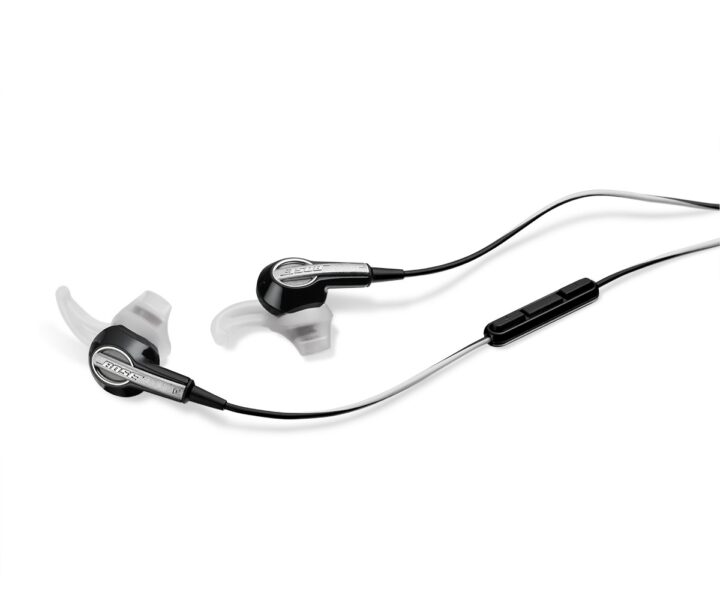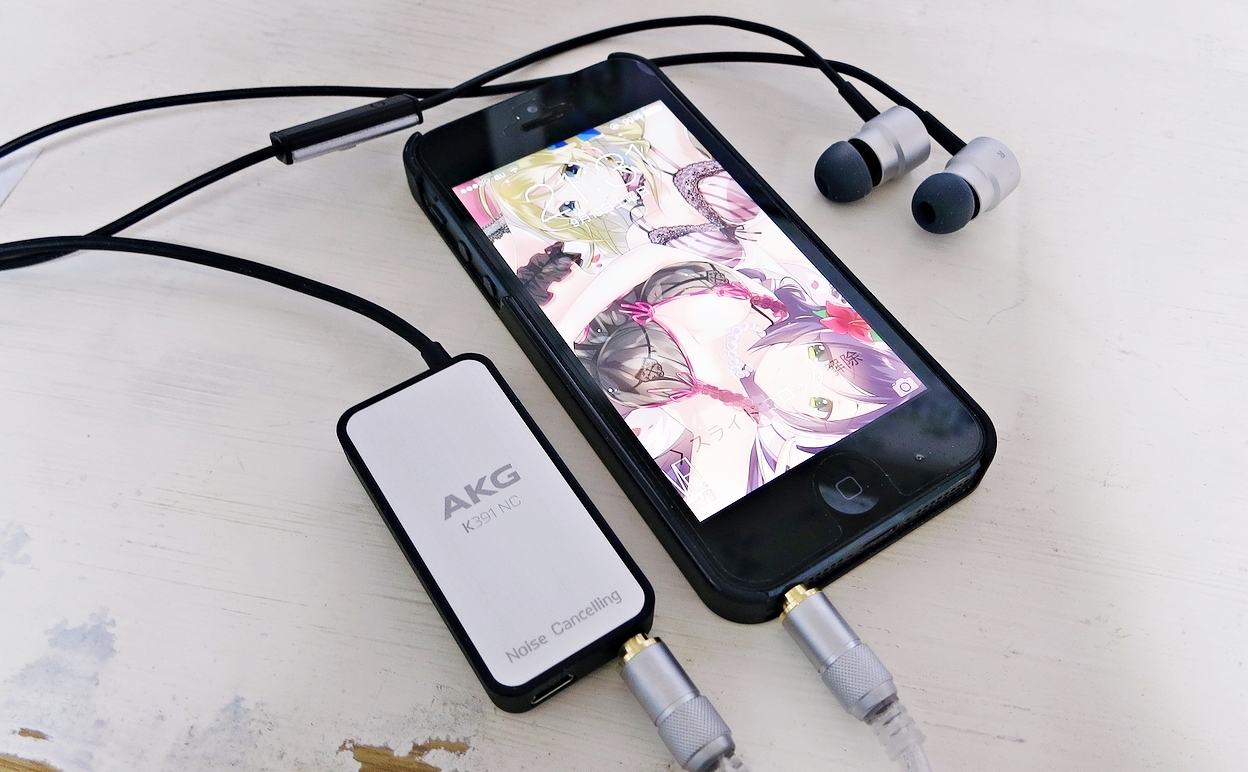
I don’t tend to venture much into the headphone and earphone world, but I’ve gone and bought a pair of earphones for the first time in several years. The model I chose is the AKG K391NC from Austria. I’d long been wanting a noise-cancelling earphone for blocking out noise on the Shinkansen, planes, and trains, and I did previously write a listening review of the BOSE IE2 MIE2i MIE2 mobile headset. The current successor model, the Bose QuietComfort 20, is particularly impressive in its cancelling performance, but the price put me off, and so I’d been making do all this time with the B&O A8 (under construction), which has essentially zero sound isolation. Those who’ve been reading along may remember that I’d mentioned wanting the AKG K391NC more than once on this site.
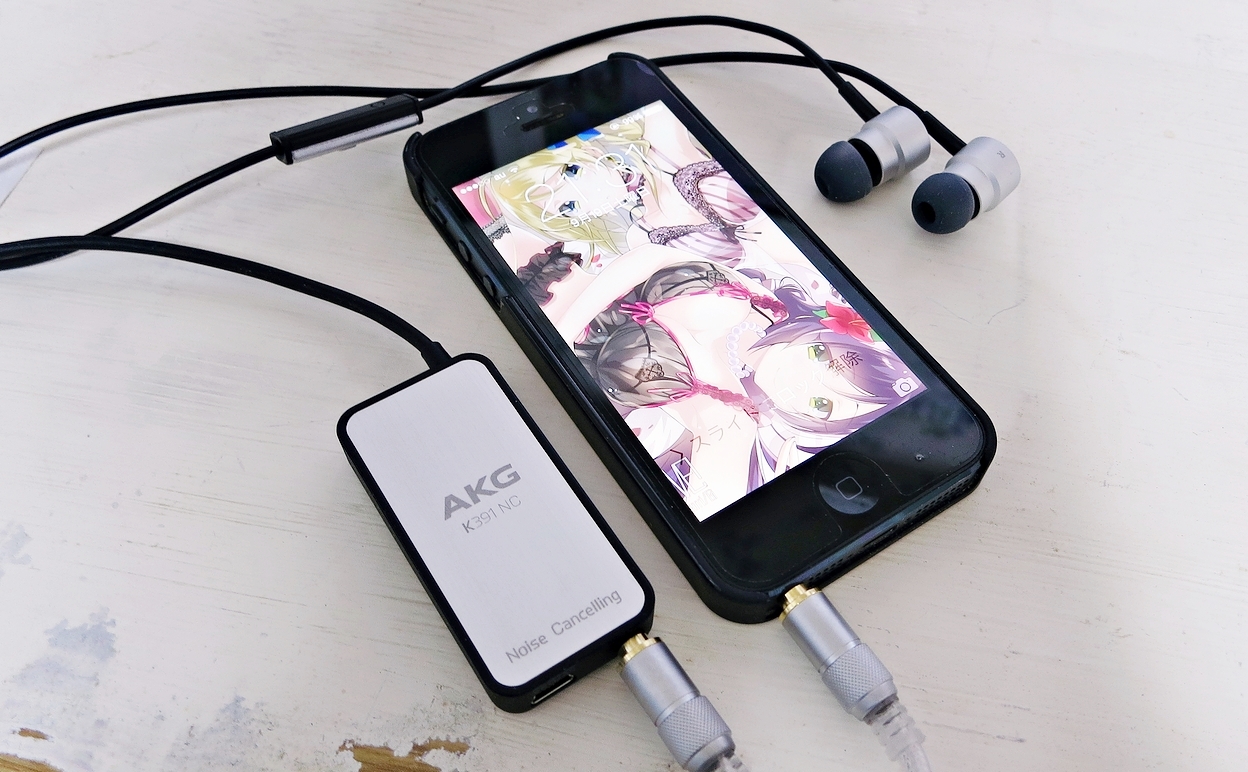
I’m not quite up with the trends in the earphone world and can’t really work out why, but the AKG K391NC seems to be a spectacularly unpopular model. On top of that, it was discontinued earlier this year and reduced to remaining shop stock, with the street price dropping sharply from around ¥14,000 all the way down to the ¥6,000 range. I’d had my eye on it at one particular shop, and managed to catch the very last unit in their clearance sale just in the nick of time. Writing a review just as something is becoming hard to find — that’s par for the course here, as always. ← Hopefully it might still be of some use to anyone buying second-hand! And so, here is that belated review.
AKG K391NC — Sound Quality Review
This was somewhat different from what I’d imagined. An incredibly straight-down-the-middle European tone. This is AKG through and through. I’d expected something a little leaner, with a more modern flatness, treble delicacy, and resolution — but that’s not quite what it is. The foundation is a warm, smooth, traditionally well-balanced sound. The generous hall tone and natural, fatigue-free character make it clearly well suited to classical music. Right after purchase the sound was a touch cloudy and sweet, and I thought I’d made a mistake — but I connected it to the SACD player, the ONKYO C-S5VL, lined up a good number of classical and jazz high-quality SACD releases, and ran it in at high volume (note: high enough to hear comfortably for short periods, but not so loud as to damage the earphones) for about two days. After that, the amount of detail increased considerably and the tonal character became sufficiently clear and satisfying.
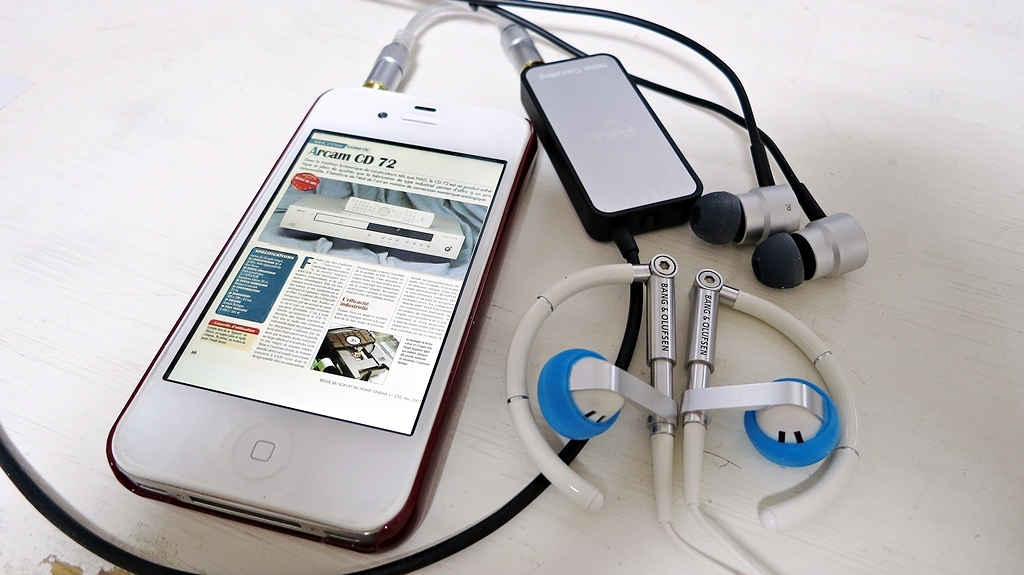
The basic balance is that of a home Hi-Fi speaker — the B&O A8 (under construction) and SENNHEISER MX400 that I’ve used for years both have quite a pronounced high-frequency tilt, and there was always a sharp sense of disconnect from the frequency balance of the speakers at home; the AKG K391NC, by contrast, matches the balance of a home loudspeaker almost exactly. There is none of the listening fatigue that comes from the hyped highs and lower-midrange of the typical “high-quality earphone” — this is a properly orthodox design. Nor does it sound muddy or veiled (note: when NC is active). It is a rich, elegant Euro sound, free of distortion.
Sound quality differs with noise cancelling on and off
The sound quality is entirely different with noise cancelling ON versus OFF — or rather, the volume level is different. ON gives 100 dB and OFF gives 92.5 dB… a difference of no less than 8.5 dB between active and passive. Perceptually it sounds more than twice as loud, so if you inadvertently activate NC while listening, some tracks will come out at quite a thunderous level — do be careful.
With NC passive, the sound is flat and natural with a European character — quite warm, and rather similar to the sound of CREEK. That said, objectively speaking the mildness tips a little too far, and it is difficult to call it high-quality sound in proportion to its original price (around ¥14,000 and above). Switch NC active, and it takes on a moderate V-shaped character. The lower midrange and upper midrange are emphasised so as to sound wide-range to the ear, the warm tone recedes, and compared to NC passive it appears dramatically clearer. It is not a flat balance, so it is fundamentally different from a monitor-type sound — it is a crafted soundstage — but it hits the musical sweet spots in a three-dimensional and rather enjoyable way. By design too, it seems clear that the sound is intended for use with noise cancelling permanently active.
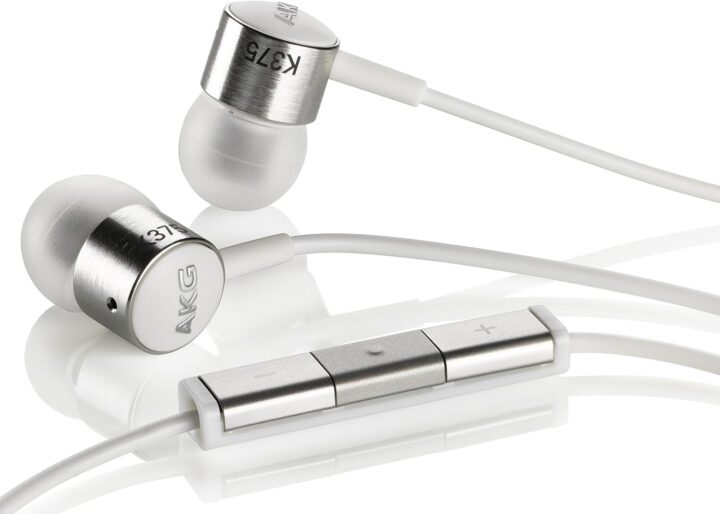
Even so, there is none of that sense — as with the sibling models the AKG K374/K375 — of excessive bass emphasis or high-frequency roll-off producing muddiness; the K391NC is entirely free of that. Even using the same driver, the voicing of the two models seems to point in different directions. The article “Music Geeks!” describes it as a hidden gem offering a taste of AKG’s flagship K3003, and indeed, as Harman’s own description puts it — “a natural, transparent sound that inherits the flagship’s DNA, with an even energy balance free of exaggeration, conveying the full emotional impact of the music” — this feels precisely like a legitimate, orthodox downgrade. It offers information density and resolution befitting its original price bracket of around ¥10,000–¥14,000, while being dominated by a spacious hall-toned soundstage and a refined, elegant smoothness; so if you own both this and the AKG K374/K375, it would be worth switching between them depending on the source material.


Noise Cancelling Performance
It uses a feedforward noise canceller. However, the noise cancellation performance feels a little half-hearted — perhaps not quite satisfying enough. Part of that may be down to it having been designed in Austria, where towns are not as noisy as Japan. The canceller essentially only works on low frequencies, so unless you get a very tight seal with the ear tips, conversation and everyday ambient sounds pass through quite audibly. In one sense this is a sensible safety decision. It probably ended up at this level of effectiveness as a compromise against the negative impact that heavy NC would have on the fundamental sound quality. That said, the low-frequency background noise that pervades trains, aircraft, and city streets does disappear by more than half, which I think is a practically sufficient balance — you can enjoy music without finding yourself in a dangerous situation.
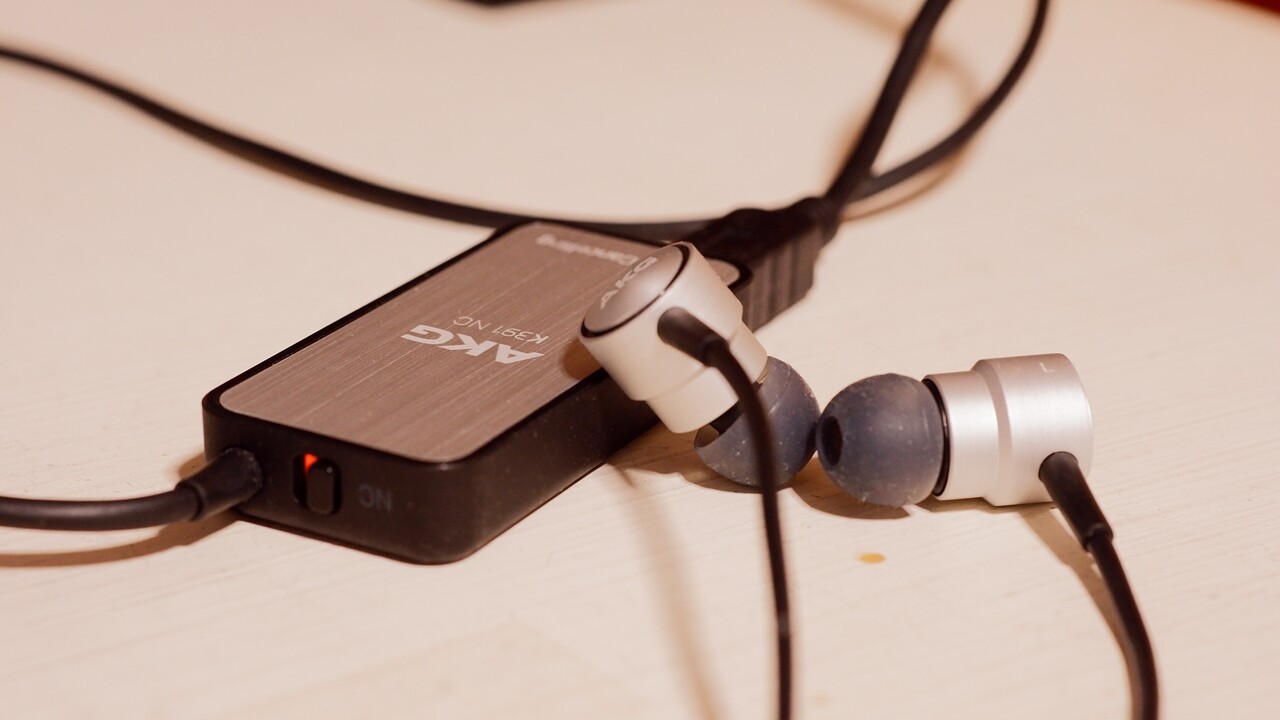
The part number for the genuine AKG K391NC ear tips is AC6BK, but since isolation varies considerably depending on the tips, adjusting that to suit your own needs should make it more than adequate for practical use. As far as I’m concerned, the real point of a noise canceller is not just to reduce external noise — the deeper value is that it lets you listen to music at a consistently lower volume, which is kinder to your ears.
Lithium-Ion Battery
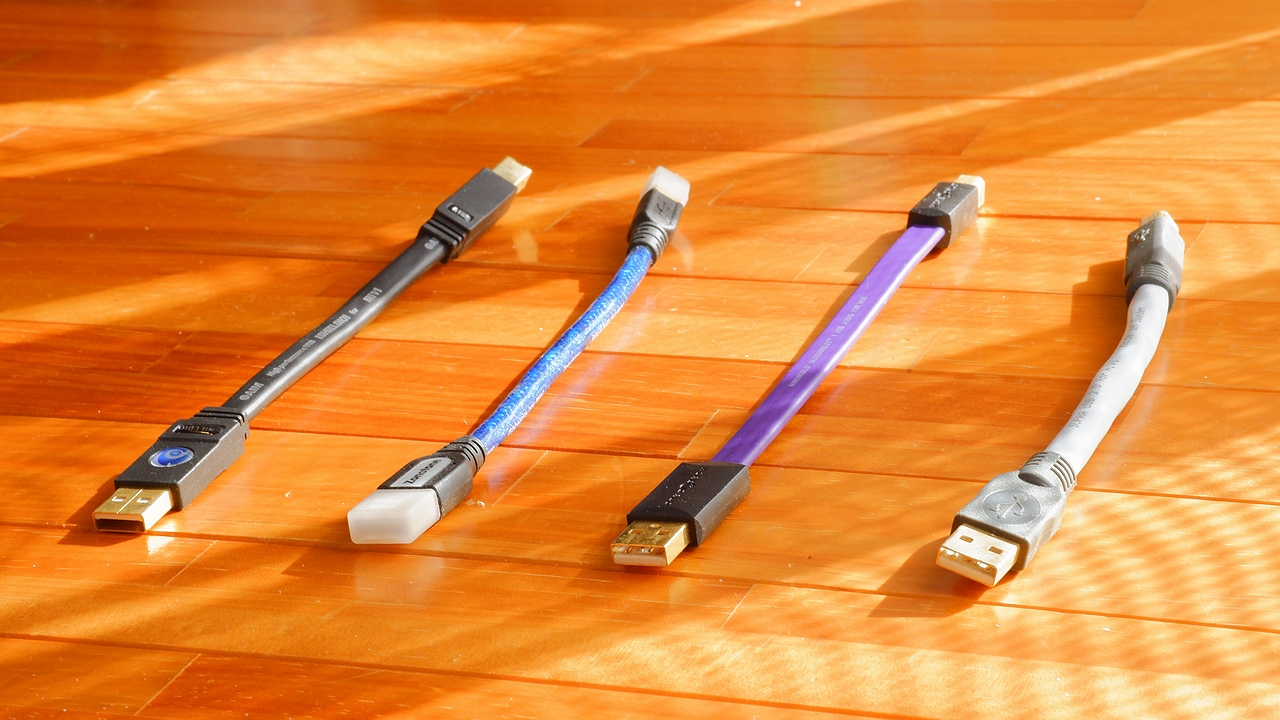
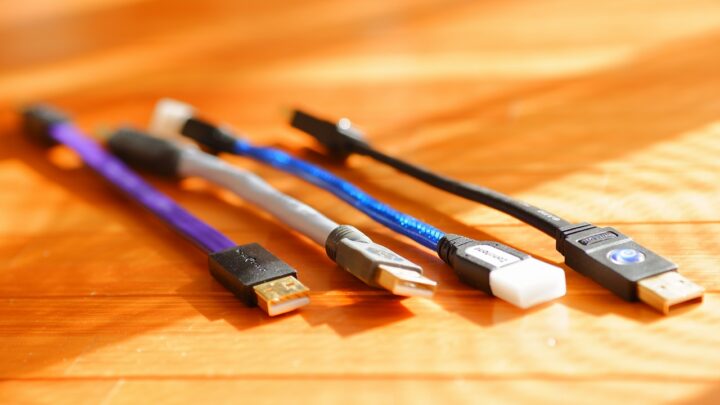
The built-in lithium-ion rechargeable battery is rated at 35 hours, so in normal use you can go a full day without charging, or several days at a stretch… provided you remember to switch it off after use, that is… which I fairly often forget to do. Charging takes about one to two hours via a standard USB Mini-B cable. One could, of course, use a ultra-premium Mini-B USB charging cable at around ¥100,000 per metre for a significant improvement in sound quality (that’s not true).
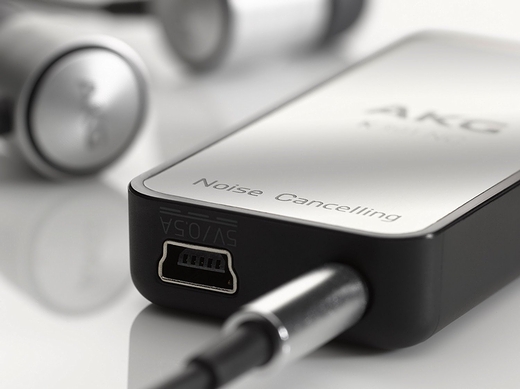
When storing for an extended period, keep it charged to avoid damaging the internal battery. One quietly useful thing about this model is that even when the battery dies, sound still comes out (in passive mode), so the earphone’s core function is not held hostage to the NC circuitry. That said, when I consider what to do when the lithium-ion battery eventually fails — you can’t replace it yourself, and due to the construction the battery alone cannot be swapped out; it has to go in for repair, at a cost of around ¥9,000 including tax (note: as of autumn 2015). If the battery goes, the repair cost will exceed what I paid for the unit itself…
Design and Handling
The design is attractive and in photographs the aluminium finish looks quite premium, but in person it feels rather plastic and slightly toy-like. This is AKG, but at this price level it’s made in China. The noise canceller unit is far smaller and lighter than I’d imagined.
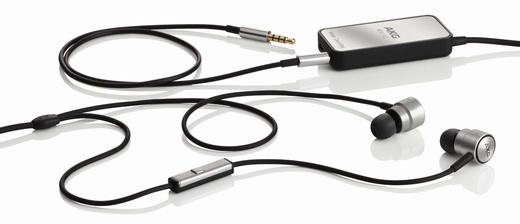
One complaint: on the NC unit, both cables exit from the same side rather than “entering from below and exiting from above” — personally I think having them on opposite sides would be far more practical for putting in a pocket or clipping to a belt. And the cable lengths are all rather odd. The cable between the DAP and the NC unit is a full 50 cm, which gets enormously in the way. That said, it is detachable, so replacing it with a short, high-quality mini-to-mini cable for use with a DAP solves the problem.
Ear Tips
Writing “eartips” as one word seems to be the industry standard. With the AKG stock tips, L size turned out to be the right fit for me in terms of isolation. Even so, they make my ears ache slightly after a while — I wish there were something between L and M. Having used earphones this long, perhaps that’s just par for the course, but I gather that enthusiasts accustomed to other earphones tend to find the fit unsatisfactory, so if it bothers you, replacing the tips is probably the way to go. I want to swap mine too. Not being used to the earphone world, I had a moment of panic trying to change the S and M tips — it turns out you flip the mushroom inside-out first, then twist the tube inside into place and it slots in easily.

 ポチップ
ポチップ
 e-Earphone Rakuten Store — Replacement Ear Tips [PR]
Recabling
The AKG K391NC has a warm, smooth, graceful European tone at its core, but this same quality can come across as slightly unsatisfying from a Hi-Fi standpoint — a sense of being not quite enough. So I tried replacing the 3.5 mm mini-to-mini cable between the iPhone and the NC unit with a FiiO L16 (which uses Oyaide HPC-23TN conductors), and found that a pleasant degree of resolution and a crisp, dense, nimble quality were added to the sound, the excess sweetness receded, and virtually all my sonic dissatisfactions simply vanished.
 ポチップ
ポチップ
PCOCC-A is something else. For some reason the volume seems louder too. The downside is that the sound comes more forward, which brings the stereo image even closer into the ear — but even so, the power of recabling is remarkable. A mini-to-mini cable of only about 10 cm makes this much difference even with earphones. The tonal changes are fascinating, and it makes me want to try various other 3.5 mm to 3.5 mm mini-to-mini cables. Next up: silver wire or silver-coated wire.
Compatibility with Headphone Amplifiers and DAPs
The K391NC’s impedance is 32 Ω. Stated frequency response: 12–24,000 Hz. So it does not support hi-res audio, I’m afraid. In terms of sound quality, it pairs well with the iPhone 4 and iPhone 5 — and the iPhone 4 actually sounds better than the iPhone 5, oddly enough. It does seem as if some thought has gone into voicing for iPhone use. Even so, the headphone output of an iPhone does struggle to drive the K391NC with real authority — the sound lacks a certain weight and energy, and there’s a touch of thinness to it, with fine detail noticeably absent. Connecting it to the headphone output of my home integrated amplifier, the TAG McLaren 60i (under construction), which has an exceptionally good headphone output, you get a real sense of what the AKG K391NC is truly capable of. Even the modest ONKYO C-S5VL‘s headphone output is enjoyable with its high-resolution character — but the gap between an iPhone’s analogue output and a dedicated home audio component’s headphone output is simply a wall that cannot be crossed. For those who spend a lot of time listening through a DAP, a quality portable amplifier would really be worth considering.
 ポチップ
ポチップ
For player apps I switch between the iOS 7.1 built-in player, the ONKYO HF Player, and Denon Audio, depending on the material. For spaciousness, the iOS 7.1 stock player wins; the ONKYO HF Player has a narrower sense of range, but impresses with its midrange presence, a metallic sparkle in the highs, and a lively musical momentum — it lifts the mood, and in particular keeps the sound from getting lost when out and about. Denon Audio has a moist, smooth tone that is evocative of DENON’s home Hi-Fi components, with a sense of refinement. However, for listening through what is after all a high-resolution earphone, the surface of vocals and strings in the upper frequencies may be a touch too smooth and polished. I use all three, switching between them according to the sound quality of the album in question.
— In Summary —
This time I was able to pick up the K391NC at a clearance rock-bottom price, so rather than any complaints, I feel enormously pleased to have got this level of performance for what I paid. After all, it was the same price as the sibling models without noise cancelling, the AKG K374/K375. Looking at it the other way, had I bought it at ¥14,000, this review would probably have been just a touch more measured in its enthusiasm…
 ポチップ
ポチップ
But even so, unpopular as it may be domestically, I genuinely think AKG’s sound is outstanding in a number of ways. I happen to have a thorough weakness for European sound, so for those of you with discerning taste who want something a little different from the crowd in your earphones and headphones, I have no hesitation in saying that Austrian AKG products make for an excellent partner. In particular, to fans of classical music and fans of the anime K-On!, I’d like to say without further argument: do keep at least one AKG product to hand. And ideally, the model of choice would be the AKG K3003, if at all possible…

Auto Translated by CS4.6