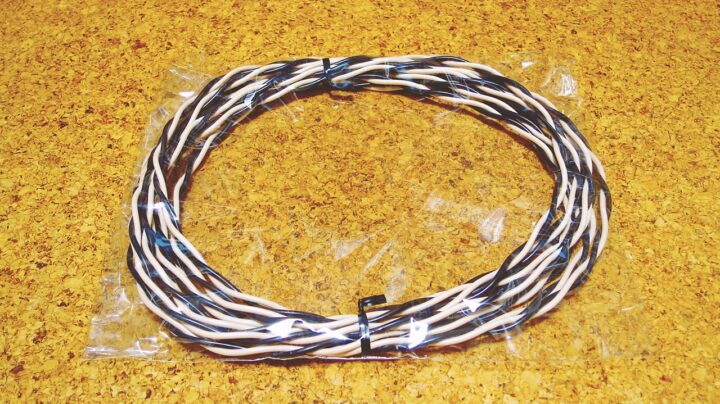
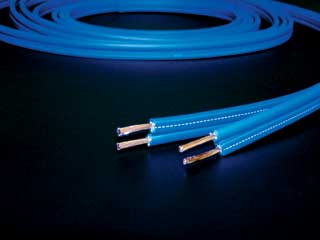
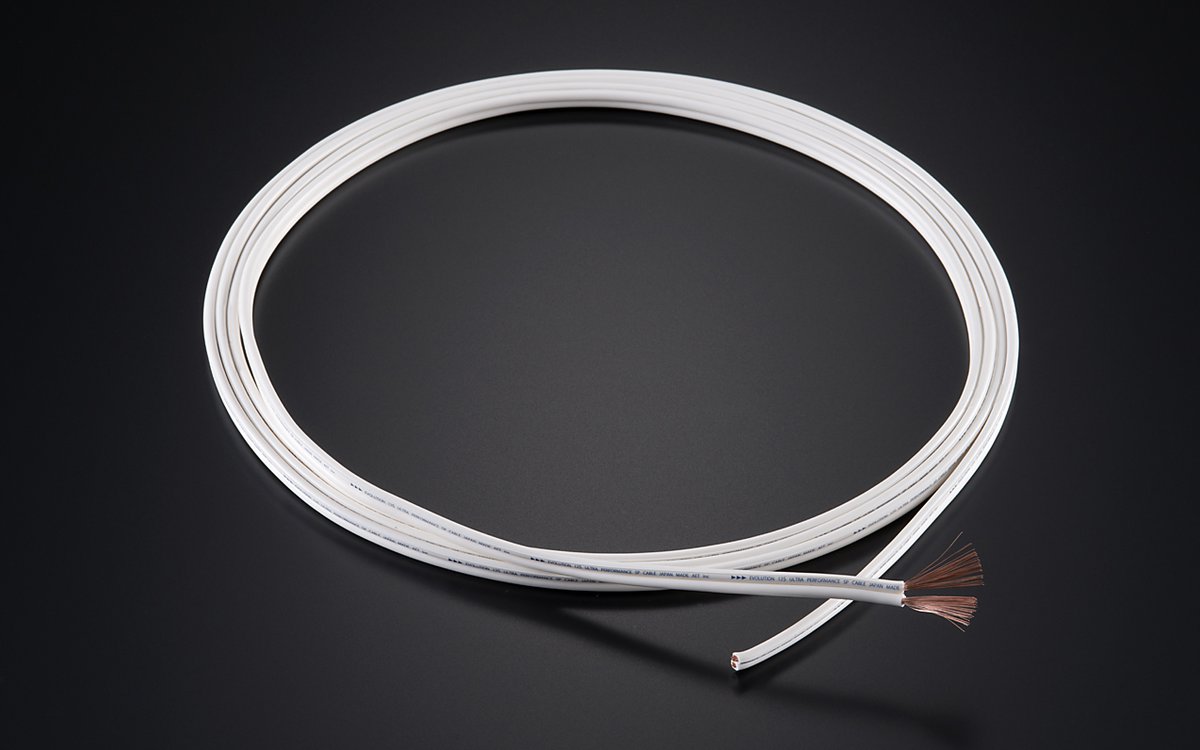
What I purchased this time is the AET EVO-F125. It is a cut-to-length speaker cable at the lower end of the AET range, priced at 720 yen per metre. It uses premium virgin oxygen-free copper in a multi-strand twisted construction. For reference, the AET EVO-F75, EVO-F125, and EVO-F200 differ only in thickness (conductor cross-section), with the numbers in the model names indicating the gauge in square millimetres (mm²). ※ Note that at the end of 2021, the successor model EVO-C125 was released. Once shop stocks of the EVO-F125 are exhausted, it is expected to be replaced by the new model.
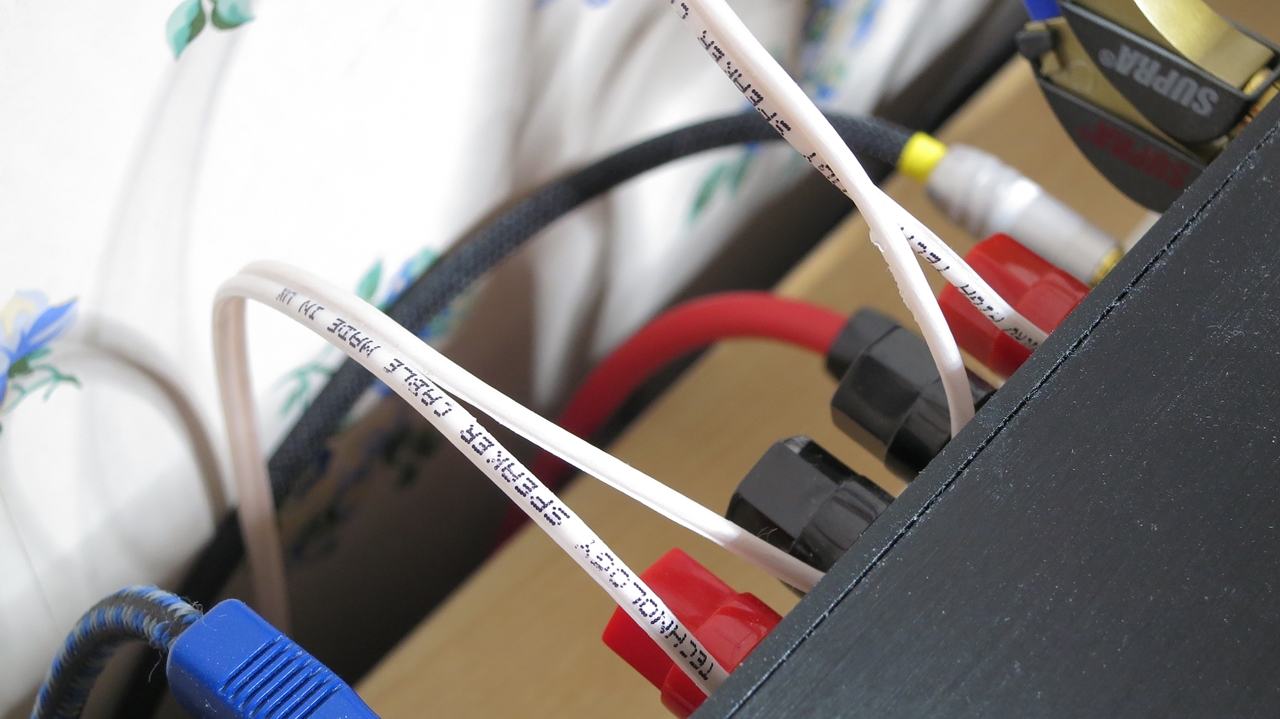
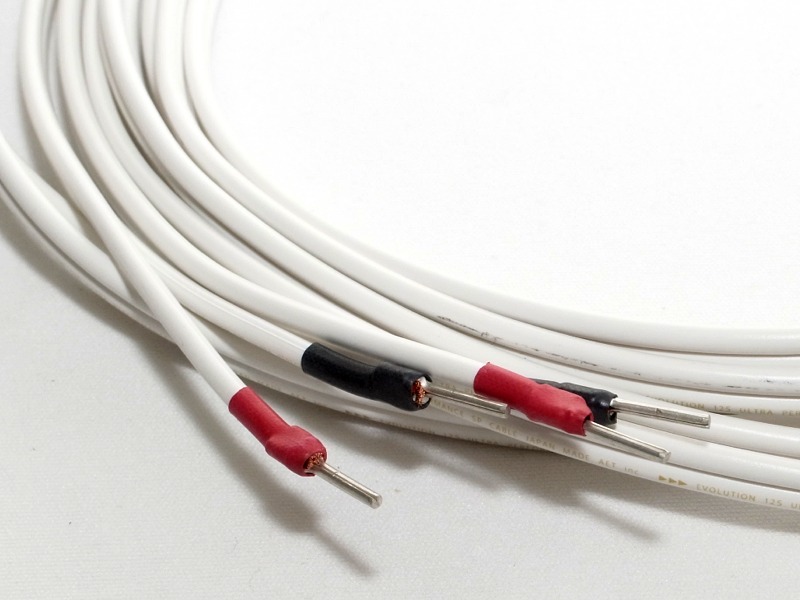
At first glance it looks like an entirely ordinary two-conductor parallel construction of the kind that has been around for ever, with so little visual character that one might easily walk straight past it — and yet, true to AET form, this too is a Japanese-made cable. The white PVC jacket has a slight tackiness to it, and stripping it with scissors was a little awkward, so I ended up using a 2SQ cable stripper (with the 1.25SQ stripper, a fair number of the conductor strands were nicked). According to the manufacturer, “Designed with optimised electrical and mechanical characteristics for audio use. High-quality outer sheathing adopted, compatible with in-vehicle environments.” There is also a colour variant — the EVO-F125S — which comes with a black jacket.
AET EVO-F125 Sound Quality Review
The moment it is connected, what catches the ear is the high degree of transparency and the crisp, sparkling resolution of a cool, bright treble. The overall character is strikingly similar to the AET 6N14G — a comparable model from AET’s early lineup that I reviewed some time ago — and that composed, clear-headed, delicate, and transparent tonal quality, reminiscent of a highland morning, carries an air of refinement that seems entirely out of proportion to its looks and price. The piano in particular comes through with a beautifully sharp, hard-edged, glittering quality that is genuinely attractive. There is a certain bloom that one associates with multi-strand twisted wire, but if anything this seems to contribute to a sparkling, refreshing character rather than working against it.
A direct comparison with the 6N14G might reveal differences, but when I try to put it into words, the review ends up reading almost identically. Also worth noting: despite being an unplated OFC pure copper cable, the sound takes on no strange colouration. That said, the slight bloom around image outlines that is inherent to multi-strand twisted construction will presumably become more pronounced as the gauge increases. In a bi-wiring configuration, deliberately using the thinner EVO-F125 — or the even thinner EVO-F75 — on the tweeter side should yield an even more finely honed, clean treble.

 ポチップ
ポチップ
What is genuinely surprising about the EVO-F125 is its resolution — a level of detail that simply does not feel like an entry-class cable. A lustrous, beautiful tone; a richness of reflected sound; a sense of moisture and informational density; a tonal quality with a genuinely high-end feel. In sonic character it bears some resemblance to AET’s insulators, the SH-2014B/SH-2007B (the B brass type). There is a reasonable degree of musicality as well, though the impression is less that the cable is making a statement of its own, and more that it is passing the music through faithfully. The weaknesses, to put them charitably, are a slight gentleness — a marginally reduced sense of pace — and a somewhat passive quality that leaves the vertical spread of the soundstage feeling a little undefined. Given how thin this cable is, I knew from the outset not to expect too much in terms of drive or range extension; but the sonic clarity and resolution are so far beyond what one would normally find at this class that one inevitably finds oneself reaching for more from that refined sonority.


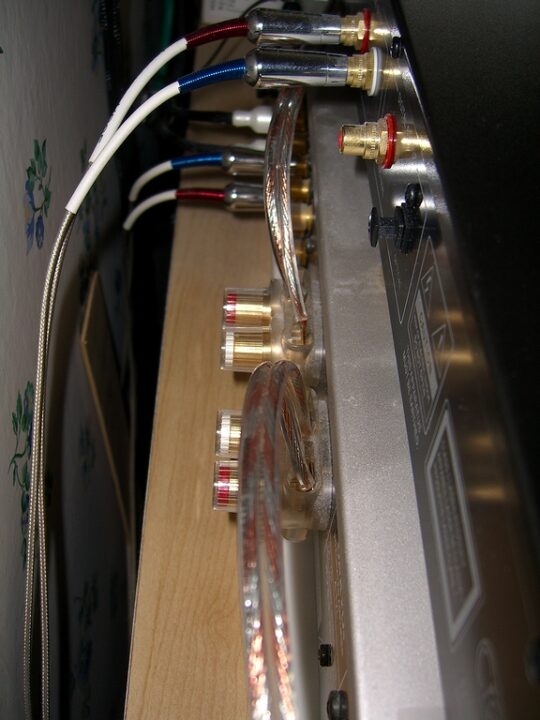
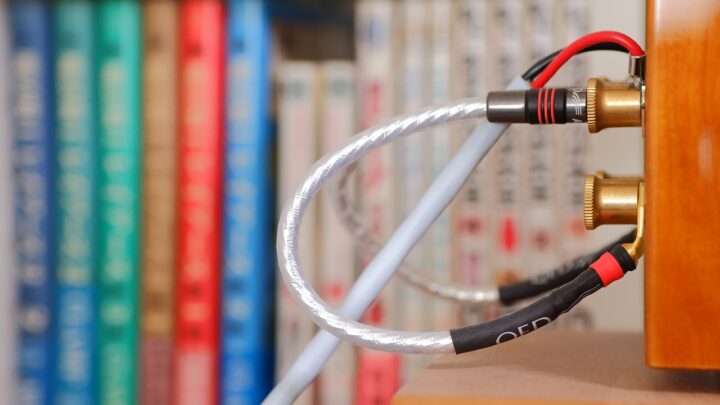
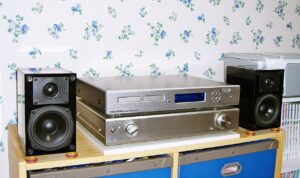
The cable I happened to acquire this time was the EVO-F125, but with compact bookshelf speakers such as the QUAD L-ite2 and audiopro Image12/Image11, 1.25SQ feels slightly on the thin side, with the note count coming across as a touch sparse. For single-wiring, I think going up to the 2SQ EVO-F200, with its greater number of conductor strands, would extend the bass end of the range a little further and improve the overall balance. (In terms of gauge, the EVO-F200 is probably the closer match to the 6N14G as a successor.) The tonal compatibility is particularly good with the ONKYO A-1VL × audiopro Image12 sub-system, which I put together with resolution as the priority, and I feel the EVO-F125 is quite capable of serving as the reference speaker cable for that system.
On the Differences from the New AET EVO-C125 (to be added)
The cable I purchased this time was the EVO-F125, released in 2014; but subsequently, at the end of 2021, the EVO-C125 arrived as its first successor in seven years. These two models are nearly identical in retail price and appearance, yet the naming of the OFC conductor has changed: from “premium virgin oxygen-free copper” on the EVO-F125 to “specially refined classic OFC” on the EVO-C125.
In the Ippinkan review linked above, the EVO-F125 is described as follows:
The tonal character is hard — [omitted] — the treble and bass extend further and the sound becomes sharper in definition, but the fundamental substance of the music feels thinner than before; personally, I prefer the balance of the pre-EVO models.
This matches my own impression: the sound is cool, hard-edged, and modern in character, and I feel it is not particularly well suited to those seeking softness or warmth. In my own listening environment, however, there is a relatively generous amount of room ambience, so I do not find it dry. With that in mind, the new EVO-C125 has been announced by AET with an explicit aim of achieving “a rich, moist mid-to-low range with an excellent sense of warmth, evocative of vintage sound“ — which suggests they may have retuned the cable away from its hard, modern character towards something more classic and mellow. How much it has actually changed is something I intend to find out by ordering one and doing a direct comparison at a later date. ※ I will add to this section when I do.
ポチップ
~ Summary ~
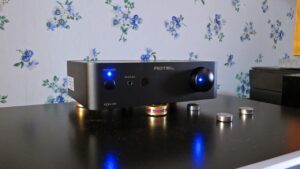
The AET EVO-F125 is an entry-class cable whose defining characteristic is a high-resolution sound with an unmistakably straightforward Hi-Fi quality. For that reason, I would not recommend it for audio systems where the overall treble is already too harsh or where some degree of distortion is present, as it will tend to amplify those weaknesses. In systems with a slightly warm or forgiving tonal character, however, or in budget systems where the note count is lacking and the frequency range feels narrow, it should be capable of lifting the sense of freshness in one go. In sonic character it is close to the ROTEL RDA-06, and when paired with it the cable conveys the amplifier’s performance faithfully while neatly compensating for its upper and lower frequency weaknesses — the result was a compatibility so pleasing it made me smile.
In terms of musicality as well, there is nothing lacking — despite having its parameters clearly set towards clarity and resolution, the music never becomes dull or unengaging, and the cable combines a bright expressiveness with an absence of any odd bias or sense of artificial colouring. The old AET 6N14G left me with considerable doubts on the musical side at the time, whereas with the EVO-F125 I feel no such dissatisfaction — whether that is down to my listening environment having changed since then, or whether the cable itself has genuinely evolved, I cannot say. What I can say is that the EVO-F125 I purchased this time left me with a distinctly positive impression, and personally, among currently available cut-to-length cables at under 1,000 yen per metre, I feel the AET EVO-F200 and EVO-F125 are the best buys at the entry level, both in terms of sound quality and ease of use.
 ポチップ
ポチップ
Going up from this level in AET’s speaker cable lineup, one immediately enters the territory of finished pairs costing tens of thousands of yen — models such as the EVO-1302F, EVO-1302S, EVO-1304F, EVO-1304G, Evidence SP, and SIN SP EVD — aimed squarely at the serious mid-range to high-end purist. Perhaps partly because of that gap, the cables introduced here achieve a quality within the structural and cost constraints of a low-priced two-conductor parallel construction that shows no deference whatsoever to the higher-priced models just above them — and so if you are unsure where to start, I think you can confidently reach for the AET EVO-F75, EVO-F125, or EVO-F200 without going wrong.
 Category: Speaker CablesCategory: AET

Auto Translated by CS4.6