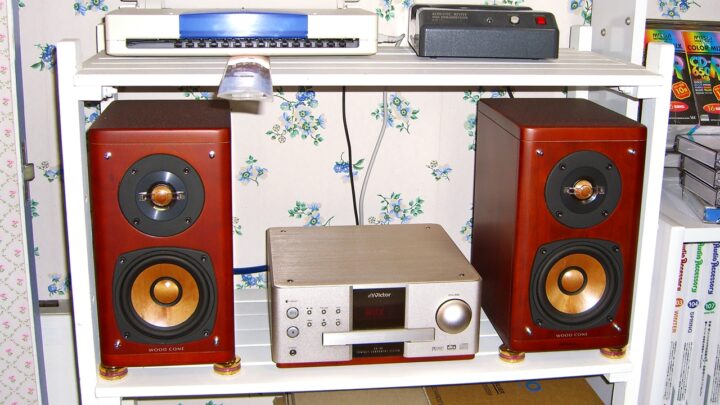
【JVC Victor Wood Cone Speaker】
Part 1|Part 2|Part 3
This time I would like to write about amplifiers that bring out the best in the JVC/Victor SX-WD5. I have written on several occasions that the SX-WD5 is, in character, a “beautiful-sound” type of speaker, which is to say, by the same token, that it is a speaker with a distinctly individual personality. The warmth, transparency, and clarity of its midrange and treble are enormously appealing, but it is by no means flat or wide-ranging, and the sense of weight in both the upper and lower registers is, unavoidably, a little lean.
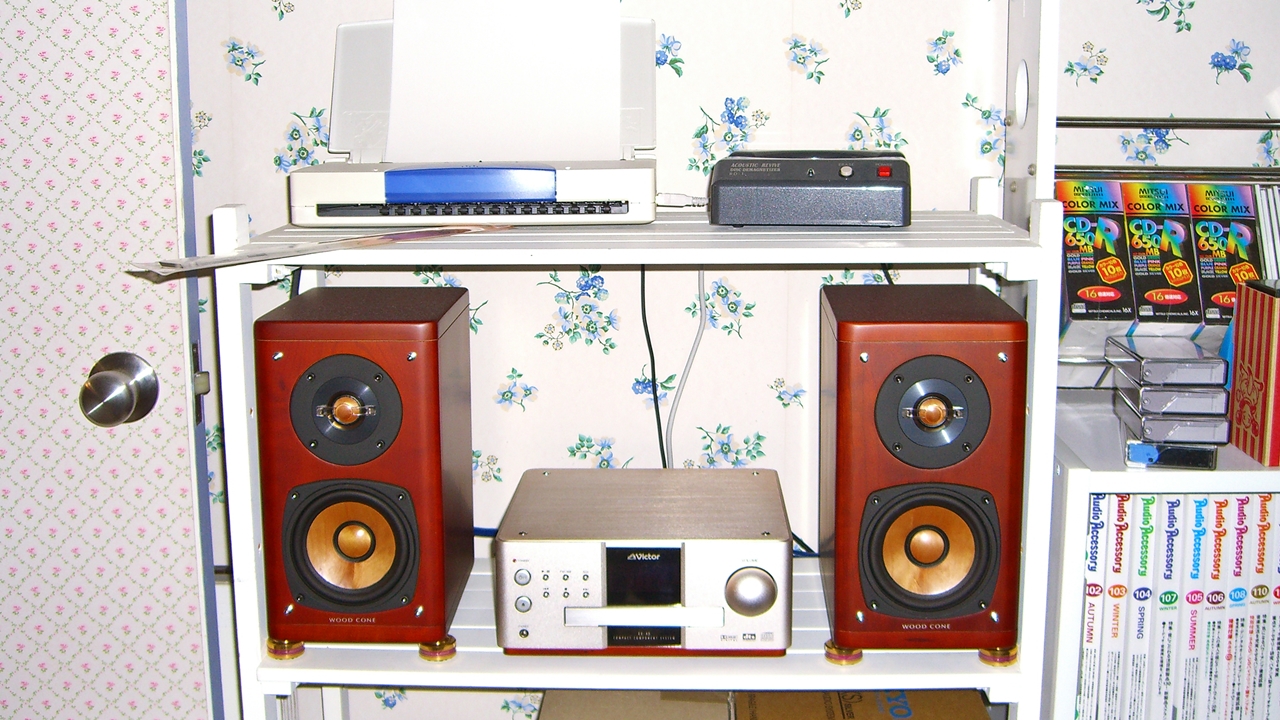
Depending on which amplifier you pair it with, or indeed what music you listen to, it is entirely possible that the verdict could swing to the complete opposite. When I first listened to this speaker myself, without thinking too deeply about it I paired it with a 100,000-yen class integrated amplifier from a company beginning with D that happened to be on hand, and the sound that came out was, to put it charitably, not good — frankly, it was quite dreadful, and I was rather taken aback.
With separate Hi-Fi components, even combining excellent pieces with one another does not necessarily produce a good sound in the way that “1+1=2” might suggest. When evaluating the overall sound of a system, “compatibility” between components is, in essence, far more important than price range or grade. (This question of compatibility is, in fact, the single greatest difficulty with separate Hi-Fi components, and it is a subject that tends not to be discussed openly even among audio enthusiasts.)


Drawing on my personal experience of pairing amplifiers with the Victor SX-A103 — a speaker with a similar character — I came to think that Victor’s beautiful-sound type of small speaker responds better not to a wide-range amplifier with a vivid, incisive sound, but rather to one with a rich, lustrous, full-bodied tonal quality and a substantial midrange. In the case of the SX-A103, for instance, the pairing with the Musical Fidelity A1 Junior was wonderfully well-matched. The speaker’s taut, clearly defined beauty of tone compensated for the amplifier’s weaknesses — its lack of resolution and freshness — while the musical vitality each possessed reinforced the other’s, making the result more passionately expressive than either could manage alone. The amplifier’s rounded tonal character also smoothed any harshness in the speaker’s treble, while increasing the sense of density in the mid to lower-mid region, and with female vocals in particular, the combination produced a seductiveness and allure that could hardly be surpassed.
With this in mind, when driving the WD5 the focus should be, as far as possible, on enriching the sweetness of tone and the density of the midrange — which makes pairing it with a second-hand Musical Fidelity A1 series amplifier, or a compact older model from the Musical Fidelity X-Series, or indeed a well-regarded valve amplifier with a gentle tonal character, a rather interesting proposition.
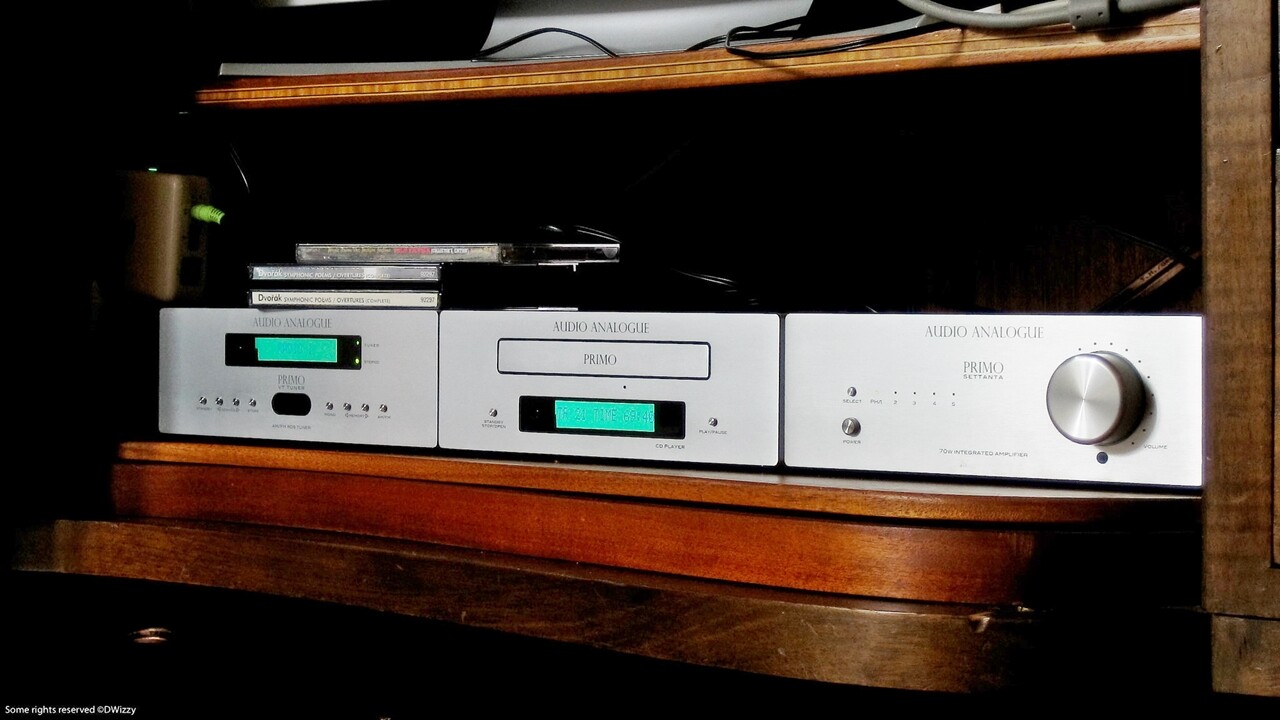
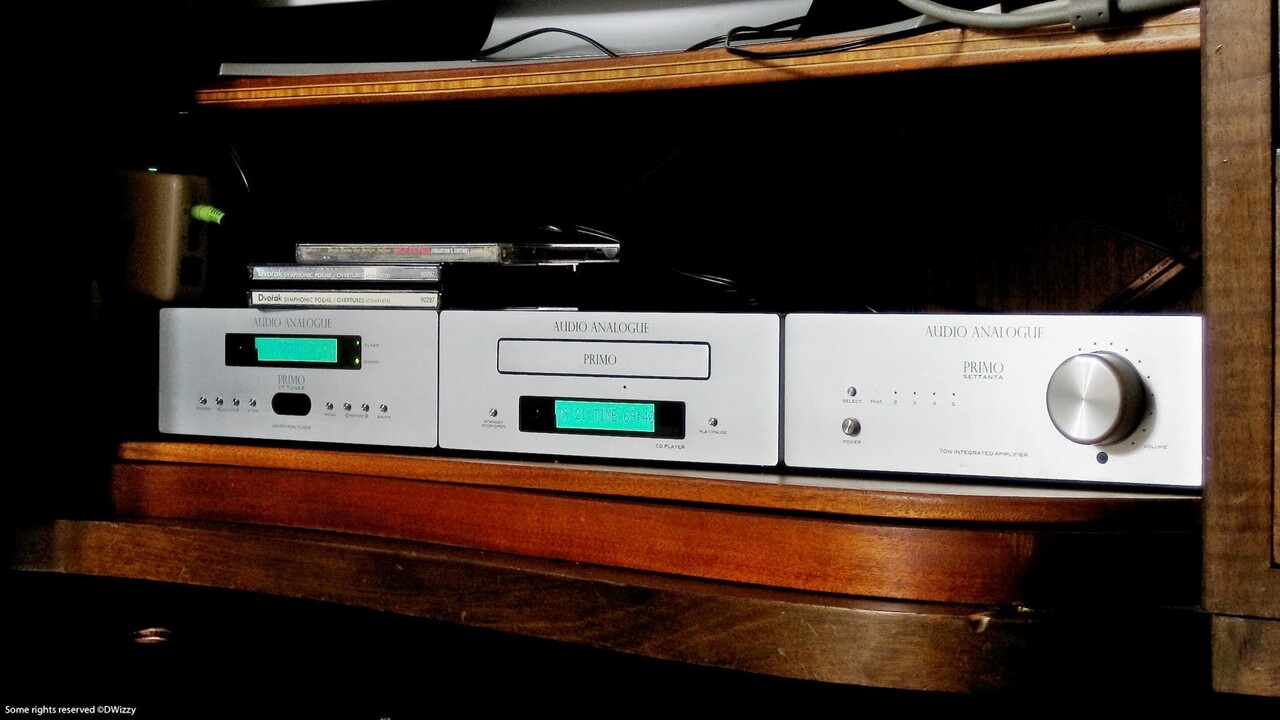
When thinking about how to recreate the same sonic character as Musical Fidelity, but at a higher level and in a currently available product, the first candidate that comes to mind is a pairing with the Italian AUDIO ANALOGUE “PRIMO” series. Despite being mini-component sized, the PRIMO’s sound quality is fully on a par with that of genuine separate Hi-Fi components. Its finish precision and chassis rigidity are, quite literally, in the high-end class. The operating feel is simple yet highly refined, and it inherits every last bit of the luxurious, high-quality feel of far more expensive flagship models, with no compromise whatsoever.
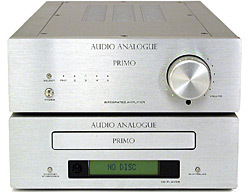
An integrated amplifier and CD player of this calibre are currently on sale for a little over 100,000 yen each — an almost unbelievably reasonable price — so if you fail to get hold of one before it is discontinued, you will surely regret it. In terms of sound quality, the amplifier’s driving ability has a well-established reputation, said to surpass that of run-of-the-mill high-end amplifiers. From a musical directness and sense of enjoyment, too, I personally felt it might even outshine the higher-end models. If I were pressed to name weaknesses, they would be these: despite the high-end-like assurance suggested by its precision finish and chassis rigidity, the volume control steps are not especially fine — as with the higher-end models. The selector’s channel separation is a little underwhelming (the Musical Fidelity A1 is, in truth, much the same…), and if the mains supply doesn’t agree with it the transformer can hum — there are, it seems, a few endearingly Italian quirks of that sort. Even so, setting those things aside, this is a product with more than enough in the way of quality and sound to make you want to keep it close at hand and use it for years to come as a long-term companion — that, I think, is what the Audio Analogue Primo series is.
 AUDIO ANALOGUE PRIMO SETTANTAAUDIO ANALOGUE PRIMO SETTANTA 2.0New CD Player and Integrated Amplifier from the AUDIO ANALOGUE “PRIMO” Series
The combination of the AUDIO ANALOGUE PRIMO and the JVC/Victor SX-WD5 is truly something special. (Had I not heard this pairing, I would probably never have featured the Victor SX-WD5 on AUDIO STYLE.) The design pairing of the DEUS and PRIMO sits without any awkwardness, and there is a visual coherence even when you make the change; the sound achieved is one that, while possessing the restraint one would expect of a new-generation amplifier, brims with musical sensibility — a brightness and warmth within the softness, and a richness of midrange. The acoustic warmth of the wood cone and a singing quality that is distinctly Italian each bring out the best in the other, and the result is a depth of soundstage reproduction with genuine musical expressiveness — something you could never hope to obtain from a Japanese high-performance mini-system of the same physical size as the PRIMO.
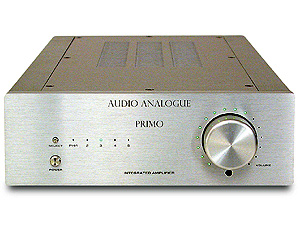
As for compatibility with source material, it pairs well with Western music that is not too aggressive, female vocals, and jazz vocals too. And as was the case with the Victor SX-A103, it may actually pair surprisingly well with Japanese pop. Even with low-quality recordings that have been electronically enhanced, compressed in dynamic range, and clipped in the bass, the wood cone’s character makes them sound beautiful on this system, and the way it gently rolls off the lower register means there is no risk of the drums throwing the overall balance out and drowning the all-important vocals. On the other hand, with acoustic sources it handles brass, woodwind, and guitar well, but — unlike the Musical Fidelity A1 — I honestly felt that strings were, shall we say, borderline. As for piano, the AUDIO ANALOGUE PRIMO itself has something of a FAZIOLI-like character, so that side of things is fine in its own way — though the lack of bass weight does mean it takes on a different meaning from a fully convincing reproduction.

 ポチップ
ポチップ
Either way, if you are drawn to this kind of beautiful-sound character, there is nothing to lose in buying one, and there is simply no other model currently available that can stand in for the JVC/Victor speaker (※ the JVC SX-WD7 was subsequently released). If you have listened to it and felt you loved it, I think you can trust your own instincts and go for it without hesitation.
 ポチップ
ポチップ
【JVC Victor Wood Cone Speaker】
Part 1|Part 2|Part 3

Auto Translated by CS4.6