【Cleopatra’s Daydream × Pastel Piano: A Hi-Fi Discussion】
Twitter Log 1|Log 2|Log 3|Log 4|Log 5|Log 6|Summary

Cleopatra’s Daydream @cleopatrasdream · Sep 11
CDs are so cheap now that you can just buy ten at a time without thinking twice — but what do you make of that, really? Way back when I was in high school, I’d save up my pocket money and manage to buy just one LP a month, that was it. With nothing else to listen to, I’d play it every single day. Coltrane’s solos going on and on, seemingly without end, making no sense whatsoever — and I had no choice but to listen. But before I knew it, my ears had grown accustomed, and melodies began to rise up from within the phrases, and something started to come into view. And because those records were precious — you’d scratch them if you picked up or dropped the needle in the middle — you’d listen all the way through without stopping. That was a fine kind of discipline, that was.

Pastel Piano @pastel_piano · Sep 14
It may be essentially the same question as: what do you make of the digital camera, where you can shoot as many frames as you like without it costing you a penny — unlike film? The sheer volume of knowledge that abundance has brought, and the breadth of it, is I think one of the most drastic social shifts since the 2000s. But on the other side, it feels as though the time and capacity to pursue one thing deeply has been lost from society. That goes for cameras, for recorded music, and for the written word as well — including the way that sometimes valuable thoughts get chopped into fragments on Twitter and the like, and squandered needlessly.
Cleopatra’s Daydream @cleopatrasdream · Sep 14
Hear, hear. Agreed entirely.
Pastel Piano @pastel_piano · Sep 12
On the playback of old recordings — since both the means of recording and the means of reproduction were narrow and limited at the time, regardless of genre, the optimal solution is probably to seek out the playback equipment of that era, or something close to it. It is simply incompatible with the modern digital stereo image (note: with its wide soundstage). It depends a great deal on how the remastering has been done, but I think it is difficult to reconcile both on the playback side. In terms of matching with modern recordings alone, there are people who pursue the B&W Nautilus to recreate a studio monitor sound and get as close to the original as possible — but that doesn’t mean old mono recordings are going to sing pleasantly through a Nautilus. I feel that in this area, one simply cannot escape the context of the era in which the recording was made.
Cleopatra’s Daydream @cleopatrasdream · Sep 12
The B&W Nautilus is an outstanding speaker built with modern driver technology, and it does need a certain amount of support from the surrounding equipment — but it can handle old recordings perfectly well: Pablo Casals, Andrés Segovia, Furtwängler, Rollins, Coltrane, and the rest.


 ポチップ
ポチップ
Now, the real question is genre. My own territory is source material recorded on acoustic instruments. Within that range, I have not encountered any recording from the 1950s onwards that has given me genuine trouble in evaluation. Of course, there was a time when my assessments were inconsistent, but after looking into the various causes, I arrived at a position where a great performance can be felt as a great performance. I believe there is no recording on a CD released by a major label that is wildly, obviously wrong.
Pastel Piano @pastel_piano · Sep 12
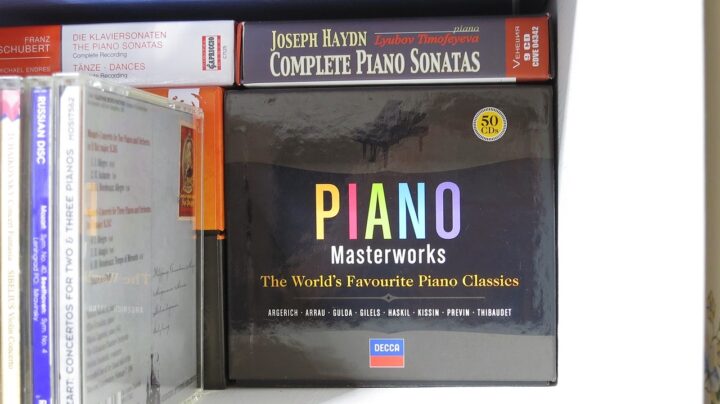
As for major label releases, I have been made to drink far too much bitter tea by remasters to place much trust in them. It is not a matter of tonal balance or quality in any technical sense — rather, it is that remastering quite plainly and repeatedly strips away musicality entirely, or conversely restores it. If I evaluate purely by how much musicality survives, setting sound quality aside, the earliest pressing tends to have the highest probability of being the best, and with each successive remaster the sound tends to drift towards something unpleasantly over-retouched and cloying. That said, there are occasional remastering successes, and I always end up clinging to that faint hope. You raised the question earlier, and budget box sets are a case where the sound is homogenised across the whole set — so either almost everything turns out well and you punch the air, or the lot is a disaster and you come away thoroughly deflated. A certain DECCA remaster I picked up the other day nearly had me throwing it out the window…
Cleopatra’s Daydream @cleopatrasdream · Sep 12
Remastered editions also depend greatly on compatibility with one’s equipment. Quite right — the early CD pressings where nothing much has been touched can often be the better option. On the other hand, there are cases where the improvement is unmistakable and the sound is clearly several steps above the original analogue pressing. I understand your experience very well. It is precisely the phenomenon I have been watching unfold before my eyes over the past twenty years. From here, I’d like to speak a little — not to the dedicated enthusiast, but to the general music fan — about the causes that lie behind these troubling phenomena.
Pastel Piano @pastel_piano · Sep 14
I don’t often find myself hearing remasters as thin, actually. More often it is that the upper frequencies sound dirty, or the treatment is so heavily applied that everything comes across as overdone and congested, or a resonance that should have been there has vanished — or else some artificial electronic reverb has been added in its place, which feels very wrong. And then there is the loss of musicality. Glenn Gould, who gets reissued so relentlessly, is an interesting case — the quality swings wildly from one release to the next, better and worse in turn, and it really is quite something.
 ポチップ
ポチップ
My own rough division of remasters is into two types. Those where the original analogue recording has been gone back to and remastered from scratch, and those where a digital recording has been remastered again at higher bit depth. The former, as you say, holds the possibility of the sound being brought back to life with fresh energy through modern technology — capturing the audio anew from the best available source material, converting it via A/D, and so on.
What concerns me, though, is the case of digital recordings being digitally remastered yet again. Upsampled to high bit depth, with fabricated data padded out, then compressed back down to a 16-bit CD. And then further degraded still by normalising both quality and volume levels across a box set or series. The major labels do this on a rotating basis, regularly. The result is a sound that grows progressively more digitally enhanced and unconvincing, and in most cases the musicality collapses along with it. If something was recorded in 16-bit, I think a 16-bit CD of that recording is perfectly fine as it is. If you want to hear an upsampled version, you can do that yourself through your own DAC — so please, just give us back the original data.
Continues in 【Sound Quality Problems in Modern High-End Audio】.
【Cleopatra’s Daydream × Pastel Piano: A Hi-Fi Discussion】
Twitter Log 1|Log 2|Log 3|Log 4|Log 5|Log 6|Summary


Auto Translated by CS4.6