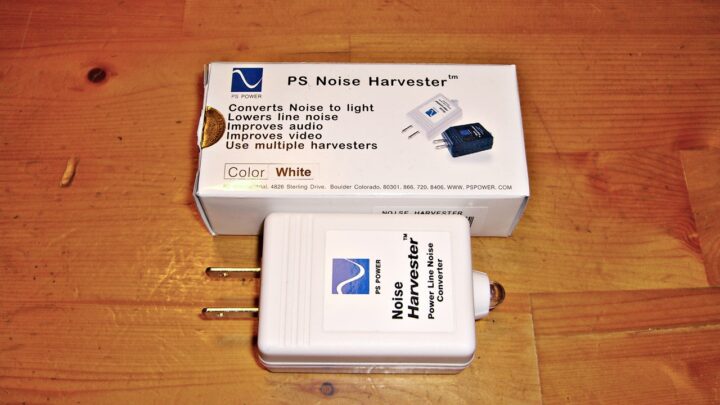
Many of these models have already been discontinued, but aside from the PS AUDIO Noise Harvester which I have tested both at home and elsewhere, here are some similar mains noise filters I have come across.
AudioPrism Quietline MK3
The Quietline is a pioneering parallel mains filter well known among Hi-Fi enthusiasts, and as it happens it is a related product to the Red Rose Music audio cables I use. Red Rose Music is a small high-end manufacturer producing gear through a collaboration between Mark Levinson — a figure of near-cult status in American high-end audio — and AudioPrism, and it also serves as the New York agent for AudioPrism.
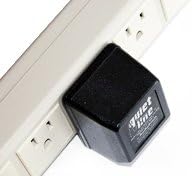
In appearance it looks very much like a tiny AC adaptor. As its name suggests, the sound becomes quieter — background noise disappears and the stillness of the soundstage deepens. As a side effect, however, the overall presentation does become somewhat subdued. I tested its effect at a friend’s home where high-end equipment is in use, and given the high domestic retail price at the time, I decided against introducing it into my own system. Still, for listeners who place particular weight on audible S/N and silence, it should prove worthwhile. It is no longer available domestically, but the Quietline MK3 — with noise attenuation performance improved by more than 10 dB over the previous model — can still be found in the US and elsewhere for around $30 per unit, so if you are interested, why not try ordering from overseas?
2007/05/23
AudioPrism Quietline MK3 Back on Sale
Addendum: I had briefly mentioned this product in an earlier article covering parallel AC line filters I had tried, written around the time I purchased the Noise Harvester from PS AUDIO — and now the AudioPrism Quiet Line parallel AC noise filter, which had long been unavailable in Japan, is once again being sold domestically.
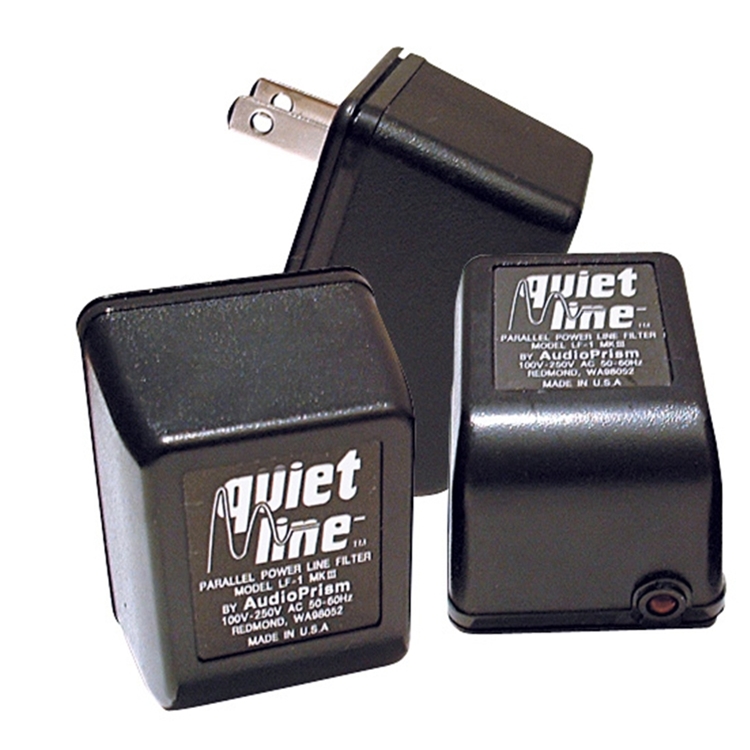
This new model is the latest Quietline, the Mk3, with noise attenuation performance improved by more than 10 dB over the previous model. From the MK III onwards it also features a noise checker function — LEDs that blink to indicate noise levels, just like the  PS AUDIO NOISE HARVESTER — making it a promising rival to the Noise Harvester. (Note: the direction of sonic change will naturally differ between the two.) The street price is roughly half that of the old Quietline MK II, so it is easy enough to try, and I am half-tempted to pick one up myself.
Quantum Products ElectroClear QRT-1
A product from US-based Quantum Products, imported by Harmonics (Combak). Made in California. I wonder if they are related to NORDOST, which subsequently brought out AC power strips and parallel mains noise filters under the same “QRT” (Quantum Resonance Technology) name? The manufacturer emits a truly remarkable quantity of mystifying claims about applying quantum resonance technology to organise electrical current at the particle level — so much so that even I, no stranger to dubious audio science, found it a bit much. That said, setting the theory entirely aside, it does seem to actually work. I heard a demo of the company’s Quantum Symphony (QS-1) in a shop and found myself desperately wanting one, whatever the explanation. It is difficult to describe, but the atmosphere in the room simply shifts.
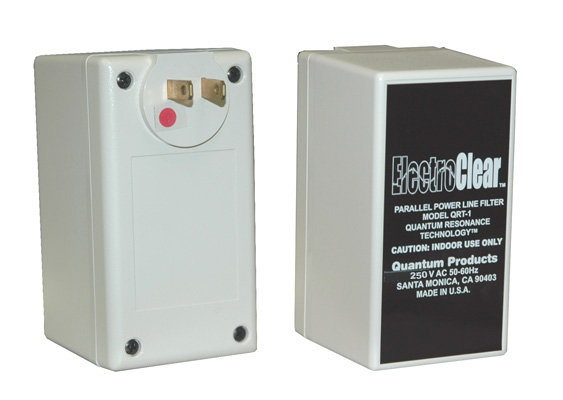
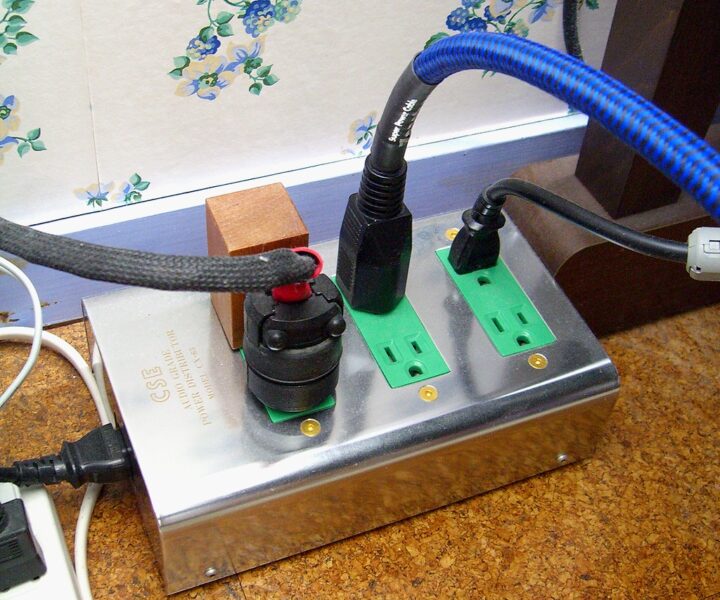
It was rather expensive, however (around 40,000 yen at the time), so I later acquired the junior model, the QRT-1 — and despite being cheap (around 10,000 yen list price?), it is really quite a different thing altogether. It is a series-type unit with a pass-through socket on the back, though when I contacted the manufacturer at the time, I was told the internal circuit is parallel. The sound… well, to put it kindly, the sound becomes as light as a feather. To put it less kindly, it becomes plasticky and cheap-sounding. I plugged it into an audio power strip, the CSE CX-63A, and the sound of my Clavinova in the next room changed in the same way, so something is certainly happening. That said, the build quality feels a touch too cheap for a series-type socket unit, and the tonal character is what it is — I think this one will divide opinion.
Harmonix AC-ENACOM
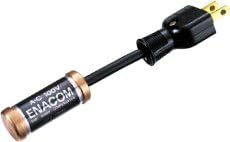
This one is from the Japanese brand Combak/Harmonix. I went through a period of using its sibling product, the Speaker ENACOM (SP-ENACOM), which was enthusiastically praised at Ippinkan — and my impression of the SP-ENACOM was that while the audible S/N improved, the music lost some of its vitality and became subdued, the tonal temperature turned cool, the sound images tightened and became slimmer, and the upper midrange and treble extended. For speaker-connected parallel filters personally, I would sooner recommend the radio.wave.cut, which is more effective at removing distortion while preserving the musical life of the sound, compared to the SP-ENACOM — though the two sound different, so the ENACOM may suit some environments better. In any case, the AC-ENACOM I have not tried myself. I would guess the sonic character is probably much the same, but for that I shall refer you to jazzaudiofan’s detailed review.
AudioSpice ACC18 Signature
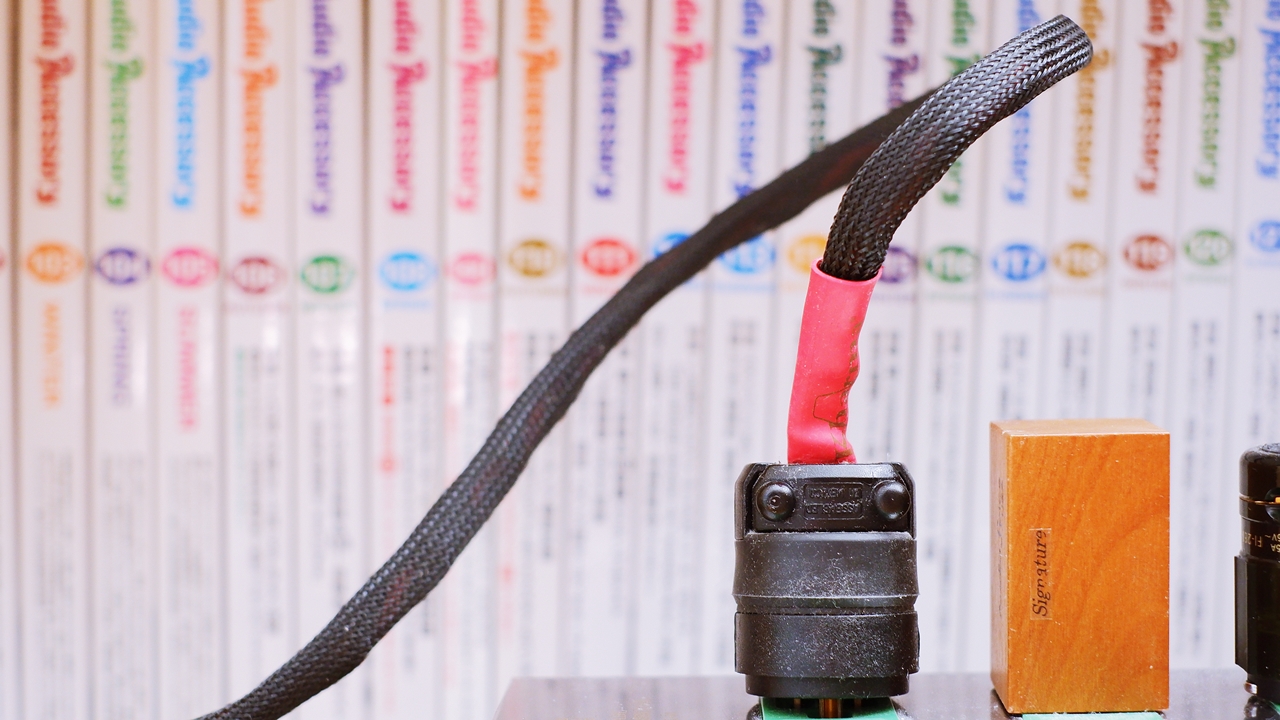
An AC noise filter (AC-LINE CLEANER) from American company AudioSpice. The domestic list price at the time was 7,200 yen. Of all the products here, this is probably the most obscure. At launch it received only a brief mention tucked away in issue 97 of Audio Accessory magazine (2000), and after that it quietly vanished without ever attracting much attention — a thoroughly minor accessory. It is so obscure that searching for it now turns up nothing, and there is a good chance the manufacturer no longer exists. There was apparently a manufacturer website at some point, as I have a few images I seem to have saved locally, so I have included them here. Incidentally, this is the one product in this list that I still have and actively use — one AC accessory I simply cannot part with.
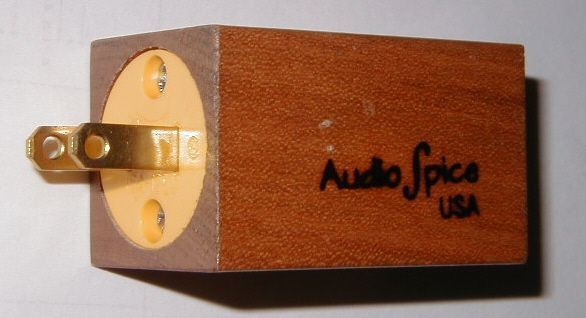
What sets it apart from the others is that it comes in a wooden box. Given that I have always been drawn to natural, understated interiors, I naturally ended up buying it more for the look than for any sonic reason. Summarising the impression given by Mr Katsuo Suzuki in the pages of Audio Accessory magazine:
The noise-absorbing capacitors have been completely renewed, and the adoption of high-quality resistors makes this a more effective power cleaner. Usage is simple — just plug it into the mains socket, and the muddiness in playback disappears, replaced by a clean, clear soundstage. The articulation of individual notes is rendered with vivid clarity, which raises the overall three-dimensionality of the sound while also bringing a deep, lustrous tone and a fresh, real quality to playback. The clean soundstage gives a sense of increased rhythmic energy, as though sounds that had previously been constrained have now been set free…
Quite an impressive piece of writing, I think. And in fact the review above is extremely accurate. To add my own impressions: the focus of sound images sharpens and clarifies, and the transparency of the soundstage improves. The tonal character is slightly cool, with a fast transient attack and a metallic sheen combined with a certain smoothness; the perceived frequency response sounds flatter compared to when it is not in use. The midrange is clear and easy to follow, and extension improves in both the treble and bass directions. Because the colouration from decay and resonance is tidied up, the sense of reverb retreats very slightly — but there is none of the excessive high-frequency roll-off that AC noise filters often bring, and overall the direction is a favourable one.
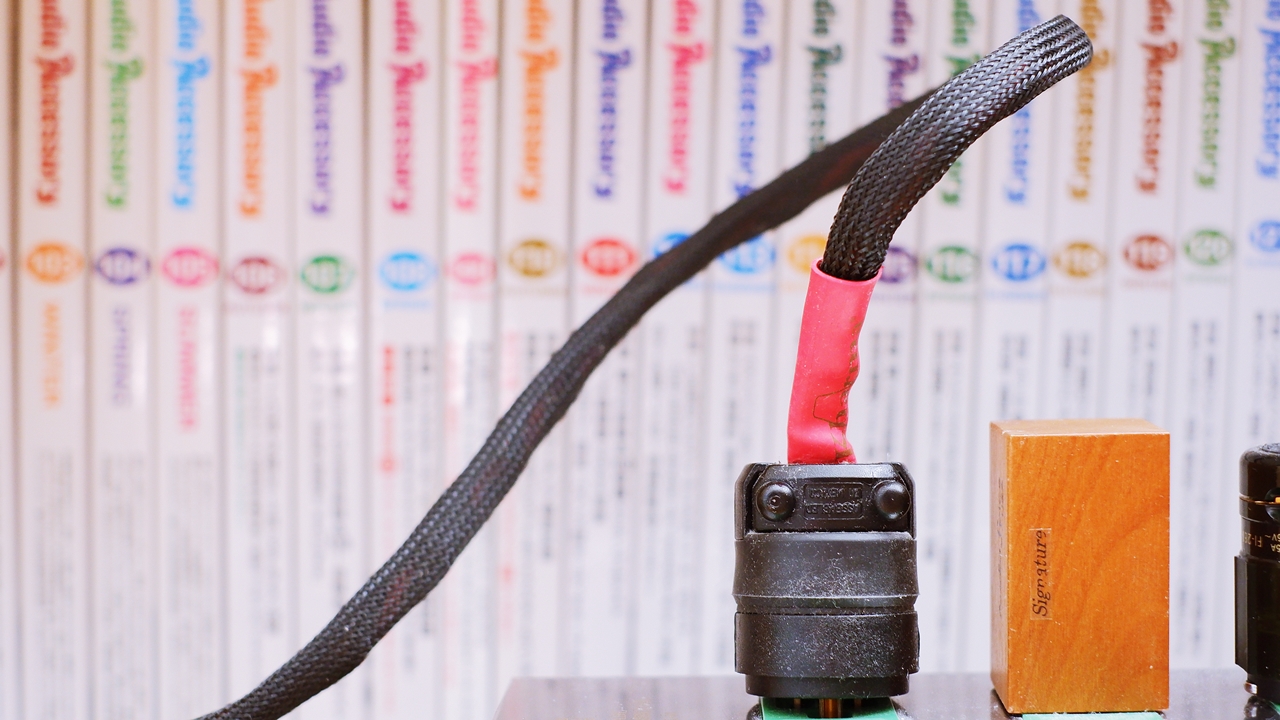
The character is a cool soundstage with taut, well-controlled rhythmic drive. The vibrational quality of fundamental tones becomes more distinct. Without it, the naturalness and freedom of the sound — a kind of relaxed openness — is clearly greater, so on that point alone my impression differs from the Audio Accessory review. Using it sharpens the focus of sound images, but introduces a slight sense of tension into the sound. The image that comes to mind is of piano wire with its tension turned up just a fraction. The wooden enclosure, I suspect, is a deliberate choice to soften a certain kind of tension and metallic colouration that must come from the internal components.


 ポチップ
ポチップ
And so — comparing it to the PS AUDIO NOISE HARVESTER, the effect is more immediately audible in my system, and the direction of the change is, if anything, the opposite. I have tried various combinations, but for my current system at home, a single AudioSpice ACC18 Signature seems to be just right for now. If a used ACC-18 were to come up for sale somewhere, I would snap it up immediately for my secondary system.
And there we have it — an AUDIO STYLE guide to parallel-type, easy-to-try AC noise filters, in the spirit of compact and considered pure audio.
Auto Translated by CS4.6