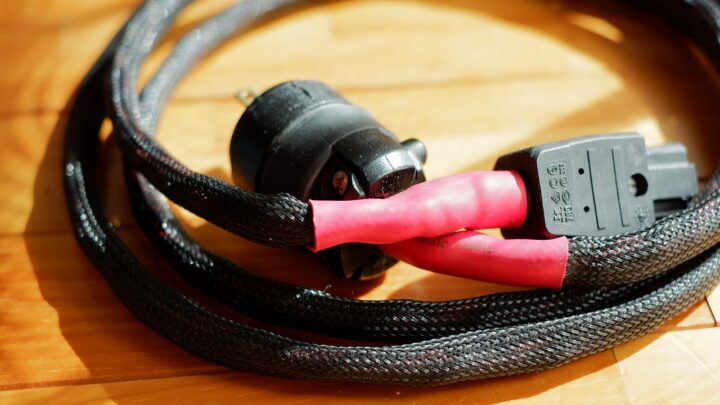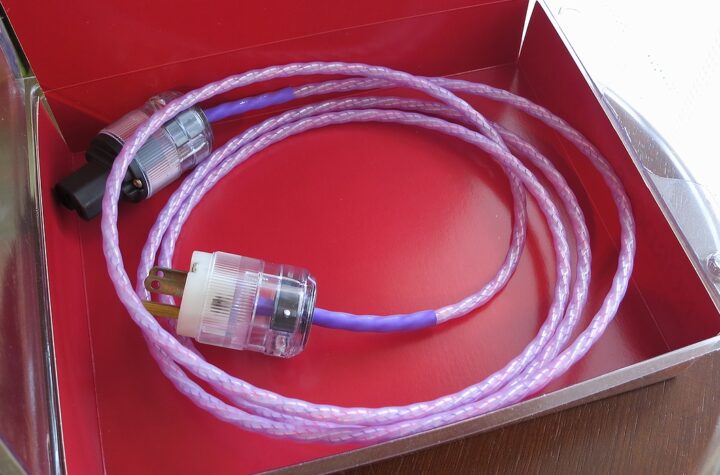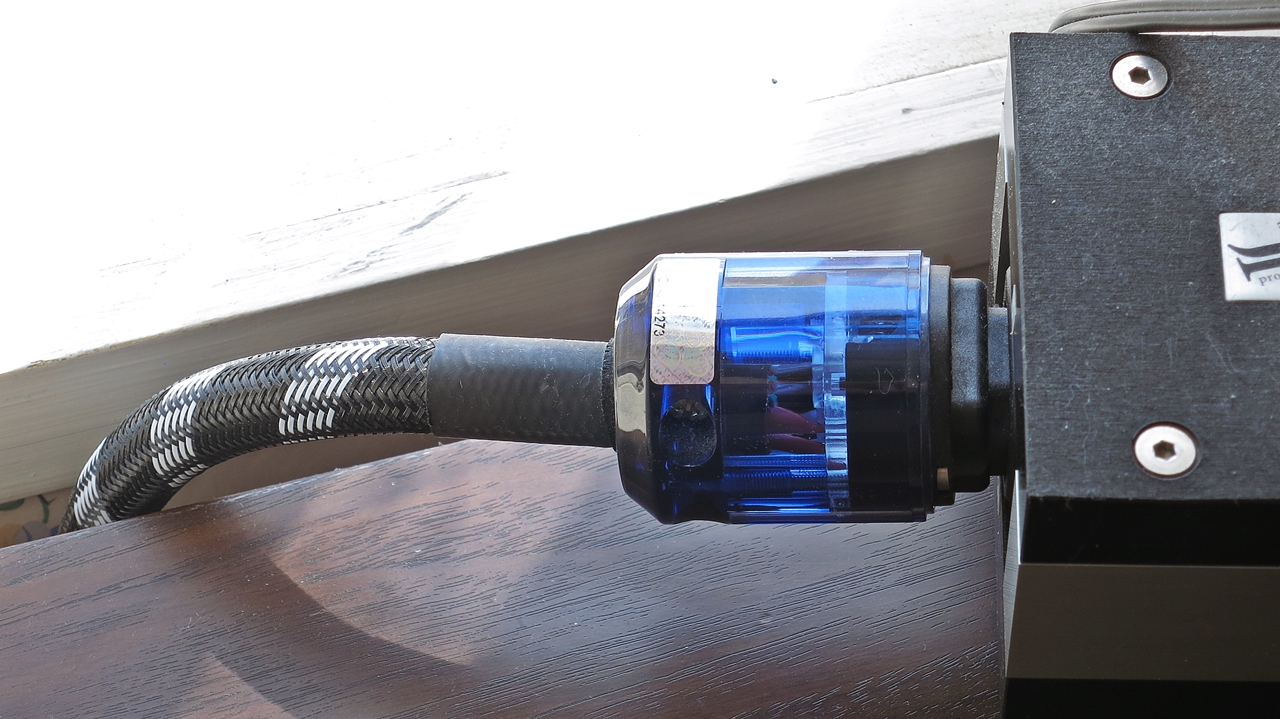
This time I’ll be introducing Real Cable’s Citrine PSOCC-2 power cable from France. Real Cable is apparently France’s number-one domestic cable manufacturer — occupying a position rather like audio-technica does in Japan — and a comprehensive cable maker at that, with tuning decisions made by none other than the female president, who is the daughter of the company’s founder. I started out by trying a few of Real Cable’s more affordable TDC/CAT speaker cables, which I now use in my bedroom secondary system. I’ll save the review of those for a separate entry; this time, it’s the Citrine PSOCC-2 power cable. The domestic distributor is Network Japan.
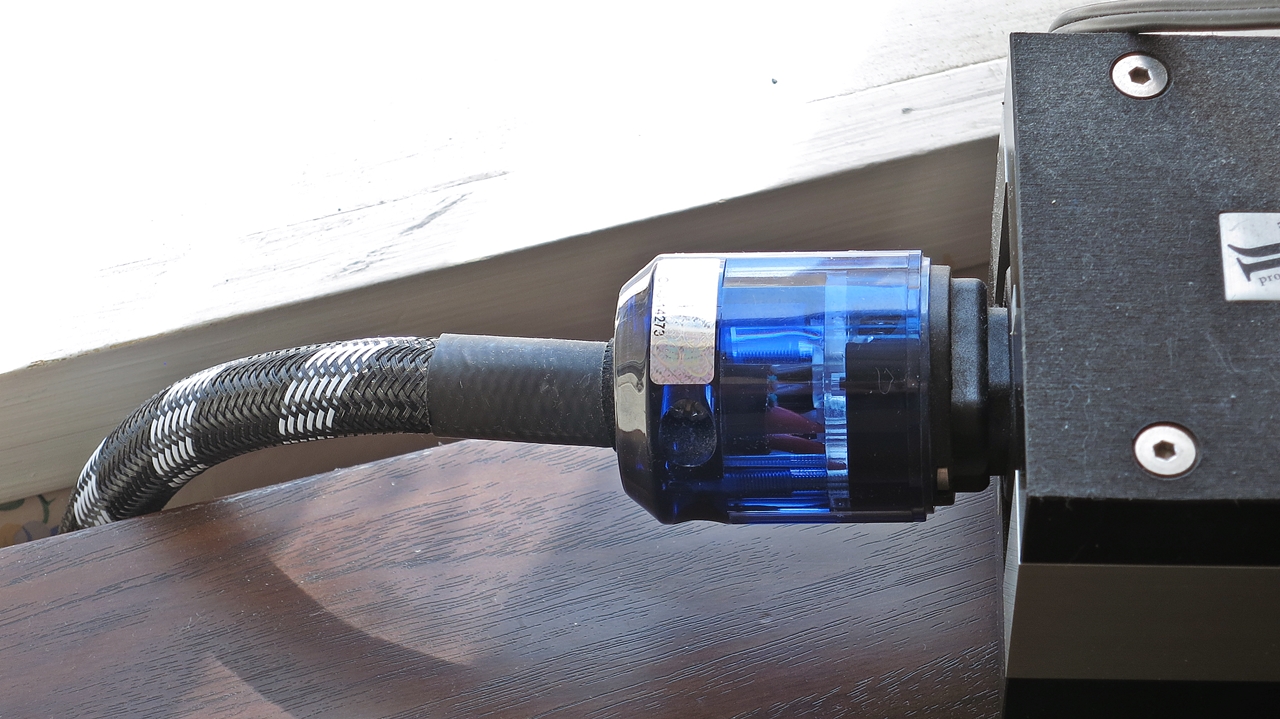
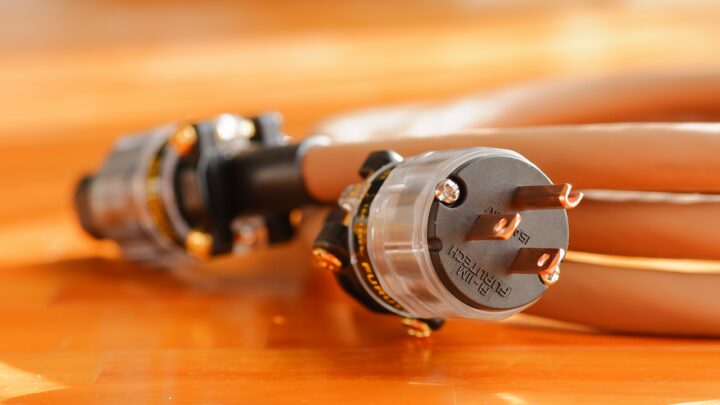
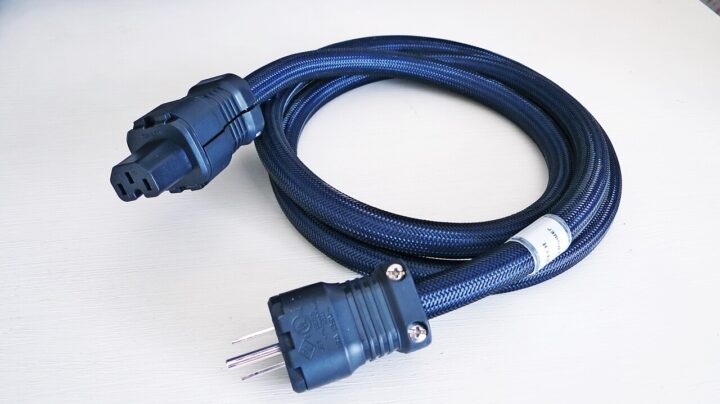
Real Cable currently offers two power cables in Japan — the PSOCC-1 and the PSOCC-2 — but the only difference between them is the plating on the Oyaide power plugs used; the conductor itself is the same Citrine PSOCC in both cases (also available by the metre).
Oyaide AC plugs in Japan-spec and a French-made conductor
The difference between the PSOCC-1 and PSOCC-2 comes down to the power plugs used in the Japan-spec versions: the PSOCC-1 uses the unplated Oyaide P-029/C-029, while the higher-grade PSOCC-2 gets the silver + rhodium-plated P-037/C-037. Incidentally, the Citrine doesn’t appear on the French manufacturer’s website, so it would seem to be their “PSOCC4MF” power cable fitted with higher-grade Oyaide plugs as a Japan-specific specification. As for the name Citrine (yellow quartz) — speaking as someone with the peculiar condition of chromesthesia where sounds appear as colours, I can report that it doesn’t actually sound particularly yellow, or amber-coloured for that matter.


 ポチップ
ポチップ
 ポチップ
ポチップ
The PSOCC conductor is also sold by the metre domestically, with a recommended retail price (before any discount) of ¥7,500 for 50 cm and ¥15,000 for 1 m — blimey, that’s steep — though the French price is €35 for 50 cm, so it’s much the same. At the discounted domestic price it’s relatively reasonable. The finished product in its home-market spec without Oyaide plugs is €149 for 1 m. Quite honestly, since the Oyaide power plugs themselves aren’t cheap, the finished cable works out better value. Some high-end overseas cables are apparently fitted with counterfeit Oyaide plugs more often than one might think, but as this is a domestic distributor specification for the Japanese market, there’s no need to worry about that here.

Real Cable Citrine PSOCC-2 — Sound Quality Review
The one I purchased is 1.2 m. It’s short, fairly thick, and quite stiff, so cable management is not its strong suit. First I try it connected to the SACD player ONKYO C-S5VL in my main system. The Citrine PSOCC has an even more pronounced character than the company’s TDC speaker cables, and just as I had privately feared from the look of it, it seems likely to be what you might call an acquired taste in Japanese terms — a novelty item, in the best possible sense. The conductor is described as OCC, but from the sound of it, I’d suspect it’s more in the PCOCC family. Rather than the approach taken by domestic cables — skilfully masking the weaknesses inherent to OCC-type conductors and arriving at a kind of averaged-out result — this feels more like a cable that has deliberately taken the character of its material and amplified it as a defining trait. It’s not a flat, audiophile-neutral type of sound; instead it magnifies the midrange as if through a loupe, drawing you into the music with a forceful momentum.
As such, it doesn’t seem particularly well-suited to general-purpose use. This is, in a sense, a piece for the more experienced user — one that demands a certain technique in system-matching, a bold decision about where to deploy its somewhat flamboyant, very French esprit to best effect.
The sound quality is clear and high in perceived resolution (perceived resolution, I should stress), with a hard, brilliant, metallic image. Unlike the speaker cables, which one might expect to be warm-leaning, the tonal temperature here runs cool — quite possibly due to the considerable influence of those silver + rhodium-plated Oyaide P-037/C-037 plugs at each end. The perceived frequency response is a kind of life-sized kamaboko curve, with a presence-rich midrange that pushes forward with good response (& with depth behind it too). The centre of gravity sits low. Whether it’s the character of the OCC copper or not, this sounds remarkably masculine for a cable voiced by a woman — there’s a certain forcefulness to it that can feel ever so slightly insistent, yet paired with a high degree of musical focus, strong damping, and a bouncy, rhythmically alive bass that is well-defined yet carries a pleasing softness. Musicality is a genuine strength. Rather than diffusing reflected-sound components broadly across the soundstage, it instead loads the image itself with a rich bloom of colouration — so while the imaging is clear, it reads as slightly large. Guitar picking is convincingly real, but the delicate touch of the piano can get a little swallowed up in the sustain, so a touch more separation would be welcome. The centre of gravity being low means width and height in the soundstage don’t open up easily, but the front-to-back dimension has a substantial, dynamic quality that makes a real impression.
That springy elasticity, the distinctive musicality, and the tendency to describe things through image rather than soundstage space — all of these are qualities I find in the company’s more affordable speaker cables too, such as the TDC200, so they may well be hallmarks of Real Cable as a brand. That said, the TDC200 and CAT150 speaker cables I bought by the metre are not this forthright in character — they have a feminine, gentle, warm sound that is their real strength.
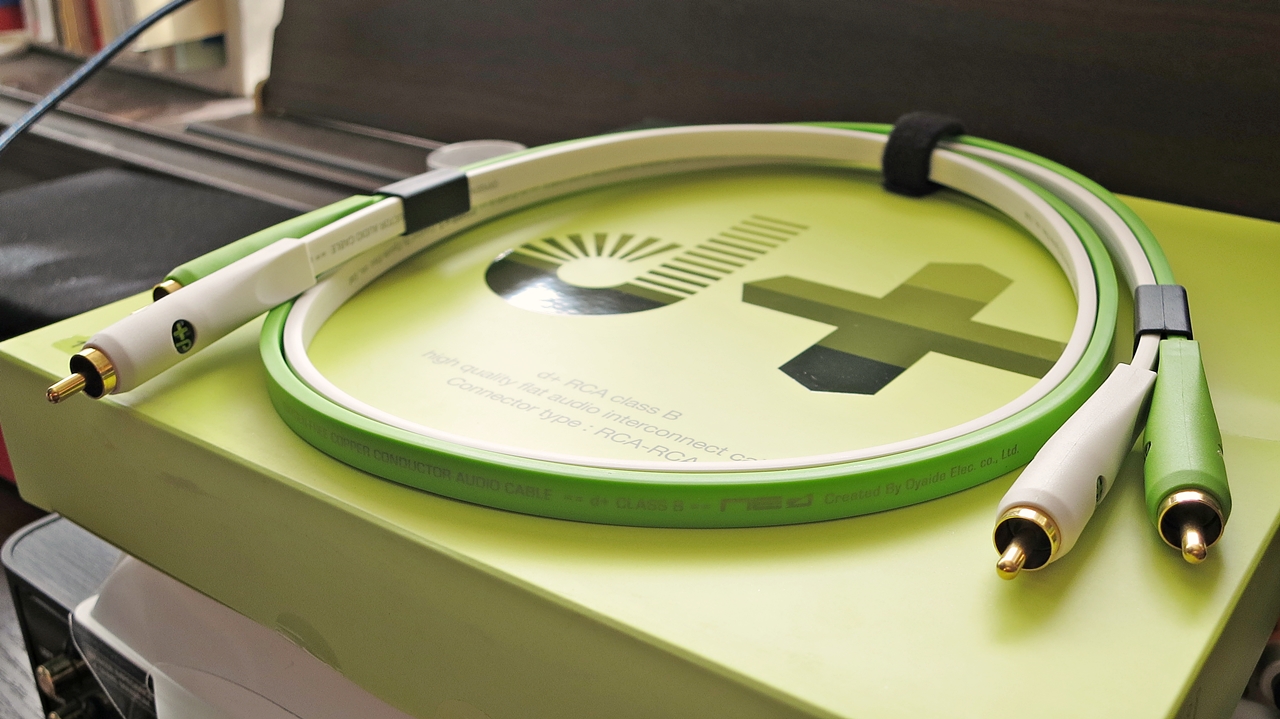
If there is one thing about the Real Cable Citrine PSOCC-2 that personally gives me pause, it’s a certain metallic brightness — or what can at times feel like an intentional edge of distortion — in the upper midrange through to the treble. After burn-in and once the cable has settled into the system, it does subside to the point where one’s ears adjust, but this metallic quality in the highs is something I’ve also noticed from time to time with ATOLL and the inverted-dome tweeter speakers FOCAL made some years back (not the current range) — which makes me wonder whether it might be a characteristic of products from France and the French-speaking world generally… (a mystery).
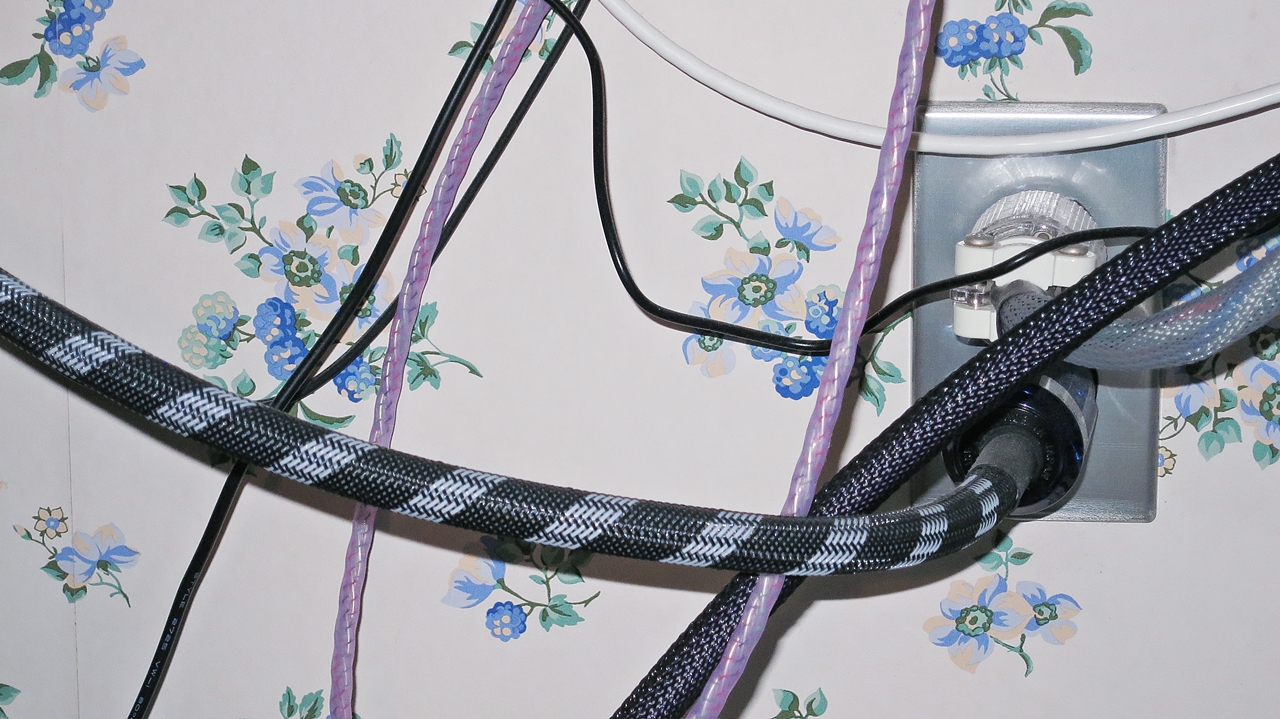
The tonal character of the Citrine PSOCC — the kind that might lead you to wonder, if nobody told you otherwise, whether it was actually a silver-plated cable — is, I can’t help feeling, further accentuated, for better or worse, by the silver + rhodium-plated Oyaide P-037/C-037 plugs, and I suspect that swapping in different plugs would take the treble in a considerably milder direction (almost certainly). To take the edge off the highs while preserving the cable’s appealingly bright, characterful personality in the best sense, the gold-palladium P-046/C-046 might be worth trying; for a flatter bass and a beautiful, wider-range presentation, the platinum-palladium P-004/C-004; or, if you’d rather lean into that spartan forcefulness and aim for something more orthodox, the unplated beryllium-copper P-004/C-004 (white) could be an interesting direction to pursue.
 ポチップ
ポチップ
 ポチップ
ポチップ
— Summary —
In a word, the Citrine PSOCC-2 has the kind of groovy, opinionated personality that, approached from a strictly audiophile standpoint, could easily prompt a “what on earth is this?!” reaction — and yet it also carries the feeling of a cable voiced by music-lovers who tuned it by simply listening to music they love, with their preferences fully unleashed. As if to say: the trends in the Hi-Fi world, the modern ideal of accurate high-fidelity sound — none of that really matters in the end; what matters is whether the music is enjoyable. There’s a wonderfully self-sufficient, take-it-or-leave-it quality to the sound that I find rather appealing. “Real” here seems to mean less “audiophile accurate” and more “the passion of a live performance” as the reference point. It has a fairly raw, instinctive, spartan expressiveness, and from my own perspective — someone who tends to favour classical refinement — it does feel rather bold. Connecting the Citrine PSOCC to a component with a plain, neutral sound risks the component’s own character being overwhelmed entirely, as if the whole thing has been retrained to sound like a Real Cable product. Whether plugging in a single cable and going “oh la la, French sound!” fills you with delight, or has you crying in despair, is — quite probably — entirely down to the person using it. (I have a draft about follow-up system-matching further down the line, so if I feel so inclined I’ll publish that as a follow-up at some point.)
 Power cables & power accessories


Auto Translated by CS4.6