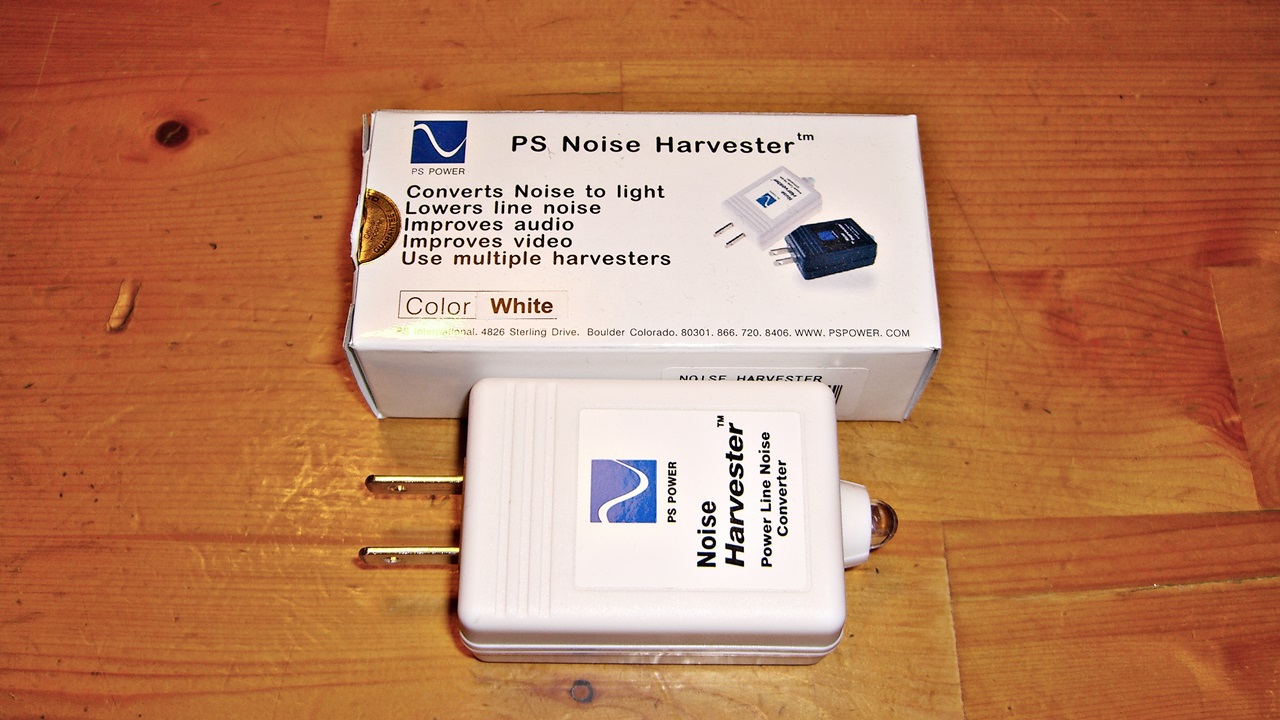
What I purchased this time is the Noise Harvester from American company PS Audio, a mains noise filter that has recently been gaining popularity among Hi-Fi enthusiasts. “Noise Harvester” — a slightly odd name. Apparently, plugging it into a spare socket removes noise and improves sound quality… or something along those lines. And on top of that, it is a rather amusing gadget in that the amount of noise contaminating your mains is made visible through a blinking LED.
There has been a fair amount of talk going around about whether it works or not, so I thought I might as well step up as a guinea pig on this one. I have tried all manner of gadgets like this in the past, and most have ended up gathering dust, but this is very much the sort of product that resurfaces on a cyclical basis — a clever bit of marketing, one might say. So, once it arrives, I hope to write a review touching on how it differs from the similar products that were fashionable in years gone by.
Appearance of the PS Audio Noise Harvester I Purchased
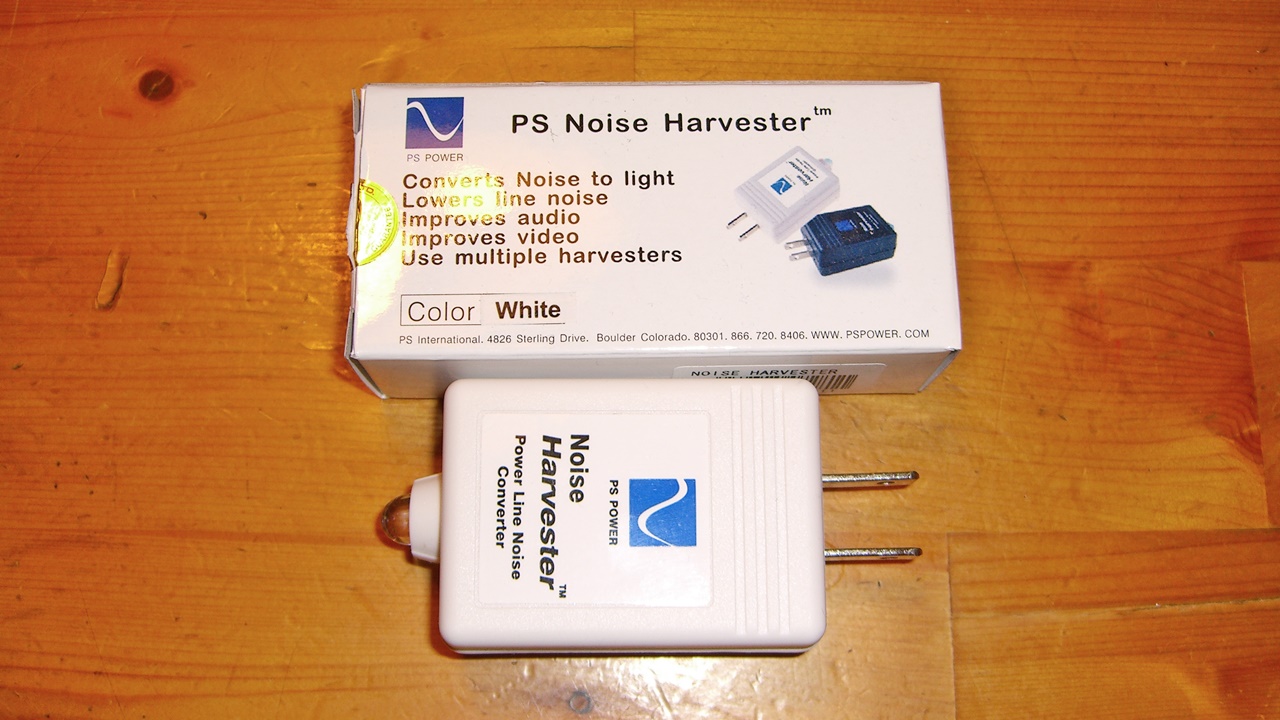
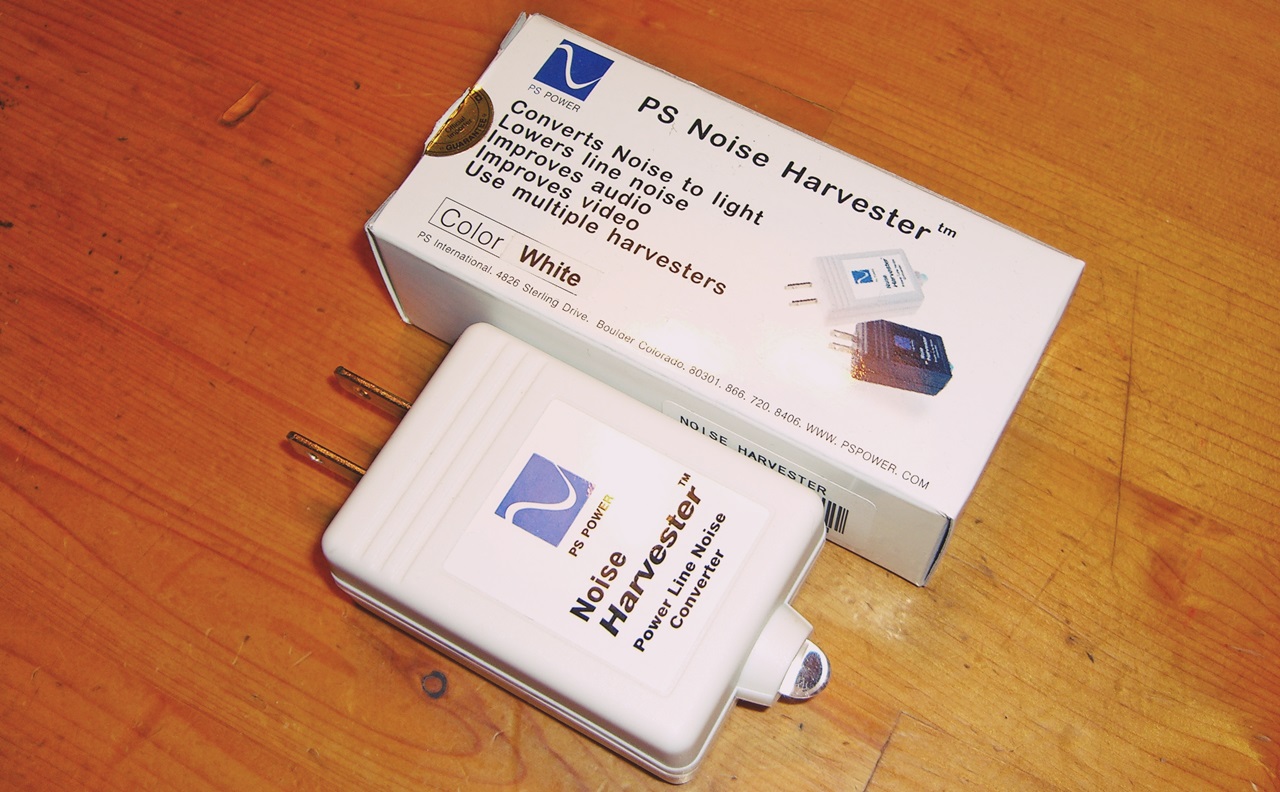
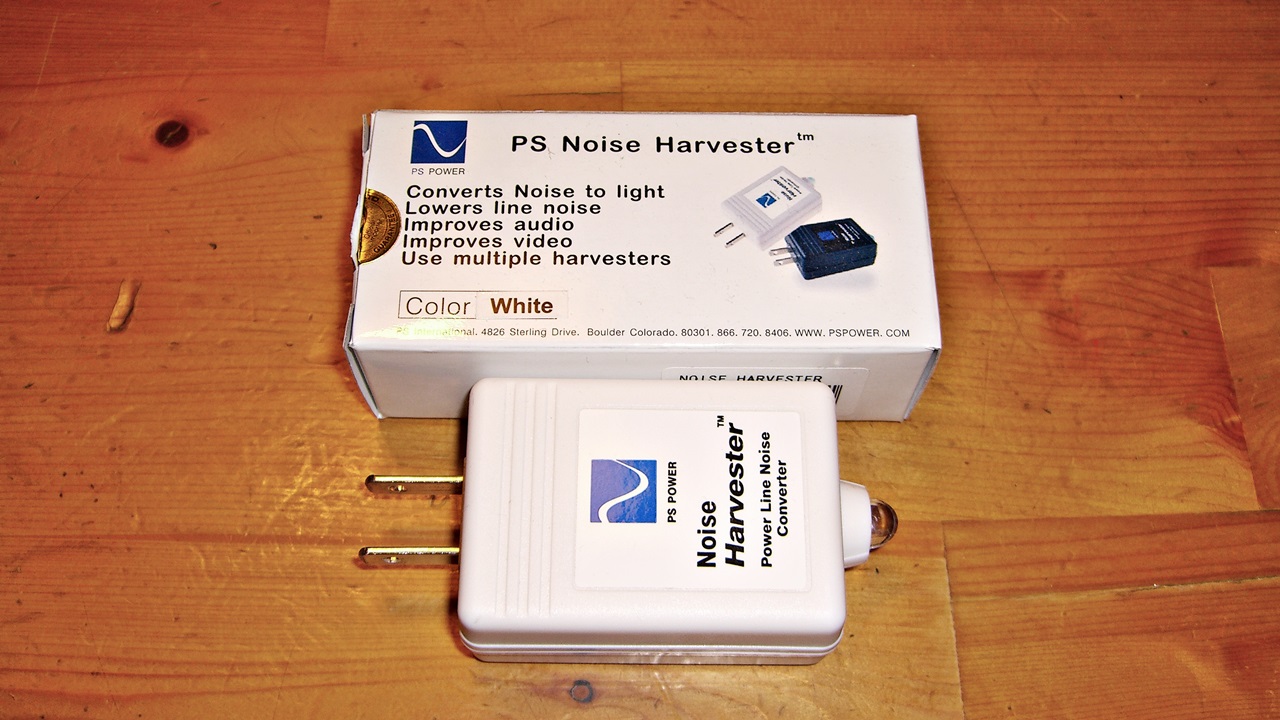
Here is what it looks like, along with its outer box. I purchased the white version to match my interior.
There was a video from PS AUDIO‘s American headquarters explaining how it works, here 《Link is now dead following discontinuation in the home market.》… it had a certain air of late-night infomercial about it that I couldn’t help but find amusing. The US list price appears to be $99, so the domestic retail price seems quite reasonable, all things considered. As for how it works — I’ll leave the technical details to those who know better — but the principle apparently involves temporarily absorbing noise components in the 8–15,000 Hz range into an internal capacitor, then discharging everything at once once enough has accumulated. The LED blinking is simply a decorative visual representation of that process. Those of a certain rank may find this all rather puzzling.
I have a particular fondness for this sort of “out-there” accessory here at the AUDIO STYLE blog, and I have tried quite a few over the years. Whatever one might say about logical consistency, in most cases the sound does seem to change in some way or another. Whether that change is genuinely for the better is, of course, another matter entirely. Similar parallel-type mains noise filters have been released by various manufacturers over the years, and they seem to set off a boom among Japanese Hi-Fi enthusiasts every few years. Well, it seems much the same cycle has come around again, and I thought it might be entertaining to willingly let myself be taken in.


 ポチップ
ポチップ
Plugging the PS AUDIO Noise Harvester into the Power Strip…
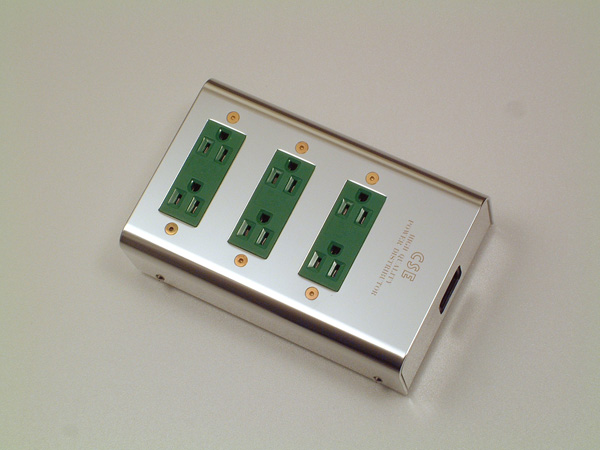
First, fresh out of the box, I plug it into the audio-dedicated power strip on my main system — the CSE CX-63A. … Nothing. Not a flicker. Puzzled, I tried it in spare sockets in the kitchen and near the wireless router in the hallway — still no response. I was beginning to think it might be faulty, and after poking it into various sockets for a while, the blue LED finally started blinking. After testing it in a number of spots, it seems the Noise Harvester itself is simply slow to wake up — for some reason, when brand new or after sitting unused for several days, it refuses to light up for a while. As an instant noise tester, then, it seems rather unreliable.
Once it enters blinking mode, it flashes at a fairly steady rhythm — in my home, roughly once every few seconds, rising to about twice per second after evening. Between around 10 and midnight it is at its most active, sometimes hitting four blinks per second. Living in a block of flats where the mains environment should, in theory, be rather poor, the noise levels still seem relatively modest — there is no blinking at all in the small hours or on weekday mornings. On weekend evenings it blinks a little faster than on weekdays, as one might expect. On one occasion during this time slot, the LED went into a near-continuous rapid blink, and at that point there was an extraordinary buzzing noise that made listening to music quite impossible. I initially panicked, having no idea where the sound was coming from — it reminded me of an insect. That said, under normal conditions and depending on your setup, you probably would not hear it at all unless you put your ear right up to the power strip.
Incidentally, once it starts blinking, it does so regardless of which spare socket in the vicinity you plug it into. Using other similar parallel-type noise filters alongside it, or plugging it into the Audio-Technica noise filter tap AT-NF34 I use for my video system, makes no difference to the blink rate. The noise appears to be almost entirely external in origin, and switching household appliances — including the computer — on and off seems to make virtually no difference. The one exception is the PIONEER plasma television PDP-427HX. It seems to generate noise for around ten-odd seconds after switch-on, and also briefly when changing channels with the remote, causing a short burst of blinking. In this respect, at least, the Noise Harvester does appear to be effective at visually signalling the presence of noise.
The All-Important Sound Quality Review
I imagine this is what everyone is really curious about…
Honestly, I can’t say I notice much difference.
So apparently I have tin ears after all. To give a more considered answer: in my environment, the sound does change to some degree, but the difference is extremely subtle. I am quite confident I could not tell in a blind test with the unit inserted and removed at random. What follows, written out in words, will inevitably read as more dramatic than it actually is, so please bear in mind throughout that we are talking about differences too small to distinguish in a blind test.
With the NOISE HARVESTER plugged in, the leading edge of notes becomes very slightly rounded, and the tonal balance shifts fractionally towards the lower end of the frequency range. This is the key point: the sound becomes just a touch softer, a little lukewarm, one might say. The upper-frequency bloom diminishes, and with it a slight sense of distortion recedes, with the result that left-right stereo imaging seems to become marginally more defined — or at least it seems that way to me. There is a faint improvement in rhythmic drive, and an impression of added sensuality and smoothness. This is actually the opposite tendency to the sound-becoming-subdued direction that is common among accessories of this type. So, subtle as it is, there is a character here that does feel consistent with other PS AUDIO products.
With the Noise Harvester removed, there is more upper-frequency bloom, and along with it a slight impression that distortion increases. In my system, however, this bloom in the upper-mid range actually makes the soundstage sound clearer and sharper — though it may simply be the effect of added colouration. Without the Noise Harvester, the faster transient attack means the tonal palette also sounds richer and more varied. After a great many insertions and removals, it seems that personally I prefer the sound without the Noise Harvester. As for any change in picture quality on the large plasma television — I could not detect anything at all, I’m afraid. I actually notice more of a difference in picture quality from which position in the power strip the television’s plug is connected to. Even recording the same anime content on repeat via SKY PerfecTV! and comparing A/B yielded nothing. Oddly, though, the difference in sonic character does seem to carry through — faintly — to recordings as well.
I said I doubted the difference would be audible in a blind test, but of course this will vary from one environment to another. That said, speaking purely of my own setup: the differences from inserting and removing the Noise Harvester are less clearly audible than the differences in both sound and picture quality that arise from trying the valve amplifier, belt-drive CD player, DVD recorder, and so on, in each of the six different sockets on the CX-63A power strip, or indeed than the sound quality differences from other similar parallel-type noise filters. Among accessories of this kind that I have tried, this may be the subtlest yet. To put it bluntly: even simply plugging a bare mains plug with no wiring attached into a spare socket can produce a fairly noticeable change in a system’s sound, and whether the Noise Harvester makes any meaningful difference beyond that — in my environment, at least — is honestly unclear. That said, the process of plugging and unplugging things prompted by the Noise Harvester did lead me to stumble upon a socket position that gave a noticeably cleaner picture on the Sugureco than before, so there was some trial-and-error benefit in that sense.
 ポチップ
ポチップ
Questions About the Degree of Sound Quality Change and Cost-Effectiveness
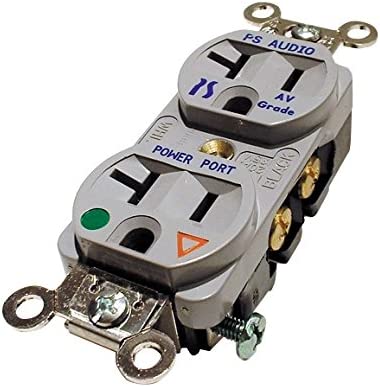
What struck me most keenly — and I say this with all due respect — is whether it is really acceptable to advertise a product with such fanfare about dramatic improvements when, depending on the circumstances, (setting aside the possibility that there is something wrong with my own environment) it may produce only this degree of change. Advertise it heavily enough across various publications and sales will surely follow. I myself ended up buying it not because I particularly wanted it, but simply for blog material. PS Audio presumably developed this as the lowest-priced entry point into their range of mains accessories — a gateway product intended to raise awareness of their brand and draw buyers towards their more expensive power cables XPD/XPL and mains conditioning systems. But the reality is that many people, depending on their mains environment, may simply not hear any meaningful difference from the Noise Harvester, and given the nature of the product, that seems entirely understandable. In that situation, ten thousand yen is not a trivial sum. If one is spending the same ten thousand yen, I rather suspect that the PS AUDIO POWER PORT wall socket from the same company would give far more people a clearly audible and meaningful difference — whatever one may think of the sonic character.
Ultimately, regardless of how effective the Noise Harvester proves to be in any given environment, I feel that its main selling point lies in the fact that it lights up — communicating its noise-absorbing activity visually, convincing the eye that it is doing its job, and delivering a kind of psychological reassurance and peace of mind. In that sense, unlike many accessories that rely solely on sonic change to justify themselves, the visual immediacy of the LED seems to serve as both an emotional and a rational justification for the purchase.
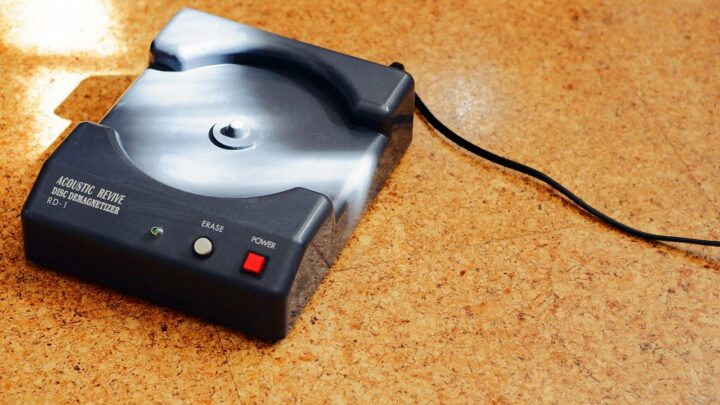
So, as a self-confessed devotee of occult audio accessories lurking in a quiet corner of the internet, I find the candid admissions of “I couldn’t hear much difference” that one occasionally encounters in other people’s impressions of this product entirely unsurprising. If anything, the difference between playing a CD before and after degaussing with the Acoustic Revive RD-1 — a product that has been stirring debate for years due to its subtle effects — is honestly far more clearly audible. One magazine described the Noise Harvester as threatening to render isolation transformers obsolete, but if anything, I find myself wondering what sort of environment would allow something like this to produce dramatic results. If noise levels are high enough to send it into continuous rapid blinking, the sound of the unit itself becomes irritating — and I notice that almost nobody seems to mention this. If your mains is so polluted that this thing works dramatically, you would really be better off investing promptly in a proper mains conditioner or AC regenerator.
ポチップ
The reason I feel so strongly about this is that my greatest concern is the following: products whose effectiveness varies enormously depending on system and environment — mains-sensitive items where results differ greatly from one setup to another — end up in the hands of enthusiasts across a wide range of system levels, and the risk is that more and more people will come away thinking, “Well, I suppose audio accessories really are all just placebo after all.” At a thousand yen it might at least raise a smile as a blinking noise checker, but for the average person, a ten-thousand-yen note is not a toy to be laughed off. PS Audio’s American website offers a 30-day return guarantee, but that is not available in Japan. (Note: please do not blame the Japanese distributor, who is selling it at close to the US price despite having to comply with PSE certification.) It would be wonderful if loan audition schemes became more widespread in Japan, but that is a thorny issue for all sorts of reasons. Were the product promoted honestly — clearly noting that results can vary enormously even on decent systems, and that the unit itself generates considerable noise in certain conditions — then the claims about sound quality would sit better. As it stands, however, this particular case strikes me as one where only the benefits have been amplified and let loose in a style not unlike a late-night infomercial.
~ Summary ~
In fairness to PS Audio, it should be said that in addition to the return guarantee mentioned above, the fact that they have not deliberately built in an artificially heavy sonic signature — not loaded the circuit with components designed to ensure the sound changes conspicuously so they can say “hear that?” — could be seen, depending on how you look at it, as a sign of integrity on their part. And for what it is worth, the power cable XPD/1.8mk2 xStream and the PS AUDIO POWER PORT wall socket I mentioned earlier both fall, whatever one thinks of their sound, firmly into the category of products that deliver a strikingly clear sonic change.
My findings here at AUDIO STYLE have turned out as they have, but given that assessments will shift dramatically with the environment and that perceptions differ from person to person, those who have found a clear and meaningful improvement can consider their mains environment upgraded and well done to them. Whether the mains environment here at AUDIO STYLE is simply low in noise to begin with, or whether my ears are simply not up to much — I shall leave that judgement to each of you. ⇒ Read other articles on mains noise filters
Auto Translated by CS4.6

List of comments (19)
いつも楽しく拝見してます。今回はおつかれ様&感謝々々です。私はACエナコムを使ってます。効果は?でしたが、3つも使わなくてはいけないとは! 最近アンプの電源ケーブルを奮発して、とどめを刺された感じです。ひょっとして卒業できるか? 電源は大切でした。
どうもです。
興味深く読ませて頂きました。(^^ゞ
「変わる」「変わらない」で世間も喧しいのですが、そもそも電柱から来ているラインから分電盤までと、宅内配線から混入するノイズとは別物なのはご存じの通り。その辺を切り分けて考えないと、とんでも無いことに…。
で、宅内をオーディオ専用ラインという形で処理していると、やはりなかなか光らないのです。
というわけで、音質変わった?と言われると、「残念ながら変わったと思えない」と答えています。
PS
このハーベスターは、コンデンサーの塊みたいなものですので、充電されるまで寝起きが悪いです。
>nanasiさん
電源は大切ですよぉ。
オーディオマニア的には、スピーカー/アンプ/プレーヤーとそこそこのケーブルを揃えましたら次は電源のテコ入れです。、ハイエンドサウンドを手に入れるには実際電源の高品位化が一番効果的かも知れません。私は相当おざなりにしてますけど…。 ちなみにアンプにどんな電源ケーブルを購入されたのですか?
エナコムは、スピーカー用は割とクッキリ変わりましたよ。高校生くらいの時に逸品館さん&コンバックの中の人に勧められて一時期使っていたことがあります。
>>Sugarさん
コンデンサーが一杯になるまで反応しないのですか~考えてみればそうか。って事は、挿して直ぐに変わったように感じたとするとプラシーボかっ!…。 Sugarさんくらいの方でもやはり有意差を認められなかったのですね。ちょっと安心しました。
電源系は、コンセントボックスにしても壁コンにしてもケーブルにしても、びっくりするくらい判りやすく音質が変化するのを身をもって感じてます。大型のアイソレーションレギュレーター等もです。だから屋内配線や配電盤まで手を出す方が出てくる。一部ハイエンドは別にして?一般的なオーディオ機器は電源周りの対策が不十分な機器が多いですから尚更変化が大きい。けれどこの手のパッシブなノイズフィルターに過剰な期待は禁物でしょうね。私にとって意味のある上で挙げたオーディオスパイスACC18でも、あくまで相対的な効果は僅かであり、かなり神経質な人でなければ意味がないと思ってます。
オーディオ歴の浅い私が初めて買ってみたのはSCR-ACでした。感想は、憧れていたのはこれだったのか! です。静かで判り易く高級な音で、満足感大です。ピアノの音とかもう……
わぉ!始めて購入したACケーブルがAETのSCR-ACですかっ!nanasiさん見掛けによらずお大尽な。Image11より高いじゃないですかぁ。私の持っている一番高いKharmaのKPCリファレンス1aでも定価35000円です。
いつも丁寧なレポートありがとうございます。古い話で申し訳ないのですが、人柱購入されたゴトウ総合音響さんの製品レポートがお蔵入りしていたら、公開していただけませんでしょうか。話が古すぎますでしょうか。
ははは ただ貴族なだけですよ 逸品館のレポートの熱さに負けました。でも安かった気がしてます。
>Kentaさん
リクエストありがとうございます♪今構想中の記事が10近くあり、少し後になってしまうと思うのですが、なんとかシンクロシートの記事をまとめられるように努力します。今更ですが、ステラメロディ購入計画はその後如何されましたでしょうか?
>nanasiさん
逸品館でオススメしてましたか~。羨ましい。ちなみに私は1万円台クラスで良い電源ケーブルはないか物色中です。
ステラメロディのことを覚えておいでとは!ありがとうございます。現在進行中ですが未だ形にはなっておりません。ACUSTIK LABから新しいSPが出たようですが…
アコーステッィクラボの新しいスピーカー情報、探しても見つかりません~m(__)m 一体どんなモデルが出るのかしら?
avcatさんの2月21日付けのニュースをごらんください。
http://avcat.jp/avnews/2007/20071.html
avvatさんの情報収集力の凄さには、ただただ驚くばかりです
>pastel_pianoさん
ごめんなさいm(__)m
やっぱりNoise Harvester買ってしまいました。
効果はほんの僅かでしたね。すごく速く点滅していましたけど(笑)
でも、もう買ってしまったので一応挿しておきます(笑)
ひょえ~買ってしまいましたか。
まぁ持っていて悪い事はないと思います。プラズマテレビ・・・KUROやピュアビジョンは電源からノイズがダダ漏れですから、それを視覚的に伝えてくれるだけでも価値はあります。ただ出来ればプラズマはきちんと電源対策はした方が良いと思いますけれど。。。そう書きつつやって無いですけれどもw
ノイズハーベスターのレビューをブログで書かれましたら是非トラックバック下さいませ♪
了解です~。
次はタップをどうにかしなければ。恥ずかしながらも只今エレコムのスリムタップを使っております(爆)
遅レス失礼します。
私もAV用に使っている今のものは20年近く前に6千円くらいで買ったオーディオテクニカの一体型のもので、当時は音質に影響があるとかそういった話はありませんでしたので効果は大した物ではありません
電源ボックスはFURMANのこんなのどうでしょうか?使ってない私が言うのも何ですが、価格が安いので気軽に試せます。アメリカでは楽器・オーディオ用として定番のブランドです。
http://store.shopping.yahoo.co.jp/esp/furman-ss-6b.html
風と音とロボロフスキーさんのインプレです。
http://otokazerobo.cocolog-nifty.com/blog/2009/02/furman-8709.html#more
ちなみにAV用に今後オーディオテクニカのAT-PT1000を導入したいと思っています。
http://www.amazon.co.jp/dp/B0000E6WCQ/pastelaudio-22/ref=nosim/
こんにちは~
ブログの記事に載せてみましたので良かったら見て下さい(^^)
http://yoshida1.blog118.fc2.com/blog-entry-44.html
>FURMAN
ページ見させてもらいましたが、良いですね~。
見たら欲しくなってきちゃいましたよ(笑)
どのぐらい効果が出るのか気になります。
お金に余裕が出来たら買ってみようかな(今日、レゾナンスクライオを買ったばかりなので)
ちなみに、クライオも記事にしてみましたので良かったら見てみて下さい。
貴重な情報ありがとうございます~(^^)
楽しく拝読致しました。私のマンションは200世帯以上の入居者がいて、電源環境が悪すぎます(´;ω;`) 徒歩5分のところにある小生のアパートにはケンウッドのレシーバがありますが、居住者が10世帯のみであるせいか、5万円のプアシステムなのにとても音が良いです。とにかく、音が透明で澄んでますΣ(゚д゚lll)。電源のノイズ対策に興味があるのは言うまでもありません。インフラノイズの「ACハーモナイザー」や、「エナコム」は大昔試しました。CSEの電源アイソレーションや、クリプトンのノイズフィルター機能付きタップも…。共通しているのは、音に生気がなくなること、でしょうか?「クワイエット・ライン」や「ノイズ・ハーベスター」にも興味がありました。
ノイズ対策の決定打は、出水電器さんの電源工事でした。8スケアの専用回線を、2回線引いてもらいました。工事費は20万円弱かかりました。高いですね。しかし…ものすごい効果ですよ!!静寂感、エナジー感、音の広がり、懐の深さ、反応の良さ。結局、いくらハイエンドな機器を揃えても、電源の強化・ノイズ対策をしないと、機器の実力が発揮されないことが分かりました。例えば、アキュフェーズの電源クリーン機器を導入しても、あまり期待できないのでないでしょうか?な~んて。
回し者では無いですが、電源工事はまるでハイエンド機器に買い換えた如くに効き目があるので、是非…。
パソコンのご動作のため、2重投稿となりましたこと、大変失礼いたしましたm(_)m
hop様コメントありがとうございます(^^)
>>居住者が10世帯のみであるせいか5万円のプアシステムなのにとても音が良いです。
羨ましい・・・。ウチも気付いたら築30年越えのマンションですので、分電盤くらいは新しく交換したいのですけれども、お幾ら位するんでしょうねぇ。。。分電盤の機種も最近のは何が良いのか知らないですし。クライオブレーカーまでにはしなくても、安全面も含めて新しい物に交換したい気持ちはあります。
出水電器さんの噂は何度か耳にしています。オーディオ機器よりも、その外側の電源やルームアコースティックの問題が、実は皆が想像している以上に遥かに重要・・・これには同意しますです。電源や部屋が良くない場合って、どんなハイエンド機器を置いてもパッとしない音しかしないんですよねぇ。。。何使っても大して変わらなくてほぼ一緒じゃん?みたいな、所謂違いが判りづらい、判らない音になるような気がしてます。自分の部屋の問題って比較がし辛くて一番気付きにくいですしね。
>共通しているのは、音に生気がなくなること
そうなんですよね。PS AUDIOの(XPDやXPL)電源ケーブルも、ただのケーブルのくせに聴感S/Nが改善し、ノイズリダクション効果が高いのですけれど、5.5スケアの導体径の割には力強良さの足りない、さめざめした雰囲気の音になります。