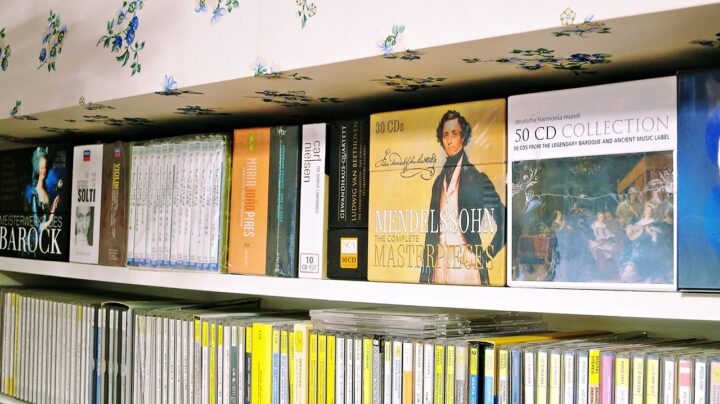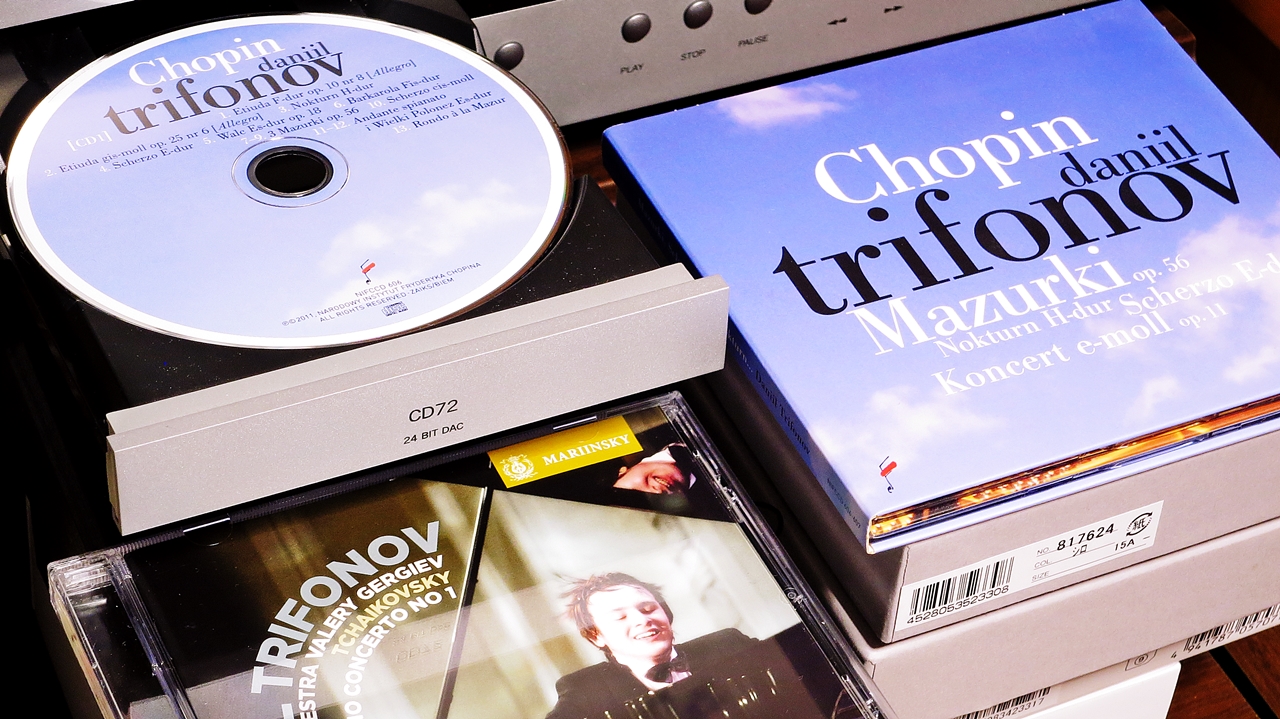
Today, after quite some time, I found myself wanting to listen to the young Russian pianist Daniil Trifonov, and went to pull out his debut album on DECCA, Trifonov Plays Chopin, recorded just after the Chopin Competition — only to find it nowhere in my study’s CD shelves, no matter how thoroughly I searched the DECCA section. Come to think of it, I had only the vaguest memory of ever actually holding the physical disc in my hands… Thinking something was off, I searched my PC’s email archive, where every past online purchase is on record, and it seems that this was something I had borrowed long ago from Rakuten Rental — what I had on hand was simply the WAV data I had ripped from it.
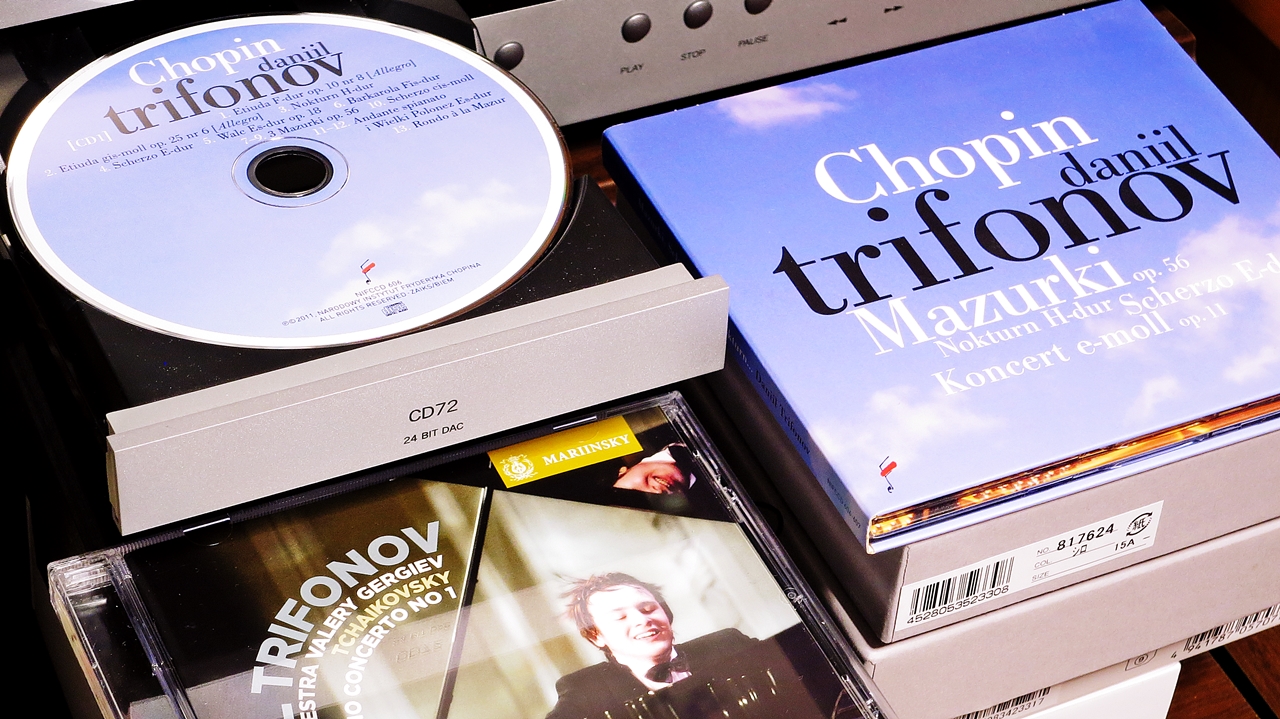
However, the ripped data from that CD appears to have been among the files lost when my HDD suffered a logical crash some time ago, and unfortunately I cannot find a backup anywhere — so I suppose I will need to buy the CD afresh to restore my library. Incidentally, one detail worth noting about Trifonov Plays Chopin is that a Fazioli was used rather than a Steinway. And what’s more, this live recording made in Italy was recorded a full six months before the Chopin Competition itself.


Since what isn’t there can’t be helped, I instead pulled out the SACD containing a live recording of Tchaikovsky’s Piano Concerto alongside solo pieces — songs by Chopin and Schubert/Schumann in Liszt’s arrangements — and I am listening to Trifonov’s playing as I write this. It is a splendid live performance with the Mariinsky Theatre Orchestra under Valery Gergiev, and I imagine there are those fortunate enough to have heard the Japan tour in person.

 ポチップ
ポチップ
The reason all this is on my mind is that Universal Music is currently running a limited-time sale, and I have been wondering — belatedly, I know — whether I should buy the Deutsche Grammophon CD of Liszt’s Transcendental Études released in 2016. It is something I have been going back and forth over, just a little.

 ポチップ
ポチップ
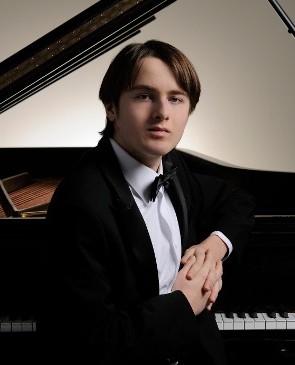
When I was following the 16th Chopin Competition in real time back in 2010, the performer who caught my attention most during the preliminary rounds was Daniil Trifonov. There is a baby-faced giant of a man, tilting his head as he spins out passages of extraordinary virtuosity, his manner of telling the music lisping and languid, tickling one’s ear intimately — and if I were to put it into words, it sounds as though the spatial perception governing the musical architecture is on the verge of a Gestalt collapse, which is precisely what makes it precarious and, at the same time, part of his charm. His Mazurka Op. 56 in particular, with its rhythm lurching like a drunkard’s gait, was simply exquisite. His appearance, too, is a little unusual — a baby face with a bowl cut, not what you would call conventionally handsome — and yet his manner of playing is delicate and gentle in a way quite at odds with his large build, and there must be something about it that stirs a certain maternal instinct, because during the live commentary the ladies were enormously taken with him; taken all together — the playing and the appearance — he was undeniably a pianist with something special about him.
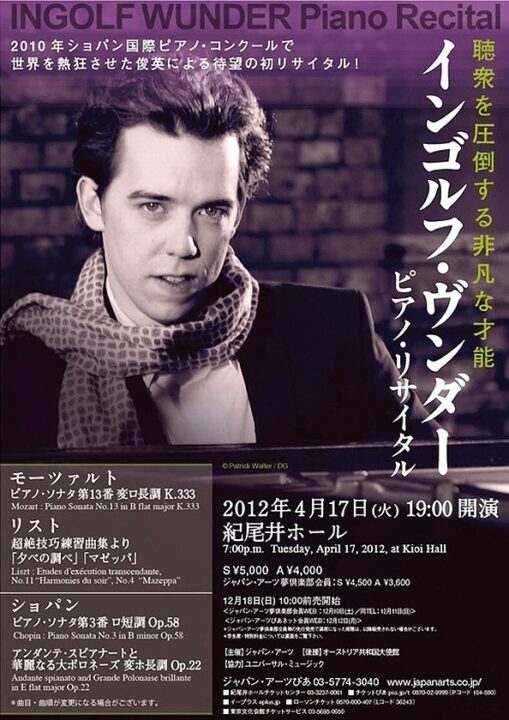
That said, his playing style is not the bold, three-dimensional kind that represents the mainstream of contemporary pianism — it gave the impression of being relatively compact in scale, and my feeling at the time was that, in terms of sheer performance quality, taking first place would be difficult, though he might realistically contest second with someone like Geniušas. Trifonov did in fact finish third, and as for first place, Yulianna Avdeeva’s richly mature interpretation was a clear head above the rest on the day, so I have no argument with that result. As for second place — Lukas Geniušas aside — I felt that Ingolf Wunder, who had gone down so well with the local audience, was thoroughly overrated with his showy and surface-level playing; and one might say that the subsequent difference in their careers on the concert platform has borne that out.
Yulianna Avdeeva’s Chopin playing — demanding in its own way — is, for the listener, something that is physiologically stressful in one way or another, for better or worse; and however highly she might be regarded among fellow professionals, one did wonder immediately how many listeners would actually choose, of their own free will, to sit down and listen to her playing for entertainment once the title was stripped away — I sensed at once that things would be difficult for her going forward in various ways. But the subject today is Trifonov. My impression at the time was that, yes, he possessed a curious charm, but the playing was rather shapeless and unfinished, the contrast between pianissimo and fortissimo narrow, and it did not strike me as the kind of commanding, assured playing that could carry a top-flight pianist to stardom.
So I had been rather counting on Trifonov quietly building a career — supported by a devoted circle of devoted fans, accumulating concerts in mid-sized halls, a steady if unglamorous path — the sort of career where I might sneak close to the stage and enjoy him at my leisure. Instead, the following year he won the Tchaikovsky Competition. In one sense his third place at the Chopin Competition was perhaps unlucky, and being on home ground at the Tchaikovsky no doubt meant considerable backing of various kinds in the Moscow Conservatory sense of things; but in any case, the result decisively cemented his credentials as a major artist.
Tracing his trajectory from there: of all the prizewinners from 2010, it was Daniil Trifonov who went on to become a worldwide phenomenon — from his DECCA debut to his move to Deutsche Grammophon, repeated concerts at Carnegie Hall, recitals with leading orchestras in major venues — over these nine years, quite contrary to my expectations, he has been steadily advancing along the rails of a brilliantly successful major career as one of the young star pianists of the day.
A budget two-disc set combining the aforementioned DECCA Italy live recording with his 2013 Carnegie Hall debut live recording

As for me personally, after picking up a few albums around the time of his win, my enthusiasm rather cooled, I never went to see him in Japan, and I have been out of touch with his work for some time — but listening to sample recordings of his playing after the move to Deutsche Grammophon, it does not sound to me as though the quality has changed all that markedly from his Chopin Competition days. There is still something ungrounded about it, and even listening to the Transcendental Études and the like, the structural solidity that the repertoire fundamentally requires seems to evaporate — the brilliant virtuosity ends up, I think, in a kind of Gestalt collapse brought on by an overrunning Russian pianism, and while it is interesting, I cannot help feeling: but is this really all right? That is partly why I think Trifonov is, in his essence, not so much a grandioso presence of the very highest order as the type who whispers casually and intimately in your ear — but is he really that remarkable?
And so, coming full circle back to the live competition recording from the Chopin Competition, I find that the playing captured there is, after all, the most refined — youth and fresh inspiration intertwined with a sweet, beguiling manner of address — and it is, for me, the version I find most comfortable to settle into.
 ポチップ
ポチップ
Incidentally, last summer (2018) he was involved in a traffic accident while cycling in New York, where he lives, injuring his ankle, and apparently had to suspend his performing activities for a time. A Japan tour had also been scheduled for the end of the year, though whether it was still due to the after-effects of the accident I cannot say — in any case, the tickets were refunded. He does seem to be someone for whom cancellation-inducing troubles follow him around the world with some regularity; and if I may be allowed to voice a personal preference, I think he ought to shave that beard as a charm against misfortune. Surely it does not suit him — he has such a nice face without it, hasn’t he?
 Adrift in Classical MusicOn the Piano


Auto Translated by CS4.6