[About the audiopro Image11]
Prologue|Part 1|Part 2|Part 3|Re-release
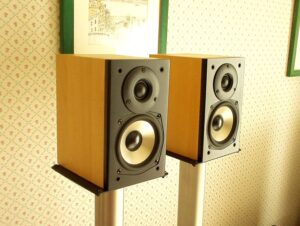
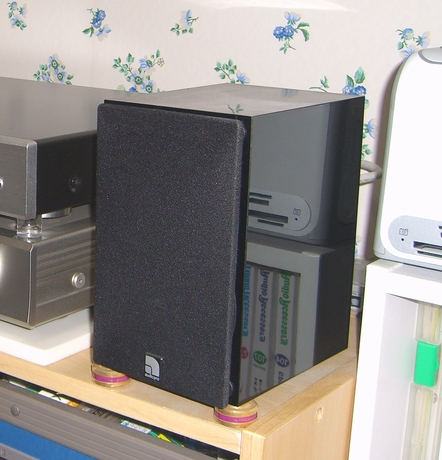
What is the best approach to Hi-Fi insulators for the original audiopro Image11? This is the question, but the speaker is not particularly fussy about placement to begin with, and because the cabinet itself is well-made, it tends to sound reasonably good under almost any conditions as long as you avoid placing it directly on a surface. That said, the most significant weakness of this speaker is its light bass, and addressing that becomes the central point of any setup.
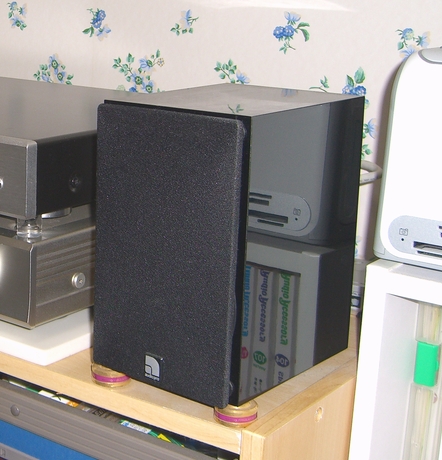
The treble of the original Image11 — which was razor-sharp and harsh when new — shifts, as burn-in progresses and the speaker settles in, towards something rather smoother and softer. Once that happens, having been drawn in by the sharpness of the high-frequency response when it was brand new, I find myself strangely left wanting a little more. In the case of a unit that has fully completed its burn-in, it might be worth adding a degree of hardness and freshness to the treble while still preserving the music’s lively character.
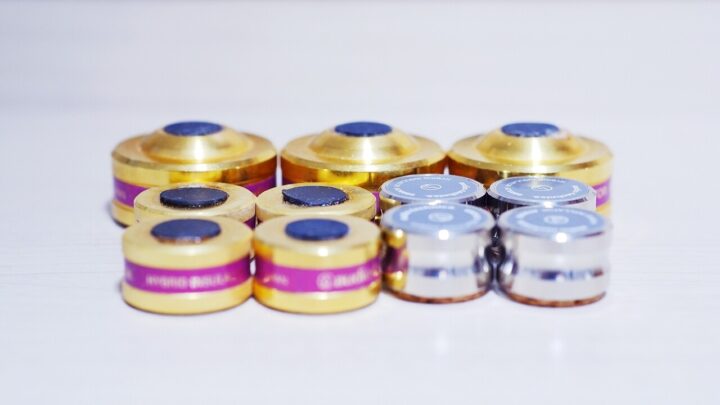
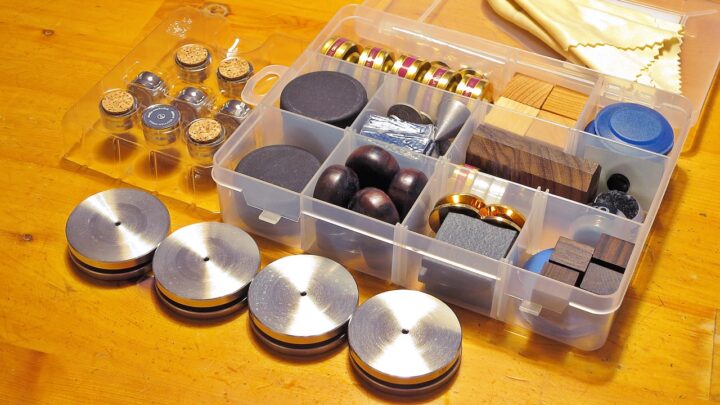
In situations like this, the audio-technica AT6099 proves quite useful as a means of improving the speaker’s light bass through insulators.


 ポチップ
ポチップ
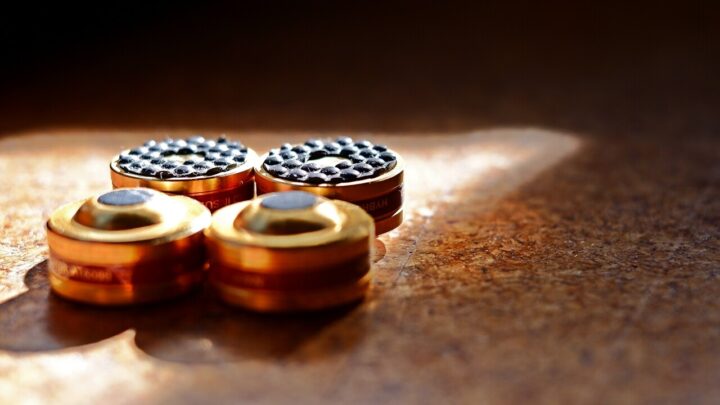
The audio-technica AT6099 is a highly versatile Hi-Fi insulator that, while relatively affordable, proves useful not only under speakers but also under amplifiers, CD players, and the like. The key lies in its hybrid construction, which combines three different materials — brass, Sorbothane, and Hanenite — to produce a well-balanced and pleasingly nuanced sound. Because soft rubber-type materials such as Sorbothane inevitably add a somewhat soft character to the fine detail of the sound, the AT6099 is perhaps not ideally suited to those seeking the uncompromising tonal precision and quality of high-end Hi-Fi. However, when you want to address a lack of bass and an overall lightness of sound in entry-level pure Hi-Fi components or mini systems, increase the density of the midrange, or take the edge off harsh treble, the audio-technica AT6099 is a very strongly recommended insulator. Within its softness, the brass character peeks through in the upper midrange and treble with a bright quality, lending the music a generous and lively expressiveness — it is an accessory that makes for easy, accessible tuning to help you enjoy music in a more immediate and approachable way.

The sonic character of this AT6099 worked very well in taming the incisiveness of the audiopro Image11’s tweeter before sufficient burn-in had taken place, and in extending the deficient bass to restore balance — but as the speaker settled in, the softness of the Sorbothane material began to take over, and there is no denying a tendency for things to become a touch too gentle for serious, concentrated listening. The AT6099’s distinctively musical richness of expression and its wide soundstaging are genuinely attractive qualities, though. At this point, a piece of advice came from Baba Denki in Kagoshima — the shop where I purchased this Image11 — which was to support the Image11 using six 10-yen coins in a three-point configuration.
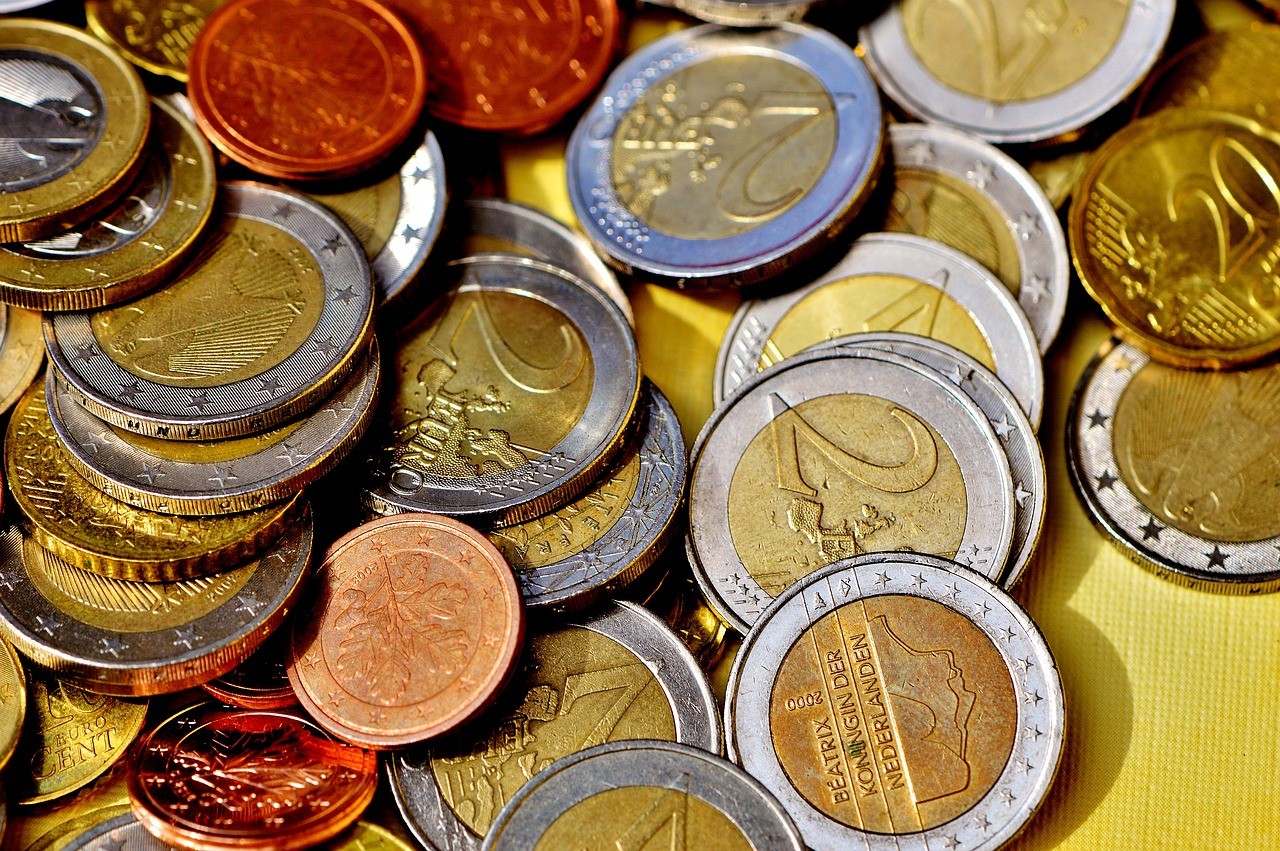
Using 10-yen coins as speaker insulators is a popular method that has long been featured in beginner-level Hi-Fi articles in magazines, and I now recall, rather belatedly, that I once spent time collecting various coins and materials and swapping them in and out. At some point, however, my attention was captured by expensive dedicated Hi-Fi insulators, and I had completely forgotten about the 10-yen coin — the most familiar and fundamental pure-copper material of all.
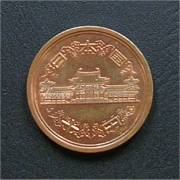 I immediately tried swapping out the audio-technica AT6099 × three-point support that had been serving as feet for the sub-system speaker in favour of six 10-yen coins, and found that a hardness was added to what had been a soft tonal character, with overall resolution improving markedly. The perceived frequency response flattened out, the bass gained sufficient depth and solidity, and the sound took on a firm, stable quality. The audio performance and high-end atmosphere improve dramatically for just 60 yen, so please do give it a try if you are interested. The result gave a sense of limits being broken through — not only in terms of balance, but in terms of sound quality, the latent capability of the audiopro Image11 was made abundantly clear. One caveat, however: the tonal tendency of 10-yen coins is that while perceived S/N is good and they excel at conveying stillness and a sense of inner depth in music, they can at times make the overall expression feel a little dark or overly earnest — so it might be even better if one could add brightness and expressiveness while retaining that resolution and tonal hardness.
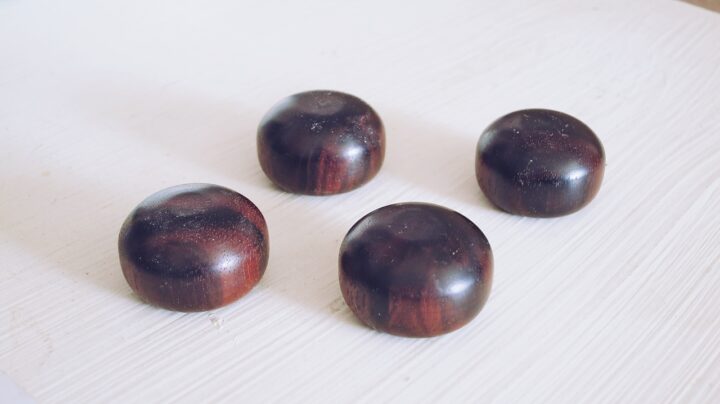
This brought to mind the Rosenkranz Eco Brass, which I had once borrowed for a trial some time ago. It is a little on the pricey side, but I would like to try it again. Other options that might be worth trying include 500-yen coins, which seem likely to have a brighter resonance. Six of those would come to 3,000 yen — but since the face value is preserved, it is effectively free, in a sense. Perhaps think of it as keeping coins under the mattress. And when using 10-yen or 500-yen coins, it is worth going to a bank and exchanging them for new ones if possible. Clean coins without surface oxidation or scratches look better, and the resonance will probably be better too.


Baba Denki, where I have purchased several speakers over the years, also stocks the audiopro Image12 — a successor model with an improved tweeter — as well as a wide range of other compact speakers at attractive prices (note: as of 2005). It is not particularly well known, but it is something of a hidden gem for mail-order Hi-Fi.
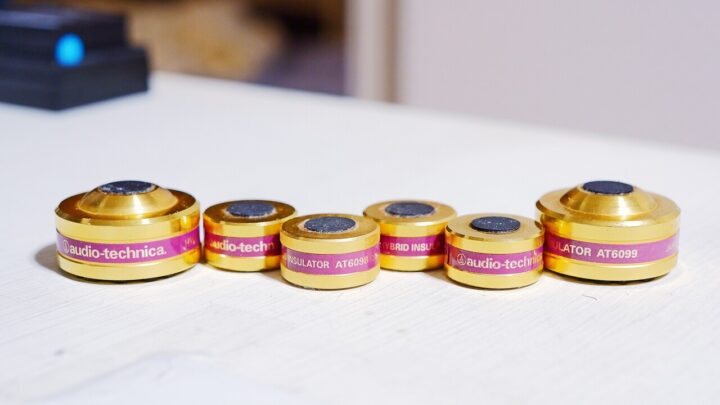
Having tried several speaker insulators with the audiopro Image11, my personal priority is not sound quality per se but rather avoiding listening fatigue over long periods, and enjoying music in a generous, unforced way — so I have now returned to the audio-technica AT6099 rather than the 10-yen coins. For extended listening sessions with music on in the background, the AT6099 simply allows for more relaxed, enjoyable listening. The one issue, if it can be called that, is that the top panel of the storage unit on which Sub-system A is set up is made of particleboard. Placing a dedicated high-quality audio board on top of it should bring about a significant improvement in resolution, so I would like to experiment with various options at some point.
[About the audiopro Image11]
Prologue|Part 1|Part 2|Part 3|Re-release

Auto Translated by CS4.6