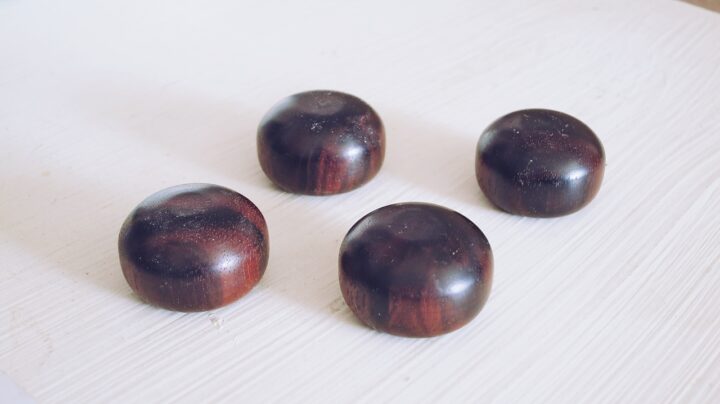
ABA SUNSHINE’s ultra-thin damping sheet A-40. Whether “ABA” or “SUNSHINE” is the brand name is rather confusing — but let’s set that aside for now. A few years ago, when I visited one of the Audio Square shops I frequent and listened to various speakers and components, I felt a little guilty about leaving without buying anything, so I picked this damping sheet up as a kind of courtesy purchase. ※ I try to make a habit of buying at least some accessory or CD whenever I visit a shop for a listening session, even if I don’t end up purchasing any equipment.
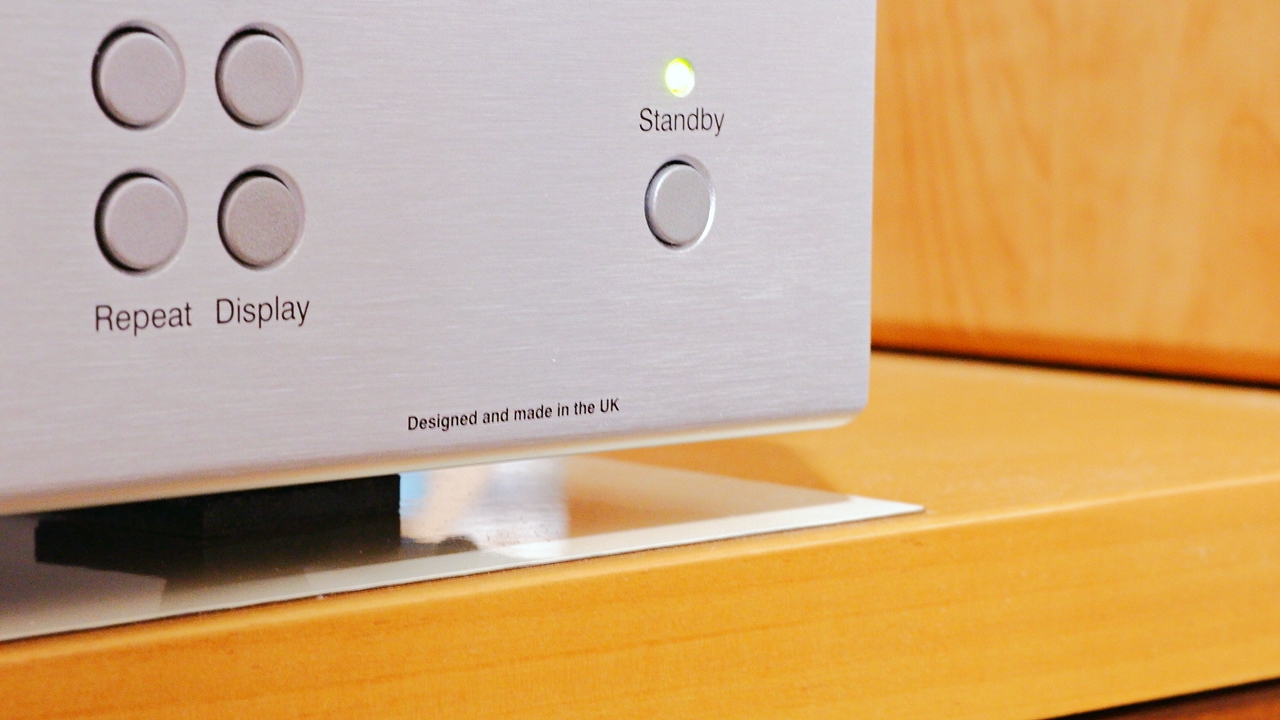
A highly versatile ultra-thin damping board
The A-40, A-30, and A-50 differ only in size — the material inside is identical. The A-40’s list price is ¥3,500, making it one of the cheapest under-component accessories in the Hi-Fi world. Above this sit the thicker black B Series and the grey V Series which uses magnesium; the A Series is the most affordable entry-level offering of the three. If you really want to know what SUNSHINE — a company whose main business is magnesium — is truly capable of, the V Series would be the place to go, but for now I’m trying out the most affordable A Series.
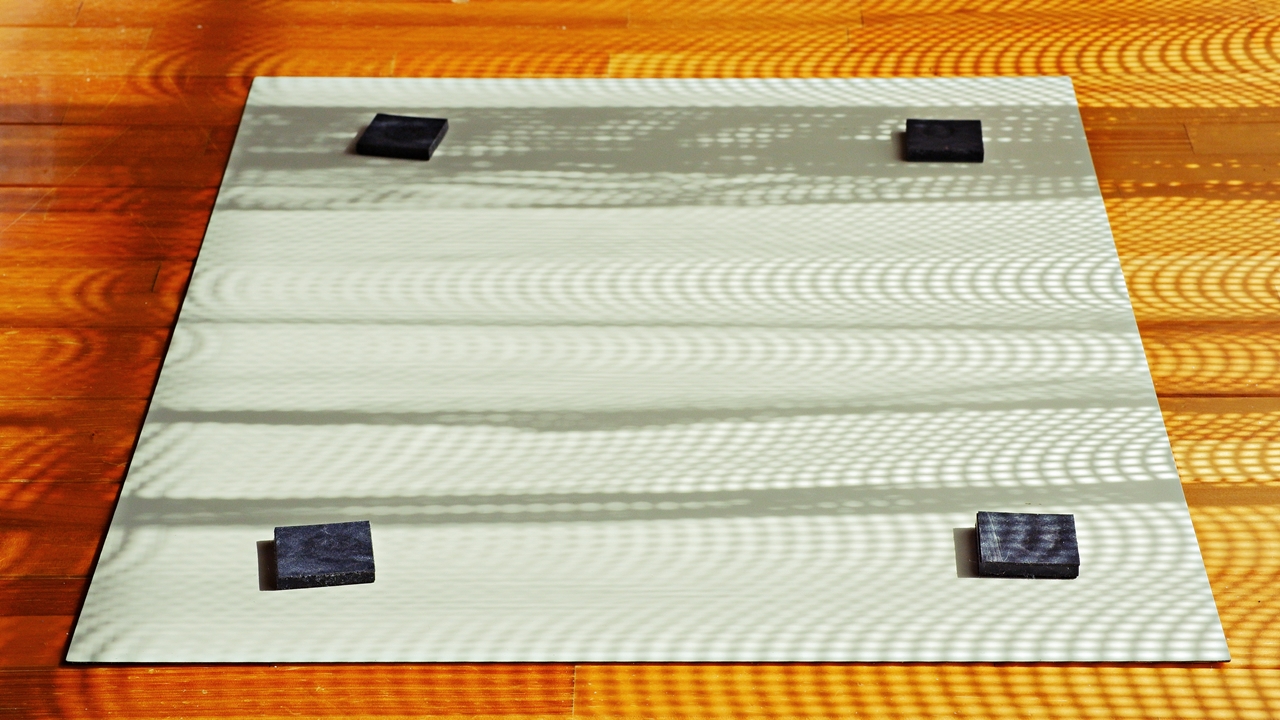
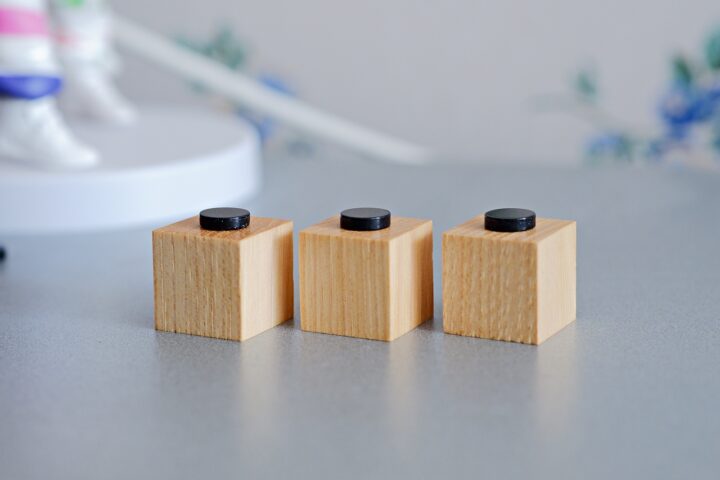
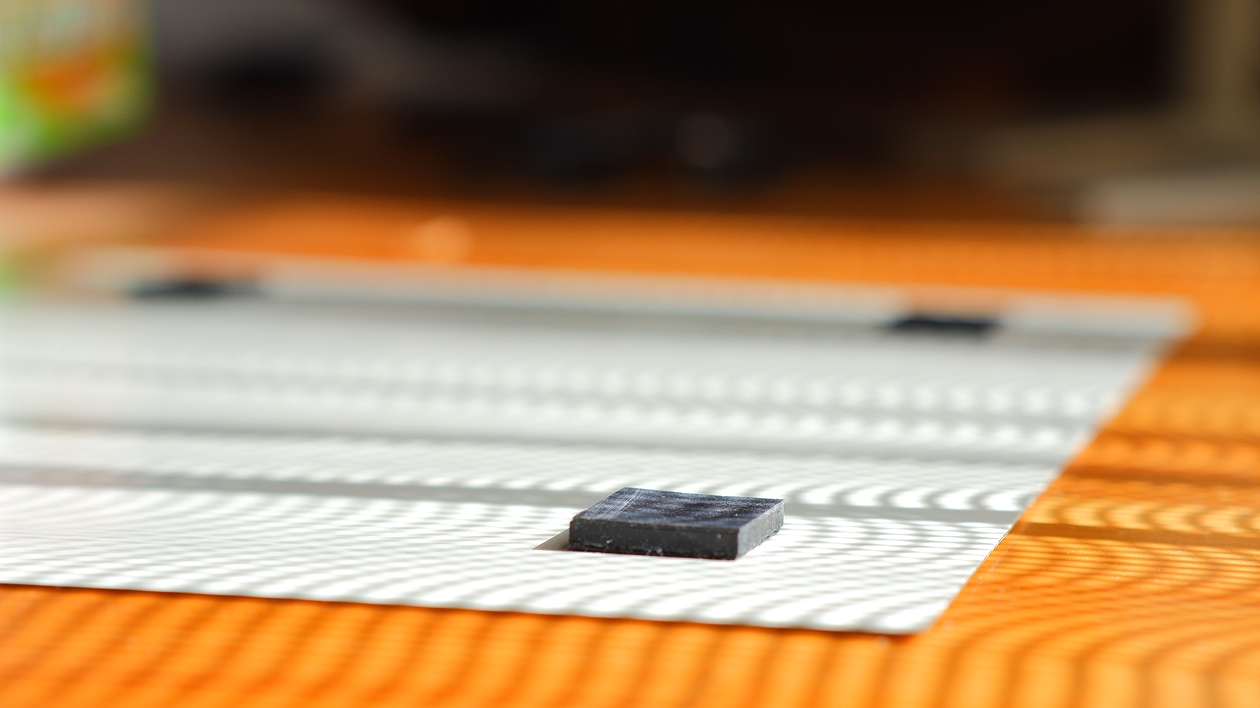
At just 0.6mm thick, this is less of an audio board in any substantial sense and more literally what the name says: a cut sheet. The cream-coloured side has a gloss finish, while the reverse — an olive/greenish hue — is matt-painted steel with what appears to be some kind of synthetic rubber or resin sandwiched in between, giving it a moderately firm feel. According to the manufacturer, it is “two layers of 0.3mm steel with a resin-based damping material hot-pressed between them.” It has a rather industrial feel about it — the sort of vibration-damping steel plate you might expect to source cheaply for commercial use — though since this is presumably tuned for audio applications, whether the price is high or low for what it is remains genuinely unclear. The wavy appearance in the photograph is just a shadow from the curtain; the damping sheet itself is plain. The black ■ squares are J1 Project C30S-J/4P insulators, discussed later.
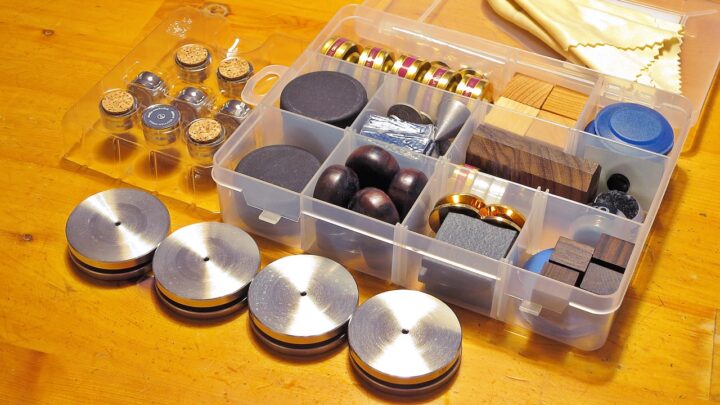
The two sides have different finishes — and different sounds
Initially I thought I might use it as an under-board for the CD players in my main system — housed in a Wakatsuki audio rack — specifically the C.E.C TL5100Z and the SACD player ONKYO C-S5VL. Unfortunately it didn’t seem to get along with the rack at all; placing it underneath actually made things worse. The upper-midrange took on a somewhat metallic, brassy quality, and the response above that felt a little deadened and dry. Musicality suffered too, and the balance no longer felt flat — it was a rather dispiriting “what on earth is this?” moment. Flipping it over helped slightly, but not nearly enough to consider using it in the main system.
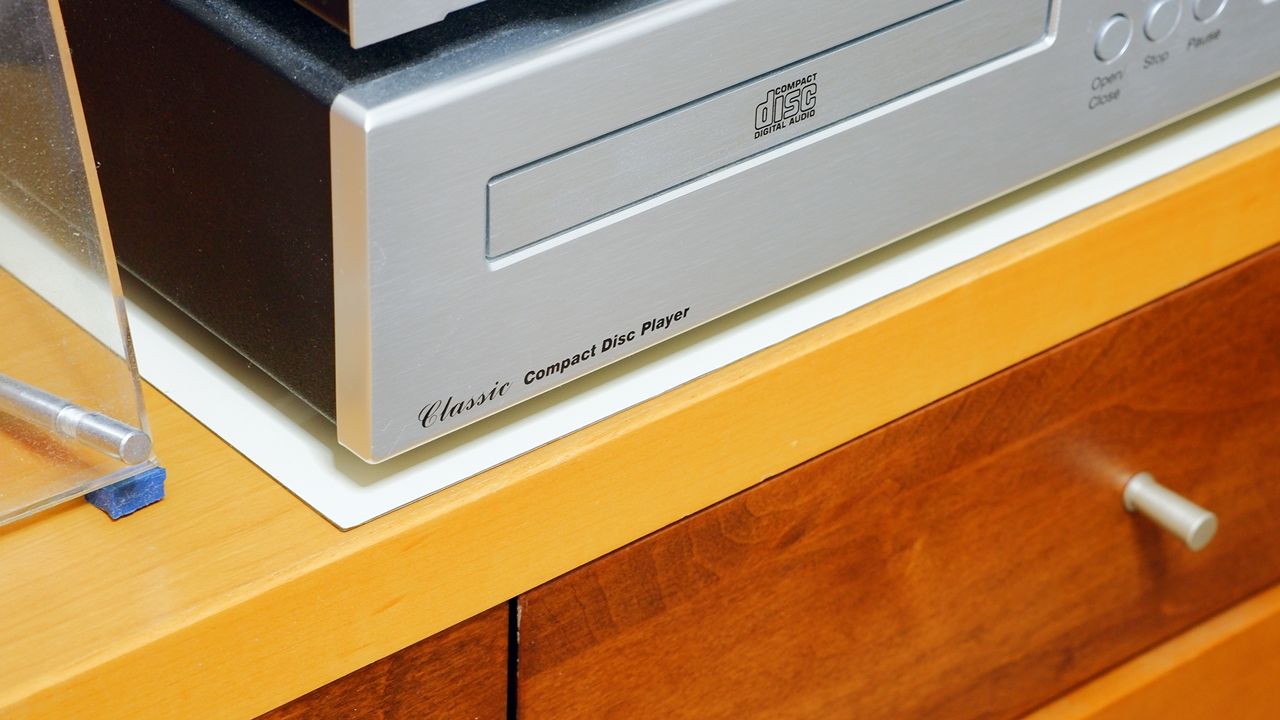
Undeterred, I next tried it under the CD player of Sub-system C — a CLASSIC CD sitting on top of an alder chest — and this time things seemed at least marginally better than having nothing there at all, so it stayed. Alder laminate has a rather soft, matt-ish quality among timbers, and placing the CREEK directly on it was making the already somewhat understated CREEK sound even drabber. The SUNSHINE ABA A-40 turned out to supply just the right touch of lustre and warmth to compensate — something of a timely rescue, one might say.
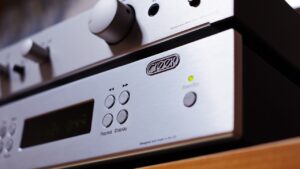
Now, when the A-40 had been used in the main system, the reversed orientation had sounded better — and so when I moved it over to the CREEK sub-system, I simply left it upside-down out of habit and carried on using it that way for a while. Partly it was because the olive underside colour actually suited the low chest better aesthetically. Then one day it struck me that something seemed a bit off, and I flipped it back to the correct orientation with the cream side facing up — and, well…
It seems that the reversed orientation gives a slightly more matt, less lively sound compared to the correct one. With the sheet the right way up, its character comes through more clearly — the sound gains brightness and sheen, and works to cancel out the CREEK’s particular tonal tendencies. There’s also a greater sense of rhythmic drive. A slight peak emerges in the upper midrange, lending a faintly metallic sparkle, but in this particular system that falls within acceptable limits — indeed, it’s almost welcome. The improvement in damping seems to reduce the slight bloat in the mid-bass, which raises the perceived centre of gravity a little and makes the three-dimensional imaging noticeably more defined than before.

The CREEK CLASSIC CD is run at 120V via a step-up transformer, and on its own the bass had always been a touch excessive — so this turned out to balance things rather nicely. As for the impression of sparse ambience I noticed in the main system, the CREEK system is more of an image-focused rather than soundstage-focused design, so it doesn’t bother me at all here. There will certainly be cases where reversing the sheet suppresses its character slightly, flattening out any frequency emphasis it might otherwise introduce, and that could actually be the better match in some situations. If you’re using any of ABA SUNSHINE’s thin damping sheets, I’d recommend trying both orientations before settling on one.
The black higher-tier models and size variations


All of this naturally makes me curious about the higher-tier damping sheets. The most accessible option would be the black B Series, though since it uses the same materials as the A Series — just “a resin-based damping material sandwiched between 0.6mm and 0.8mm steel plates” — I suspect it would simply have a stronger version of the same character. Which suggests that perhaps you’d need to jump straight to the V Series (which uses magnesium, available in grey and black) to experience something genuinely different. Incidentally, the sizes for the ultra-thin damping boards are as follows:
・20 = 200mm × 250mm
・25 = 220mm × 290mm
・30 = 395mm × 295mm
・40 = 445mm × 345mm
・50 = 490mm × 445mm
For a typical full-width Hi-Fi component — most of which run to around 42–45cm wide — the 40 or 50 would be the natural choice. Anything smaller would either need to be used in pairs under compact speakers, or is really intended for smaller components where dimensions aren’t fixed by convention. While I was deliberating, I also noticed an insulator called Mg SPENCER in their range — a three-layer construction combining pure magnesium, birch, and 0.6mm damping sheet. At that price, I’d be tempted to give it a try. I wonder whether the damping sheet layer is the same as the A Series. Apparently the voicing was done by someone from TIGLON, and the idea of a three-material sandwich construction has a certain personal appeal as well — so this might be my next step… but looking just now, it seems to have been discontinued. Ugh.

 ポチップ
ポチップ
Come to think of it, an audio board almost always has a much larger effect than a small insulator — though the flip side is that when the character of the board doesn’t suit your system, the result can be fairly alarming. The next step up would be the SUNSHINE ABA audio board S40 at ¥15,000 list price… tempting. The S Series, incidentally, apparently consists of a Russian birch frame with a B Series ultra-thin damping sheet fitted inside — which makes it quite good value when you think about it. In my budget Hi-Fi sensibility, the most I can realistically bring myself to pay for a single audio board is around ¥20,000 — ¥30,000 at the absolute outside. And boards that are excessively thick create problems from an interior aesthetics standpoint as well, so the S Series being only 15mm tall is rather appealing on that count too. That said, the S Series is apparently currently suspended from production, and who knows when it will return.
~ Summary ~
Building and tending to this many finely tuned miniature systems means that each individual accessory is, (by the rather startling standards of the high-end audio world,) thoroughly inexpensive. On the other hand, as illustrated here, when something doesn’t work where you originally intended, a bit of trial and error often turns up another spot where it fits perfectly — and that, too, is one of the pleasures of this hobby. Since then, I’ve been running the CREEK CLASSIC CD with J1 Project C30S/4P insulators placed between it and the SUNSHINE ABA A-40 for further fine-tuning. I’ll write up those findings on another occasion — so that’s where I’ll leave it for now.
 Category:SUNSHINE(サンシャイン) / ABACategory:Other Hi-Fi Accessories


Auto Translated by CS4.6