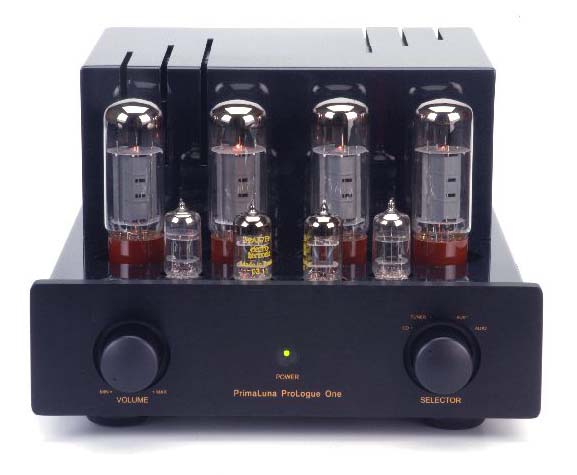
【Prima Luna ProLogue One Listening Report】
AH! Njoe Tjoeb 4000|Listening Event|Part One|Part Two
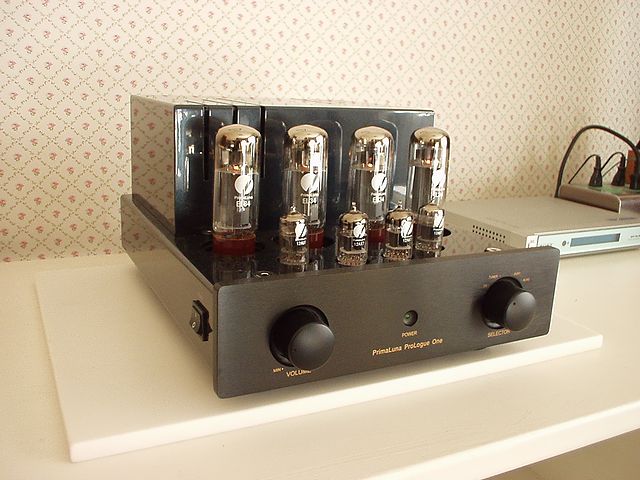
On the evening of Monday the 12th, a review unit of the PrimaLuna ProLogue One — a Dutch-made valve integrated amplifier — arrived from Bach Kogei-sha.
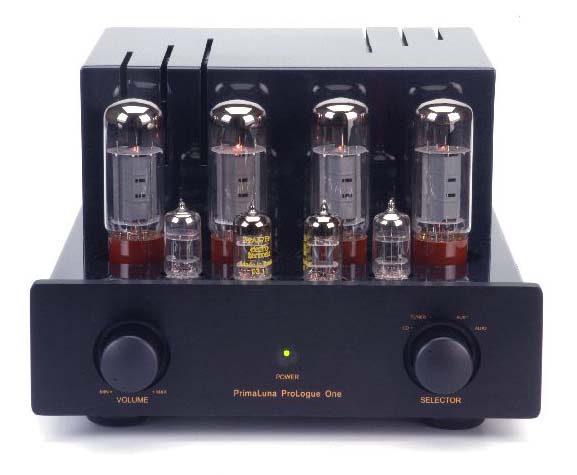
PrimaLuna is an amplifier brand under AH!, based in the Netherlands. It is not particularly well known in Japan — virtually no coverage in domestic magazines, and still only a handful of dealers — but in audio publications abroad, particularly in the United States and the United Kingdom, it has been receiving extraordinarily high praise, winning annual awards in multiple titles and making quite a sensation of a name for itself in recent years.
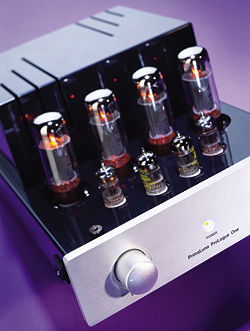
The box it arrived in was, first of all, heavy. The amplifier itself is not all that large, but the side of the carton read 17 kg. The chassis has a thoroughly solid feel to it, with a finish quality that conveys real refinement — you can tell straight away that this is an industrial product made with great care. Incidentally, the box was marked 100V, which suggests it may differ from the 117W US-specification unit?
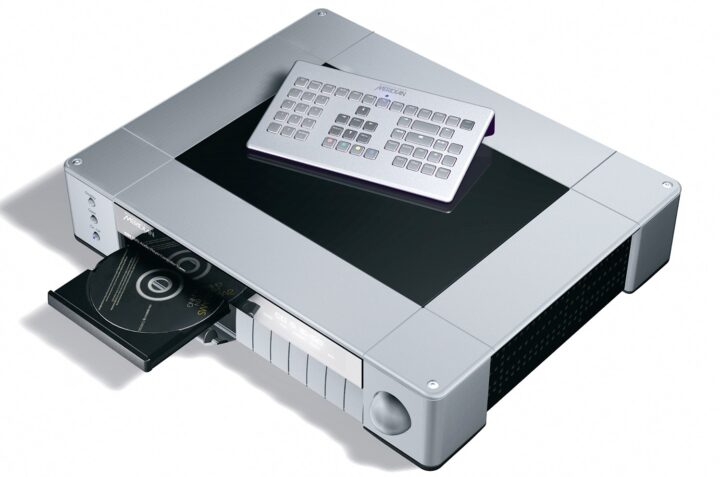
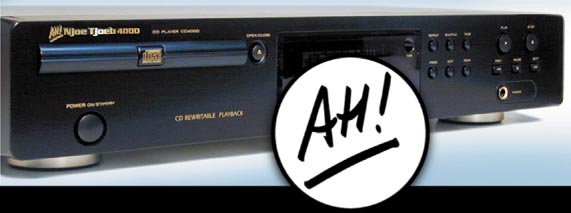
I put on a pair of gloves and nervously set it up between my main system’s Vienna Acoustics MOZART T-2. The TAG McLaren 60i and Onkyo A-1VL I normally use have been temporarily moved to secondary duty. I had also asked for the Njoe Tjoeb 4000 — the CD player from AH!, the same brand’s sibling label, which jazzaudiofan also uses, and which is actually the main thing I am considering buying — but for some reason it did not arrive this time, only the amplifier. Well, the Njoe Tjoeb 4000 can wait for another occasion; for now I shall use my reference CD player, the CEC TL5100Z, and get on with a report on the PrimaLuna ProLogue One.
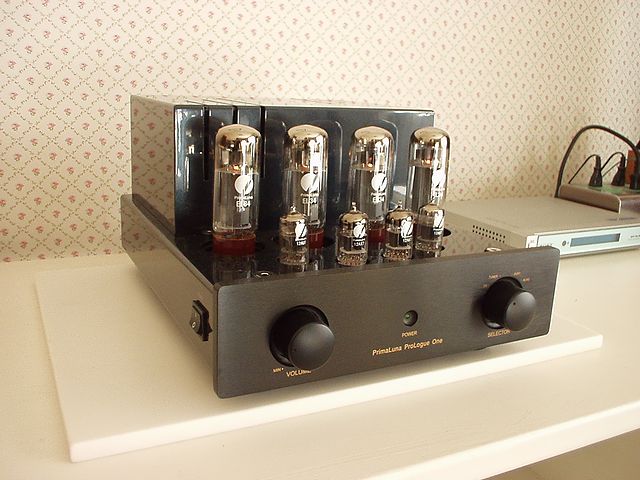
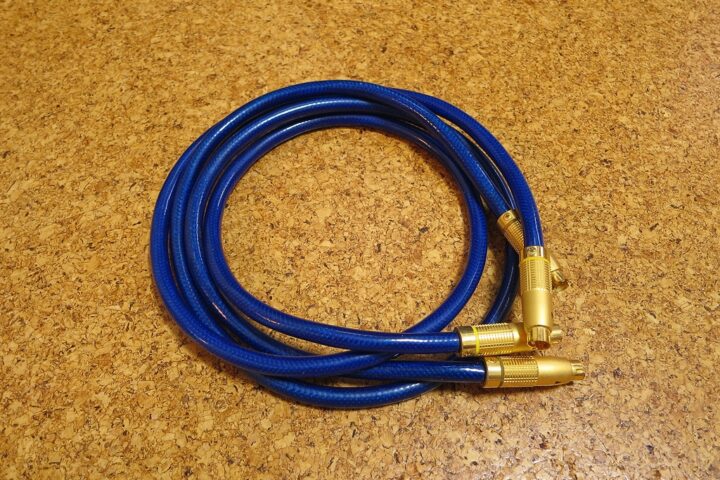
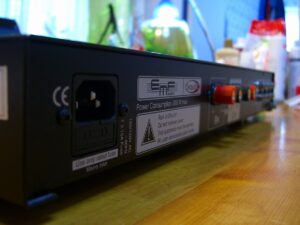
The rear speaker terminals are WBT insulated type. The power inlet is a detachable 3-pin connector. The review unit is fitted with PrimaLuna’s optional auto-bias board — reportedly the first of its kind in the world — which is claimed to deliver correct operation with any system combination, maintenance-free. Speaker terminals offer a choice of 4Ω or 8Ω, but the Vienna Acoustics Mozart T-2 is nominally 6Ω, so what on earth does one do??? — that sort of feeling. Being a complete beginner with valve amplifiers, I was thoroughly at a loss. Not really knowing any better, I just went with 4Ω — on the rather casual reasoning that even a 6Ω speaker will likely be operating at 4Ω in certain frequency ranges anyway.
Switch it on, and the valves glow with a faint warmth. That alone is enough to conjure an atmosphere for engaging with music. There is something about a valve amplifier as a piece of machinery — it has an aura that draws you toward listening to music, and that is deeply appealing. The unit had gone cold during transit, so I waited a while for it to warm up, then prepared to hear some sound.


 ポチップ
ポチップ
The piece I chose was Chopin’s Ballade No. 1. The performance is by Đặng Thái Sơn, the Vietnamese pianist who won the 10th International Chopin Piano Competition — Đặng Thái Sơn. Whenever something new arrives, this always seems to be the first thing I reach for. He is the pianist I once aspired to, and still the one I love most of all. (A digression: speaking of Vietnamese pianists who also happen to be Chopin players, I am reminded — and yes, this makes me something of an idiot — of Mui, the one-legged girl playing the Raindrop Prelude in episode 9 of BLOOD+, which aired the other day. The storyline was almost comically sentimental, yet the way the music matched the visuals was oddly affecting, and something in my mind quietly clicked into place. That piece, incidentally, was the first Chopin I ever managed to play, back in primary school.)
But let us return to the amplifier.
Oh — oh my — oh, oh, oh — this might be something rather extraordinary straight out of the box?!
Having not tested a valve amplifier for quite some time, the way the sound comes out is a genuine culture shock. There is this quality of extraordinary moisture and richness, and the right hand seems almost to flutter. With this pianist, the angle of the right and left hands differs, resulting in quite distinct timbres between the two — and yes, that difference comes through clearly here. But what is really remarkable is the bass. The bass from the A-1VL was moderate enough, so the contrast feels all the more striking. As a result, the resonance of the wound bass strings of the piano has real physical presence — an impression of hearing it from closer than before. The sound itself has a kind of unified, organic quality; sharpness and pinpoint imaging are perhaps one step short of ideal. The image is large and full-bodied, with a sense of proximity — not in the sense that sound merely projects forward, but that the instrument simply sounds life-sized and large, with genuine front-to-back depth. There is a great deal of information. In particular, the mid-bass through to the low bass reveals things I have never heard before, in considerable quantity. The mid to upper range too — there is none of that enhanced, outline-emphasised quality of “treble colouration,” yet all manner of previously inaudible detail is emerging, and the micro-detail retrieval is quite remarkable. It is well beyond the A-1VL and TAG McLaren 60i. High-end-level information retrieval, one might say. Having only just been set up, there is still a slightly sleepy quality to the sound, and at this stage it does not sound high-resolution in the conventional sense — but it is undeniable that all sorts of sounds that would normally remain buried are coming through, which makes me look forward to what burn-in will bring.
The tonal colour is distinctive and individual. Amid a quality of moisture there is a characteristic shadow, a sense of chiaroscuro, and the surface texture of the sound is velvet-like. This velvety quality is reminiscent of the Philips sound — also Dutch — though the overall tonal colour is less Philips and somehow closer to that of Accuphase. That said, the PrimaLuna’s way of sounding is more expansive and fuller-bodied. This velvet-like texture works quite positively for string instruments — very realistic. The piano, however, feels slightly over-made-up; something harder and more lustrous would be more faithful to the real thing. To put it in terms of the instrument: it is as if the soft pedal has been pressed ever so slightly, just enough to shift the alignment of the piano wire and hammer felt by the faintest degree — producing a slightly muffled, soft-edged timbre. To put it bluntly, a Steinway starts to sound like a Yamaha. Ugh. With the violin too, depending on the recording, there are cases where it becomes overly bright and takes on a wailing, jutting quality. This is a tendency that Vienna Acoustics tweeters can lean toward, but in truth it is a symptom that appears when the amplifier is over-driving — when the amplifier is well matched, it simply does not happen.
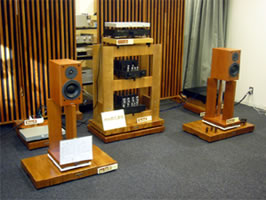
The impression from the recent listening event comes back to me — or rather, it now becomes clear, somewhat belatedly, that the sound at that event was in fact very heavily shaped by the AH! and PrimaLuna combination. There is none of that metallic harshness, and a woody, natural quality comes through.
 ポチップ
ポチップ
I tried playing Shigeko Suzuki’s “Close Your Eyes,” which had made such a good impression at the listening event. This CD has actually been a problem at home — for some reason, both in the main and sub systems, the guitar sounds oddly plasticky. But through the PrimaLuna, everything changes. The vocals have an extraordinary physical presence — warm, sensual. What on earth is this. The soundstage is life-sized in scale, the bass has real weight and power. It is strikingly realistic. In a word, this amplifier is extraordinarily well suited to jazz. I find nothing to criticise.
 ポチップ
ポチップ
The next album is Sumire Kudo’s Pampeana. Again, convincing. The cello, though, is very close — too realistic, almost. This seems to be where the sense of a potential compatibility issue I felt at the listening event was actually coming from — the PrimaLuna itself.
 ポチップ
ポチップ
I am now playing Rachmaninov’s Piano Concerto with Jorge Bolet, which happened to be lying around. This too is impressive. The bass is so full that Dutoit conducting the Orchestre Symphonique de Montréal has absolutely thunderous presence. Fujiko Hemming’s Chopin Piano Concerto No. 1 is also very good — the clarity of that fine Decca recording really comes into its own. The Victor pressing I heard at the listening event was a completely different experience by comparison. When you play orchestral works through a Hi-Fi system, even where surface-level resolution is present, in most cases the musical tone tends to become flat and monochromatic — but here, individual players can be heard going their own ways, locking in together and occasionally slipping just fractionally out of sync. At this price point — around ¥150,000 retail — that is, in a sense, quite remarkable. Normally it simply does not happen. Naturally, jazz sessions go without saying — the individuality of each player’s intent stands out with striking clarity.
 ポチップ
ポチップ
And yet, having got this far, I have begun to feel that something is missing…
First of all, the sound quality is simply good. For an amplifier at ¥150,000, this is somewhat alarming. There is a distinctive character that will divide opinion, but just on first listen the sound quality itself is genuinely strong. Would there be another amplifier at this level capable of producing sound like this straight out of the box? I had assumed that valve amplifiers were all about their particular nuance and colouration, so to feel rather upended in that expectation is quite something — and yet even as I respond favourably, there is a part of me that is not entirely satisfied. Something is missing!
 ポチップ
ポチップ
I noticed it the moment I put on Samson François playing the Chopin Waltzes. The musicality — that is what is missing. The tonal colour is emotionally expressive and rich in colour, which creates the illusion of high musicality; but there is an undeniable sense of disconnection between the expressive nuance and the flow of musical time. I sat with it for a while. Thinking about it in reverse: it is difficult to imagine that someone with the ears to refine a sound quality like this would not understand musicality — so if musicality still feels lacking, perhaps something somewhere in the system is at fault. That said, there is no point rushing. The unit has only been here a matter of hours; it can hardly be said to have properly settled in. With a valve amplifier, it is to some degree expected that the presentation will be somewhat flat shortly after switching on and setting up. For now, let us trust in its potential and hold on.
In any case, the driving power is extraordinary. The engine displacement is simply in a different class from any amplifier I have used before. Because it uses EL34 valves, I was expecting something more yielding — delicate and slender — but in terms of control, it comes remarkably close to the digital amplifier ONKYO A-1VL. In terms of drive capability, the ProLogue One is several steps ahead. It is driving the Vienna Acoustics T-2’s dual woofers — which are prone to phase shift — with complete ease, and if anything the presentation is distinctly over-driven. If 35W per channel from EL34 valves produces this, what on earth would the 40W ProLogue Two with KT88 valves be like?

 ポチップ
ポチップ
Regarding imaging and stereo placement, personally I would not mind a slightly tighter focus. I gather that EL34 valves have the edge for delicate vocal nuance, while KT88 is said to be better for firmness and control. I am now curious to hear the ProLogue Two as well. That said, in terms of speaker matching, the situation is already clearly one of over-driving — the bass is simply too weighty, giving the overall presentation a heavy, ponderous quality. This heaviness suits the piano well enough, but with orchestral or string music it translates into a kind of Hi-Fi-ish, unnatural sense of mass. Though that may just be the nature of tall floor-standing speakers. Switching the speaker output to 8Ω makes everything lighter and gives the soundstage a more open, airy quality, but a rather insubstantial, thin impression also emerges, which is not ideal. The presentation approaches that of the TAG McLaren 60i, but if that is the result, the 60i still has a better overall balance.
If I were to state a weakness at this point, it would be that the treble is somewhat restrained, with a slight roll-off to my ears. As a result there is no sense of distortion whatsoever — it does not become fatiguing even at high volumes, and never grates — so one could happily listen to music in a relaxed state for long periods, even all day. In terms of perceived frequency balance, the emphasis is firmly on physical presence, resolution, and low-end extension from the midrange downward, in a pyramidal arrangement; those who prefer a flat, clean upper register with beautiful high-frequency detail, or who are drawn to resolution in the treble, may not find this to their taste.
As for nuance: there is a blend of delicate melancholy and shadowed refinement in the voice of the sound, alongside what might be called a slightly pushy, larger-than-life quality — and the two are thoroughly fused together. It is, for better or worse, warm and dense European tone. It conjures the image of a glamorous prima donna, heavily made up. Because it is an amplifier that will render even recordings one would not normally be able to enjoy more listenable through a degree of colouration, in terms of contemporary, monitor-like resolution and a flat, straight-forward reproduction of information, the domestic ONKYO A-1VL still has the upper hand.
So much for now — but all of this is simply the impression from the first and second day. The sound quality changes noticeably as the unit gradually settles in over time, and it seems that the review unit had accumulated something of the character of whatever speakers and cables had been connected to it before (at Bach Kogei-sha, presumably), all blended together into the sound — so in truth, my feeling at that stage was something like: decent sound, but not quite for me. Or perhaps it resembles the sound at the Tokyo listening event because this is simply what the unit sounds like fresh from transit. However, by the third day, all of the impressions I have written above changed dramatically — the sound becomes something entirely different.
Continued in Prima Luna ProLogue One Listening Report — Part Two.
【Prima Luna ProLogue One Listening Report】
AH! Njoe Tjoeb 4000|Listening Event|Part One|Part Two
Auto Translated by CS4.6

List of comments (3)
詳しい試聴レポート、楽しく読ませていただきました。
真空管アンプと半導体アンプの一般的な違いを念頭に
おいて読むと「なるほど!」とうなずかせられる
さすがのレポートでした♪
中低域が力強く、少し膨らみ気味になること、
高域がロールオフ気味になること、
ヴォーカルが妖しいまでに魅力的であること
解像度・音の分離よりも音の実体感が強調されること、
音場においては左右の広がりよりも奥行き感が出て、
音像は前に出てくること、などなど…。
それにしても、この後ガラリと変わっちゃったんですね。
真空管は通電してから安定するまで72時間くらいかかると
きいたことがありますが、どうなったのやら^^。
続きを楽しみにしています。
jazzaudiofanさんこんにちは。
丁度72時間くらいで激変しました。
で、変化した後の音は、その一般的な違いが半分くらい当てはまらない音に…。
試聴機は既に返送いたしまして、
レポートの続きは既に書き下ろしているのですが、
色々推敲したりリンク貼ったりする時間が無くて…
しかも風邪ひいたみたいで頭痛い。。。昼間病院行って来ました。
あと、なんかAH!Prima Luna関係は私がブログで私的レビューを書くことを
各方面に実は良く思われていないみたいで、結構神経使います(汗)
ネットの中心で愛を叫びたい今日この頃です…。
日本は凄い寒波ですよ!12月としては観測史上初とか。
消費電力も過去最高とか!横浜でも私の地域では夜になると氷点下です。
エアコンが効かなくなってきました。新潟など既に2m以上雪が降ってます。
今日はこれからフィギュアスケート観てから生姜スープと葛湯飲んで寝ますが、
明日は日曜なのでぼちぼち続きをアップするつもりです。
風邪をひかれたとのこと、お大事にしてください。
こちらは日本の秋のような気候ですので過ごしやすいですが、
季節感がないのも寂しいといえば寂しいです^^。
>各方面に実は良く思われていないみたいで
え、そうなんですか?(汗)
素人にはわからない事情が交錯しているんでしょうか…。
でも、楽しみにしてますよ♪(←無責任?)