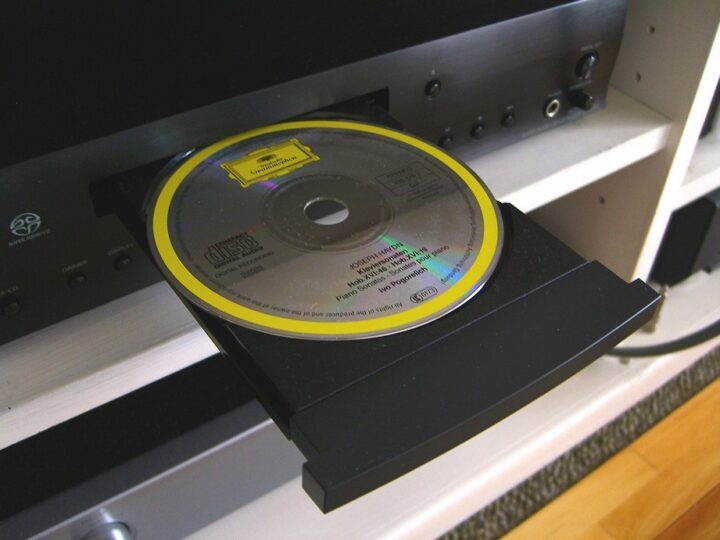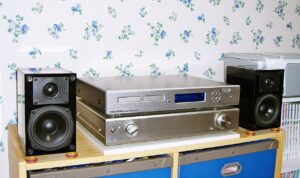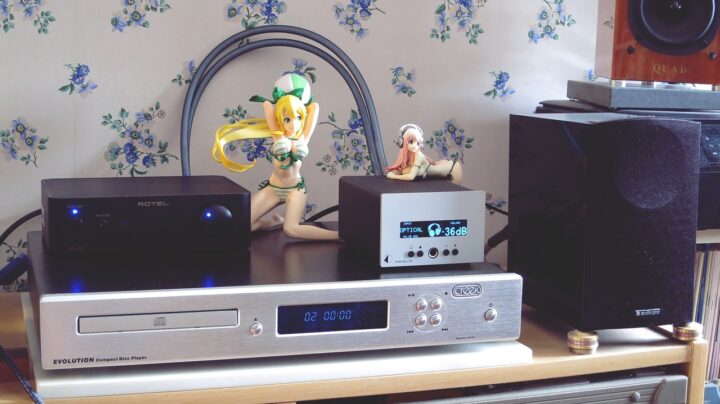
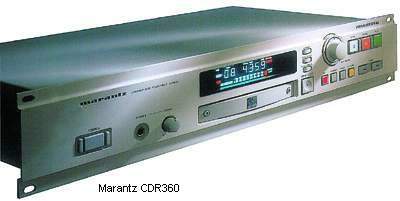
Today I pulled out two copies of the exact same CD I had somehow bought twice (this happens more often than I’d like to admit…) — Herbert Blomstedt conducting the San Francisco Symphony Orchestra, Richard Strauss: An Alpine Symphony — and loaded them simultaneously into both the professional CD-R recorder MARANTZ CDR630 and the belt-drive CD player C.E.C TL51Z in my main system. I matched the start times by eye as closely as I could, then listened by flipping the selector on my integrated amplifier back and forth between the two.
I’ve done CD player sound quality comparisons many times before, so the sonic differences are nothing new to me — but what I noticed afresh this time was that the two machines gradually drift apart in time as they play. I had started them in perfect sync, yet when I switched the selector some while in, the audio was ever so slightly out of step, which left me puzzled. It seems the C.E.C TL51Z falls behind by roughly one second over approximately fifty minutes. (Note: the disc contains a 35-minute track (An Alpine Symphony) followed by a 17-minute track (Don Juan), but the drift is already perceptible during the uninterrupted first 35 minutes. Also, any start-time offset caused by track switching between these two players appears to be within visual tolerance — i.e. negligible.) I can’t help wondering whether this is actually the secret behind the belt-drive player’s reputation for a relaxed, unhurried sound!
Incidentally, when I fed the digital output (optical/coaxial) of the C.E.C TL5100Z or TL51Z into the CDR630, a periodic click noise — in rhythm with the disc rotation — appeared in the DAC monitor audio on the CDR630 side, and synchronisation was impossible without engaging the SRC (sampling rate converter). The CDR630 accepts signals within 44.1 kHz ±100 ppm for DAC monitoring and real-time recording at normal speed, but it appears the C.E.C TL51Z is producing timing jitter that exceeds that specification.
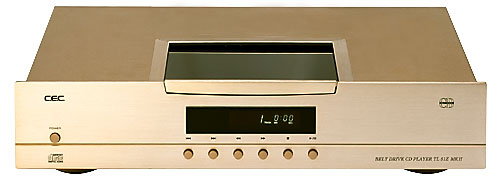
With the CDR630’s built-in SRC in the chain, it can certainly be used as a DAC and will burn CD-Rs as well — but in this combination, the data is naturally a mangled mess. The sound is noticeably murky to the ear too, so belt-drive machines of that era are, regrettably, of no use as a transport for burning CD-Rs. One is left wondering whether the wonderful sound of a belt-drive player might actually come from a kind of 1/f fluctuation introduced by deliberately breaking precision through rotational irregularity… ※ Addendum: this applies specifically to early belt-drive CD players from the 1990s; later models have been improved.


 ポチップ
ポチップ
As for C.E.C’s belt-drive transports paired with the company’s own standalone DACs — in addition to the conventional S/PDIF digital transfer via TOS-link or coaxial digital cable, which are known in principle to have synchronisation issues, C.E.C employs a separate method called CEC Super Link to synchronise the clock signal. Designer Carlos Candeias must have felt the necessity, which is why he went to the trouble. That said, when pairing a general-purpose standalone audio DAC with a belt-drive CD transport, the DAC’s tolerance for timing fluctuation must ordinarily be far wider — I have never once experienced dropouts or skipping in practice.
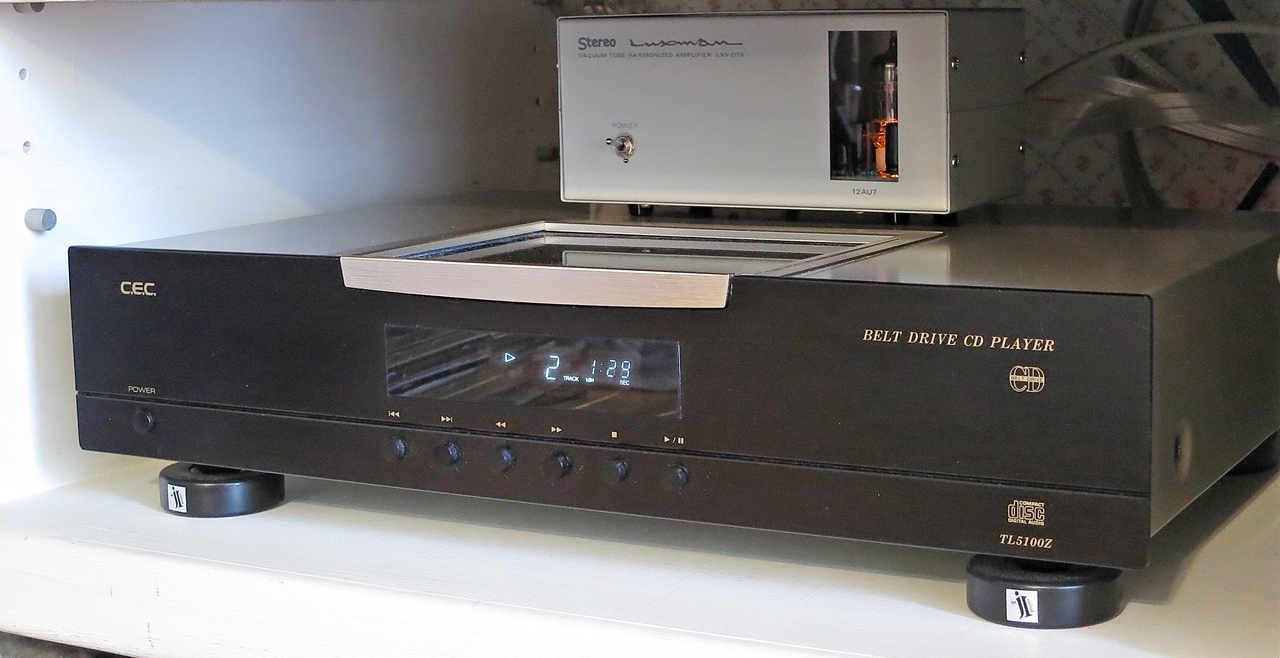
Some readers may well think, having read this, that they could never use such a questionable CD transport — but this is, after all, an eccentric music-loving miniature-garden Hi-Fi enthusiast writing. In terms of what I actually hear, the C.E.C TL51Z/TL5100Z sounds far better than the MARANTZ CDR630. Even when both are used as transports feeding the same external DAC, the difference is plain. The TL51 belt-drive has a smooth, rich, analogue-like weight to its tone, with a wide frequency range and a generous soundstage. The CDR630, by contrast, offers a compact, crisp, and nimble sound. The sonic characters are quite different, and I think anyone could hear the distinction — but my own position is simply that if the music sounds good, that’s enough. I prefer results over theory.
The CDR630 carries the MARANTZ name but was designed and produced during the Philips era (made in Belgium), and is fitted with a bitstream DAC and a die-cast mechanism — it has a quietly musical sound and is by no means bad. Objectively speaking, though, the sound quality is about what you would expect from something priced roughly ¥100,000 below its original list price of ¥165,000. It’s a close match with the ARCAM CD72T — more a matter of personal taste than outright hierarchy. Against the more modern designs of the ONKYO C-1VL and C-S5VL, musical character aside, it loses rather easily on sheer low-level detail retrieval.
 ポチップ
ポチップ
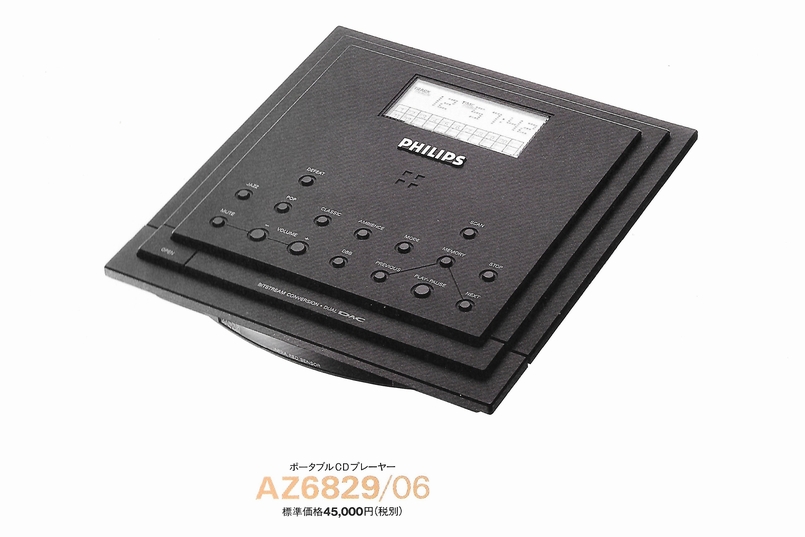
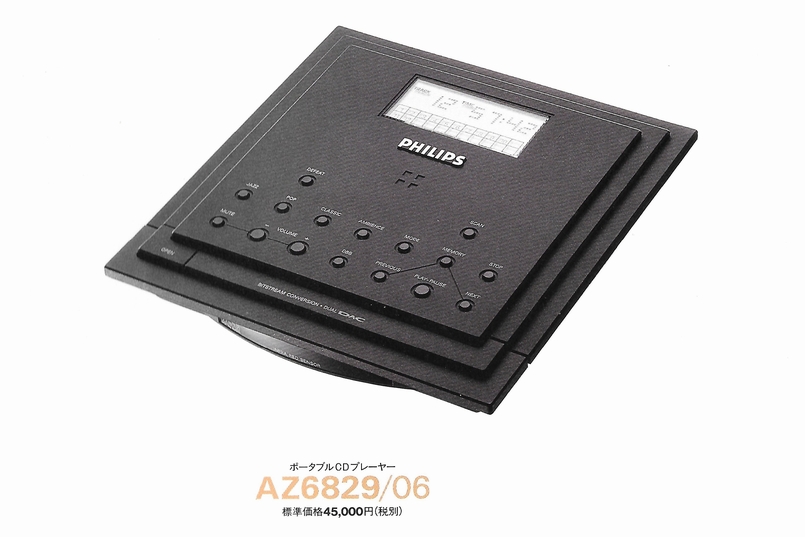
This timing issue is something I encountered before, seven or eight years ago, when I ran the same kind of experiment with several CD players I had on hand at the time — each one drifted at a different rate, and I remember finding it quite amusing. Using the SONY CDP-X555ES (a mid-range Sony, spec-obsessed as the brand was, so I’d expect its timing accuracy to be high) as the reference, the PHILIPS portable CD player AZ6829/06 — which I actually preferred the sound of over the Sony — turned out, on dismantling, to use a ceramic resonator rather than a crystal oscillator. The timing instability was audible enough to sense by ear, and in A/B comparison the tempo seemed ever so slightly faster. If I recall correctly, over a track of four or five minutes it was already drifting by well over a second. Perhaps that is the secret behind the bright, lively character of the PHILIPS AZ6829/06 — though I must stress this is entirely baseless speculation.
There is also this, which I heard second-hand from a friend who owned one: a budget CD player from a certain domestic DE▪ON manufacturer of that era (model number forgotten) was apparently drifting by several seconds over the course of a single disc… which is rather something. 16-bit/44.1 kHz digital may be digital, but the CD-DA format is still ultimately a consumer-level standard — perhaps the DAC side is able to lock on and operate even with fairly loose incoming timing, without applying any correction. Though if the drift were bad enough, I imagine some listeners might just barely notice the pitch shifting… To be fair, one could reasonably argue that a drift of this degree is imperceptible, and I want to be clear that these are purely subjective impressions.
On the matter of error correction: those who collect classical or jazz CDs will know the experience of encountering an import disc that skips despite having no visible scratches on the surface. This comes down to lax quality control in CD manufacturing — pit formation irregularities, warping, and eccentricity arising from sloppy pressing at the factory. Playback compatibility varies from player to player; machines with generous disc-condition tolerances and excellent servo mechanisms seem to handle almost anything, but the C.E.C TL5100Z occasionally struggles with cheap reissue imports and SACD hybrid discs. Interestingly, the C.E.C TL51Z, which uses the same drive mechanism, handles most discs without complaint — so it may simply be individual variation between units. (On later models with an improved belt-drive mechanism, this should no longer be an issue.)
Then there is my PHILIPS PLD600 (a compatible LD player). When it plays back without incident the sound quality itself is fine, but even with domestic pressings it quite regularly skips at certain fixed points and gets stuck in a click-noise repeat loop. With import discs the rate of problem discs is even higher. This is again entirely baseless speculation, but even on discs that don’t actually skip, I have a feeling a considerable amount of C2 error correction must be going on behind the scenes — or perhaps the read correction is barely functioning at all. It is a little frustrating, but as a tool for identifying discs with pressing issues, it has its uses.

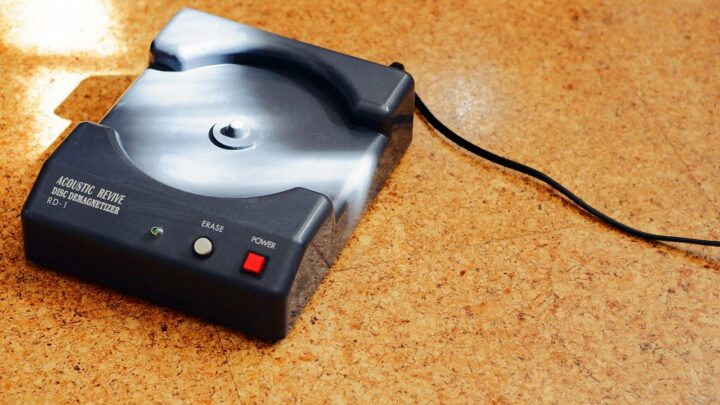
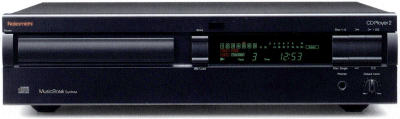
Incidentally, the Nakamichi head unit Nakamichi CD-35 I use in my car almost never skips on pressed CDs, but CD-Rs are another matter. Being a car audio unit, I assume it has a reasonable memory buffer, but perhaps the issue is more basic — a weak pickup output, or something of that sort. Skipping rates also vary considerably depending on the CD-R brand, and since the discs just sit in the car, something that plays fine when freshly burnt may start skipping after a few months or years of degradation. On top of that, demagnetising with an Acoustic Revive RD-1 sometimes cures the skipping — or, strangely, moves it to a different point on the disc. Yet those same CD-Rs will play back without particular trouble (sonically speaking, at least) in an ordinary CD player, and can usually be ripped without issue as well. One is left wondering what on earth is going on.
 ポチップ
ポチップ
Come to think of it, there is that saying that high-end CD players and transports deliberately suppress pickup operation to the bare minimum, in order to avoid the sonic ill effects of servo current — and that cheaper machines are actually more robust at reading discs as a result. Whatever the technical truth of that may be, my accumulated experience leaves me feeling that real-time CD-DA readback in consumer Hi-Fi is rather loose and easygoing in nature. If a player skips occasionally, it stands to reason that for many more discs it is either interpolating recoverable data errors or filling in the gaps beyond what can be properly recovered — and doing so without the listener ever noticing.
 ポチップ
ポチップ
Anyway, if you own several optical CD players, it might be worth trying this experiment: get a few copies of the same disc featuring a long uninterrupted track — Richard Strauss’s An Alpine Symphony is a good candidate — load them all up simultaneously, and see whether they all keep spinning in lockstep right through to the end. You may well find one player in the bunch that runs slightly fast or slow… it could be rather entertaining.

Auto Translated by CS4.6