【Bringing Home the CREEK Evolution CD Player】
Part 1|Part 2|Part 3|Part 4
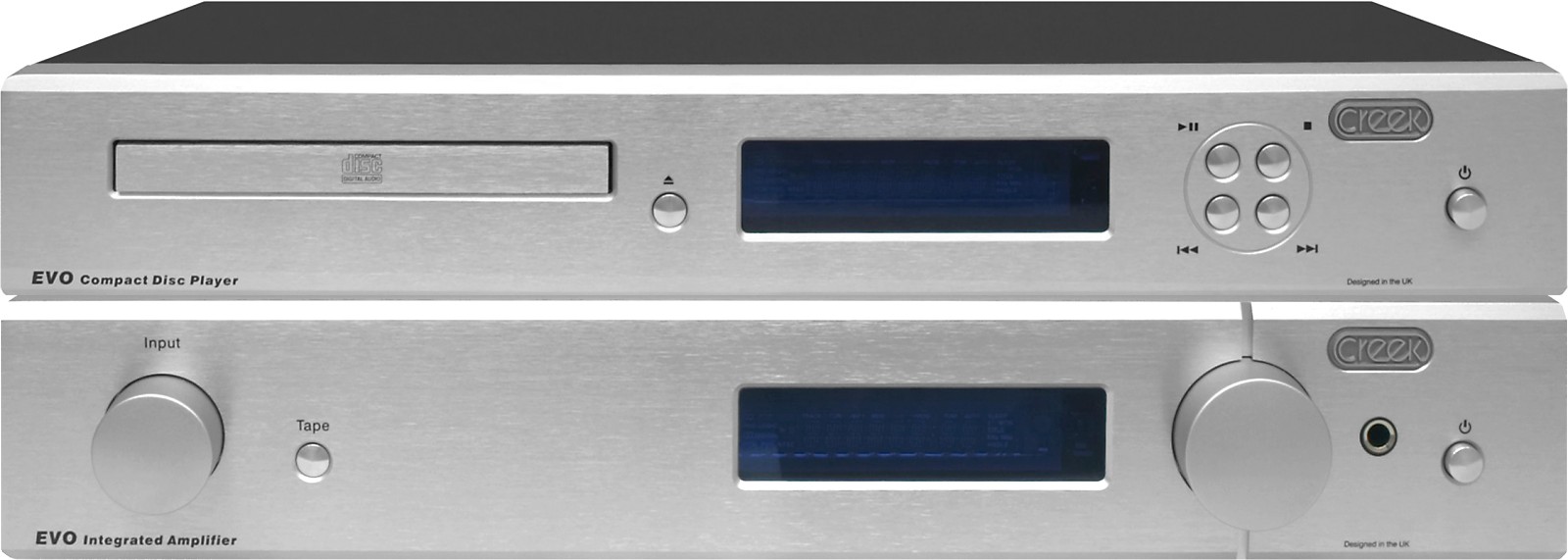
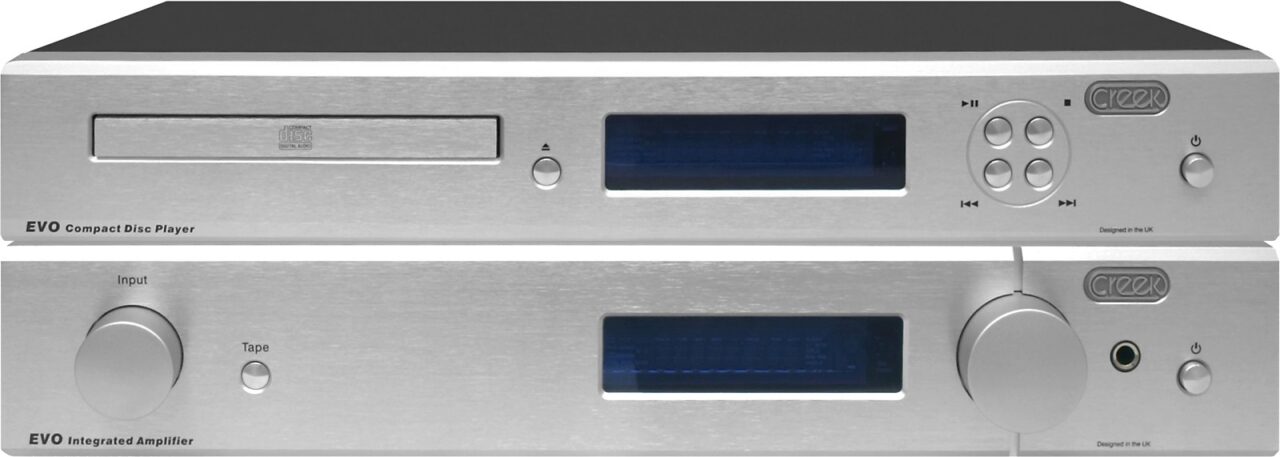
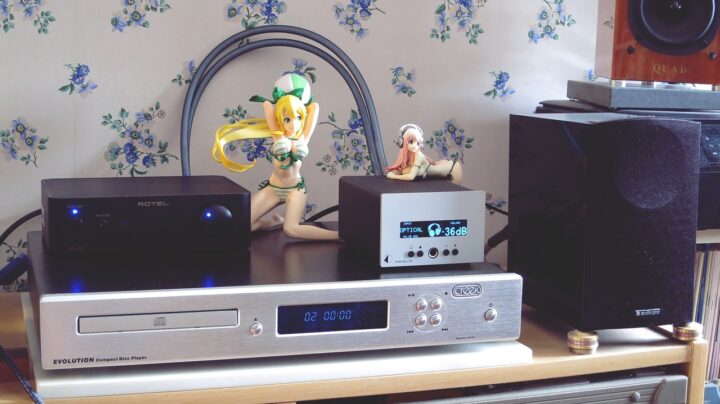
The latest CD player from British manufacturer CREEK AUDIO — the EVO CD player — which I ordered the other day, arrived a few days ago. And so, beginning with this instalment, I’d like to review the Evolution CD over the course of several posts. The Evolution CD I purchased this time is Creek’s entry-level model — a CD player in the Evolution series, priced at their most accessible and strategically competitive point.

 ポチップ
ポチップ
 This is actually the first Creek audio component I’ve purchased in fifteen years — since I was in my mid-teens. The Creek product I used before was the integrated amplifier CREEK 4240 — the very thing that first awakened me to the world of desktop Hi-Fi, the integrated amplifier that in one fell swoop demolished my then-prevailing values of catalogue specifications and magazine award histories, in the face of the overwhelming sound quality and musical expressiveness of a foreign product. The reason I chose Creek again this time comes down to a single-minded desire to return to where I truly ought to be — a return to origins, after having spent the past several years falling into the habit of chasing sound quality over musicality.
Distributor: Hi-Fi JAPAN
Creek Audio of the United Kingdom announces the Creek EVO (Evolution) series — the return of the 43 series, their most popular range, which was discontinued in 2002. The visual design shares a family resemblance with the previously released Destiny series, while achieving a considerably more accessible price point.
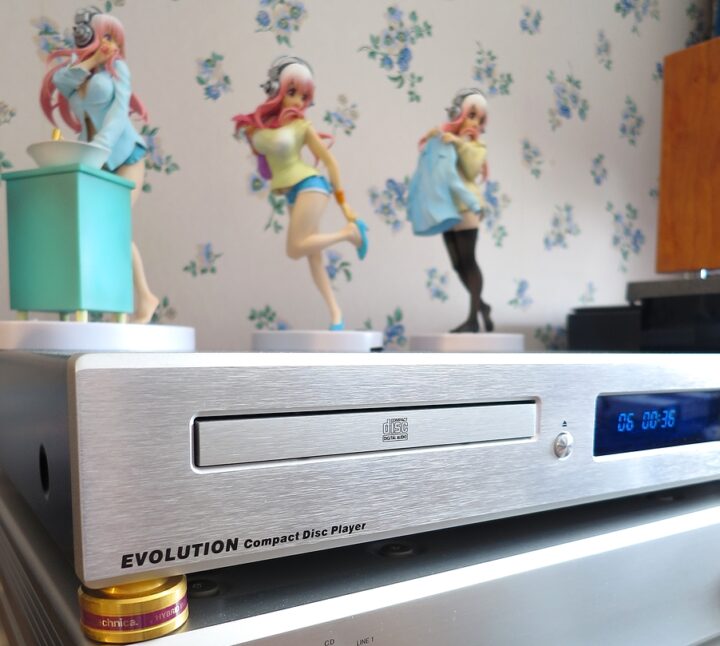
At a glance, the exterior shares a similar design language to the higher-end models. The 5mm-thick aluminium panel with a hairline finish gives it quite a premium feel. The difference between the Evolution and the top-of-the-range DESTINY series on one hand, and the mid-range CLASSIC series on the other, lies in the chamfering along the top and bottom edges — something absent from the CLASSIC series. Thanks to this cut, the chassis looks even slimmer than it actually is. ※ Personally, I rather prefer the design of the CLASSIC series…
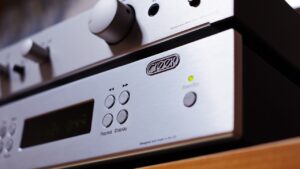
The 4240 integrated amplifier I used previously was a model predating even the 43 series — a compact integrated just 6cm tall and a mere 23cm deep, small enough to sit on a window ledge. Compared to the unpretentious construction of Creek products back then, the Evolution series is a considerable step up. The width is nearly the same at 43cm (plus 1cm), but the height is 7cm, and the depth has grown by a full 10cm to 33cm (measured, excluding terminals). Slim as it is, seeing it in person gives the impression of something noticeably larger. Even the feet attached to the base plate are solid machined aluminium — the sort of thing you rarely see even on domestic Japanese equipment. You might honestly be better off not using any Hi-Fi insulators underneath it at all.
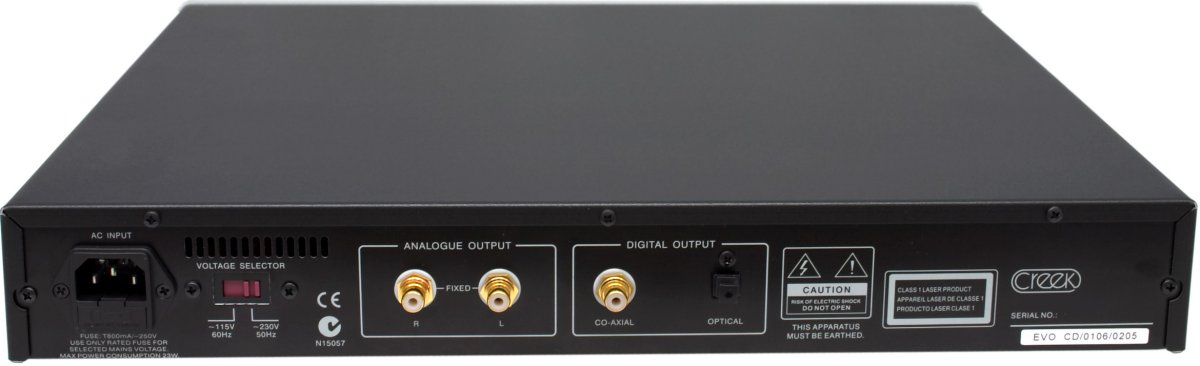
The rear connectors, which in British products of that era were decidedly no-nonsense affairs, have now given way to substantial parts capable of accepting even the thickest of cables.
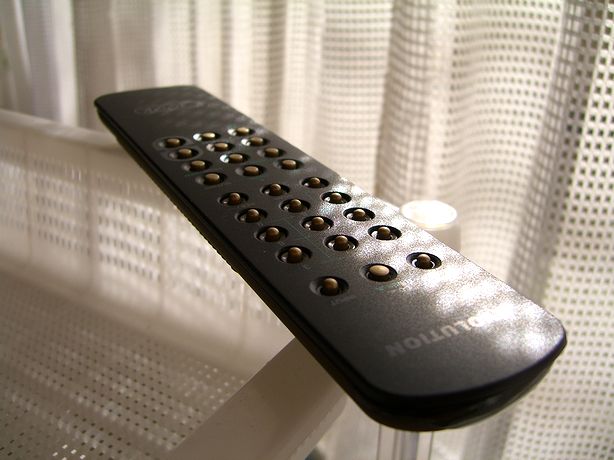
The remote control too is rather elaborately designed and finished, with a satisfying premium feel and appropriate heft. One does wonder where exactly they’ve chosen to allocate the cost. The indicator is blue. Track and time display are perfectly normal. Brightness can be adjusted in three steps, but for some reason the display cannot be turned off entirely. Nor is the brightness setting stored in memory, so once the power is switched off it resets to maximum brightness again (which is, frankly, far too bright). Foreign products always have these odd blind spots in their usability.
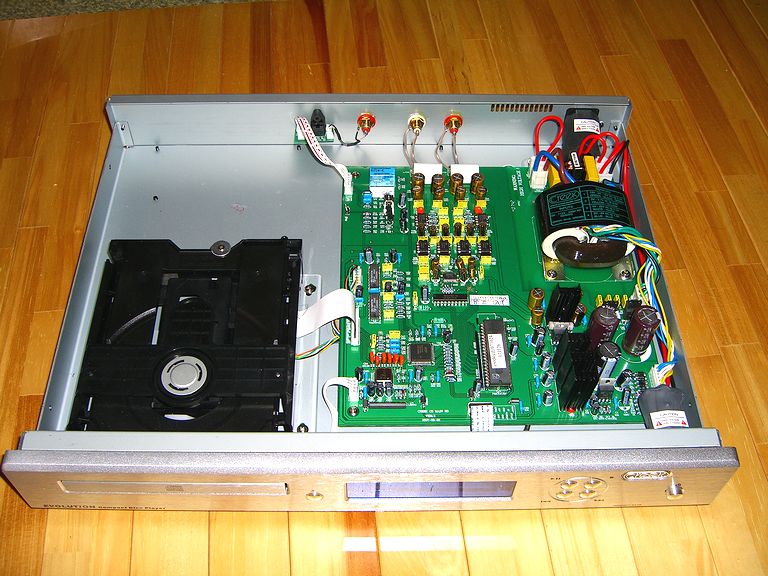
And here is what it looks like with the lid off. The transport mechanism is the Philips CDM-12.X. With that mechanism now discontinued, higher-end models have already switched to PC drive mechanisms, making this likely the last model to use a purpose-built single-speed audio transport. After the original CD60/DAC60, which used a Philips multibit DAC, successive Creek CD players and standalone DACs have generally used Crystal Semiconductor DAC chips — but the entry-level EVO CD alone uses a single Burr-Brown delta-sigma 24-bit DAC, the PCM1738E. Op-amps are two Burr-Brown OPA-2134PAs, and four OPA604APs (I can’t quite read the markings). There are also two Philips TDA7073As. The power transformer is not toroidal but an R-core type. I expected it to be rather sparse inside, but there’s actually quite a decent amount going on (well, relatively speaking). ↓ Below is the Creek CD43.
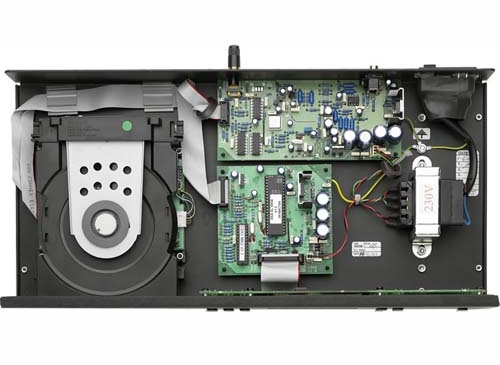
Setting aside the original Creek CD player, the CD60 (which used a Philips 16-bit DAC if I recall correctly) and its rather densely packed interior, subsequent Creek products were far more sparsely populated. The 4240 integrated amplifier, for instance, had so few components you could practically count them on one hand — the ultimate expression of simplicity as a virtue. That said, while the 4240’s board assembly was immaculately neat, the Evolution CD is a touch slipshod. Do pull yourselves together, ladies on the British production line… Capacitors and such were pointing every which way, some making odd contact with neighbouring parts, so I carefully straightened and spaced them by hand as far as I could without snapping anything. After doing this, the sound — which had been rather tense and on edge — relaxed somewhat, and took on quite a charming character. ※ Later note: this Evolution series was manufactured in China, not in the UK itself.
I purchased this ostensibly as a CD player for the secondary system, but for the purposes of sound quality evaluation I connected it to the main system first. Speakers are the Vienna Acoustics T-2 MOZART Signature. The integrated amplifier is the TAG McLaren 60i, and the CD players for comparison are the C.E.C TL51Z and TL5100Z, along with the MARANTZ CDR630.
To be honest, I’m rather bewildered. There’s something peculiar about whether I’m pleased with the purchase or not. No — as a purchase it was an unqualified success, but the sound quality exceeded my expectations so far beyond what I’d imagined that all manner of plans I had in mind have been thrown into disarray. In the first place, I wasn’t expecting anything from Creek in terms of modern Hi-Fi sound quality — what I was after was what I call musicality: high musical expressiveness, something I could enjoy happily as a compact desktop sound in the study’s secondary system. On top of that, I had actually wanted the higher-model CLASSIC CD player, but compromised on the Evolution CD for reasons of price. The thinking was: since I wasn’t prioritising sound quality, the entry-level model would do…
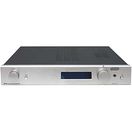 For reference, the EVO CD and EVO AMP are priced at £495 each in the UK. The mid-range CLASSIC CD and 5350SE integrated are £850, and the top-of-the-range DESTINY CD Player and Destiny AMP Integrated are £1,200 apiece. Given that the Japanese domestic price of the Evo CD is roughly double as shown in the linked pages above, buying through the distributor in a 100V Japanese specification — including airfreight and support — doesn’t feel particularly poor value. With the CLASSIC series and Destiny there might be a slightly wider gap between UK and Japanese prices, or so I thought — but when I actually did the sums properly without subtracting VAT, the difference isn’t that dramatic. If anything, the distributor is doing a reasonable job. Sterling was ¥230–240 until recently, so with exchange rate risk factored in, the Japanese retail price is perhaps about as tight as it can be… Depending on how much one can negotiate in Akihabara or Nipponbashi, there may be room to work with. (Continues in Part 2)
【Bringing Home the CREEK Evolution CD Player】
Part 1|Part 2|Part 3|Part 4
Auto Translated by CS4.6
List of comments (6)
さっそくクリークのレヴューを掲載されましたね。(まだまだ続くでしょうが)
クォードCDの記事とのトラックバックの件、試しにやってみました。
うまくいったかよくわかりませんが、よろしくお願いいたします^^?
トラックバック多謝です~♪ちゃんと出来てますd(^_-)トラックバックを自由開放すると訳の分からないのが色々飛んできますので、一応要認証にしてます。よって直ぐに反映されませんがご了承下さいませ♪
良い買い物だったみたいですね^^
私は滋賀の単なる音楽好きな男ですが
昨年、ゴトー総合音響でググッて
こちらのサイトをみつけました
休止中だったみたいでしたが過去題に
AH!の記事をみつけ 真空管未体験の私は
激しく記事に惹き付けられ、とぅとぅ今日
一番やすい機種ですがプロローグ1を
発注しちゃいました(^^ゞ
チューンCM1+ProLogue One+marantzのCD6002で
二アフィールド視聴を楽しんでいくつもりです
(机150x70xH72 by Victor)
http://www.jvc-victor.co.jp/interior/product/new_desk/index.html
ビクターの回し者じゃないけど こういった机も
いいもんですよ~♪^^
座って、耳の位置にSPがくるのって快感です
グレアムペンギンさんはじめまして♪
おぉぉぉぉぉ!プリマルナに行かれましたか~。その組み合わせの場合、ニアフィールドの枠を超えて、かなり雄大なスケールになりますよ~。
B&W CM1を質の良いスタンドに乗せて10~15畳くらいのリビングで相当な音質と迫力で鳴ると思います。あと、初期予算を抑える上でマランツCD6002を選択されるのもなかなか賢明と思います。スペースに余裕がございましたら、スピーカーの間隔を1.5~2m、後方50cm以上あるセッティングもぜひ試してみて下さいませ♪
ビクターって家具も作っているんですね。知りませんでした。丁度私が書斎で使っている机もリンク先のようなタイプのものです。色は自分で白く塗り替えました。スペース面でCM1とProLogue Oneを並べたら、机としては使えなくなりそうですが…大丈夫ですか?(滝汗)
旧家(築江戸時代?)の平屋、部屋数だけは多い我家です
私の書斎(勝手に言ってるだけ)は8畳間フローリング
カーッペット敷き、天井の真ん中照明器具の部分が
180x140くらい長方形で30センチほど深くなった
へんな造りになってます(^^ゞ
現在、机上にゴトーチューンのcm1が両端に載ってますので
机の幅150センチの間隔そのままです!
DIYで脚と板買って、固定してない棚にSPがのってます
SPの下にはDIYで調達した硬質ゴム3点支持のみ
SPの上には棚板とCD、プリンター、etc(^^ゞ
長年使用のSPエッジが破れ、SPを新調
そのながれで、LD/CDコンパチ機しか知らなかったのを
CD6002を購入、んで今度はアンプという次第です。
机の幅、奥行きともに充分ありますし ノートパソと
タブレット、フィルムスキャナーしか置いてませんので
スペースは余裕でありますよぉ(≧▽≦)ヾ
なんだかワクワクするデスクトップですねー♪
(そして広っ!)
ただ、スピーカーの後方空間はあまり空けられませんよね?CM1のバスレフは付属の詰め物で閉じた状態ですか?
>SPの下にはDIYで調達した硬質ゴム3点支持のみ
500円玉と10円玉も試してみて下さいー。