【Cleopatra’s Daydream × Pastel Piano: A Hi-Fi Discussion】
Twitter Log 1|Log 2|Log 3|Log 4|Log 5|Log 6|Summary
This third entry features Cleopatra’s Daydream’s thoughts on Hi-Fi, interspersed between our exchange on Twitter. (The first half consists of tweets addressed to all followers.)


 ポチップ
ポチップ

Cleopatra’s Daydream @cleopatrasdream 12 September
Until you can say with confidence that you have gotten a single piece of music to play fully and completely, there is no way ten different pieces are going to sing. And if ten pieces across genres won’t sing, then a hundred never will. If your Hi-Fi is hitting the central axis of the music, it will sing. Older recordings are narrow in range, and precisely because of that, the heart of the music — its central axis — is clearly defined. You tune your modern equipment to align perfectly with that axis. When the axis slips, mould grows on the music. That is what makes it so easy to tell. Modern recordings are fresh and wide in range, so even when the axis is slightly off, you still end up with something that sounds pretty, resonant, and like a nice recording. That is where the trap lies.
When you listen to modern recordings on a system that has been properly centred on the axis using older recordings from around the 1950s, you realise the sound that has gone in is jaw-droppingly good. But when the calibration is still immature, you get the view that modern recordings sound thin and dull, and that older ones are better. There is certainly no shortage of systems in that state, yet when you actually improve them, you come to see that the recordings themselves were never at fault. For the many ordinary listeners who play music without tweaking their Hi-Fi at all, the way a piece sounds — its character, its feel, and everything else — shifting around depending on the era, the genre, or the equipment must be a bitterly frustrating thing. From the performer’s side, it must be even more galling. But I will say it plainly: a truly remarkable performance — a genuinely extraordinary one — breaks through those barriers and comes out the other side. Even through YouTube and a laptop speaker, Bud Powell’s ferocious touch drives straight into your heart. Let us sharpen the antenna of the soul that hears it.
It was some years back now, but a senior recording engineer I was close with at the time said something, holding a prized vintage microphone up to a double bass: “When you record with this thing, the essence survives — no matter what path it takes to reach the listener.” But the remarkable thing about old recordings goes beyond that. Because only the chosen few could get a recording made, it was giants, masters, and geniuses every one of them. To begin with, the sheer presence of the sound that came out of them was on a completely different level. And it was recorded in a single take. With few microphones, the sense of space is natural. There are so many qualities you simply cannot replicate today. Contemporary Records, famous for Roy DuNann’s celebrated recordings — the more natural your system, the more effortlessly and lightly it responds, and the more fully you can savour what those records have to offer. DuNann modified Neumann microphones, reduced the number of contacts, bypassed anything unnecessary in the recording chain, and kept everything as simple as possible. The result is a body of recordings that are full of what you might call a raw sharpness — not manufactured through emphasis or exaggeration.
Cleopatra’s Daydream @cleopatrasdream 12 September
The direction of Hi-Fi technology has always been, fundamentally, towards lower distortion and wider range. And at the far end of that road — infinitely far — lies the ideal of perfectly faithful transmission. Older equipment, I think, tends to carry a richer human flavour. No electroacoustic device exists with perfectly flawless transmission. And it is precisely because of that imperfection that room opens up for human sensibility to fill in the gaps. Many people feel an unease with the inadequacies of electrical sound reproduction, and they compensate, adjusting the balance so that it becomes music again. The degree of that compensation may vary, but from the era of the gramophone right through to modern Hi-Fi, it has always been there in one form or another.
There was a time when legendary equipment was more plentiful than it is now — an era, you might say, when there was more room for that kind of compensation than today, and when sounds of genuine artistry and character existed. The Decca, whose design is the mirror image of the famous Decca Tree recording configuration. The Autograph, which conjures a stereo-like sense of space even in mono. If you removed the Autograph’s drive units and spoke into the empty opening left behind, it felt less like a back-loaded horn and more like an echo chamber folded into a box. Years later, when I travelled through Europe and made a point of visiting concert halls, I would listen to the sound carrying across the stage and think — I have heard this somewhere before. And then it would come to me: of course — that is Tannoy. That is the Autograph. One has to admire what those earlier generations knew.
Cleopatra’s Daydream @cleopatrasdream 13 September
People often ask me: what is the trick to getting better sound from your Hi-Fi? There is no shortage of techniques. There are over a hundred points of adjustment. I sometimes listen alongside people to compare. Even with seasoned enthusiasts who consider themselves veterans, or well-known figures in the industry, I have been genuinely surprised at times — thinking, how can they not hear that difference? With fine adjustments, each individual change may be small, but if you make ten adjustments all pointing in the same direction, the cumulative improvement becomes large enough for anyone to hear. That is why you need to listen acutely for each small change at each individual point, and align it precisely — so that it points exactly toward the North Star you carry inside yourself. Without that inner North Star, you will not know which way to turn when adjusting the sound. (A needless aside, but by North Star I mean your internal standard of judgement.) Even if you know a hundred different adjustment points, it is rather like sitting a layman down in front of a 48-channel mixing console. You cannot simply start turning knobs on a piece of equipment with no visible markings or labelled functions.

Cleopatra’s Daydream @cleopatrasdream 14 September
Speaker terminals are a genuine nuisance. No matter how high-grade the terminal, the sound is more honest without one. Among high-end speakers with wire coming directly out of the cabinet, the only ones I know of are B&W‘s original Nautilus and Time Domain’s Yoshii9. Details like this tell you how seriously the developer was actually listening. With Hi-Fi equipment, just by looking at how something is made, you can form a reasonable picture of the level it is at — without even hearing it. The equipment developer and the person who chooses that equipment face each other through the equipment itself. In an instant, each sees through the other’s level. What you choose is, in a sense, a reflection of who you are.
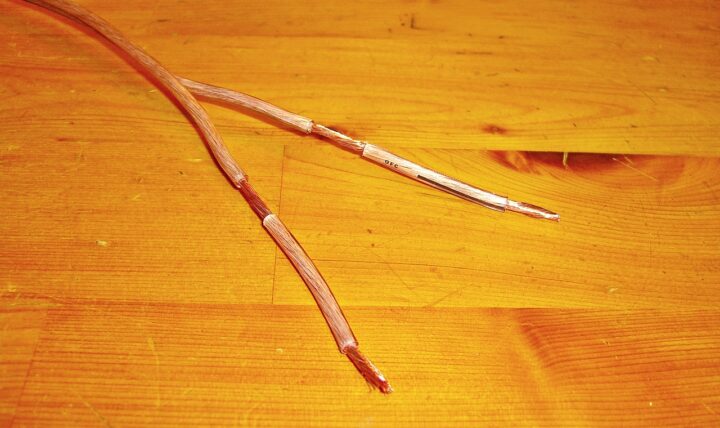
Even a report on something as minor as a jumper cable reveals the person behind it — their background, their accumulated experience. The underlying principles are clear, the meaning and context properly placed, and there is genuine reflection. You read it and know straight away: this is someone who actually does it. You can also tell, as a reader, what kind of ears — what kind of standards — this person listens with. An excellent piece of writing. (Note: I am rather embarrassed by this.) Many Hi-Fi components designed to have low distortion at the material level are honest and straightforward — almost to the point of seeming fragile — with little sense of punch or definition. But that is rather like viewing a digital photograph as a RAW file: in reality, the tonal gradation is breathtakingly rich. With Hi-Fi equipment, if you incorporate outstanding technology and simply announce “this is the sound it produces” — that is irresponsible as a maker. In editorial terms, it raises the question of who bears editorial responsibility. No matter how fine it may be as an electronic device, if the maker does not understand the musical centre — if the sound misses the pivot of the fan, so to speak — then it cannot be called a Hi-Fi component. That is not the fault of the technology or the materials. It is the chef’s fault.
Cleopatra’s Daydream @cleopatrasdream 12 September
Even my car stereo — which, I will be honest, has a far better tonal balance than many a mediocre high-end system (I call it a car stereo rather than car audio because I have put no real effort into it) — sometimes leaves me dissatisfied when I put on a CD. It is a tragedy when a fine performance fails to come across as compelling. But there is another problem too: a rough, sloppy live performance can end up sounding like an energetic, driving one full of guts. And that inflates its perceived quality. PA sound, generally speaking, tends to be a little crude. Textural nuance, gradation, light and shade — these things become thin. With a system that has that kind of PA-like roughness, the appeal of something like a quietly introspective ballad performance simply does not come through.

Pastel Piano @pastel_piano 14 September
That is a perfect illustration of the way Hi-Fi equipment, acting as a filter, can add a kind of “musicality” that was never present in the original live sound — and pass it off as genuine. Where does the actual music end, and where does the added colouration begin? Telling the two apart is extraordinarily difficult.
 ポチップ
ポチップ
Cleopatra’s Daydream @cleopatrasdream 14 September
No, it is nothing so refined as that — the roughness was simply harder to see. Once you have seen through it, you are never fooled again. But something I once rated highly because it fooled me with its sound will catch an acquaintance in exactly the same way when they hear it later. When, out of genuine goodwill, I tell them that it is actually not what they think it is, they — trusting their own ears — dig their heels in and argue back. That is hardly a scene unique to music and Hi-Fi, is it? There is a saying that you should not carelessly bring up politics or religion, since they only lead to arguments — and Hi-Fi can easily find itself in that same category. Perhaps it is because theory, abstraction, and emotion all become tangled together as someone builds their personal convictions. If you think I am talking nonsense, please feel free to ignore me — just consider me someone who has come along a different path. And if something resonates, well — feel free to engage with me every now and then.
Pastel Piano @pastel_piano 14 September
@cleopatrasdream Good evening. With so many tweets flying between us, I am finding it rather hard to follow the flow — I am not quite used to how Twitter works yet, and things are getting a little jumbled. I am currently editing the conversation into chronological order.
Cleopatra’s Daydream @cleopatrasdream 14 September
Thank you. Though I should say, this is not really a debate or a formal discussion, so I have not been writing my replies particularly precisely. I have been reading all the replies I received over the course of an evening in one go, and then writing down whatever comes to mind as a general impression of the whole.
 Continues to Twitter Log 4 — Problems Embedded in Recordings and Remastered Sources
【Cleopatra’s Daydream × Pastel Piano: A Hi-Fi Discussion】
Twitter Log 1|Log 2|Log 3|Log 4|Log 5|Log 6|Summary

Auto Translated by CS4.6




List of comments (4)
面白い話題です。
日本のオーディオファイルの方には音楽性云々以前に分不相応を正してほしいですね。
例えば、日本のオーディオファイルに多いのは狭くて天井の低い四~八畳の部屋にタンノイのオートグラフやJBLの4343を詰め込んだりと
ナンセンスにも程があります。あとアナログプレーヤーならまだしも、アンプやケーブルも重厚長大路線でなんだかな~と思います。
私は自作スピーカーで自分のHi-Fiを作りだそうとしています。自作の世界も日本は変わっていまして、日本だとネットワーク素子が悪者扱いされますが
海外では積極的に使い、高次のクロスオーバーネットワークやフルレンジにも補正を入れて周波数をフラットにしています。もちろん周波数がフラットで
あることが絶対とはいいませんが、海外の人が日本の自作スピーカーの周波数を測定したら即倒します。とてもじゃないですが、音楽を聞ける周波数になって
いないと思います。なので日本の自作する人は満足できずに大量に似たものをまた作るのです。
あと私の主観の自作視点だとスピーカー端子も、もちろん直出しの方が音質がいいですが、それより優先するべきはスピーカーの内部配線とスピーカー
ケーブルの銘柄を合わせることです(音が一番スムーズにでます)他には、ネットワークをエンクロージャー内に入れないことです。(これはディナウディオC1や
フランコ・セルブリンのAccordoでやっていますね)
ツァイススキーさんはじめまして。
ツァイス好きと云うことはCONTAXのマニアの方でしょうか?うちにあるカメラは今は京セラT-Proofくらいしか無いです・・・。あとはもう使い道が無いですが、リバーサルフィルムを観る為のルーペも引き出しの中にあったっけ。CONTAX T3欲しかったなぁ・・・買えずじまいでしたが。
部屋とおオーディオ機器の大きさの関係は昔から謎です。マンション暮らしなんで、畳の六畳間に巨大スピーカーとか言い出す親とか見てると・・・当時の憧れ的な価値観なんでしょうね。目的と手段が本末転倒してるとは思います。
内部配線はごもっともです。私は大きな自作はやりませんが、ユニットを外すとかなり細い撚り線だっりしますので、本当はうちのスピーカーなんかも配線を張り替えたり、ネットワークを外に出して別箱にしたりすると劇的に良くなったりするのかもと考えたりします。なんでネットワークって殆どのスピーカーで敢えて箱の中なんでしょうねぇ。そういやカーオーディオでは外にあるのに。
pastel_piano様はじめまして。
そうです、私はCONTAXが好きです。(最近のコシナツァイスも嫌いではないですが)リバーサルフィルムはいいですよね。
CONTAX T2とコダクロームの組み合わせが凄く好きでした。クラシカルで深いコントラストの描写がもうホントに最高なんですが、コダクロームがT2の寿命より早いとは(泣)
目的と手段が違っているコトはよくありますよね。たとえば、オーディオエンジニアは限られた制約の中でバランスよく設計しているのに安易に
高価な部品や重く・太く・硬くするのは良くないですね。特性を良くしようとして音が死んじゃいそうです。
ネットワークを外に出して別箱は他にはB&W SS25がやってましたね。ただやっぱり接続を間違えるとツィーターが壊れますし、ネットワークは
部品の設計や選定でガラリと音質がかわるので、安易に部品の値段などでケチを付けられたくないのでは?他には回路図もアンプより読みやすいからですかね?
私の次回の自作はScan-Speakのフラグシップ、Illuminatorラインで作ることを考えています。理由は、自分の感覚だと音の音色はウーファーが支配的かな~と考えているので
ハイエンドメーカー採用例が多い(Illuminatorラインはまだ見たことないですが)のと2012年のstereo8月号付録のフルレンジユニットがハイファイではないですが音楽性が
高く、クラシック音楽が生き生きとした音色に惚れ込んだからです。Scan-Speakの音の名刺は私には最高でした。
ツァイススキーさんおはようございます~。
先日ブログで使っているEX-Z750を壊してしまい、代わりにNikon P300を中古で買いまして、
昨日はブログをお休みして外で色々撮影してきました。遅レス失礼します。
銀塩は冷蔵庫の中に10年落ちのコダクロームが10本くらい入ってます。ダイナハイカラー100。うぅぅぅまだ使えるのかな?昔はネガでエクターとかコニカのインプレッサを使ってました。最近のコンデジはある程度良くなってきたみたいですが、それでもまだ昔の単焦点の高級コンパクト+銀塩フィルムの描写に比べると、まだまだ感覚的に遠い感じがします。P300やP330も35Tiと比べてしまうと・・・orz
T2が現役の頃は35Tiと比べて、35Tiの日本的な精細な描写とCONTAXの感性をえぐる描写とのギャップに、やっぱり感動させるのはCONTAXだよね~とか思った訳ですが、コンデジ全盛の今となってはどちらも実は凄かったという。
ステレオ誌のスキャンスピークのフルレンジは、今年のタイプでは無くて去年の付録のやつですね。うちのヴィエナアコースティックT2はツィーターがスキャンスピークD2905/93003です。スピーカーの自作はやらない(出来ない)のですけれども、ツィーターだけ上位に換装するだけでもどうなるのかな~と少し興味があったり。でもスキャンスピークのユニットはお高いです。