【Nordost RCA Cable Sound Quality Comparison】
Red Dawn |Blue Heaven|
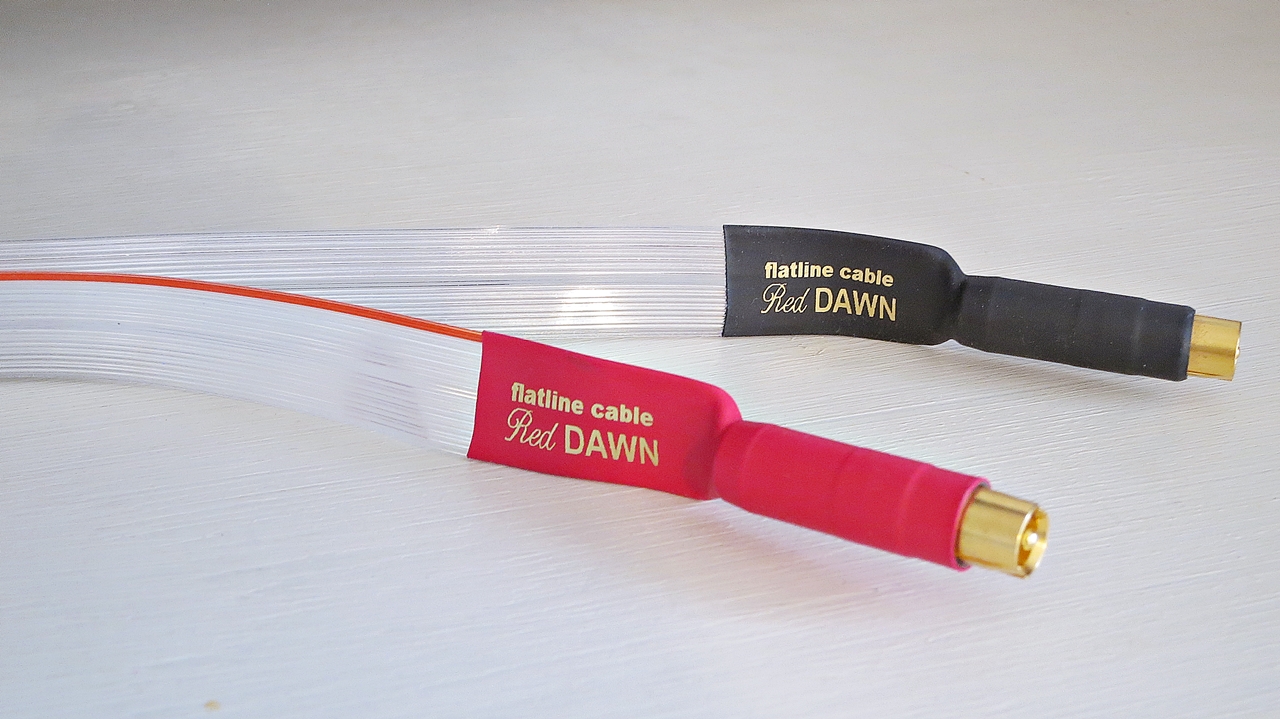
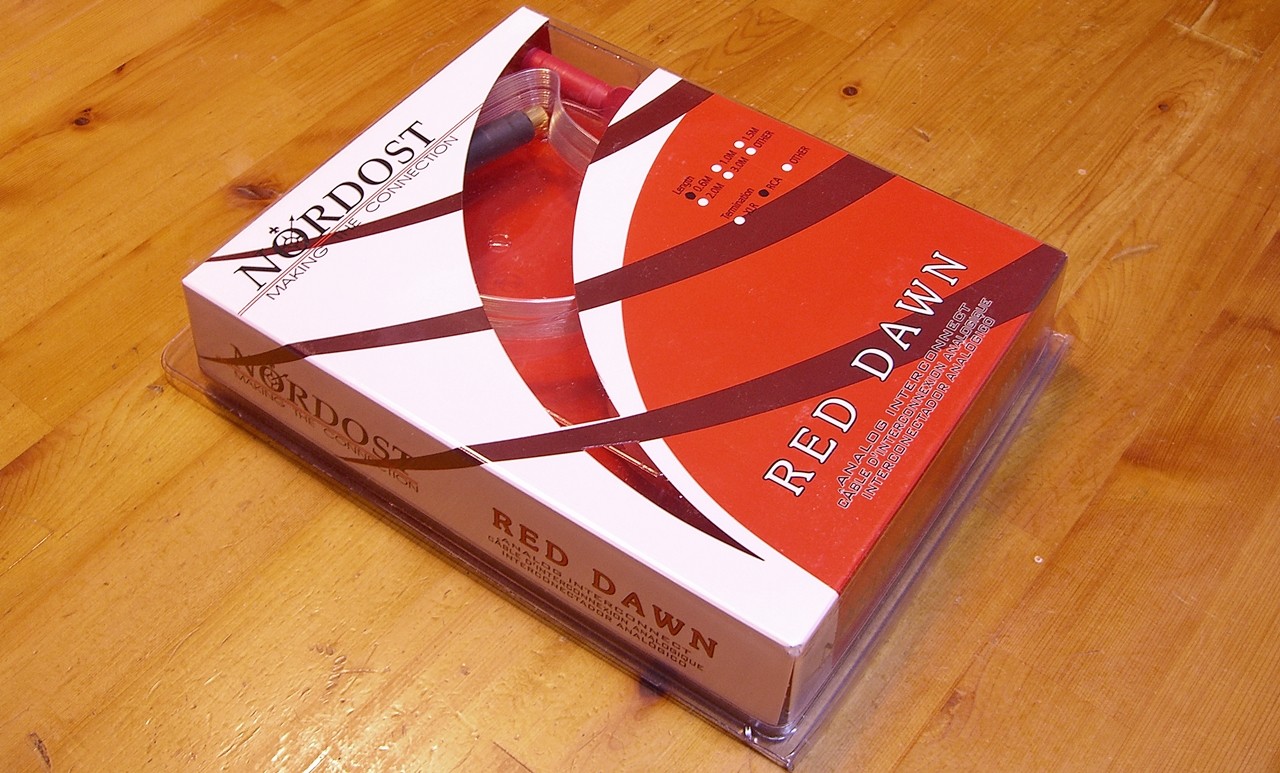
The NORDOST Red Dawn RCA interconnect cable from the United States (in terms of form, probably the Rev. II). This is the RCA cable I have been using throughout in my main system, but as I have changed the wiring, I thought I would write a review of it after quite some time. Despite owning around seven Nordost cables up to now, I had somehow never once properly reviewed any of them on this blog. I left the subject alone for far too long, and this silver-coloured flat-line series has long since become a discontinued model…
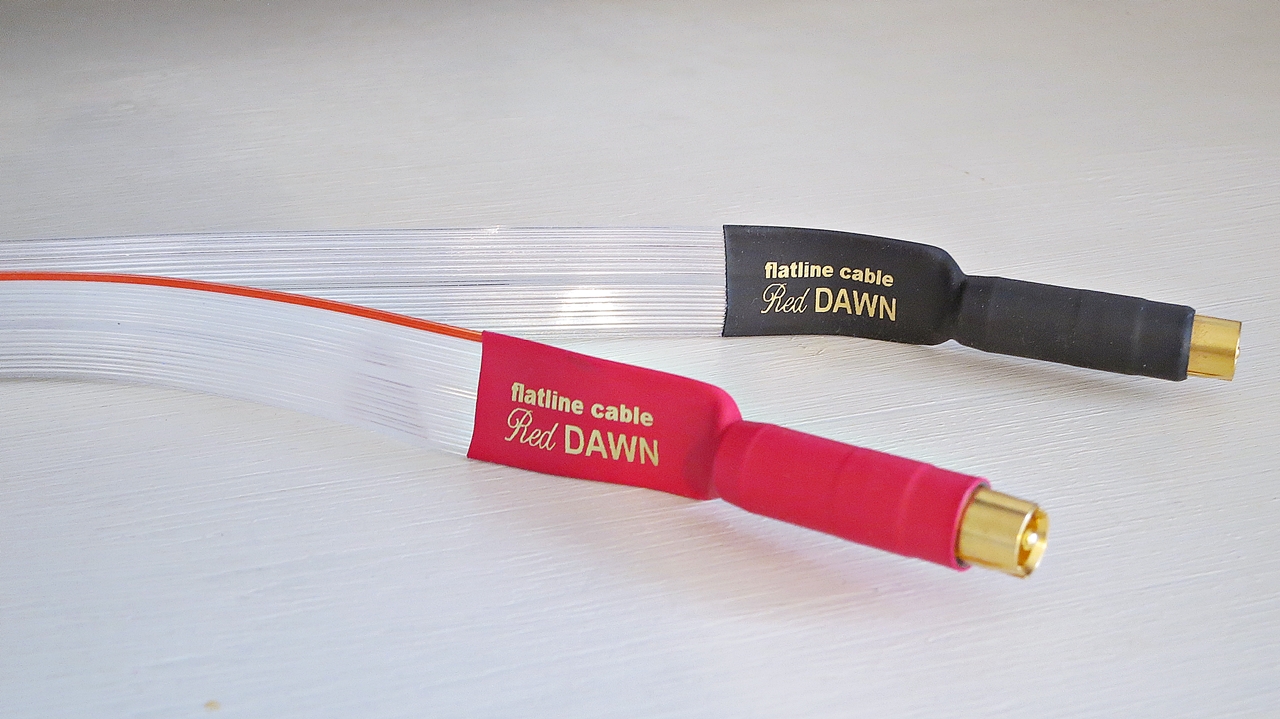
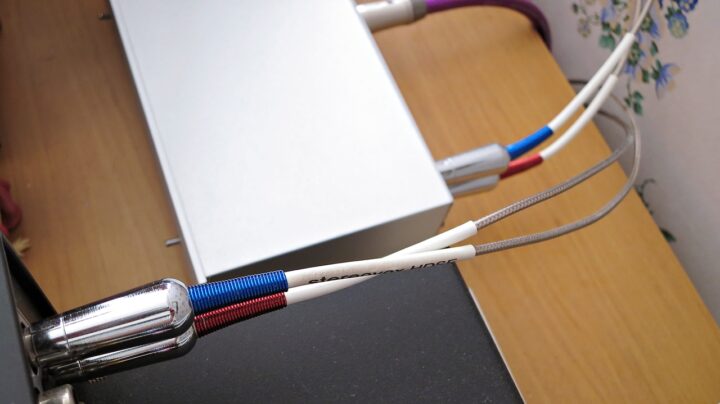
Among the interconnect cables I own, this old Nordost flat-line cable has quite an unusual yet attractive design, and I am rather fond of its appearance. The conductors consist of thin, flat 99.999999% 8N OFC conductors with 60μ silver plating, arranged as single-core conductors in a parallel configuration of 20 side by side on a flat plane, insulated with a thin transparent FEP (fluorinated ethylene propylene) sheath. It is fairly rigid to the touch, and the jacket is delicate and scratches extremely easily; if you bend it sharply and leave a crease, it will not spring back, so handling requires the utmost care. Incidentally, all Nordost cables are produced at the company’s headquarters in Massachusetts, USA.
NORDOST products such as the Valhalla 2 and ODIN — speaker cables and power cables costing over a million yen a set — are enormously popular in high-end Hi-Fi circles, but of course what I use is nothing of that rarefied kind; it sits at roughly the second or third tier from the bottom of the Nordost range, intended for the ordinary Hi-Fi enthusiast. That said, “lower-priced” is still by Nordost’s own standards, so among the RCA cables I own, even this Red Dawn happens to fall into the most expensive category.
Incidentally, “Red Dawn” means a red daybreak. As for the name — I’ll keep it just between us that at the time I vaguely wondered whether it had something to do with the American film “Red Dawn.” That film was remade in 2012 at some point with the fictional enemy switched from the Soviet Union to North Korea, of all places.


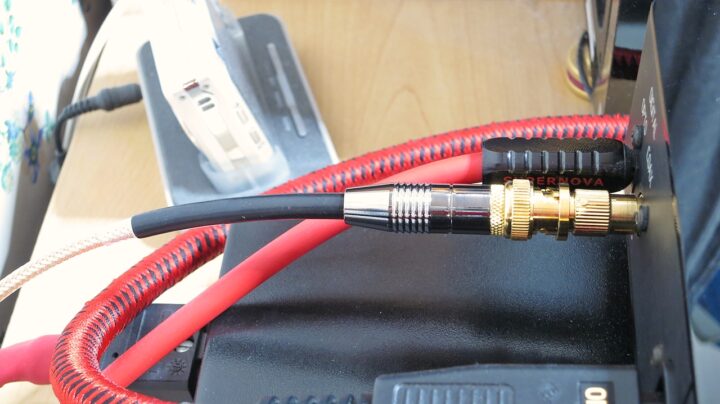
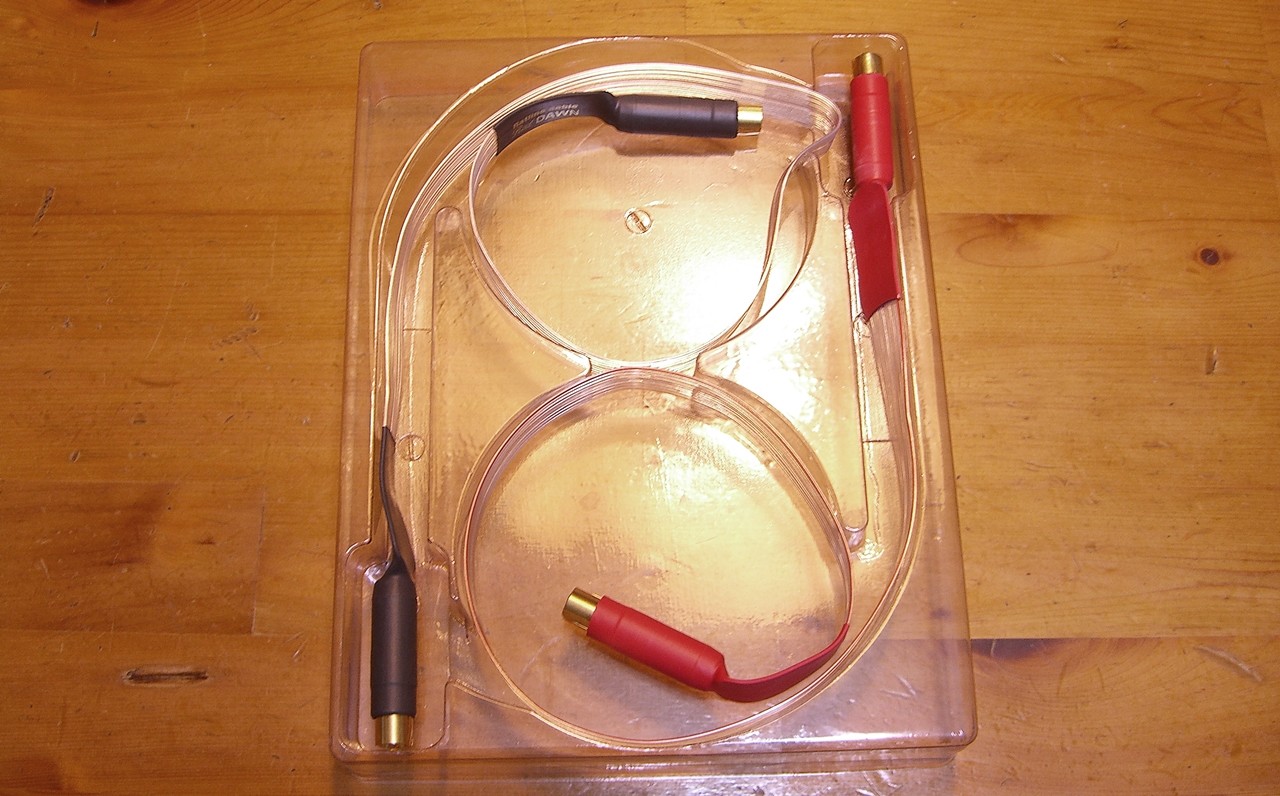
The Red Dawn uses a NEUTRIK ProFi NF2C-B/2 RCA plug made in the Principality of Liechtenstein — well regarded for its quality — though it is extraordinarily difficult to insert, which is a drawback. Unless you approach it at precisely the right angle it simply will not slide cleanly into the RCA socket, so when doing blind wiring at the back of an audio rack I invariably end up wrestling with it for about ten minutes. The contact feel is solid, so I suppose this is simply the trade-off for the high quality. The RCA plugs on the lower-ranked Blue Heaven are easy enough to push in and pull out, though…

 ポチップ
ポチップ
The Red Dawn had originally been used as the main cable for the analogue direct output from the TL5100Z PCM1702 to the TAG McLaren 60i, but this time, in order to insert the LUXMAN valve harmoniser into the analogue output of the TL5100Z, a wiring change became necessary, and the 0.6m Red Dawn turned out to be just slightly too short to reach from the valve harmoniser — sitting on top of the rack — to the integrated amplifier.
In my main system, the primary signal path for CD playback is not the direct analogue output of the C.E.C TL5100Z via Red Dawn, but rather a configuration in which the TL5100Z’s belt-drive mechanism is used as a transport, with the coaxial digital S/PDIF fed into the CI AUDIO VDA-2 DAC, and from there connected to the integrated amplifier, the TAG McLaren 60i. Since a 0.6m RCA cable does reach in this arrangement, I reassigned the Stereovox HDSE — which I had been using with the DAC for the first half of this year — to the LUXMAN valve harmoniser, and connected the 60cm NORDOST Red Dawn to the CI AUDIO VDA-2 DAC in its place.
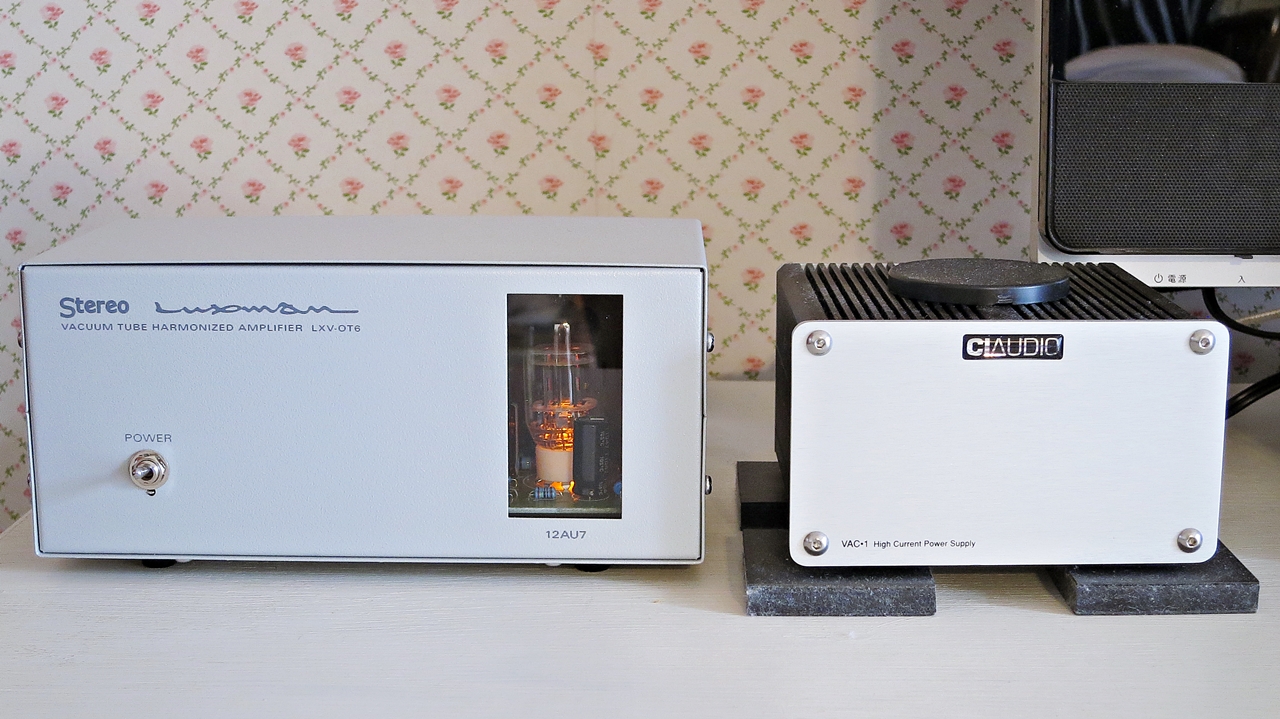
Incidentally, since the CI AUDIO VDA-2 has two sets of analogue outputs, the Red Dawn and the Red Rose Music 1934 on the other output are connected in parallel, with the option to switch between them as desired. (Note: this arrangement does not keep the sound of each cable entirely separate — they mix to a degree via the earth line and vibration interference.) It is a little difficult to explain in words, but in short, three different RCA signal lines from the same belt-drive CD player are connected to the integrated amplifier, allowing three distinct sound characters to be selected according to the source or one’s mood.
CDP ⇒ Analogue cable ⇒ Valve harmoniser ⇒ Analogue cable A ⇒ Integrated amplifier
CDP ⇒ Digital cable ⇒ D/A converter ⇒ Analogue cable B ⇒ Integrated amplifier
CDP ⇒ Digital cable ⇒ D/A converter ⇒ Analogue cable C ⇒ Integrated amplifier
※ Further details will be covered in the CI AUDIO VDA-2 review page at a later date.
Compared with the slightly dry-leaning Stereovox HDSE, on first listen there is noticeably more reverberant content and a greater sense of moisture. In terms of sound quality, it is easily two ranks above. Compared with the Red Dawn, the HDSE sounds relatively lacking in clarity — that impression is hard to shake. Soundstage localisation improves in all directions — particularly towards the rear — and the frequency response opens up in a high-speed, flat manner; however, the tonal character feels slightly dark, with a sense of heaviness around the upper midrange. The bass is not elevated, but in the low-frequency direction it is solid rather than generous in quantity. There is a coherent, somewhat hard yet smooth tone of the kind one associates with single-core wire, but there is no trace of the brightness one might expect from silver-coated conductors. The stereo image is slim and tight, though without any emphasis on edge definition. Musically it leans slightly cool and restrained in terms of energy, but it handles light and shade rather well. The natural warmth to the touch and the sunny, free-spirited quality one gets from the HDSE — those more positive, outgoing qualities — recede considerably.
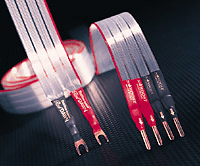
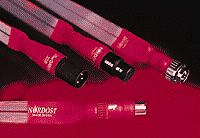
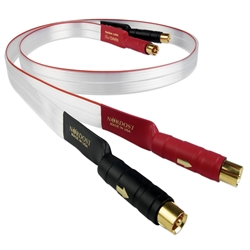 The structure is almost entirely unshielded — nothing more than a thin, clear FEP insulator over the silver-coated 8N copper parallel single-core conductors, whose internals are fully visible — yet the sound does not turn out as bright and open as the appearance might suggest. In compensation, the perceived S/N ratio is remarkably good despite the absence of shielding. There is a generous quantity of indirect sound within the soundstage — hall tone and echo — yet the direct-sound image is never swamped by it; the vibrato of strings, the sustain of piano wire, synthesised effects, and the ambient background noise in anime scenes all come through with exceptional clarity and accuracy. The high-frequency resolution is high, so even though the design dates back nearly twenty years, this is a quality that would truly come into its own with today’s hi-res audio. To be honest, the analogue-leaning, somewhat lower-resolution character of the TL5100Z makes it hard to say that the Red Dawn’s clarity is being drawn out to its full potential.
The weakness lies in the musical dimension. It handles light and shade — particularly the gradation of tonal colour in the darker regions — with considerable depth and richness, but it is almost too earnest, and there is a persistent sense of unease, as if something is pressing against the forehead. There is something about the cold, smooth quality of its resonance that resembles the character of a granite board. That said, I never felt this at all during the period when it was connected directly from the TL5100Z, so it may simply be a matter of compatibility with the CI AUDIO VDA-2 DAC. The tonal character and the cultural atmosphere it conveys are too refined to be called typically American, and it is by no means a dull, colourless sound devoid of personality — but there is a feeling of being slightly too preoccupied with the presentation of acoustic spatial phase and spatial resolution, and the impression of singling out just one particular aspect of the music is difficult to entirely dismiss. Even so, it is a fact that in a thoroughly straightforward sense the sound quality is genuinely good. It has always been somewhat over-specified for my system, but I have the feeling that the times are finally catching up with what Nordost sounds like.
 ポチップ
ポチップ
The Red Dawn series has since been updated to the LS model. For RCA and balanced cables, the parallel flat-line construction has been discontinued, replaced by a conventional single-core structure (6 conductors) different from the speaker cable.
As this is getting rather long, the second half will be on a separate page. I will compare the sound quality with the lower-tier Blue Heaven, which I also use regularly, and examine its compatibility with the LUXMAN valve harmoniser I recently put together.
 Continues to: NORDOST Blue Heaven vs Red Dawn — a sound quality comparison.
【Nordost RCA Cable Sound Quality Comparison】
Red Dawn |Blue Heaven

Auto Translated by CS4.6