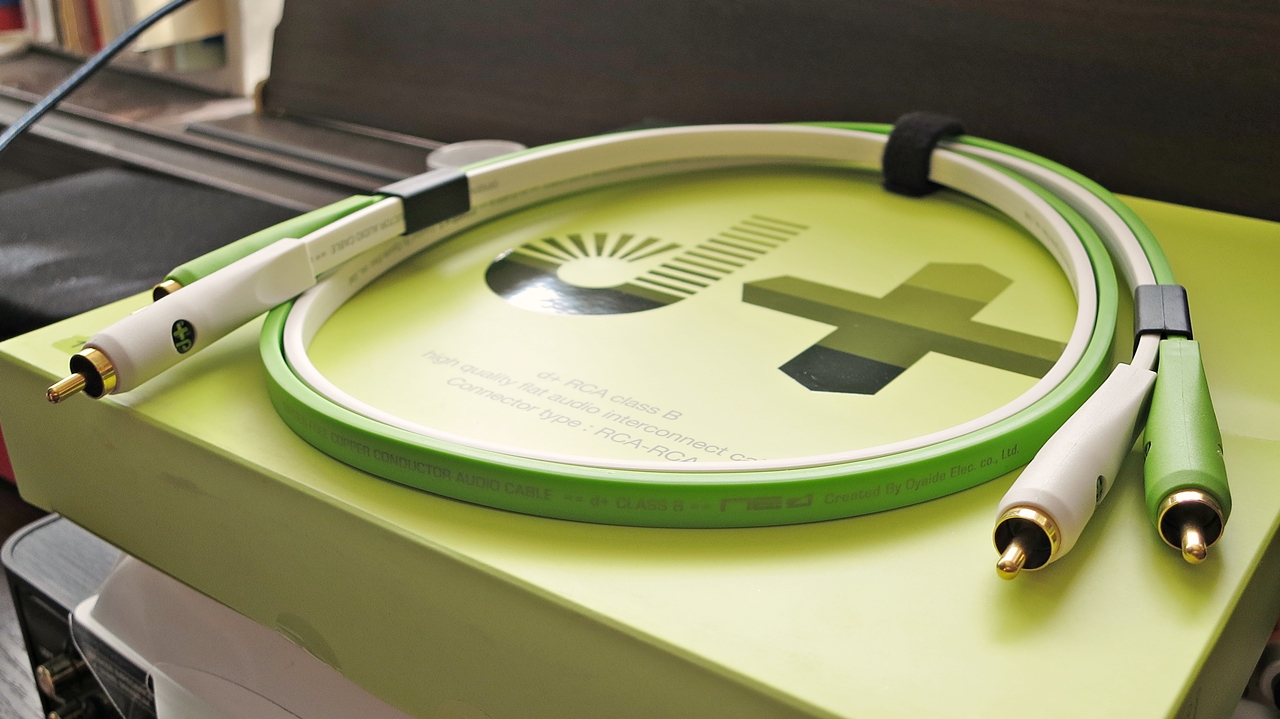
The Oyaide NEO d+RCA Series gives more of an impression of being a club DJ staple than a pure Hi-Fi product, and seems to have broad distribution through the musical instrument trade. In Japan it tends to get buried beneath the high-end cable crowd and doesn’t make much of a presence, yet it is in fact Oyaide’s RCA interconnect cable that is sold all around the world.
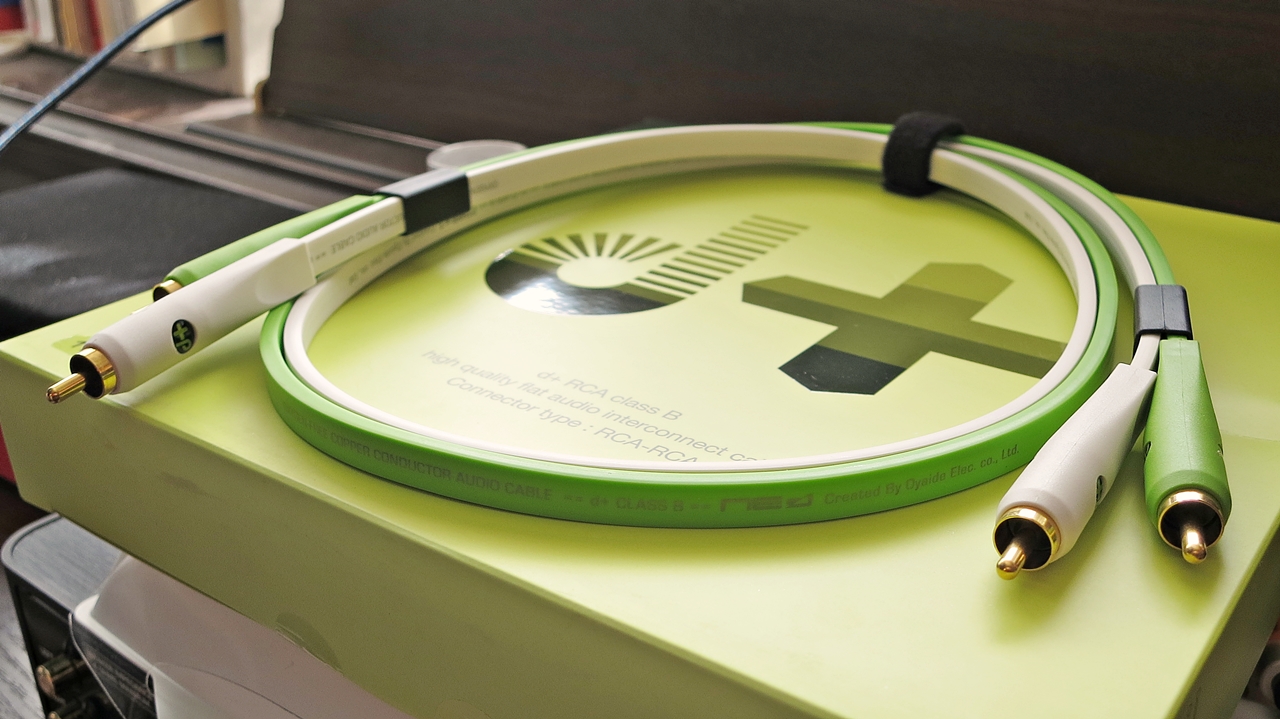
Among the lineup, the yellow-green Class B is the entry-level model at the bottom of the d+RCA Series. Above it sit the orange d+ RCA class A rev.2, which uses 102SSC conductors, and the purple d+ RCA class S, which uses PCOCC-A — but all of them fall within what would be considered entry-class price territory from a pure Hi-Fi standpoint, and they represent a determined effort by Oyaide to pursue practicality and performance beyond their price.
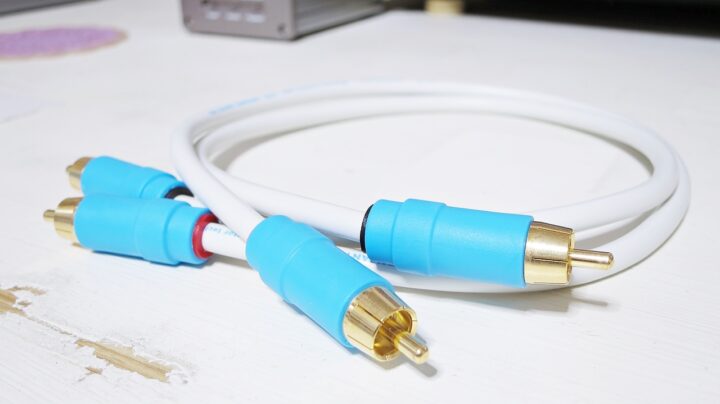
The first thing that catches the eye with the Oyaide NEO d+RCA classB is its stylish design. And when you actually handle it, the build quality turns out to be rather well done, and it is very easy to work with — which is another point in its favour. The flat, kishimen-style cable does not bend sideways, but the PVC jacket has a reasonable degree of flexibility and pliability, so there are no problems at all when routing it. In person it feels less cheap than you might expect, and it has a surprising weight to it. The connectors are made of bronze alloy with gold plating, the contacts have a moderate-to-slightly-loose fit, and the housing is PBT with glass fibre, so there seems to be no risk of damaging equipment even with repeated plugging and unplugging. Perhaps because it is intended to be handled roughly in demanding, highly visible environments such as clubs and music studios, the moulded one-piece construction gives the impression of having been designed with thorough consideration for practical durability. These d+ RCA series cables carry the NEO brand and are manufactured in China — which is part of why they are quite reasonably priced, even though they are an Oyaide product — but there is nothing slapdash about them as a product; if anything, the build quality is far more solid than some of the peculiar so-called high-end cables that sit in the awkward mid-price range.


Sound Quality of the Oyaide NEO d+RCA classB
A sharp, clear, well-defined sound — high-speed in character, perhaps. The imaging has a crisp, snappy quality, and the overall presentation is lively and articulate. It has what you might call a V-shaped tonal balance, with the upper-midrange through treble being particularly sharp. That said, the sense of space and the range in all directions — up, down, front, back, left, right — is somewhat limited, which is pretty much what you would expect at this price. The bass is clear and punchy, tight with well-defined pitch. The quantity is moderate, though, and the depth could go a little further. The rhythm does not so much swing along as maintain a precise, measured quality — there is a pleasant tension in the guitar picking, and it marks time accurately and neatly. Guitar sources suit it well, and on the whole it produces a pleasing impression. It also handles programmed rhythm tracks in rock and pop rather impressively. Perhaps owing to the multi-strand construction of 33 × 0.18mm OFC wires, there is occasionally a slight stranded-wire blurring to the edges of the image, but in a good way this can be heard as a straightforward, honest character that simply lets the natural quality of OFC speak for itself. In terms of tendency, I think it is similar to the Oyaide NEO d+USB class A that I reviewed previously.
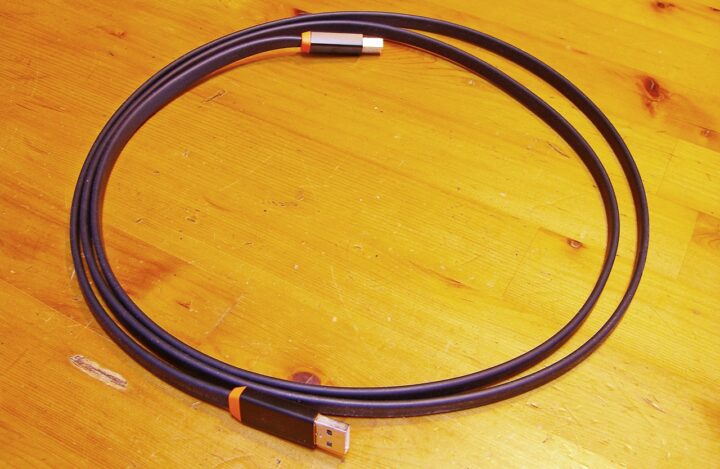
That USB cable at the time used PCOCC-A conductors, however, so the closer comparison might actually be the purple d+ RCA class S. ※ The Class A and Class S both have rather handsome aluminium outer covers on the plug connectors. The Class S also has the distinction of using PCOCC-A conductors, which are no longer in production and are now quite rare.
If I were to describe the sound of the Oyaide NEO d+RCA classB NEO in terms of colour, it would be a bare-copper tone, slightly on the dark side. The colour temperature is on the warm side, yet the actual sense of warmth feels cool. There is very little of the bright, cheerful yellow-green and white of the outer appearance. The sound does not impose much in the way of unnecessary colouration on the music itself; rather, a clear and accurate line-tracing quality comes first. The midrange has a slightly hard edge to its nuance, and things like the expressiveness and allure of female vocals are kept in check. Vocals can feel a little nasal at the peak, and one might wish for just a touch more openness there. More than that, though, the pitch changes in the backing musicians’ playing come through with real clarity, which makes me think this cable is actually rather well suited to the kind of analytical listening that those on the creative side of music-making tend to do. The rhythm instruments in particular stand out for their neat precision and crispness, yet it never tips over into a tiresome, fussy sound — it gives the impression of having been tuned with a rather fine sense of balance.
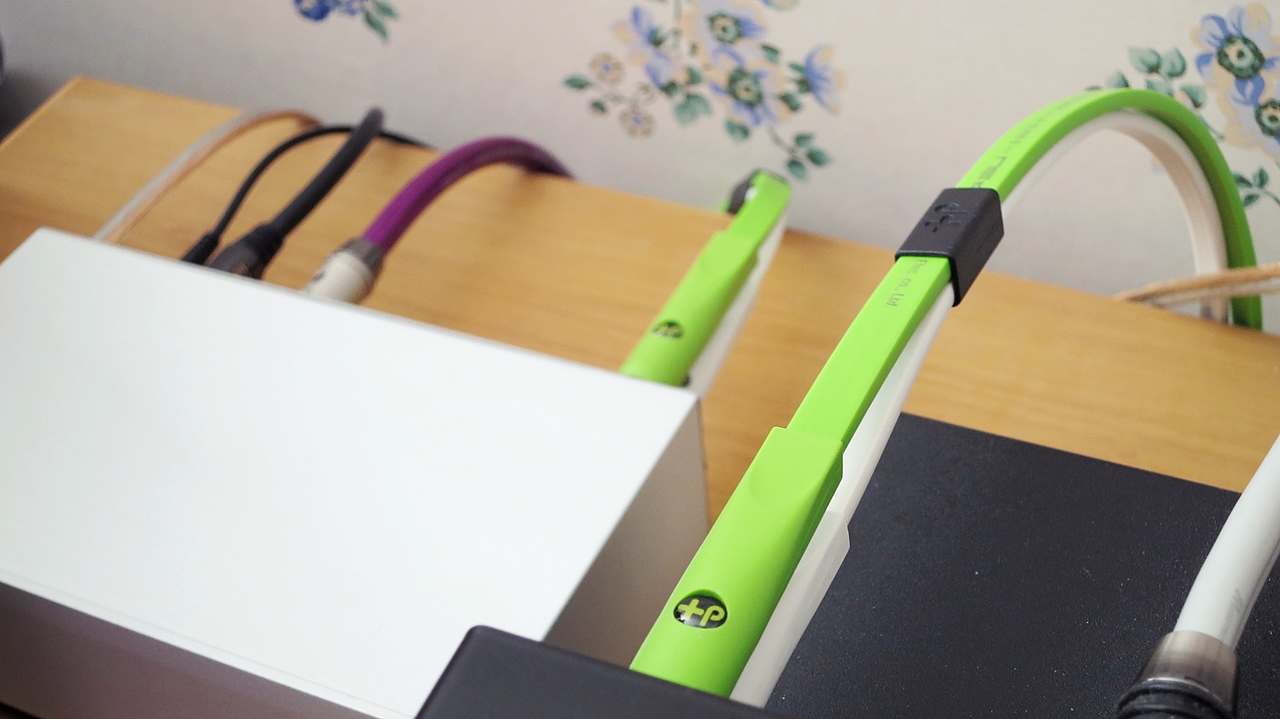
If I were to pick at the fine details and offer a more analytical assessment, there are areas — three-dimensional spatial reproduction, resolution of fine detail — where it does fall slightly short compared to some of the somewhat higher-grade cables I have on hand. That said, when you step back and look at the broader picture, the more immediate reaction is a rather positive one: can it really sound like this at this price? With another inexpensive interconnect cable in a similarly cheerful-looking package — the CHORD C-line — you get a strong sense of a character and world-view very deliberately aimed at the consumer market, for better or worse; but the Oyaide NEO d+RCA classB NEO is simply better-sounding as a monitoring cable, and delivers a more straightforward, honest sound with less distortion of character from the cable itself.
The orange class A rev.2 uses 102SSC conductors. It seems likely to offer a more natural, warm, and lively sound than PCOCC-A or OFC.

 ポチップ
ポチップ
Aimed at DJ Equipment, but High Quality — Recommended for PC Audio Too
The Oyaide NEO d+RCA classB feels, among entry-level equipment, as though it has been voiced with a sharpness emphasis that works not in a peaky, treble-heavy system, but rather in PC audio setups that tend toward muddiness and soft resolution, or in live studio equipment where signal runs tend to be long. As long as it is not being paired with high-class Hi-Fi components that have been meticulously voiced for pure audio use, its spatial reproduction limitations are less likely to stand out, and it should deliver freshness and clarity well beyond what its price would suggest. I would encourage people to try this cable’s sense of definition and clarity with equipment that is rolled off at the top, lacks resolution, and feels closed-in. Particularly in budget desktop PC audio setups, I think it would prove a genuinely useful ally. As an Oyaide product it may not carry the best image in terms of high-end Hi-Fi branding, but set that particular bias aside and compare on the basis of raw sound quality and practicality, and the potential of the Oyaide NEO d+RCA classB beyond its price should become apparent. And honestly, there are not many RCA cables at this actual street price that sound properly decent. So for anyone who has only ever known the sound of the red-and-white cables that come bundled with equipment, this might be just the place to start — try the Oyaide NEO d+RCA as a first step into higher-quality cables. ※ I decided to use it for a while in my desktop PC audio setup.
There is also the NEO OYAIDE d+MYR ClassB with a 3.5mm stereo mini plug on one end
 ポチップ
ポチップ
The d+MYR classB, with a 3.5mm mini plug on one end, has also recently been released. When you want to connect a DAP or portable DAC to an audio amplifier with a reasonably decent sound quality, the price is low relative to the sound, and the d+MYR classB seems like it would be handy to have around — tough enough to handle casually even when out and about.
~ Summary ~


Auto Translated by CS4.6