【SACD Player ONKYO C-S5VL Detailed Review】
Announcement|Purchase|Part 1|Part 2|Part 3|Part 4|Part 5|Part 6|Part 7
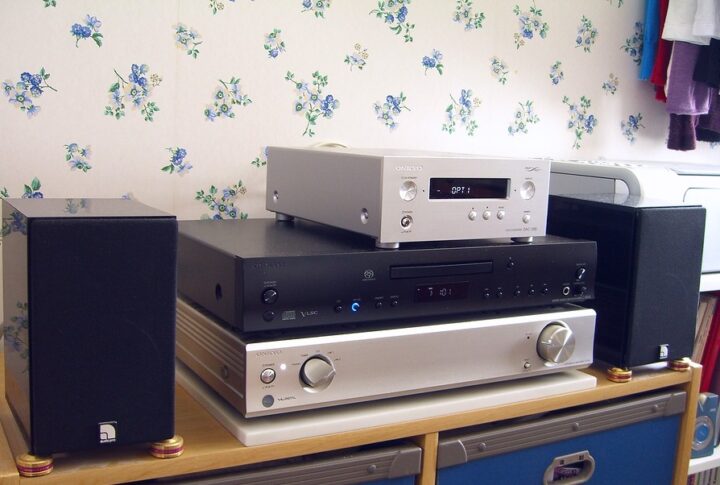
This is Part 2 of the main  ONKYO C-S5VL review. First, I set the C-S5VL up in the centre of my main system. The original plan was to pair it with the ONKYO A-1VL in Sub-system A, moving the CREEK EVOLUTION CD currently sitting there over to the main system — and that is still the intention — but for sound quality evaluation purposes, the living room with its larger scale and far greater number of musical details is the better environment, so for now this is simply a capability check.
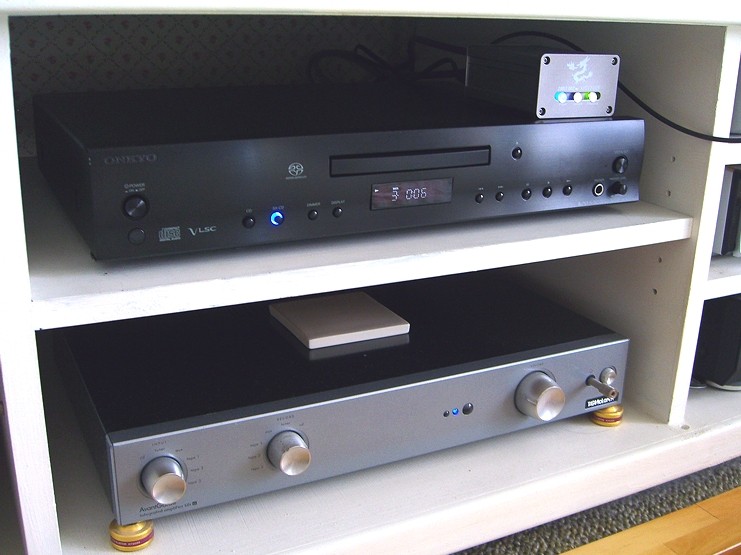
The main system configuration to which the ONKYO C-S5VL was connected this time is as follows.
■ Wall outlet: Purist Audio Design PAD CRYO-L2
↓
■ Power cable: PS Audio XPD/1.8mk2
↓
■ Power strip: J1 PROJECT PT-4
↓
■ Power cable: C-S5VL supplied accessory cable Note: Same 2.0SQ Kawasaki Denkou cabtyre cable as used with the A-1VL.
↓
■ ONKYO C-S5VL SACD Player
↓
■ RCA cable: MIT Terminator 4 (page under construction)
↓
■ Integrated amplifier: TAG McLaren 60i (page under construction)
↓
■ Speaker cable: SILTECH FT-12G3
↓
■ Speakers: Vienna Acoustics MOZART T-2
In all listening comparisons below, SACD playback was conducted in DIRECT mode (no DSD FILTER) with DIGITAL OUT OFF as the basic settings.


 ポチップ
ポチップ
As a familiar Hybrid SACD to hand, I selected the Mozart Piano Trios by the Haydn Trio Eisenstadt from Austria. Playing it back with some trepidation… oh my — it is far more transparent and refreshing than I had expected. The texture of the sound has a sparkling, fizzing quality rather like sparkling wine, and there is a sense of digital clarity being brought out in a thoroughly natural way. The sound image is slim and sharp. Lean in body, with a clean, visually intelligible focus and excellent imaging. I have been using warm, full-bodied CD players as a matter of course, so this is quite a fresh experience.
Among the players I own, this is closest in character to the ARCAM CD72T in Sub-system C, though the C-S5VL is clearer still and retrieves more detail. In a good sense, it has a youthful, approachable, nuanced, and charming sound quality. A review on Price.com quoted the opinion that “Mr Kaiyama described it as a slim, cool beautiful girl,” and I would add that she is also sweet-natured and likeable. A modest, quietly elegant presence with just a touch of light make-up — it makes a very pleasant impression on the ear. And beyond that, bright, dynamic, and lively: fundamentally, this is a musically expressive sound → and that matters enormously.
 ポチップ
ポチップ
In terms of perceived frequency response, the character is essentially flat — particularly noticeable on SACD. (Note: CD playback changes considerably depending on the filter setting.) The flip side of this is that bass weight is moderate in relative terms, and the overall balance feels slightly top-heavy, leaning towards the upper frequencies. There is an easy brightness across the mid-to-upper range, with a hint of shrillness, while the midrange itself is slender — each note of the piano flutters gently into place. The bass register is clear and fast. The air and bowing of continuo lines, cello, and double bass come through with crisp definition, which is very satisfying. Perhaps the switching-mode power supply’s speed is a contributing factor here. That said, the overall character of this player is one of light, refreshing agility, so if what you are after is the composed, authoritative presence of a heavy, high-end machine, you may find it wanting.
Podger’s playing is wonderful in itself, but the sound quality here is simply superb.
 ポチップ
ポチップ
The SACD sound through the C-S5VL is delicate in its fine-grained texture and low in distortion. The decay of detail has a feather-light touch, and even at extremely high volumes it is entirely fatigue-free. There is a certain reticence and refinement to the expression, and a softness of attack that gives SACD a more feminine quality compared to CD. Temperature-wise, it is neutral to very subtly cool. This may be specific to my unit, but I noticed a tendency for the perceived volume of the SACD layer to be slightly lower than the CD layer; for a fair one-to-one comparison between the two layers, it seems better to raise the amplifier volume just a touch when listening to SACD. The sound fills the space with a gentle, soothing quality that makes you want to immerse yourself in music for hours at a time. It speaks directly into the mind.
Some opinions suggest the C-S5VL struggles with large orchestral tuttis at high volumes — but what do I actually find? The resolution with orchestral music is fundamentally high, and the player has more than enough descriptive power to make you feel that orchestra really must be heard on SACD. However, the player’s character is not thick or voluminous — it is flat, lean, and refreshing — so yes, in terms of sheer physical force with a full orchestra, there are moments where it feels slightly short. Rather than overwhelming impact and weight, this is a player that engages you through a measured sense of pace and an honest, straightforward manner. Whether it is Zimman’s Mahler symphony cycle or Rostropovich conducting Shostakovich’s Fifth, even the loudest brass passages carry no harshness. Sharp and extended, yet remarkably low in distortion — or rather, essentially distortion-free.
 ポチップ
ポチップ
 ポチップ
ポチップ
In three-dimensional soundstage scale, one does catch glimpses of class limitations — the lack of deep bass weight makes it feel somewhat like a miniature scene. There is extension upwards, but left-right spread is moderate. Front-to-back depth in particular is a little flat. That said, the soundstage does not push artificially forward in an exaggerated way, so imaging remains stable. If anything, phase coherence strikes me as quite well-controlled. However, I think all of this becomes a minor concern unless one is actively pursuing high-end Hi-Fi in a well-spaced dedicated listening environment. For anyone who is not exclusively listening to full orchestra, it has no bearing on what matters in music.
An SACD I bought a few years ago on the recommendation of Jazzaudiofan — it has finally had its turn.
 ポチップ
ポチップ
With small-ensemble concerti and string chamber music, if anything a clean, well-ordered presentation like this is exactly right — indeed, the sheer beauty of string harmonic reproduction on SACD is something I find myself re-recognising as a sound that the bit-depth of CD simply cannot reach. The lightness of the string sound, when measured against an imagined live performance, is surely the correct answer. If anything, the more expensive the machine, the more it tends to chase an audiophile-constructed “high fidelity” that begins to feel false.
A jazz SACD, which is unusual for me — and it plays with a thoroughly refreshing quality.
 ポチップ
ポチップ
To summarise: my overall impression is of a player that builds on the practical strengths of a conventional CD player while drawing out the qualities of SACD honestly, without imposing unnecessary colouration. SACD players in the tens-of-thousands-of-yen range are genuinely difficult to get right. If the player’s fundamental capability is insufficient, the advantages of the SACD format become blurred and meaningless; and multi-channel capable machines spread their costs too thin, with the result that most are dubious when it comes to the quality of two-channel stereo playback. Among entry-level models from MARANTZ, DENON, SONY, and others, the manufacturer’s house sound character tends to be too strong, or in some cases the musicality is frankly questionable — and the net result is that you inevitably feel you must buy a higher model to truly enjoy what SACD has to offer, and so one falls into the upgrade loop.
From a business perspective, if a lower-priced model is genuinely good, there is no longer any need to push customers towards higher models. In ONKYO’s case, however, no such constraint applies at this point in time. The C-S5VL is the one and only “pure Hi-Fi class” SACD player in their lineup, which means there was no need to hold back awkwardly in deference to higher models within their own range. Of course, as a CD player at the very lowest end of pure Hi-Fi pricing — selling for around forty to fifty thousand yen — cost constraints mean it is not possible to lavish the kind of parts and construction budget you would find at the hundred-thousand-yen level, or to use expensive circuit components throughout. The switching-mode power supply may be one such compromise, and the cost-cutting on the chassis is fairly evident. Even so, the freedom and openness of being able to develop the player without any deliberate need to make it sound worse — I feel that sense of liberation comes through in the C-S5VL’s sound quality.
 ポチップ
ポチップ
I did have a slight nagging concern as to whether the C-S5VL could genuinely reproduce the advantages of SACD at this price point — but it would appear the answer is yes. One certainly cannot say that all other players in this price bracket manage the same, so perhaps the key is that, as a dedicated 2-channel SACD player rather than a 5.1 multi-channel machine, the limited budget can be concentrated entirely on two-channel stereo. Also — and I will go into more detail in the next entry — there are SACD players out there, presumably in an attempt to exaggerate the advantages of SACD, whose CD playback for some reason becomes a rather questionable affair; with the C-S5VL, that concern proved entirely unfounded. More than that, its performance as a CD player is actually rather good — which brings me to the next instalment, where I will review the sound of standard CD playback.
【SACD Player ONKYO C-S5VL Detailed Review】
Announcement|Purchase|Part 1|Part 2|Part 3|Part 4|Part 5|Part 6|Part 7
Auto Translated by CS4.6