【QUAD L-ite2 British Small Speaker Review】
Prologue|Part 1|Part 2|Single-wire|Bi-wire|Reservations|Jumper
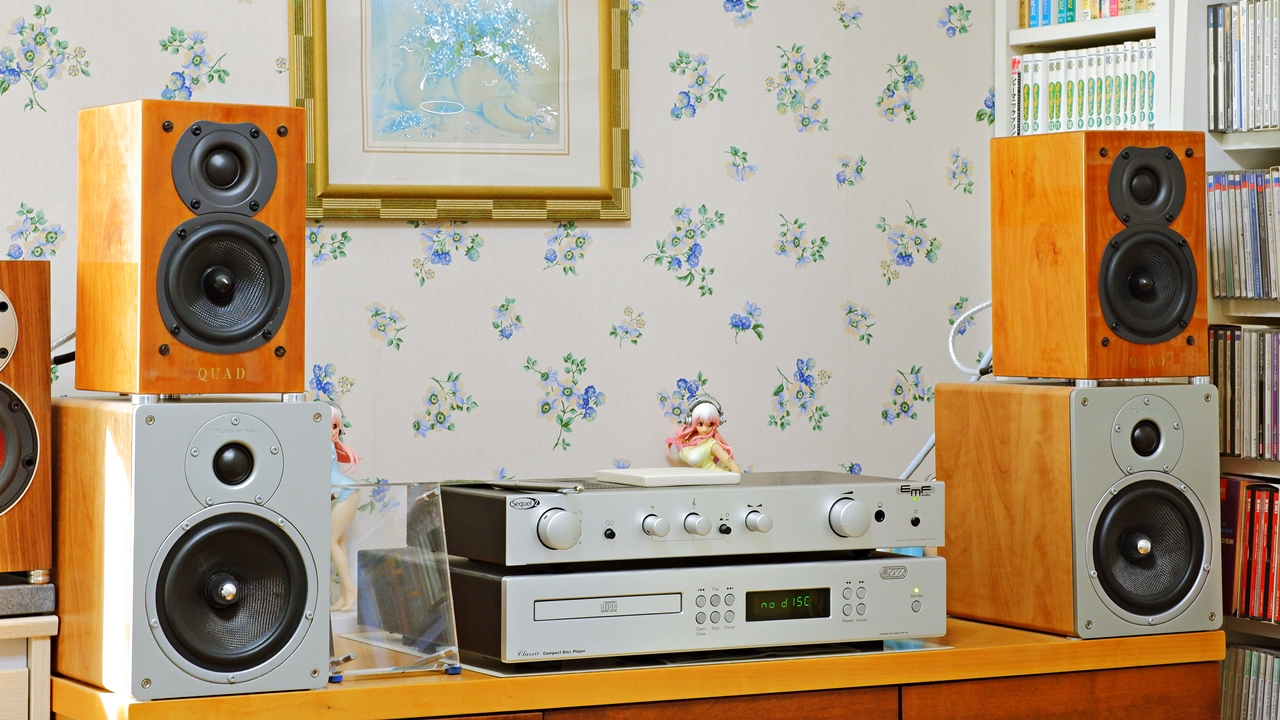
And so, straight to listening with the QUAD L-ite2… I hurriedly connected it to the CREEK Sub-system C and gave it a try… honestly, within the first three seconds I was already convinced this was a great match! A quite splendid marriage, I sensed — in fact it suits this system far better than the Image12 ever did. Remarkably, it even feels better matched than the Epos ELS-3, which is the officially recommended pairing for the CREEK…
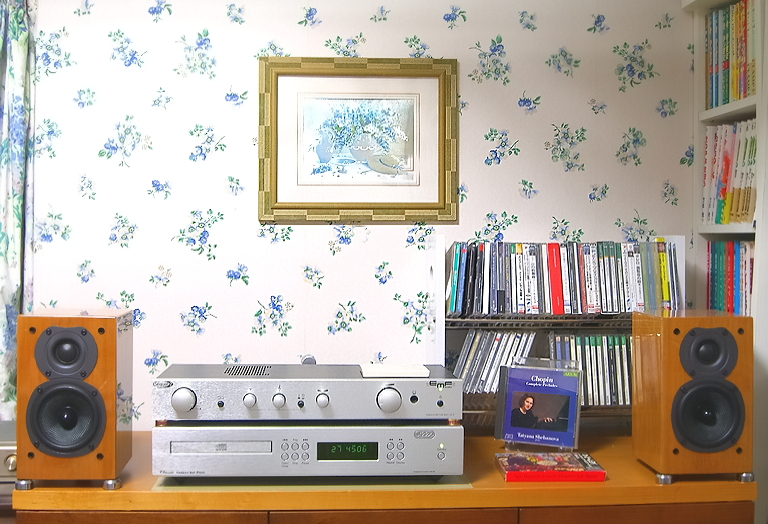
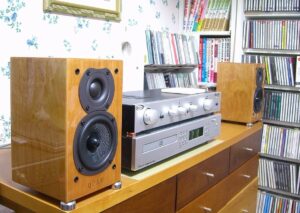
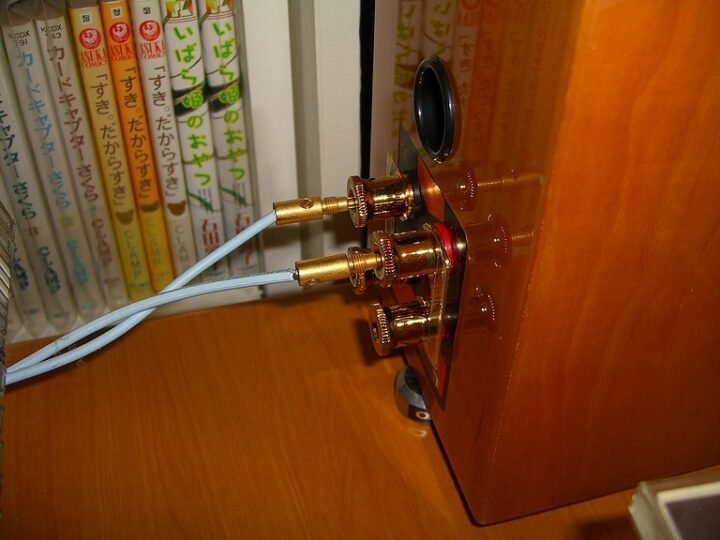
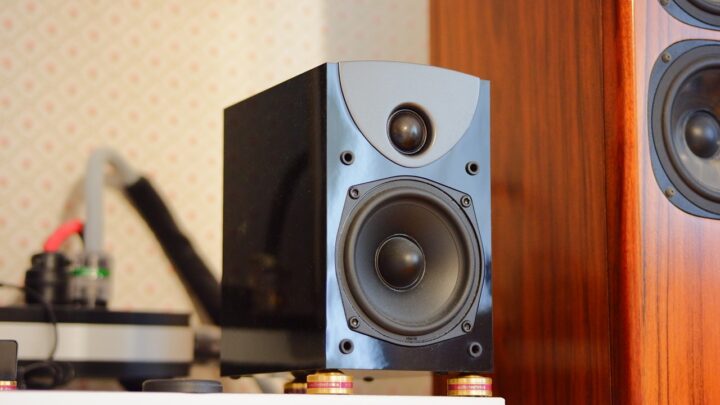
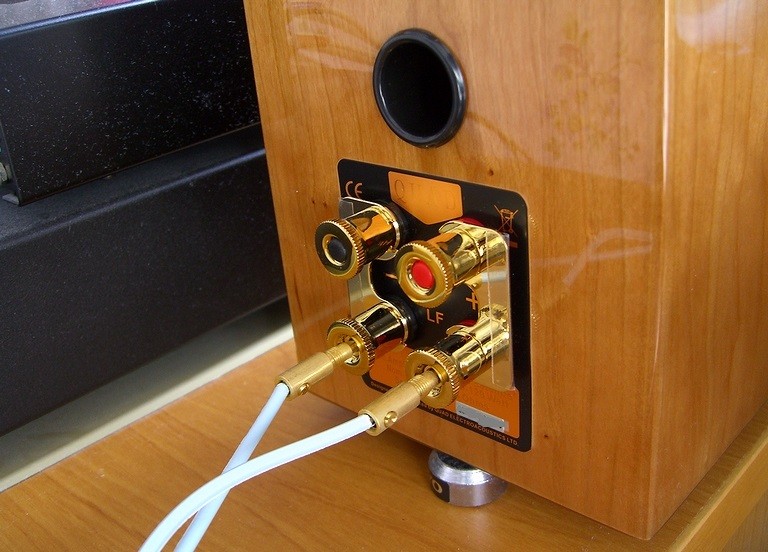
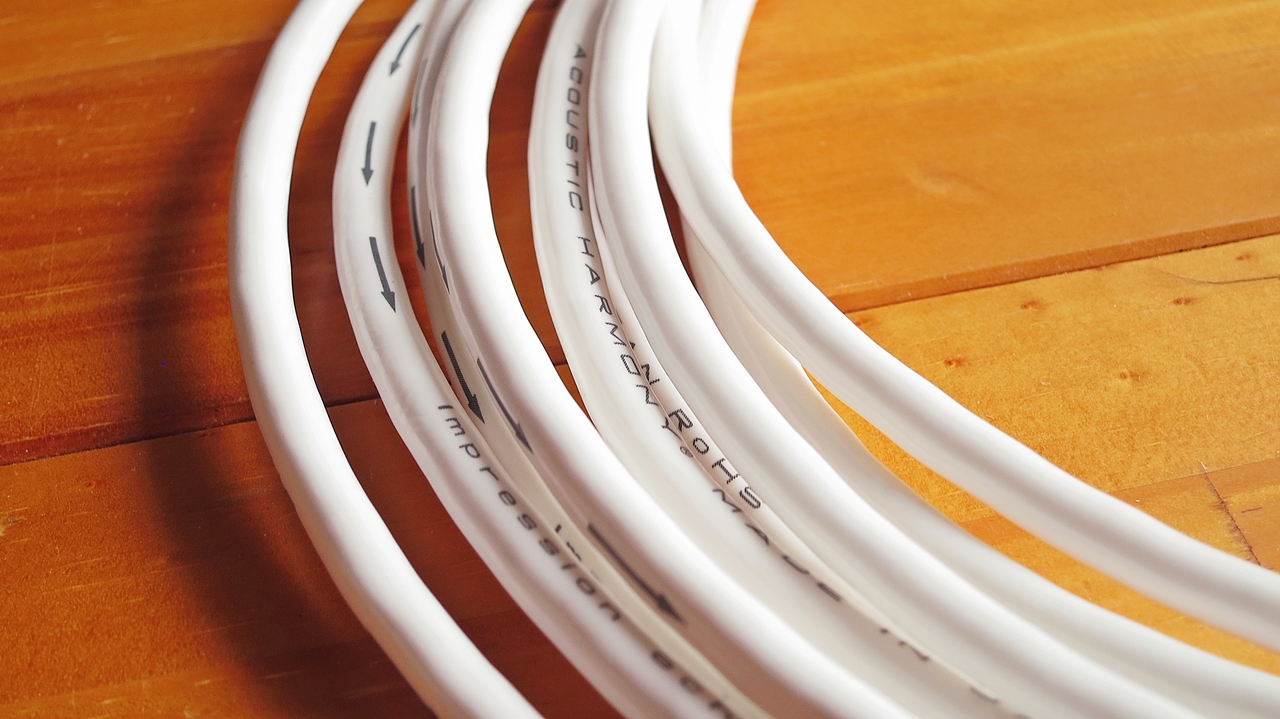
Ah, let me note the setup conditions for this impression. As you can see in the photo, the cabinet is a “Capri 105 Low Chest” with a solid alder top board. For speaker insulators I used the Onkyo AS-258, speaker cable is SUPRA CLASSIC 2.5H, and the L-ite2 has bi-wiring terminals — but I left the supplied jumper plate in place and connected to the lower terminals using audio-technica banana plugs AT6301.
QUAD L-ite2 Sound Quality Review
The QUAD L-ite2 has an analogue LP-like density to its sound, and the lower-midrange weight and balance are more than sufficient for home sub-system use. The audiopro Image11/Image12 trade high-frequency resolution for a clearly deficient bass below 100Hz, whereas the LITE2 maintains a reasonable sense of mid-bass body even without a subwoofer. And above all, it has a high degree of musicality. The woofer’s tonal character is quite warm, and the tweeter — covering from around the 2.2kHz crossover upwards — has a bright peak in the upper-midrange, giving it a lively, luminous tone. The very top of the frequency range, on the other hand, doesn’t come across as particularly prominent — though that may partly be the CREEK’s influence. All in all, this is not a speaker that renders soundstage space with sharp, modern resolution and reverb trails; it is an image-focused speaker whose character lies in a warm, classical, analogue sensibility.
Sensitivity is 86dB, which is on the low side. I’ve had to turn the Sequel2’s volume up two notches compared to before. This is where it differs from the old high-efficiency British speakers that exploited cabinet resonance — like B&W and others, it squeezes out sound with a surprisingly modern, concentrated energy. Its frequency response, compared to the audiopro Image12, has a mid-focused kamaboko curve. It’s fairly narrow, actually quite close to the ALR/JORDAN Entry S. In this respect, the higher models — the 11L2 and 12L2 — are considerably wider in range and flatter in character. The Kevlar cone woofer doesn’t have the bright, dry, airy quality of B&W’s Kevlar, but it does lean toward a punchy, well-damped presentation that calls for proper drive — so, given the low sensitivity as well, I’d say a transistor integrated amplifier with MOS-FET output and a slightly tight, well-controlled sound would be a good match. A transparent-sounding valve amplifier could also work nicely. That said, if the bass drive is fundamentally insufficient, the woofer will sound thin and limp — small and compact as it is, pairing it with an overly cheap amplifier would be inadvisable.
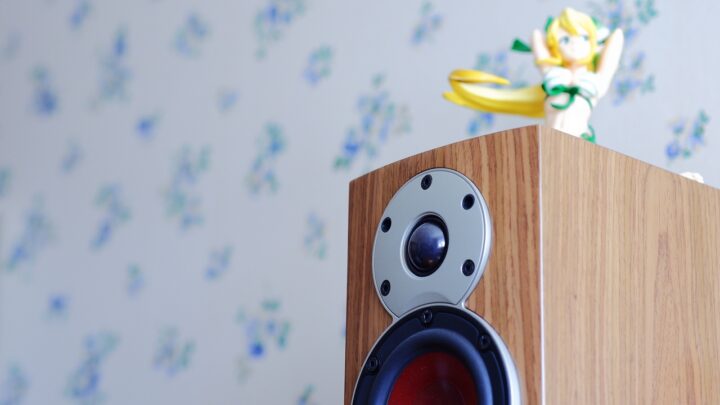
The tonal character above the midrange — handled by the tweeter — is bright and crisp around the crossover point, with a certain core to it; high-frequency reverb tails are fairly restrained, and image focus is on the broader side for a speaker of this size. So it’s not really suited to pinpoint reproduction at ultra-low, pianissimo volume levels. At present the imaging is a little vague (perhaps still burning in?). Mezzo-piano to mezzo-forte is where this speaker really comes alive. If asked whether it’s suited to near-field listening for PC audio and the like, I’d say not particularly. However, if you can listen from even a short distance away, the musicality is exceptionally high — the way it differentiates touch and renders subtle midrange nuances is really quite remarkable. For reference, I listen from around 1.5 to 2 metres.
Burn-in and Accessories: Raising the Baseline Resolution
The muddiness I noticed in the shop was, with a properly set-up home environment and a simple connection via a carefully chosen speaker cable, kept well within acceptable limits. I was genuinely worried that the combination with the CREEK — which already has a gentle top end — might compound the muddiness, but that turned out to be largely an unfounded concern. There is a tendency toward congestion in the woofer’s range, but once you understand it, it’s within the bounds of what can be accepted as character. In fact, this warm, range-narrowed flavour is precisely what a classical British sound needs. I’ll go ahead and call the QUAD L-ite2 a modern poor man’s LS3/5A. Compared to the expensive, genuine article, the tone is younger and the expression somewhat shallower — but then again, much like Nitori’s “value beyond the price” motto, the QUAD L series delivers a satisfaction that exceeds what you’d expect for the money… wouldn’t you say?


The initial impression was very positive, but after running it in for a few days the early burn-in began to take effect and the sound has noticeably softened. The woofer in particular has loosened up. In most cases this leads to reduced distortion, better resolution, and generally improved sound — but having been so struck by the sound straight out of the box, I can’t help feeling it’s perhaps gone a touch too soft… The tweeter still has a hardness to it, while the bass has become a little too rounded; the woofer-side tonal character — somewhere between the crunch of Kevlar and the smoothness of polypropylene — has started to bother me with its congestion in the mid-to-low frequency range. The musicality is there, with a nice sense of bounce, but… the attacks are rounded, which in itself is fine, and there’s a fair amount of damping at work — yet the decay at the bottom end is somehow unclear. It’s the sort of feeling that makes you want to reach for a speaker cable with thick PCOCC conductors to sharpen up those contours.
As for the upper-midrange to high frequencies handled by the tweeter — the L-ite2 doesn’t have the resolution or definition of the 11L or 12L in the mid-to-upper midrange; the texture is more natural. Rather than outlining edges, it’s a sense of there being a core within a softer sound. At the moment it feels somewhere between “natural” and “plasticky”, so perhaps patience and more burn-in time is called for? Actually, I find myself wanting to nudge it closer to the 11L sound — to the point where I’m already tempted to try a NORDOST Flatline Gold as the speaker cable… oh dear.
Attempting to Play the Beatles Through a British Loudspoeaker
When it comes to British sound, one naturally thinks of the Beatles. One of the reasons I’ve chosen to dedicate an entire sub-system to the British sound aesthetic is, in fact, this question: can it reproduce the Beatles convincingly? (Any old British rock would do really, not just the Beatles, but still.)

On the equipment side, fellow British brands such as CREEK and Naim Audio are particularly well-suited tonally to old British rock — but what about QUAD, also British? The older QUAD 44/66/67/77-series components obviously go without saying, but even during brief in-store auditions with the 11L and 12L, I remember thinking — fairly casually — that these seem to lean toward UK rock, toward the Beatles. With the L-ite2 I hadn’t listened all that closely in the shop, so I just assumed it would naturally be the same… a rather lightweight assumption, as it turns out.

 ポチップ
ポチップ
Incidentally, the higher end of the L series — QUAD’s flagship electrostatic speaker, the ESL — is too refined for rock and is really more of a classical music speaker. As an aside, those who love the piano playing of Alfred Brendel would do well to seek out the ESL. He apparently used QUAD ESLs as his recording monitor. Normally the reference recording monitors for PHILIPS were B&W 801-series, but for Brendel’s sessions he is said to have quietly brought ESLs into the studio himself.
 ポチップ
ポチップ
I still don’t own any of the remastered editions, and if I were to buy them I’d really want the imported UK box set — but even in pound sterling it’s somehow priced well beyond what I can easily justify… The Japanese domestic pressings are, needless to say, out of the question as always. With all that indecision swirling about, I pulled out a few of my old, non-remastered pressings and put them on through the QUAD L-ite2.
The result:
…
…
……It doesn’t work at all.
What on earth? Even a single minute of listening produces a sound that makes you want to take a swing at someone. The culprit is the tweeter. Not even the high frequencies as such — it’s the upper midrange, the musical frequency range. We’re talking somewhere around a few thousand hertz, between the crossover and the fundamental tones and lower harmonics of higher-pitched instruments. The drum cymbals are beyond redemption. There’s an intrusiveness, an irritating sharpness in just that range — and I mean that quite seriously. I’m listening to it again right now specifically to write this entry, and it’s genuinely tortuous.
Why is this? I suspect it’s because the recordings — early 1980s CD remasters — are already skewed towards the treble and somewhat distorted to begin with, and that high-frequency distortion gets magnified as if under a magnifying glass, producing a deeply unpleasant sound. Strangely, I don’t feel this nearly as strongly with classical recordings. Probably because with classical music, in a normal recording, there simply isn’t much in that frequency range that constitutes problematic distortion. (As an exception: playing Mahler symphonies at slightly higher volumes, I did notice something in the tutti passages. Also, DECCA recordings — Ashkenazy, Radu Lupu, and others — can produce a hard, clanging attack in the piano’s right hand in the mid-to-upper midrange. That’s the nature of those recordings to begin with, but on this speaker it is considerably amplified.)
 ポチップ
ポチップ
Perhaps this speaker, when fed rock, pop, or otherwise processed source material — especially anything heavily compressed and deliberately distorted, or simply distortion-prone older recordings — ends up amplifying that distortion through the tweeter. And probably it’s not just the L-ite; the entire L2 series using the same tweeter may share this characteristic. Come to think of it, isn’t this exactly what the whole 11L/12L harshness debate was about? It was said to have improved with the L2 generation, and I did notice greater high-frequency transparency during in-store auditions, so I’d thought it was resolved — but perhaps, even if improved, the tendency remains in the fundamental design…
 ポチップ
ポチップ
Still mid-burn-in and already things are looking shaky, so for the sake of my sanity I put on a few heavily compressed anime songs. The verdict: actually, wait — it’s fine? There is an undeniable peak in the upper midrange, but the speaker’s natural character is fundamentally smooth and rounded, so it doesn’t bother me all that much. Perhaps because the distortion-heavy frequency range in those recordings sits considerably higher than it does in the Beatles material. What was more striking, though, was how the latest clean digital recordings came out sounding dry and dusty, like a 1960s analogue pressing — which is a bit too much of a good thing.
 ポチップ
ポチップ
There really is a difference between distortion that feels physiologically unpleasant and distortion that is surprisingly easy on the ears. The Beatles recordings clearly tip the needle firmly into the unpleasant territory. Newer anime recordings, strangely enough, often have compression artefacts that feel almost comfortable — CDs that simply don’t bother me to listen to. And then there’s Pizzicato Five TYO — that doesn’t work at all either… which is odd, because it doesn’t sound distorted at all on other systems. Is it perhaps because it’s been processed to have a British-sounding quality?
 ポチップ
ポチップ
~ Summary ~
To split the difference period-wise, I put on Alyssa Milano — recorded in 1989, around the same time as that Pizzicato Five album. Quintessential idol pop of that era. And yes, no problem whatsoever. A relief. In fact, the combination of her vocal timbre and the speaker’s character was a lovely match — lively and thoroughly enjoyable.
So, swapping through various CDs that happened to be within reach, I’ve established that the Beatles in particular are disastrous (completely unexpected!), and that there are seemingly a handful of other CDs that clash badly as well. If one were to aim for a fundamental solution, it would come down to this: get the QUAD L-ite2’s tweeter to reproduce even distorted material cleanly and perfectly. Burn-in will help to some degree, but having gone to the trouble of bringing in a British QUAD speaker, there is absolutely no question of giving up until the Beatles sound the way they should. I do believe the L-ite2’s tonal character is inherently British and well-suited to the Beatles — it’s more that the frequency response characteristic seems to be creating a mismatch between source material and hardware.
The setup direction that’s becoming clear at this point is…
1) Eliminate the distortion character in the tweeter around and just above the crossover point.
2) The upper midrange has too much of a pushy, forward core to it — I want to even that out.
3) Clean up the congestion in the woofer’s range (without erasing the retro character).
These three points look set to be the key to getting the best from the QUAD L-ite2. Clarifying the bottom while removing distortion from the top — those are rather beautifully contradictory objectives. Beyond that, finding better-matched insulators and various other methods I’ve written about previously come to mind — but the first thing I tried, the approach that seemed most likely to have an immediate effect, was the bi-wiring short jumper plate. (Continues in QUAD L-ite2 Continued: Trial and Error with Single-Wiring Before Moving to Bi-Wiring.)
So there we have it — a rather premature review conducted while burn-in is still far from complete. I already have a sense that the high-frequency resolution will gradually improve. But some fine-tuning via accessories does seem to be called for — or even if it isn’t strictly necessary, it certainly is for the purposes of a miniature Hi-Fi tinkering blog. This sort of trial-and-error, down-the-rabbit-hole process tends to happen with almost any new piece of equipment, so I’d like to write about how things develop — with insulators, speaker cables, power cables, and the rest — whenever the mood takes me.
【QUAD L-ite2 British Small Speaker Review】
Prologue|Part 1|Part 2|Single-wire|Bi-wire|Reservations|Jumper
Auto Translated by CS4.6