【QUAD L-ite2 British Small Speaker Review】
Prologue|Part 1|Part 2|Single-Wire|Bi-Wire|Reservations|Jumpers
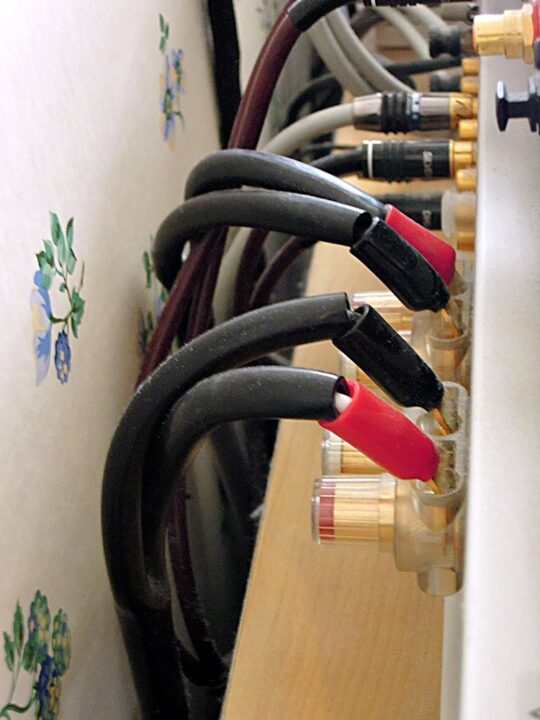
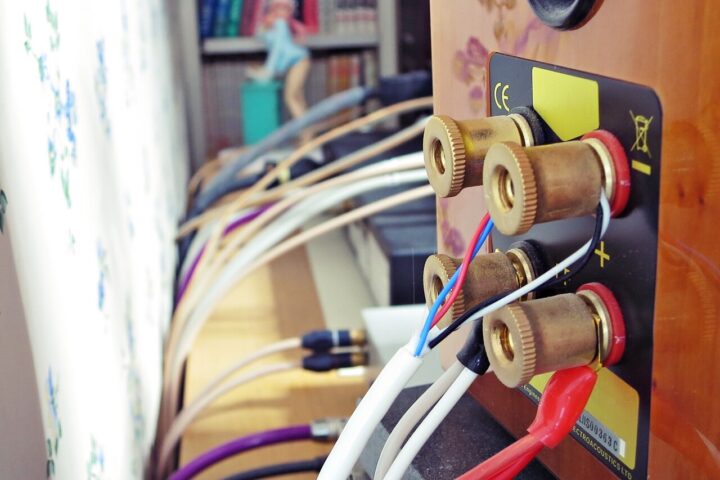
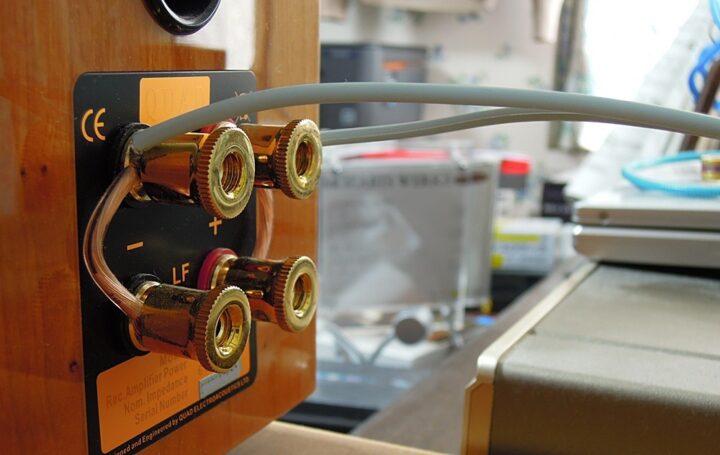
When single-wiring a speaker cable to a bi-wiring speaker terminal, the connection method with the fewest contact points and the least electrical issues is the style shown in the image below, where the bare conductors of the speaker cable are simply extended and passed straight through both terminals top and bottom. ※ In theory, this is the best and purest method of signal transmission.
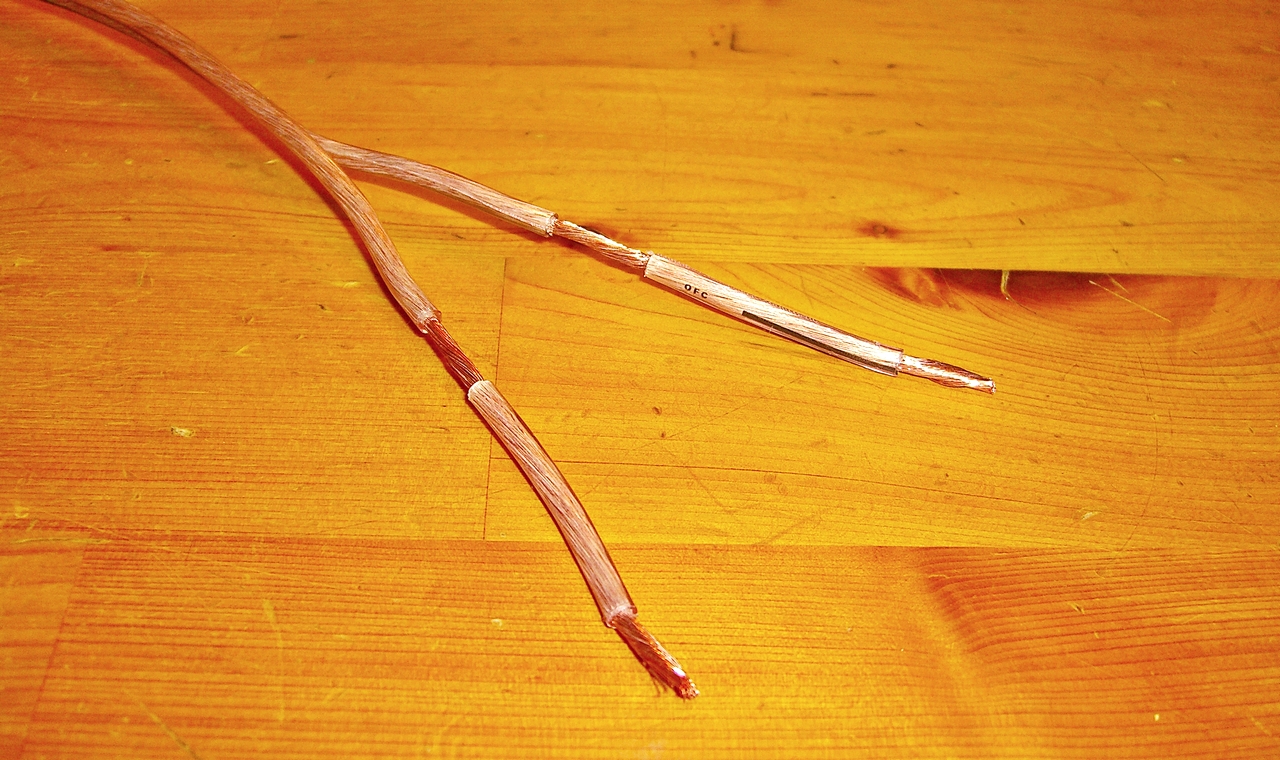
This is the complete opposite of using jumper cables to add colouration while deliberately increasing resistance. However, even this simple connection method has its problems. There is a large exposed section of bare conductor, and while things may be fine right after connecting, oxidation of the exposed conductors and sonic changes due to long-term degradation over time are simply unavoidable. Furthermore, when loosely separated multi-strand conductors — no longer damped by their insulation — are subjected to the intense vibrations of a speaker, one cannot say there is absolutely zero possibility that resonance of the conductors or movement between the individual strands might affect electrical stability and, to some degree, sound quality.
If the terminal holes of the speaker terminals are large enough that a thin speaker cable can pass through complete with its insulation, then one only needs to strip the insulation at the contact point, as in ↑ the image above — but the range of thin speaker cables that allow this method is limited. Moreover, in the case of the QUAD L2 Series that I recently brought in, the terminal holes of the speaker terminals run horizontally rather than in the usual vertical orientation, which means the terminals are simply not structured in a way that allows a single speaker cable to be slipped straight through from top to bottom or bottom to top.
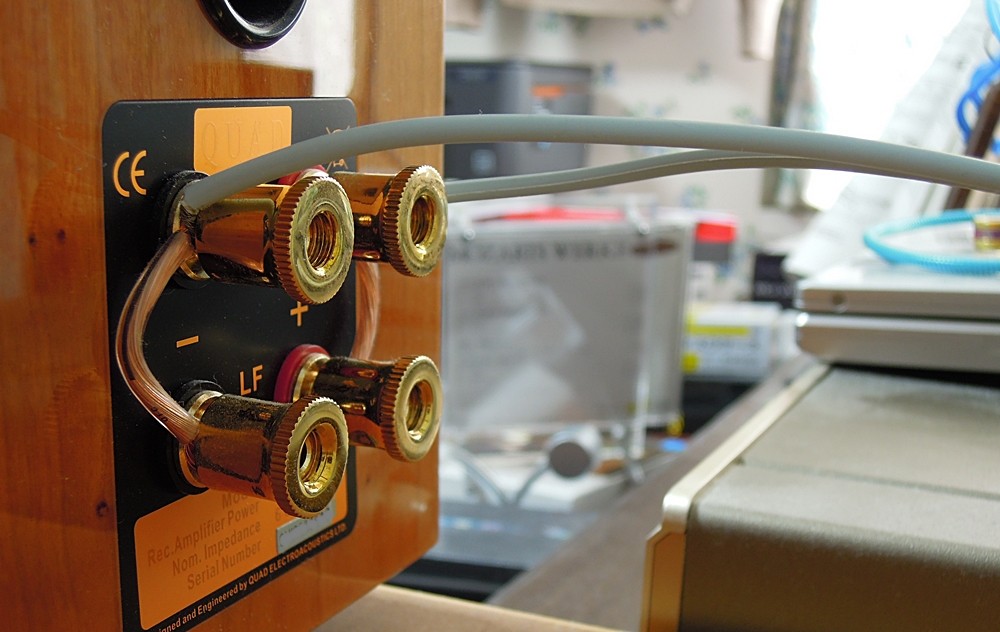
Jumper plates and jumper cables are nothing but a source of sonic degradation
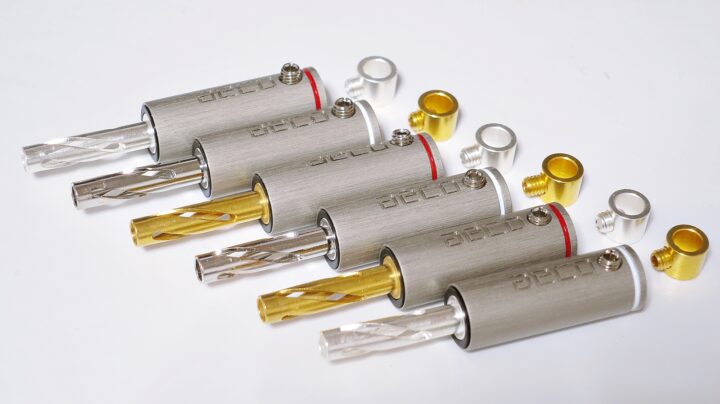
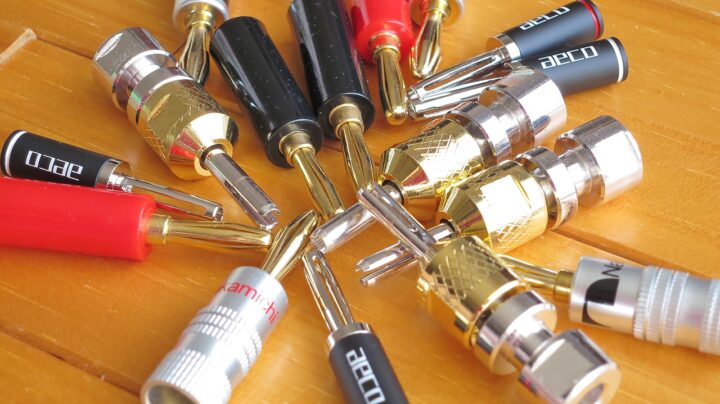
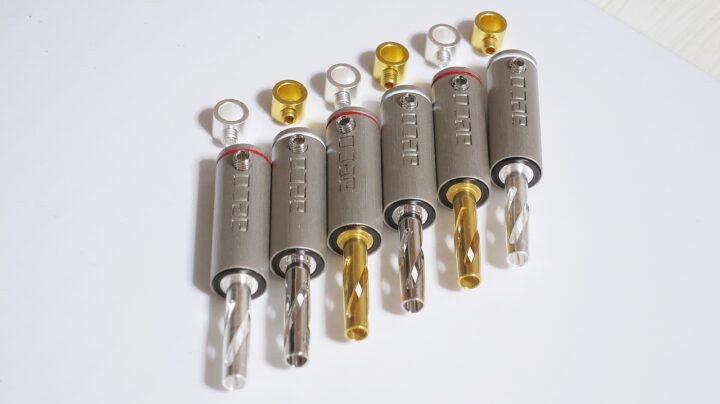
It should be noted that when people speak of a jumper cable or jumper plate “sounding good,” they do not mean “high fidelity” in the true Hi-Fi sense of the word — they mean that the jumper causes as little sonic loss as possible while adding a colouration to the sound that one happens to prefer. It follows that there is no such thing (in theory) as a jumper cable that sounds better than using no jumper at all. The same applies when adding unnecessary solder at the speaker cable’s contact points, or when inserting banana plugs, spade connectors, or similar items in between.
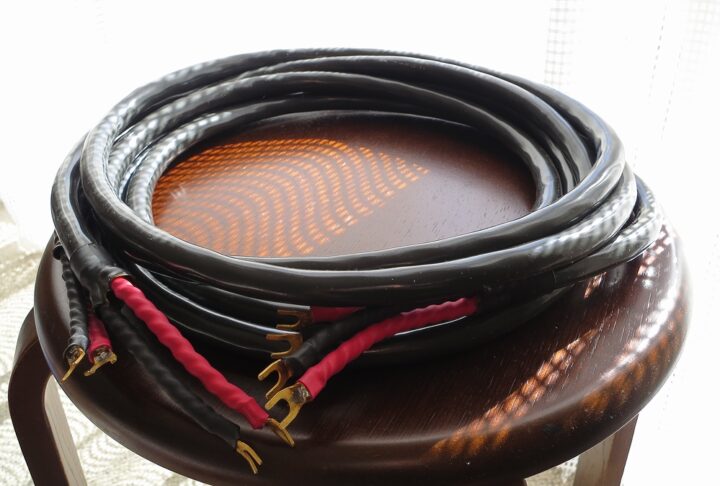
Incidentally, I personally use ORB spade connectors — made from pure copper and finished with a higher-quality gold or rhodium plating than other manufacturers’ offerings.
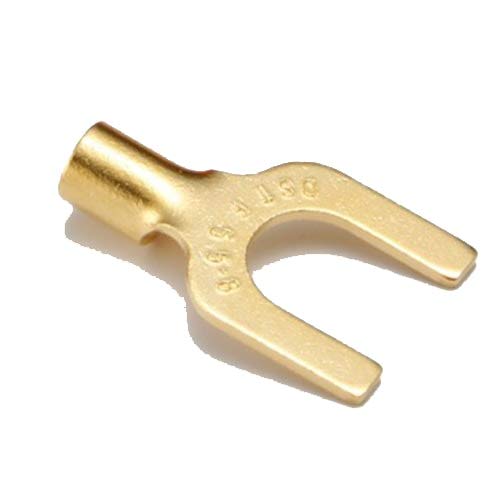

Note: That said, with high-quality spade connectors or banana plugs, depending on the condition of the speaker cable and speaker terminals, there can be a genuine benefit in increasing the contact surface area of the conducting parts and ensuring a more reliable connection. Also, when comparing banana plugs and spade connectors of identical design and materials, spade connectors generally have a larger conductive contact area and in most cases are a simpler construction with no screw-down portion, so the received wisdom is that spade connectors do sound better than banana plugs.
Questioning the Need for Expensive High-End Speaker Jumpers…
There are jumper cables of the most extravagant kind on the market, sold by certain cable manufacturers, and I regard these as belonging to the category of novelty audio accessories that have appeared only in quite recent years. They were rarely seen at least until the early 2000s, and I am fairly certain they were not to be found in the audio cable sections of shops either. It is true that using an elaborate jumper cable like this can be fun for tinkering with the sound, and if the pricing is sensible relative to the parts involved, I am personally quite relaxed about it as an offbeat sort of amusement — but in recent years there seem to be abnormally expensive jumper cables flooding the market, and I do find myself wondering, just slightly, whether this is really how pure audio ought to be. Because, whichever way you look at it, bi-wire connection is sonically the superior approach, yet one is deliberately choosing the sonically inferior single-wire connection, and then on top of that adding yet more unnecessary terminals and contact points by routing through a jumper cable. No matter how premium a jumper cable one makes under those circumstances, from a pure audio standpoint — where simplicity and directness of signal path is the ideal — is that not rather putting the cart before the horse?
For all that I say, when it comes to what I would actually use myself, I end up reaching for a jumper cable around this level…

 ポチップ
ポチップ
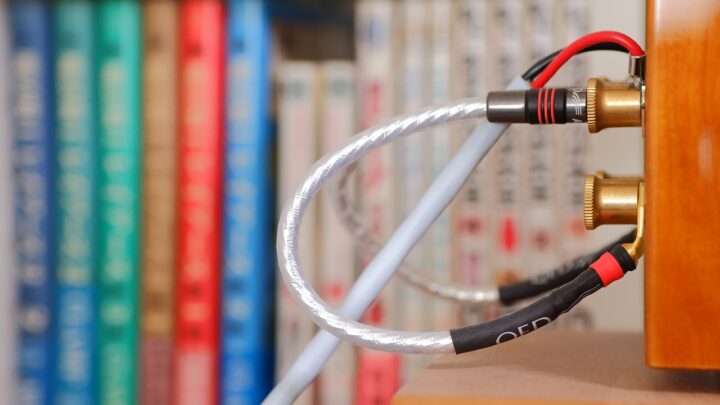
All things considered, if one thinks about it sensibly, when using a jumper cable, repurposing a cut-off piece of the same speaker cable being used for the connection is the method that introduces the least colouration. That said, with high-end speaker cables that come with moulded terminations, it may be impossible to obtain spare cut lengths of the conductor, and in such cases one might have no choice but to use a premium jumper cable alongside — I do understand that. But unless one is in the territory of high-end audio, with speakers costing over a million yen a pair and speaker cables in the hundreds-of-thousands-of-yen class, a jumper cable costing tens of thousands of yen for 10 centimetres does strike me as rather skewed in terms of cost allocation, no matter how I look at it. Well, I think of it as a kind of playful indulgence — one that deliberately steps outside the conventional wisdom and accepts a subtle shift towards a lo-fi quality in exchange for enjoying a particular colouration — so without understanding that, I really do think one ought not to take at face value marketing language along the lines of jumper cables = high fidelity, full stop.
If you need a jumper cable, use speaker cable offcuts
Incidentally, even a cut-off piece of speaker cable from the most inexpensive end of the market — a few hundred yen per metre — will sound considerably more respectable as a jumper cable than the metal shorting plates / shorting bars included with bi-wiring-compatible speakers. In fact… please do not mindlessly and unthinkingly use the included jumper plates. If that included accessory becomes your reference point, then it is entirely natural and inevitable that an expensive jumper cable will seem to produce a dramatic transformation in sound quality. If anything, it might be worth popping into your regular Hi-Fi shop and asking if they have any leftover offcuts of speaker cable they could spare… ※ At my local shop, the short odds and ends left over from cut-to-length sales go into a bargain bin and are sold off cheaply.
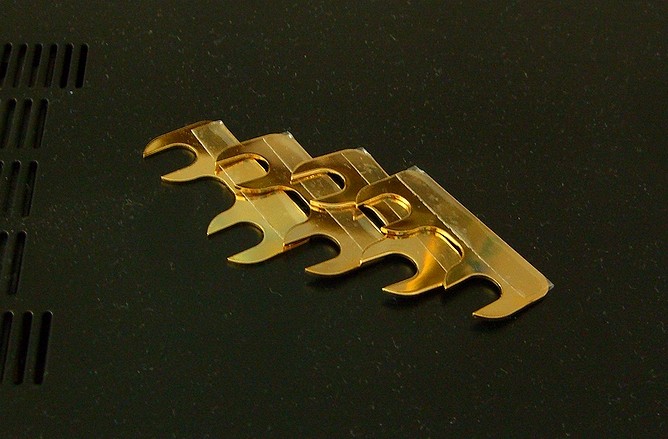
To put it in terms that are easy to grasp: if the sound of the included metal (brass) plate scores 10 out of 100 — a fail — then 10 cm of speaker cable at ¥50–¥100 scores around 80–90, and cable at ¥300–¥1,000 per 10 cm scores around 85–95. In other words, once you have a decent piece of speaker cable to use, the rest largely comes down to compatibility between components and, sonically, a matter of the listener’s own taste. (Well, the thing about pure audio enthusiasts and those who obsess over camera lenses is that a difference of one or two points on an absolute scale like this tends to feel, in practice, like an enormously significant gap that simply cannot be overlooked…) I should add that these scores are purely an expressive device for making the difference in level easy to visualise, and it would fundamentally be wrong — or rather inappropriate — to apply them to any individual case, so please do bear that in mind.
 ポチップ
ポチップ
 How to connect thick speaker cables to an AV amplifier (Kanaimaru’s website)How to implement bi-wiring with an AV amplifier (Kanaimaru’s website)
This is related to the jumper cable topic, but here is an interesting approach from Kanaimaru, who comes from Sony. As for the Monster Cable XPHP’s lower-tier sibling, the THX16P, I have previously written a review of it here on this site. Regarding the KRYPTON Setten Pro CI-G100 used later in that article — it is an oil-based liquid using squalane (liver oil from deep-sea sharks) as its base oil, and the fact that complete removal after application is difficult, along with the irreversible nature of the change including degradation in performance over time from its initial state, is something that rather gets on my nerves, being the rather fussy sort of person that I am.
 ポチップ
ポチップ
For those who really cannot manage to make their own, as I mentioned a little earlier, sourcing handmade jumper cables on Yahoo Auctions is also a good option, I think. It is quite common to come across people who list, as a hobby, hand-crafted items made from well-regarded speaker cables sold at a few hundred to three thousand yen per metre combined with inexpensive banana plugs, spade connectors, and the like. These sellers generally charge reasonable prices even when you factor in the labour. However, there are some dubious sellers out there whose products can only be described as daylight robbery, so do please exercise caution. In particular, please be especially careful not to be drawn in by impressive-looking photographs into picking up counterfeit Chinese-made copy products that frequently appear in the audio listings section of Yahoo Auctions!

Postscript: I have changed my tune…
Postscript: I feel a slight pang of guilt writing an entry like this, but after various twists and turns since then, I have ended up using a premium jumper cable made from a high-end speaker cable as its base. In other words, my conclusion is that even with a bi-wiring-capable speaker, there is no need to insist on bi-wire connection at all costs. I have come to a revised understanding: the combination of single-wire connection and a quality jumper cable can, depending on conditions, surpass the sound of bi-wire connection — at least to the ear — even if it is not theoretically the correct approach.
【QUAD L-ite2 British Small Speaker Review】
Prologue|Part 1|Part 2|Single-Wire|Bi-Wire|Reservations|Jumpers

Auto Translated by CS4.6